For your consideration...
A great chart from @yardeni, overlaying today's S&P 500 atop the 1985-2005 period.
History doesn't repeat, but it often rhymes.
Lots of folks are calling for an imminent stock market crash and/or a massive recession/depression.
But what if the bull market is just gathering steam for another run higher?
Forward earnings are currently fabulous, which bodes well.
Not a prediction, just offering an alternative possibility.
Cheers. 🍻
#macro #stocks $SPY $VOO
🚨 GIVEAWAY TIME 🚨
To celebrate the launch of the Bitaxe Gamma Hex, we're giving one away to a member of our community!
How to enter:
✅ Follow us
🔁 Repost this post
❤️ Like this post
💬 Tag a friend who needs to start mining
Winner announced in 3 days! Free global shipping!
Yield curve control, or YCC, may sound like an obscure technical policy.
It is not.
It is one of the most important tools of financial repression.
In plain English, yield curve control means the central bank decides what interest rate the government should pay on its debt—and then uses its money-printing power to enforce that rate.
If the free market demands 6% to lend to the government, but the central bank wants the government to borrow at 3%, the central bank steps in and buys enough bonds to force the yield down.
In other words, YCC is price fixing for government debt.
And like all forms of price fixing, it creates distortions, misallocations, and unintended consequences.
Of course, they may not call it “yield curve control.” They will probably invent some new euphemism or acronym. They may call it financial stability policy, emergency asset purchases, market functioning support, temporary intervention, or something else entirely.
But the label does not matter. The result is the same. The central bank buys government bonds with fake money it creates out of thin air to suppress yields and stop the system from breaking.
Remember, the Fed has only two tools in its toolkit: currency debasement and gaslighting.
That explains how YCC works mechanically. But the more important question is why politicians and central bankers would be able to get away with it.
It is not hard to imagine how YCC would also be politically popular.
Rising yields mean lower home prices. Home prices are especially important to Baby Boomers—about 22% of the population—and other politically active demographics because home equity is a major component of their wealth. So a policy that keeps yields from rising, and therefore helps keep home prices stable, could easily be sold to them. They would cheer YCC.
Likewise, YCC could be spun as a positive for younger voters because it would keep mortgage rates lower and make housing appear more affordable.
Of course, this is a Faustian bargain. There is no free lunch.
The benefits are illusory because Boomers and younger voters alike would end up paying for it through inflation. But perhaps not 1 in 100 would understand the dynamics. And that is why I think YCC would be politically popular.
That is the political sales pitch.
But beneath the slogans and euphemisms, YCC suffers from the same fatal flaw as every other central bank policy.
With any discussion about the Fed and central banks, it is essential to keep the basics in mind.
Start with the most fundamental point: central planning does not work.
That is the first principle.
Central planning of shoes does not work. Central planning of wheat does not work. And central planning of fake money does not work.
Central banks in general—and the Fed in particular—are on a mission impossible.
They do not know what the 10-year Treasury yield should be. Nobody does. That is an exclusive function of a voluntary market of savers and borrowers.
A politburo cannot centrally plan interest rates any more than it can centrally plan potatoes.
It will inevitably fail and cause enormous damage.
And once the monetary central planners start with YCC, there is no reason to believe they will stop there. YCC would likely be only the initial step in financial repression.
If YCC does not suffice, the US government will turn toward more aggressive measures.
Capital controls. Mandates forcing banks, pension funds, and insurance companies to buy government bonds. Regulations that make Treasuries appear “safe” or “risk-free” on institutional balance sheets. And countless other policies designed to trap capital inside the system and push it toward unwanted government debt.
Because bitcoin mining has made microhydro profitable, 28,000 more people in African villages have electricity
- Food/ meds can bestored in fridges, saving villagers a 12-mile trek
- Cooking meals is 3x quicker
- children no longer study under kerosene lamps (causes poor indoor air quality, eye strain and fire risk)
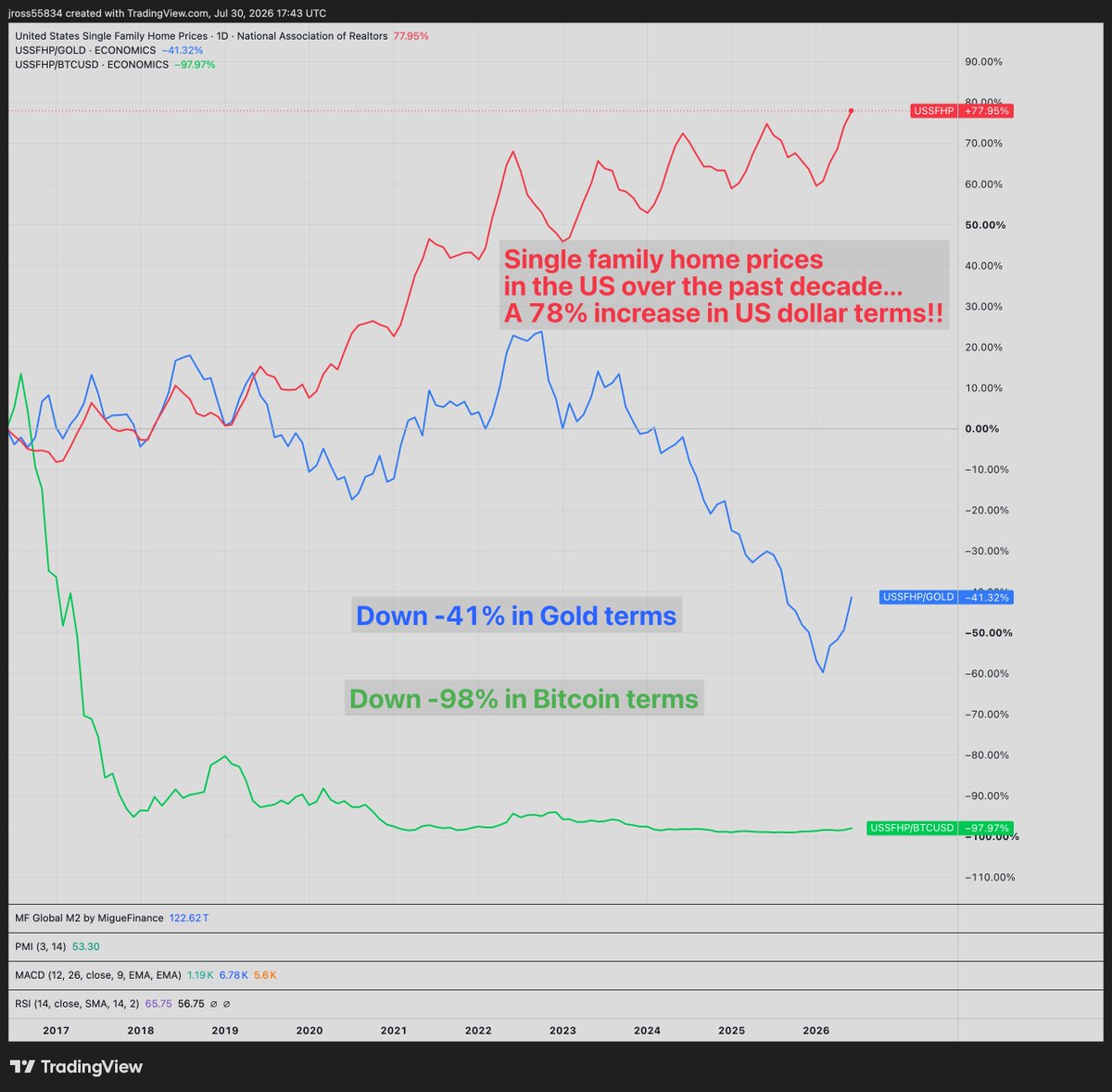
Saving for a house is a defining event for many young adults.
Over the past ten years:
- If you've saved for a single family home (SFH) in US dollars, then the prices have increased by 78%.
- If you've saved for a SFH in #gold, then the prices have decreased by -41%.
- If you've saved for a SFH in #bitcoin, then the prices have decreased -98%.
How you save over the long-run is critical.... Choose wisely.
Meet Mark. The unluckiest Bitcoiner alive.
He invested $10,000 near the top of four major Bitcoin rallies:
2013, 2017, 2021, and 2024.
Four buys. $40,000 invested at almost the worst possible moments.
At $65,000 Bitcoin, his portfolio would be worth approximately $625,000.
He survived multiple 70–80% drawdowns.
He never sold.
A lesson indeed
Meet Mark. The unluckiest Bitcoiner alive.
He invested $10,000 near the top of four major Bitcoin rallies:
2013, 2017, 2021, and 2024.
Four buys. $40,000 invested at almost the worst possible moments.
At $65,000 Bitcoin, his portfolio would be worth approximately $625,000.
He survived multiple 70–80% drawdowns.
He never sold.
A lesson indeed