@financedystop I have had 8-10 year old students have physical outbursts when they want to use iPads in class. Students crave the stimulation of iPad. They want to use at lunch tables, pickup lines, etc.
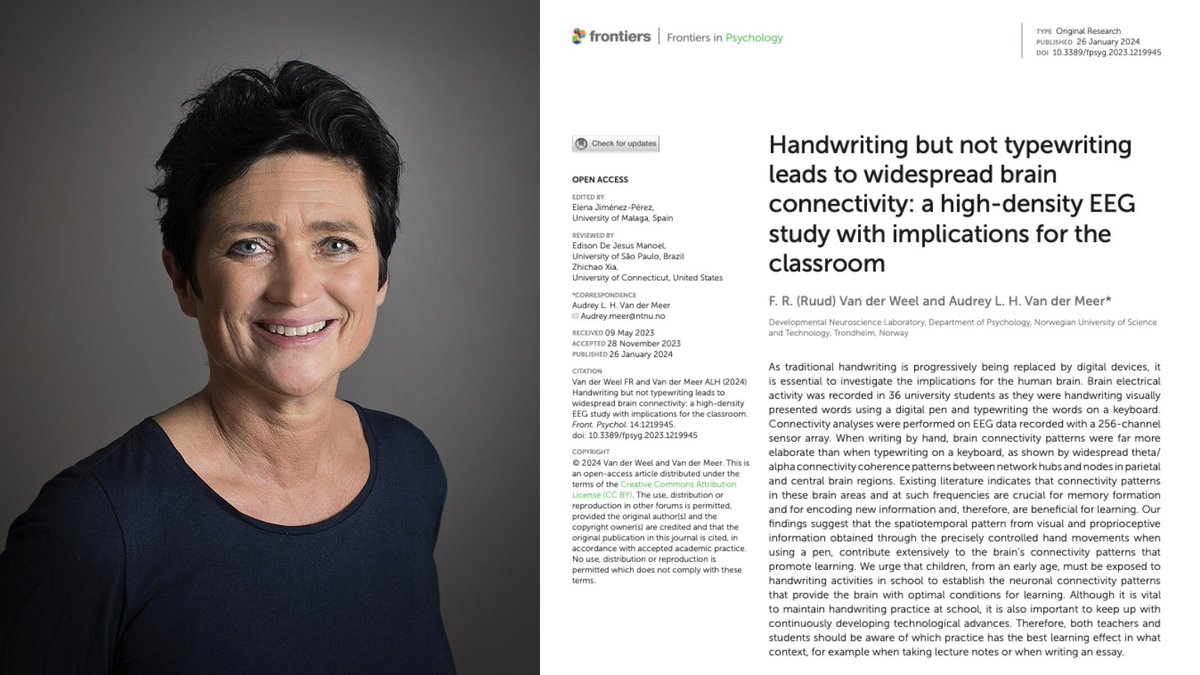
A Norwegian neuroscientist spent 20 years proving that the act of writing by hand changes the human brain in ways typing physically cannot, and almost nobody outside her field has read the paper.
Her name is Audrey van der Meer.
She runs a brain research lab in Trondheim, and the paper that closed the argument was published in 2024 in a journal called Frontiers in Psychology. The finding is brutal enough that it should have changed every classroom on Earth.
The experiment was simple. She recruited 36 university students and put each one in a cap with 256 sensors pressed against their scalp to record brain activity. Words flashed on a screen one at a time.
Sometimes the students wrote the word by hand on a touchscreen using a digital pen, and sometimes they typed the same word on a keyboard. Every neural response was recorded for the full five seconds the word stayed on screen.
Then her team looked at the part of the data most researchers had ignored for years, which is how different parts of the brain were communicating with each other during the task.
When the students wrote by hand, the brain lit up everywhere at once.
The regions responsible for memory, sensory integration, and the encoding of new information were all firing together in a coordinated pattern that spread across the entire cortex. The whole network was awake and connected.
When the same students typed the same word, that pattern collapsed almost completely.
Most of the brain went quiet, and the connections between regions that had been alive seconds earlier were nowhere to be found on the EEG.
Same word, same brain, same person, and two completely different neurological events.
The reason turned out to be something nobody had really paid attention to before her work. Writing by hand is not one motion but a sequence of thousands of tiny micro-movements coordinated with your eyes in real time, where each letter is a different shape that requires the brain to solve a slightly different spatial problem.
Your fingers, wrist, vision, and the parts of your brain that track position in space are all working together to produce one letter, then the next, then the next.
Typing throws all of that away. Every key on a keyboard requires the exact same finger motion regardless of which letter you are pressing, which means the brain has almost nothing to integrate and almost no problem to solve.
Van der Meer said it plainly in her interviews.
Pressing the same key with the same finger over and over does not stimulate the brain in any meaningful way, and she pointed out something that should scare every parent who handed their kid an iPad.
Children who learn to read and write on tablets often cannot tell letters like b and d apart, because they have never physically felt with their bodies what it takes to actually produce those letters on a page.
A decade before her, two researchers at Princeton ran the same fight using a completely different method and ended up at the same answer. Pam Mueller and Daniel Oppenheimer tested 327 students across three experiments, where half took notes on laptops with the internet disabled and half took notes by hand, before testing everyone on what they actually understood from the lectures they had watched.
The handwriting group won by a wide margin on every question that required real understanding rather than surface recall.
The reason was hiding in the transcripts of what the two groups had actually written down.
The laptop students typed almost word for word, capturing more total content but processing almost none of it as they went, while the handwriting students physically could not write fast enough to transcribe a lecture in real time, which forced them to listen carefully, decide what actually mattered, and put it in their own words on the page.
That single act of choosing what to keep was the learning itself, and the keyboard had quietly skipped the choosing and skipped the learning along with it.
Two studies. Two countries. Same answer.
Handwriting makes the brain work. Typing lets it coast.
Every note you have ever typed instead of written went into your brain through a thinner pipe. Every meeting, every book highlight, every idea you captured on your phone instead of on paper was processed at half depth.
You did not forget those things because your memory is bad. You forgot them because typing never woke the part of the brain that would have made them stick.
The fix is the thing your grandmother already knew.
Pick up a pen. Write the thing down. The slower road is the faster one.
@educator4ever36 The sport seasons never end! We look forward to California high school sports taking a mandatory 2 week break. Doesn’t help with club but much needed.
Schools should be low tech, high text.
Not because tech is bad, but because literacy is the multiplier.
Screens split attention; deep reading builds knowledge and comprehension.
Books should do the heavy lifting.
Betty Reid Soskin was the oldest ranger in the National Park Service until she retired 3 years ago at age 100.
Today, she turns 104 years young.
As a U.S. Park Ranger, she cemented the Black wartime experience into history @RosieRiveterNPS.
Happy birthday, Betty!
📷: NPS
The fourth annual STEAM Race to Space Reading Challenge will launch this October, inviting TK-12 students to explore curated STEAM-themed book lists and earn unique prizes from the program's new partners, including Blue Origin's Club for the Future. 📖 🛰
https://t.co/LdCNXu9LMa
Benjamin Banneker was a self-taught mathematician, astronomer, surveyor, and almanac author.
Born free in Maryland, he studied science without formal schooling, built a striking wooden clock at 21, and later assisted in surveying Washington, D.C.
His published almanacs gained wide respect, and in 1791 he boldly challenged Thomas Jefferson on slavery and racial equality.
Though most of his papers were lost in a fire, Banneker’s life stands as proof that even in an age of bondage, the light of genius could pierce through the darkness.
Is there a 4th Grader in your family during the 2025-26 school year?
The Every Kid Outdoors program gives your family free access to Grand Canyon National Park, and over 2,000 federal lands. Marvel at stunning landscapes, learn incredible stories & make lasting memories.
Here's how: https://t.co/CAesMsDqaF
#GrandCanyon #Arizona #EveryKidOutdoors #NationalParks
California could soon make history! A new bill (SB 68) would require restaurants to disclose the top nine food allergens on menus, making it the first U.S. state with such a law. For the more than 33 million Americans living with food allergies, including nearly 4 million Californians, this step could mean increased confidence and security when dining out.
Families like the Kimuras know how critical clear allergen labeling can be. Braxton, 17, has lived with life-threatening allergies since infancy and says restaurant meals are filled with fear and risk.
Advocates and medical groups say this legislation could save lives, while some in the restaurant industry raise concerns about cost and logistics. But for those facing anaphylaxis, the stakes couldn’t be higher.
As State Senator Caroline Menjivar, who lives with allergies herself, put it: this is about protecting millions of Californians. If signed into law, SB 68 would take effect in July 2026, bringing the U.S. closer to global standards already in place across Europe.
Read more here: https://t.co/JyHYeXMYve
Researchers at Northwestern University have discovered that an FDA-approved asthma pill, Zileuton, could help prevent life-threatening allergic reactions. In a groundbreaking study led by co-senior authors Dr. Stephanie Eisenbarth and Dr. Adam Williams of Feinberg’s allergy and immunology division, mice given Zileuton before exposure to peanut protein went from 95% at risk of anaphylaxis to 95% protected. “Let’s say you’re going to a child’s birthday party, you’re getting on an airplane, you’re going out to a restaurant, and you’re trying to protect yourself from very small amounts of potential exposure—this might be able to prevent that limited amount of allergen from getting in and triggering an anaphylactic reaction,” said Eisenbarth. While human trials are still needed, this pill could open a new path to protection for millions. Read more here: https://t.co/HMfsBZUrkt
World Ranger Day honors rangers around the world who work to preserve and protect important natural and cultural places. It's also a day to remember and commemorate those who have lost their lives serving on the front line protecting the environment around them.
A pregnant woman with a seafood allergy was recently forced to leave an EasyJet flight after staff refused to honor her request not to serve tuna, despite the airline being informed of her allergy in advance.
According to reports, the cabin crew initially agreed not to serve tuna, but once the plane began taxiing, a senior staff member reversed that decision and announced they "wouldn't be dictated to" over the PA system. The plane was turned around, and the woman was left behind in Corfu.
This incident is yet another reminder of the real and sometimes dangerous barriers faced by people with food allergies, particularly in confined spaces like airplanes.
No one should be made to feel unsafe when trying to travel. We urge all airlines to take allergy safety seriously, treat passengers with compassion, and train crew to respond with care and professionalism.
Food allergy is a disease, not a diet or preference. Read more here: https://t.co/NWAOdtAzS4
When we replace play with standardized instruction in early childhood, we ignore Piaget’s stages, Vygotsky’s scaffolding, and Erikson’s need for initiative. It’s no longer about how children learn—but how adults expect them to perform.
Before spending hours telling teachers what new found research that they need to know about for their teaching, make sure the behaviour they are being confronted with is manageable enough that they can think about more than just surviving another day.