I’ve just published a book on Bitcoin and its cycles:
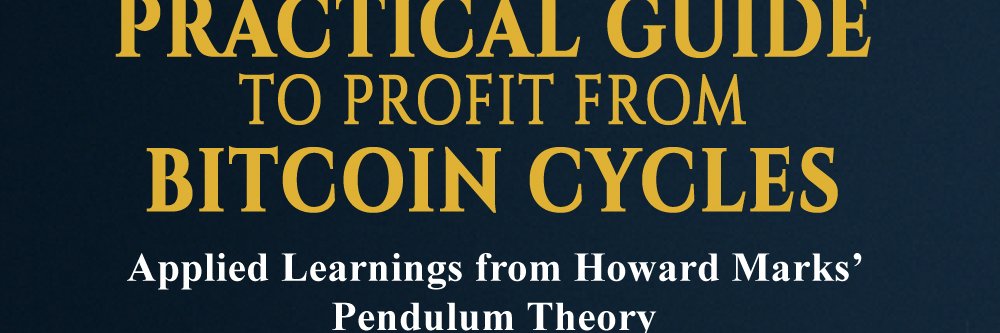
Practical Guide to Profiting from Bitcoin Cycles – Applied Lessons from Howard Marks’ Pendulum Theory
As many of you know, I’m a long-time admirer of Howard Marks. His writings on market cycles have been essential throughout my career in finance, investing, and even in life. Since I began trading in 2007, I’ve always taken mental notes on how markets behave. Later, when I read one of the most important books of my life, “The Most Important Thing”, the concept of cycles, already clear in my mind, became even more solid and easier to see.
I discovered Bitcoin in 2013 and have followed it ever since, but I only started trading it in 2015. From 2016 onward, I began writing about my market insights.
In 2024, I started drafting a manuscript, drawn from all those notes, to summarize these years of experience for my own reference. After finishing it, I realized it could serve as a valuable guide for anyone. That’s how the idea of turning it into a book was born. Since then, I’ve refined the text and added new ideas. At first, I thought publishing would take a long time and that the book might remain private, but with ChatGPT’s help, I managed to edit and revise everything much faster than I imagined.
Below are links to both the English and Portuguese editions, available in Kindle and paperback formats.
If you enjoy it, please share with your friends!
https://t.co/UEBLkkQcnh
Tokenized securities have not been held back by technology alone.
The bigger constraint has been market structure: rules built for quotes, routing, and delayed settlement were not designed for venues that execute and settle onchain.
Today, U.S. equity venues coordinate through rules layered on top of separate systems.
Tokenized market infrastructure can embed that coordination directly through shared standards, observable compliance, and verifiable settlement.
That is how it scales across institutions.
Settlement rules are changing, and tokenized markets are the next unlock.
@gaborgurbacs points to faster cash, T0 securities settlement, updated transfer agent rules, and a possible Reg NMS / Rule 611 review as signs of the same shift:
Regulation is catching up, and the U.S. is setting the pace.
Every trade still moves through a long chain of intermediaries before it settles. Each link adds cost and time.
On the @NYSE floor, @gaborgurbacs explains how revisiting Rule 611 and Reg NMS could open up tokenized markets and cut that chain down.
Nigeria is a global leader in stablecoin usage, exceeding $22 billion in annual transactions.
Stablecoins can enhance operational efficiency in emerging markets, providing faster and cheaper solutions for businesses.
I'm expecting a trend change in crypto today if payrolls data (NFP) comes in soft.
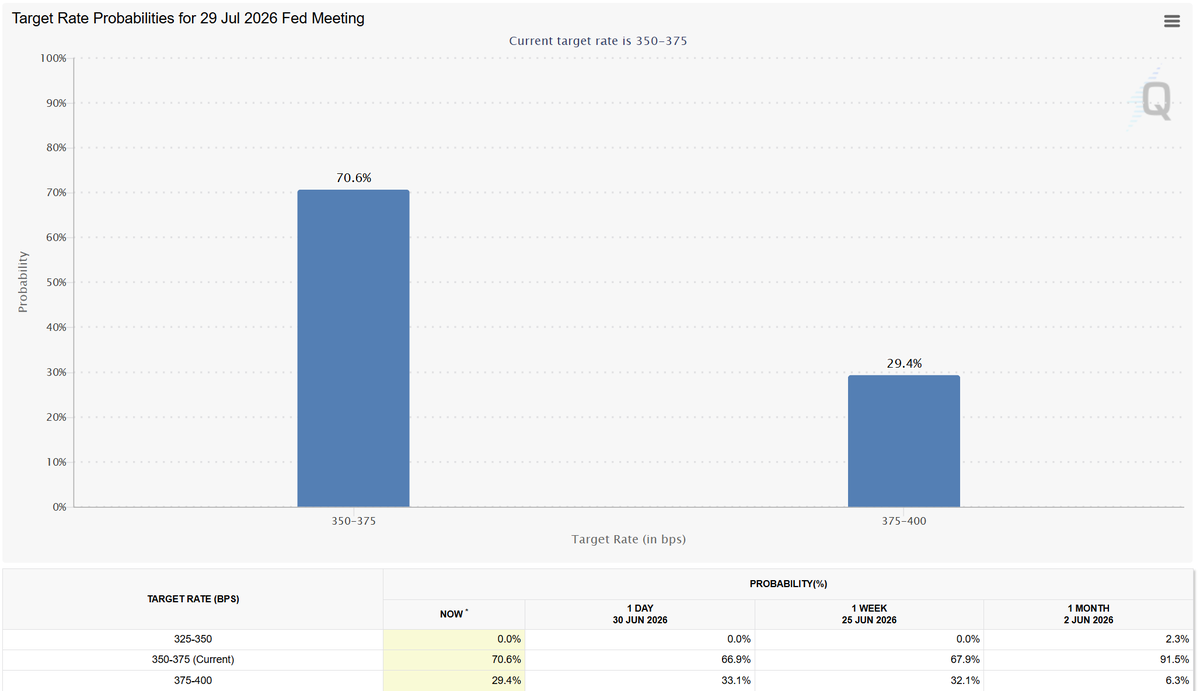
If not today, then the trend change will have to wait for the market to price in higher odds of no hike at the July FOMC (Jul/29). The next catalysts for that repricing are the FOMC minutes (Jul/8) and CPI (Jul/14). If CPI comes in hot, the repricing waits until the July FOMC itself.
NFP, CPI, the minutes, and FOMC speeches are more important than ever given Warsh's no forward guidance policy.
I expect no hike on Jul/29, given the Middle East cease fire and inflation having peaked, but the market is not so sure and needs data to hold its hand until then.
A hike would be extremely bearish. Without forward guidance, the market would have a hard time distinguishing between an "insurance hike" and the start of a hiking cycle.
The main drag on crypto in the last six weeks has been BTC and Saylor, whose unfortunate actions (using cash reserves to repurchase 2029 converts + making a test bitcoin sale) drove price from 82K to 58K. That risk is now mostly gone, at least for the foreseeable future.
Meanwhile, the main drags on equities and risk assets in general in the last two weeks have been a) the US-Iran cease fire exhausting most of the de-escalation upside, b) a hawkish June FOMC, and c) reignited AI bubble fears (misplaced IMO).
OpenAssets CEO @gaborgurbacs explains how the growth of ETFs provides a reference point for understanding tokenized assets.
From early-stage skepticism to large-scale adoption, the pattern is familiar.
See the full breakdown 🧵👇
New York got its first ever humanoid robot storefront this past weekend, and we made sure to stop by.
Our friends at @KraneShares and @openmind_agi brought the KOID Shop to SoHo, alongside @nvidia and a strong lineup of humanoid robotics teams, with visitors able to meet and interact with the platforms up close.
Congratulations to the KraneShares and OpenMind teams on putting it together!
"An estimated $124 trillion in wealth will change hands over the next two decades, much of it to a generation that expects markets to work like their phones: instant, fractional, always open."
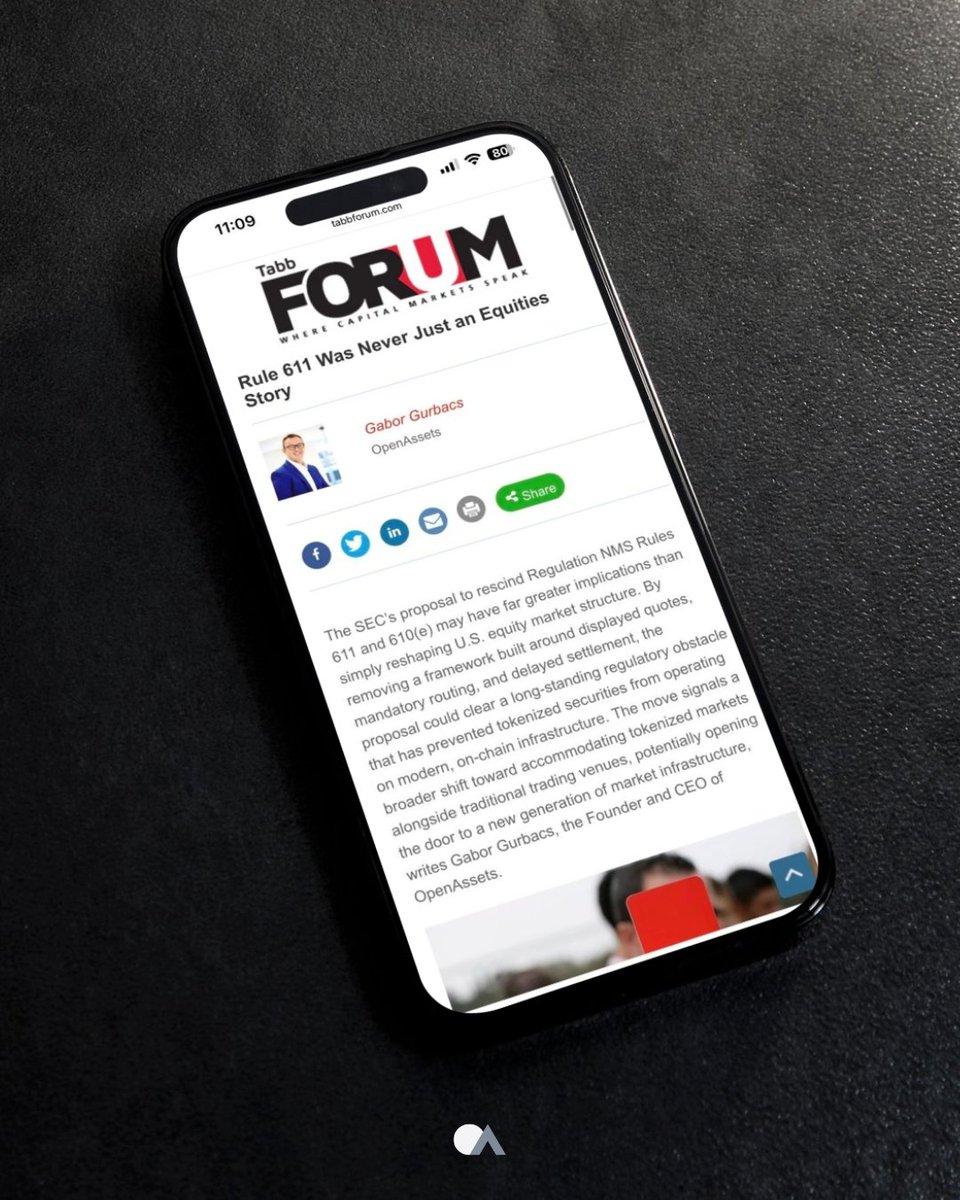
@gaborgurbacs wrote in @TabbFORUM about what the SEC's proposal to rescind Rule 611 changes for tokenized securities, and the infrastructure that has to be built before serious capital can underwrite it.
Saylor's 2029 bond repurchase was a (??) in chess terms, but today was a (!!) brilliancy move.
Nothing overcomplex - just a balance of MSTR, STRC and BTC that stops the spiral concerns.
The pundits were saying he had to lamb sacrifice one of these 3-- but all 3 are up today.
Tokenization today looks a lot like the internet in 1996. The technology already worked. What got built on top depended on the protocols and standards underneath.
Onchain assets work now. What decides the next decade is the layer beneath them: compliance, settlement, recordkeeping, interoperability.
That shared layer is what turns tokenized markets into infrastructure.
The winners in digital finance will remove "seven out of ten intermediaries" from the value chain.
@gaborgurbacs of @OpenAssetsInc tells @RemyBlaireNews this is "the decade of American infrastructure," with builders driving access to a roughly quarter quadrillion dollar global capital market.
In institutional tokenization, UX is where adoption breaks first.
A treasurer moving a tokenized asset shouldn't sign 14 transactions or pick the right chain. They should just move it.
Building the rails is solved. Making them effortless to people who already know capital markets is what unlocks production.
On the @NYSE floor, the 2026 story isn't price. It's infrastructure. In a new @FINTECHTVglobal interview, @gaborgurbacs explains how revisiting Rule 611 and parts of Reg NMS could compress a trade from ~10 intermediaries to 2 or 3, a path that could mean up to 10x market efficiency.
Watch the full interview 👇
Retail investors are stuck trading "dog and cat coins" while the world's best startups stay out of reach.
@gaborgurbacs of @OpenAssetsInc tells @RemyBlaireNews "tokenization changes this," with $120 trillion in global equity and $140 trillion in fixed income markets potentially opening up to retail investors within a decade.