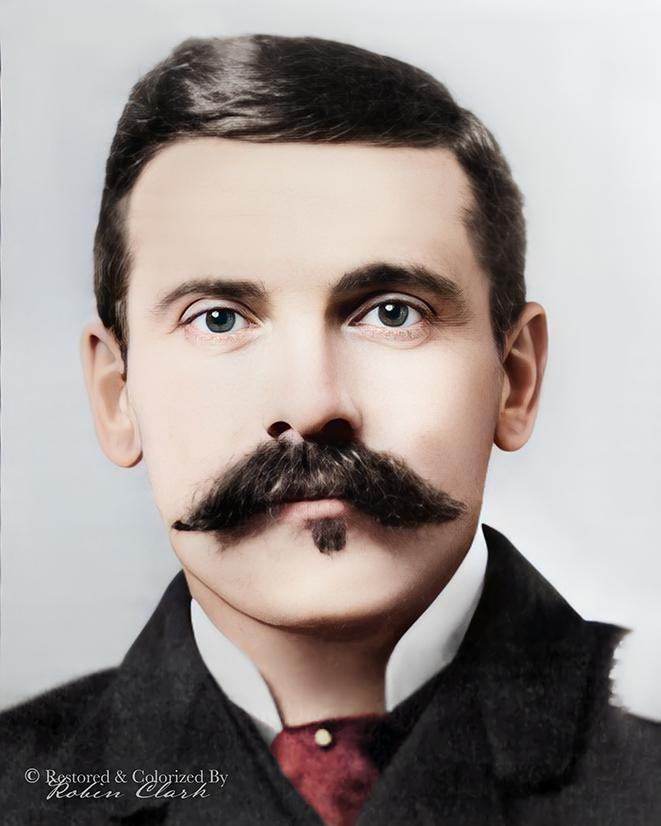
Doc Holliday was a dentist with a classical education in Greek and Latin who killed his first man at 19, coughed blood into a handkerchief for the next 17 years, and died in bed with a glass of whiskey, saying, "This is funny."
Funny because he'd spent his entire adult life expecting to die in a gunfight. He never did.
John Henry Holliday was born in Griffin, Georgia in 1851. He came into the world with a cleft palate and a partial cleft lip, a deformity that in 1851 was usually a death sentence for an infant. His uncle, a surgeon named John Stiles Holliday, performed the corrective surgery himself when the baby was two months old. His mother Alice spent the next several years patiently teaching the boy to speak clearly. She taught him piano. She taught him manners. She taught him how to bow to a woman and how to address a gentleman. By the time he was a teenager, John Henry could quote Virgil in the original Latin, play Chopin from memory, and dance a quadrille.
Then she died of tuberculosis when he was 15, and so did the small, soft world she'd built for him.
He was sent to Philadelphia to study dentistry. He graduated from the Pennsylvania College of Dental Surgery in 1872 at the age of 20, one of the youngest in his class, and his entry "Diseases of the Teeth" was considered exceptional. He won an award at a dental fair for "Best Set of Artificial Teeth in Gold." His diploma still exists. You can look at it.
He moved back south, set up a practice, and started coughing.
By 1873 the diagnosis was unmistakable. Pulmonary tuberculosis. The same disease that killed his mother. Doctors gave him a few months, maybe a year. They told him his only chance was to move west, where the dry air might slow the lungs from drowning. He kissed his cousin Mattie goodbye. He had been in love with her for years. She would later become a Catholic nun, Sister Mary Melanie, and she was the woman Margaret Mitchell would model Melanie Hamilton on in Gone With the Wind. They wrote each other letters until the day he died. Nobody has ever found those letters. The family burned them.
He went to Dallas. He set up a dental office. And his patients, watching this thin polite young man cough blood into a handkerchief between extractions, stopped coming.
So he turned to cards.
Faro, mostly. Poker when he could find it. He had a gambler's gift and a dying man's nerve, and within two years he was making more in a week at the tables than he'd made in a year pulling teeth. He moved through Texas and into the Colorado mining camps, then New Mexico, then Arizona. He drank an estimated two to three quarts of whiskey a day, partly because it numbed the lungs and partly because nothing else did.
Here is what made him terrifying.
Most gunfighters in the Old West were cowards in expensive boots. They picked fights they could win and avoided fights they couldn't. Doc Holliday already knew he was dying. There was nothing you could threaten him with. There was no future you could take from him. He would walk into a room of armed men with that thin slow smile and a Colt and a knife and sometimes a sawed off shotgun under his long grey coat, and the math running behind his pale blue eyes was simple. Every day he was alive was already stolen. The men across the table had something to lose. He had nothing.
He weighed about 135 pounds. He was five foot ten. He was usually drunk. And by the time he reached Tombstone, men crossed streets to avoid him.
His common law wife was a Hungarian woman named Mary Katharine Horony, better known as Big Nose Kate. She had been born to nobility in Budapest, run away as a teenager after her parents died, worked as a prostitute in Iowa, and ended up on the frontier with a temper that matched his. He once got her out of jail by bribing a guard. She once got him out of jail by setting fire to the hotel next door as a distraction, then walking him out at gunpoint. They fought constantly. They loved each other in the way two people love each other when they both know one of them is going to die soon.
He met Wyatt Earp in Fort Griffin, Texas, in 1877. The friendship that followed would shape both their lives. The legend goes that Doc saved Wyatt's life in Dodge City, walking out of the Long Branch Saloon to find Wyatt surrounded by cowboys with guns drawn, and putting his pistol to the leader's temple before anyone saw him move. Wyatt later said he owed Doc his life. He said Doc was "the most skillful gambler, and the nerviest, fastest, deadliest man with a six gun I ever knew."
Wyatt Earp said that. About a tubercular dentist who could quote Cicero.
At the OK Corral on October 26, 1881, the fight lasted thirty seconds. Doc was carrying a 10 gauge coach gun under his coat. He killed Tom McLaury with both barrels. When Morgan Earp was assassinated months later in retaliation, Doc rode with Wyatt on what history would later call the Vendetta Ride, a three week killing spree across Arizona that left every man they believed responsible dead in the dirt. They were never caught. They were never tried. They simply rode out of the territory and disappeared.
By 1887 the disease had finally caught up with him. He was 36 years old. He weighed less than 120 pounds. He had outlived nearly every man who had ever tried to kill him, and most of the ones who had only thought about it. He checked into the Hotel Glenwood in Glenwood Springs, Colorado, where the sulfur springs were said to ease the lungs. They didn't.
On the morning of November 8th, the nurse brought him a glass of whiskey. He had always sworn he would die with his boots on, the way a gunfighter was supposed to die. He looked down at his bare feet under the white hospital sheet. He looked at the whiskey. He started to laugh.
"This is funny."
Then he drank it.
And he died.
https://t.co/CkiVFoxXHS
This is a link to my daughter’s room review when we were in Da Nang, Vietnam and she asked me to share it on here for you guys. Please watch!
Sad day for combat wounded veterans. Thanks to @RogerWicker for being the only person to block this. Another year of work down the drain because you didn’t do your due diligence to know what the MRSA consisted of.
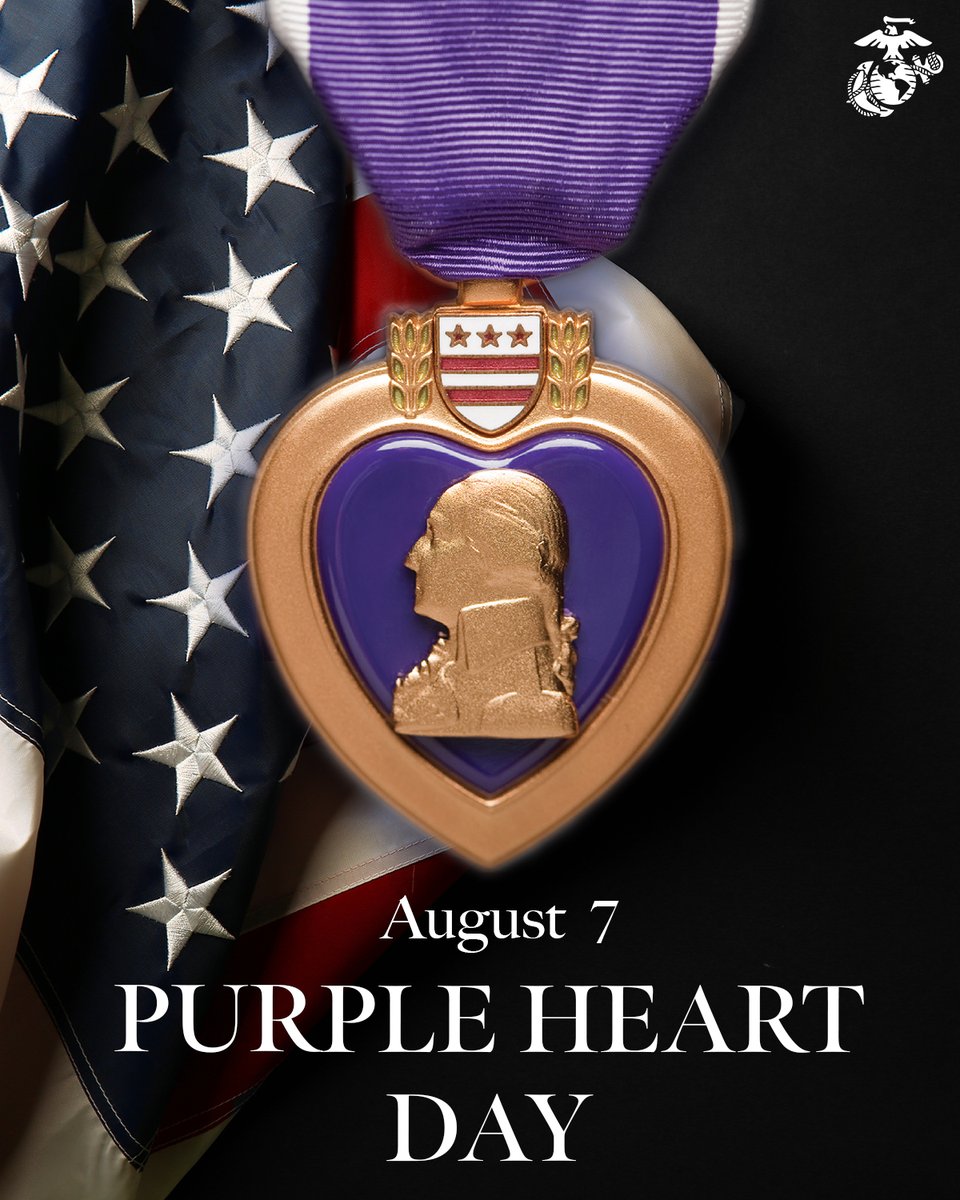
August 7th is National Purple Heart Day so please take a minute to think about those that didn’t make it home. Also a shout out to all those wounded in combat. Semper Fi!
Today we honor the brave
The Purple Heart is the oldest military award and one of the most prestigious the U.S. bestows upon its service members.
On Purple Heart Day, we pause to honor and remember the bravery and sacrifice of our wounded and fallen heroes.
Semper Fidelis
Wow, thanks for the ridiculous 33% price increase on the club card @united. Not only a massive increase but a decrease in the benefits that people actually use. You consistently make it more difficult to gain status and then reduce the benefits. Time to reconsider my choice.
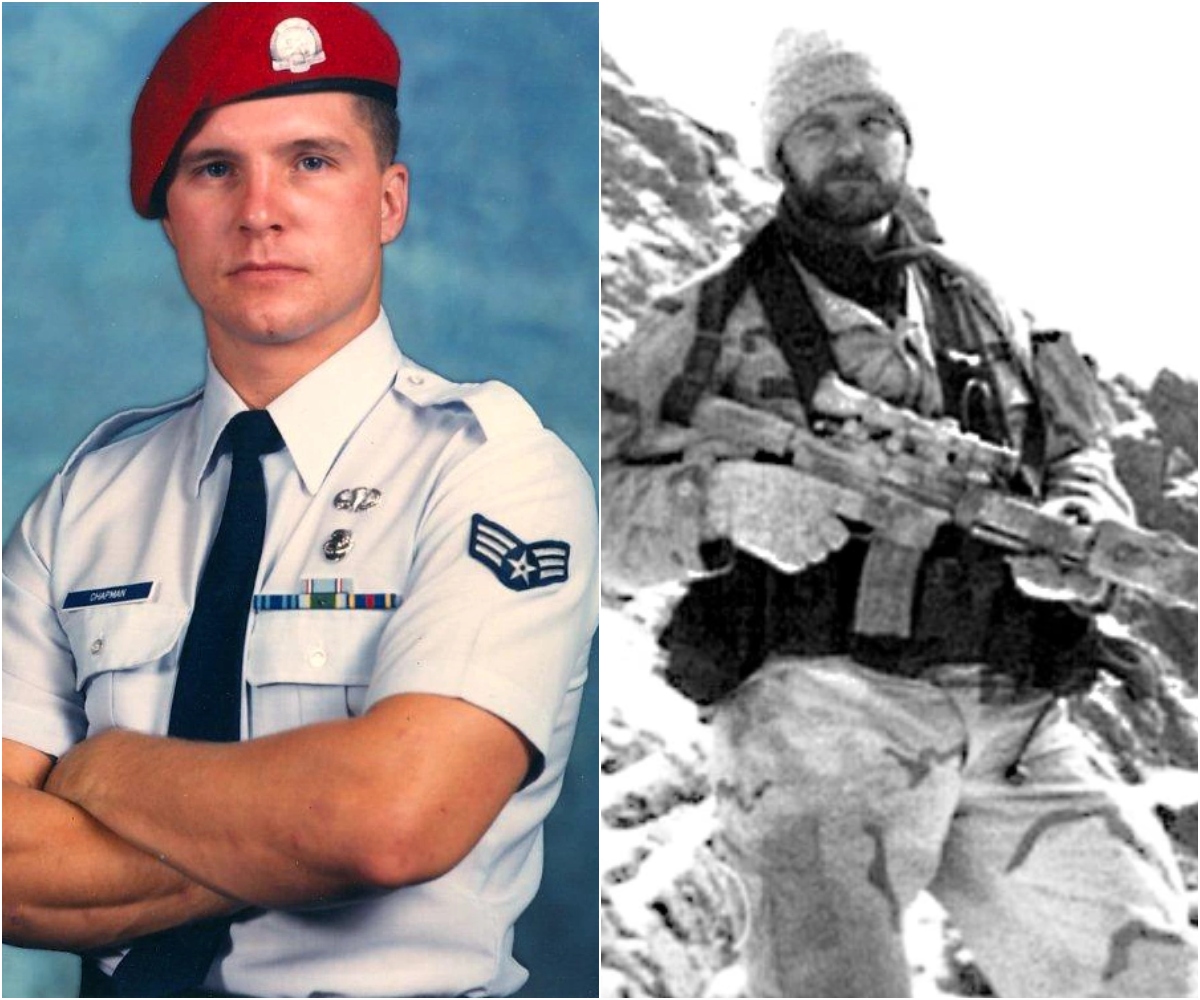
Air Force Combat Controller John Chapman was one of the world’s most elite special operators. My husband Andy was a combat controller, and I am an Air Force veteran; we know firsthand how men like CCT Chapman leave a legacy that must be honored forever.
It is outrageous that, because of personal interests and self-gratification, the board of this new museum (to include Britt Slabinski who is not only a board member of the museum but also according to the ISR footage, left Chapman for dead) has decided not to exhibit a brave man like CCT Chapman properly. Especially being that he is the ONLY ever recorded medal of honor recipient in US history.
They should be ashamed and embarrassed about their decision to exclude him. They should immediately apologize and order a meritorious exhibit in this museum that honors our nation’s heroes. CCT Chapman will never be forgotten. If the museum wants to continue to play politics, I would caution Americans from visiting.
The National Medal of Honor Museum (@MoHMuseum) is disgracing the legacy of John Chapman.
Chapman was killed in 2002 after the SEAL Team 6 team he was attached to retreated and left him alone on a mountain fighting terrorists in Afghanistan.
The 24th STS CCT continued to fight as he bled to death after being shot and blown up many times.
At one point, John passed out from his injuries. He then regained consciousness and continued to kill enemy fighters to make sure Army Rangers flying in wouldn't be shot out of the sky.
He's now not getting his own exhibit, but one of the ST6 operators who abandoned him is. It's disgraceful, and it needs to be corrected. John did something the average human can't imagine. He spent the last seconds of his life fighting alone and bleeding to death, but refused to give up in order to save the rescue team. Chapman is a hero that should make all of us proud.
Make your voices heard. https://t.co/Ee3WtizgQc
Medal of Honor hero John Chapman was killed in one-man last stand.
Now, the National MoH Museum is REFUSING to give him the respect he deserves, and a petition in support of him has been suspended.
Disgusting behavior from all involved.
DETAILS: https://t.co/Tse5aNfZjt
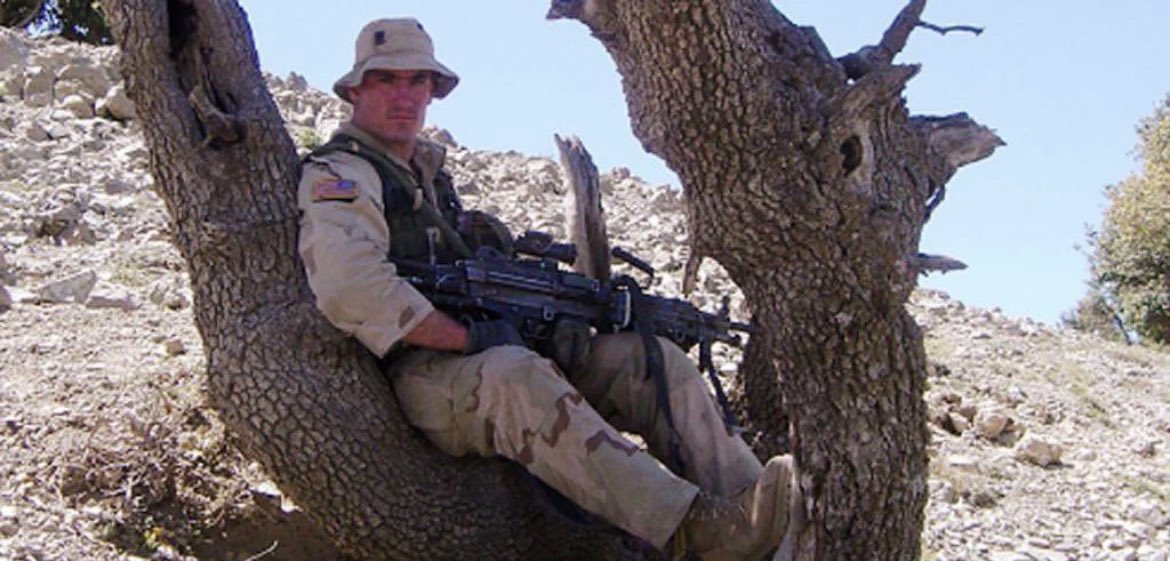
Last photo of former NFL player Pat Tillman in his army gear before he was killed by friendly fire.
After playing four seasons in the NFL, Tillman joined the Army Rangers and served several combat tours before he was killed in the mountains of Afghanistan.
Initially, the Army reported that Tillman had been killed by enemy fire. A month later, on May 28, 2004, the Pentagon notified the Tillman family that he was actually killed by fire from his own side.
The Washington Post reported that prior to his death, Tillman called the invasion and occupation of Iraq "fucking illegal".
An investigation by the U.S. Army Criminal Investigation Division (CID) concluded that Tillman and an Afghan militia soldier were killed by friendly fire when one allied group fired upon another in confusion after nearby gunfire was mistakenly believed to be from enemy combatants.
Tillman's brother testified before Congress, stating "The deception surrounding this case was an insult to the family, but more importantly, its primary purpose was to deceive a whole nation."
On September 19, 1991, while hiking in the Ötztal Valley in the Austrian Alps, German hikers Erika and Helmut Simon stumbled upon what they initially thought was the body of a recently deceased mountain climber.
However, it turned out that this was a remarkably preserved mummy, later named Ötzi, which had been encased in ice for over 5,300 years.
The mummy was surrounded by various artifacts, including a bow and a quiver containing arrows, a copper-bladed axe, a flint dagger with a wicker sheath, birch wood vessels lined with maple leaves, remnants of a backpack, a leather pouch holding small items, and clothing and shoes made from fur and leather, among other minor items.
Researchers analyzing Ötzi concluded that he likely met a violent end due to an arrowhead found lodged in his left shoulder and other injuries on his body, suggesting he was the victim of murder.