#WATCH | Prof. Veezhinathan Kamakoti, Director of IIT Madras, has been conferred the Padma Shri in the field of Science and Engineering for his contributions to academia and technological advancement.
@rashtrapatibhvn@PadmaAwards#PadmaAwards
Gravity near a black hole is far stranger than simple attraction.
This visualization highlights how spacetime curvature shapes the paths of light and matter around a non rotating black hole.
• The event horizon marks the boundary beyond which nothing can return
• Light passing nearby follows curved paths, creating gravitational lensing
• The photon sphere is a region where light can orbit the black hole
• Escape velocity increases dramatically as distance from the center decreases
• The geometry of spacetime determines motion, not an invisible pulling force
One of the most fascinating predictions of Einstein's theory is that massive objects don't just exist in space. They change the structure of space and time itself.
Rockets don't push against air. They push against their own exhaust.
Rocket Thrust Equation:
F = ṁVₑ + (pₑ − p₀)Aₑ
Where:
• F = thrust produced by the rocket
• ṁ = mass flow rate of exhaust gas
• Vₑ = exhaust velocity
• pₑ = exhaust pressure at the nozzle exit
• p₀ = surrounding (ambient) pressure
• Aₑ = nozzle exit area
Key points:
• The term ṁVₑ is the momentum thrust created by high speed exhaust leaving the rocket.
• The term (pₑ − p₀)Aₑ is the pressure thrust caused by the pressure difference between the exhaust and the surrounding environment.
• Most rocket thrust comes from accelerating exhaust gases to extremely high speeds.
• Rockets work in space because thrust comes from expelling mass backward, not from pushing against the atmosphere.
Newton's Third Law in action: exhaust goes one way, the rocket goes the other.
Electromagnetic wave interference occurs when two or more electromagnetic waves overlap, causing their amplitudes and phases to combine. Depending on how the waves interact, they can produce patterns of amplification, cancellation, and frequency redistribution, making interference a fundamental phenomenon in optics, radio transmission, and wave physics.
This figure illustrates a theoretical framework in which multiple electromagnetic frequencies are arranged into a frequency comb and combined within a resonant system. The upper diagrams show how discrete frequency modes span a bandwidth and evolve over time, while the lower section depicts Doppler processing, synthesized frequency shifts, and a phase conjugate resonator driven by high and low frequency pump beams. Together, the components represent a proposed method for controlling energy and momentum transfer through precisely engineered electromagnetic wave interactions.
learn tensor calculus.
not because it sounds advanced.
because some realities are too complex for simple vectors.
• tensors → quantities with direction, magnitude, and structure
• curvature → how space itself can bend
• gradients → change across dimensions
• manifolds → surfaces that are not flat
• invariance → truth that survives coordinate changes
general relativity.
fluid dynamics.
robotics.
continuum mechanics.
deep learning.
tensor calculus is what happens when math stops pretending the world is flat.
it gives you language for systems where everything changes with everything else.
Gravity neutralization is a hypothetical concept that proposes reducing or cancelling the effects of gravity by creating an opposing energy gradient.
This illustration shows one such theoretical model, where upward forces generated by an engineered energy density gradient are proposed to balance the downward pull of gravity. Although ideas like this remain outside established physics, they continue to appear in discussions about advanced propulsion and alternative gravity theories.
markov chains are simple but powerful.
they model systems where the next state depends on the current state.
not the whole past.
• states → possible conditions
• transitions → ways the system moves
• probabilities → uncertainty with structure
• memorylessness → only now matters
• steady state → long term behavior emerges
weather.
markets.
language.
biology.
robot navigation.
queues.
markov chains teach you a brutal systems lesson:
complex behavior can emerge from simple transition rules.
- Math behind Attention- Q, K, and V
- Math behind √dₖ Scaling Factor in Attention
- Math Behind Backpropagation
- Math Behind Gradient Descent
- Math Behind Cross-Entropy Loss
- Math Behind RoPE (Rotary Position Embedding)
- RMSNorm (Root Mean Square Layer Normalization)
Best YouTube Channels To Learn AI in 2026 (No BS). Save it.
1. Fundamentals – 3Blue1Brown
2. Deep Learning – Andrej Karpathy
3. AI Research – Yannic Kilcher
4. Practical AI – AssemblyAI
5. LLMs – AI Explained
6. ML Theory – StatQuest
7. Papers Simplified – Two Minute Papers
8. GenAI – Matthew Berman
9. AI Agents – Nicholas Renotte
10. Applied ML – Krish Naik
11. PyTorch – Aladdin Persson
12. Math for ML – Serrano Academy
13. Industry Insights – Lex Fridman
14. Real-world AI – DeepLearningAI
Difference Between the Smith Chart and Nested Apollonian Spheres ✍️
This image shows two circular diagrams side by side, but they come from very different origins. The Smith Chart on the left is a real, established engineering tool that electrical engineers have used since 1939 to design radio and microwave circuits. It maps electrical impedance onto a circle, where the center represents a perfectly matched circuit with no wasted signal and the edges represent total reflection. The Nested Apollonian Spheres on the right looks visually similar but combines real math with speculative, non-mainstream physics. The geometry on the right is real and beautiful. It is an Apollonian gasket, named after an ancient Greek mathematician. This is created by starting with three circles that touch each other and then endlessly filling every curved gap with smaller and smaller circles, down to infinity. The mathematical concepts in the diagram, like curvature being the reciprocal of a circle's radius and point inversion being a way of reflecting points through a circle, are completely legitimate tools in mathematics, used to construct patterns like this one. However, the diagram strays from established science in the physics terminology added to this real geometry. It introduces a quantity called "Planck impedance," which does not align with the standard accepted definition of impedance of free space in mainstream electromagnetic theory. It also presents a modified version of the Schwarzschild radius, a real and significant concept from general relativity that describes the size needed to compress an object into a black hole. However, it replaces the speed of light with a non-standard quantity called "Planck permittivity," which is not a recognized physical constant. Additionally, it labels the point where the circles converge as a "degenerate singularity," comparing it to black hole physics. This is a creative leap rather than an established scientific link, as accumulation points in fractal geometry and actual gravitational singularities are unrelated phenomena, according to mainstream physics. The additional formulas labeled "Swing" and "Rafter" use carpentry terms that do not correspond to anything in standard physics literature. Together, the diagram seems to propose a hidden connection between electrical impedance and gravitational physics at the Planck scale, unified through this fractal circle pattern. This is an ambitious idea in the same speculative category as the Rodin Coil and Frustrated Planck Vacuum Lattice models discussed earlier, yet it lacks peer-reviewed support or experimental evidence. The best approach to view this image is to appreciate the genuine mathematical beauty of the Apollonian gasket on its own terms, while recognizing that the specific physics narrative surrounding it treating impedance circles as equivalent to gravitational radii is an unverified creative proposal rather than an accepted extension of how the trusted, decades-old Smith Chart actually works.
I extend my heartfelt congratulations and best wishes to all candidates who have successfully qualified the UPSC Engineering Services Examination (ESE) Preliminary Examination and are appearing for the Engineering Services (Main) Examination on 21 June 2026.
#UPSC
@_Epinephrine_@Tweetin_ggg Nope bro, Avg is quite misleading to judge, median is around 18lpa-20lpa with ~80% placements, and also as of now, market is bad and cs grads have to update themselves more frequently to keep up with the market trends for initial job placements, especially off campus
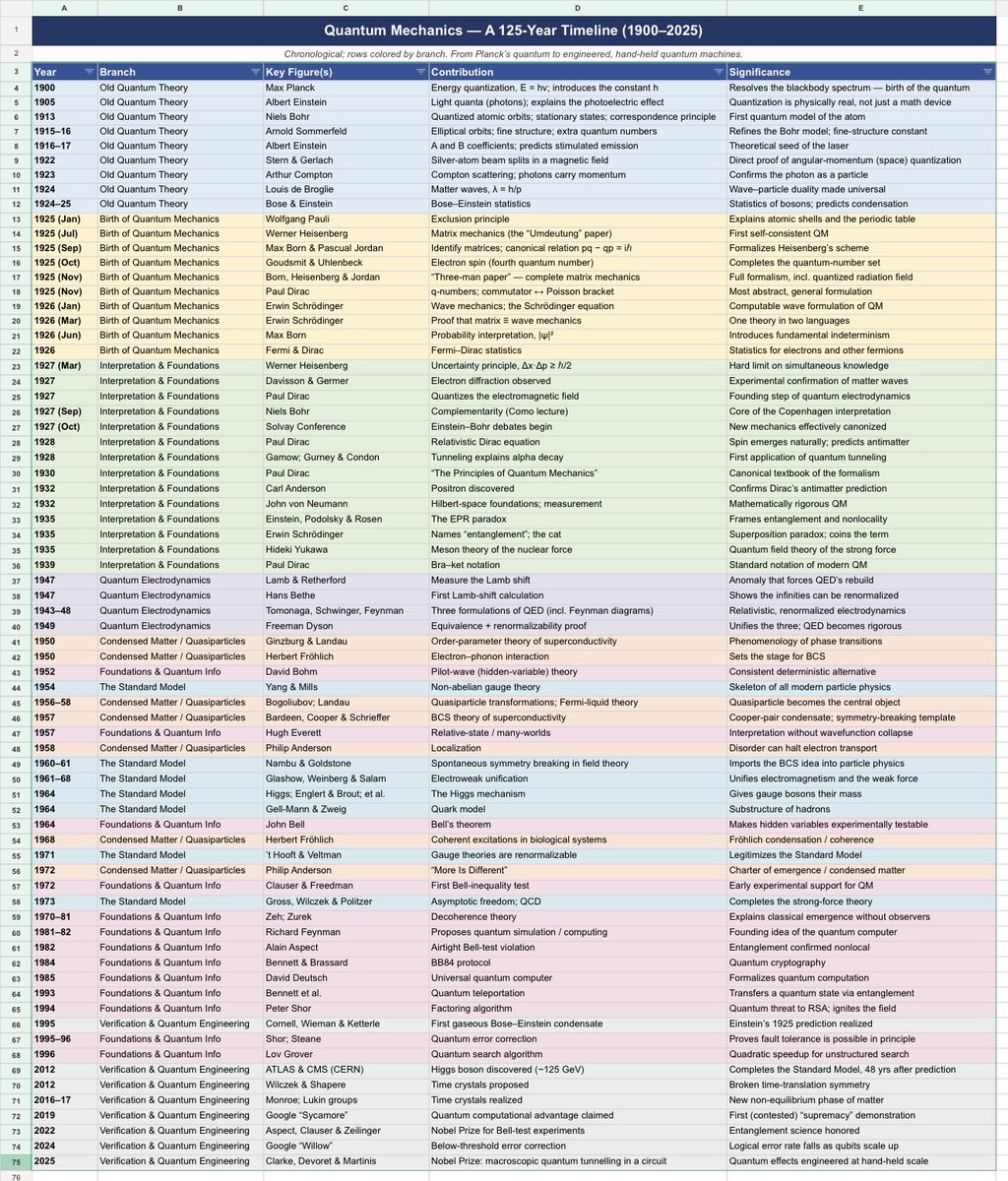
Quantum mechanics turns 100 this year. I put the whole history on one sheet — 72 entries, 1900 to 2025.
Planck kicks it off in 1900. The core of the theory gets built in about 18 months across 1925-26: matrix mechanics, then wave mechanics, then the proof they’re the same theory, then Born’s probability rule and uncertainty….After that it stops being a single field. It splits into QED, condensed matter, particle physics, and quantum information — four separate bodies of work coming off one root.
I colored the rows by branch so you can actually see those tracks running at the same time instead of flattening them into one line.
Every row is just the year, the people, what they did, and why it mattered.
It runs all the way to where things stand now: error-corrected qubits and a 2025 Nobel for quantum tunneling in a single circuit. A century of physics you can scan in a couple of minutes.
how to use AI right way to clear UPSC 2027:
(make an AI account, preferably chatgpt)
give it context on your
> answer writing: use it to get feedback on Mains answers
> notes making: use it to build notes -OR- give your notes to get value addition
> lifestyle mentor: use it to set you a detailed plan and lifestyle curation; interactions on how to be more efficient will help big time
> personal mentor: every aspect of your prep can have one conversation in chatgpt to sort things faster
all in all, use it to save time, money and smart efficient processes. best gift for your prep!
A 360° rotation feels like a full turn in everyday life. For spinors, it is only halfway home.
This diagram explores one of the most fascinating ideas in quantum physics: spin ½ systems return to their original state only after a 720° rotation. The torus, cardioid, cycloid, and orthogonal wheel constructions are geometric ways to visualize this unusual behavior, where two coupled rotations with a 2:1 frequency ratio produce a complete return to the starting orientation.
It is a reminder that the geometry underlying quantum mechanics can be far stranger than our everyday intuition, yet it follows precise mathematical rules all the way down.
THIS PYTHON BOT APPLIES TO 100+ LINKEDIN JOBS IN UNDER 1 HOUR
no clicking... no copy-pasting... no burnout
▪️ scrapes linkedin for matching roles
▪️ auto-fills every application form
▪️ answers custom questions using your config
▪️ tailors resume using openai + job description
▪️ tracks history in a local web UI
setup takes 10 mins:
→ pip install the deps
→ fill in your config files (name, skills, preferences)
→ run `https://t.co/vOKd2aMFNX`
→ watch it go





![mathemetica's tweet photo. Warping spacetime into a moving bubble allows apparent superluminal travel.
- The metric is ds² = −dt² + (dx − v_s f(r_s) dt)² + dy² + dz².
- The shaping function f(r_s) = [tanh(σ(r_s + R)) − tanh(σ(r_s − R))] / [2 tanh(σ R)] creates the bubble using shell thickness σ and radius R.
- York time θ = v_s (x_s/r_s) (df(r_s)/dr_s) measures spatial expansion or contraction.
- Energy density follows (1/8π)G₀₀ = −(1/8π) [v_s² (y² + z²) / (4 r_s²)] (df/dr_s)².
It models hypothetical interstellar warp propulsion in general relativity.](https://pbs.twimg.com/media/HLLHm6tbQAANtMl.jpg)





