Human videos contain rich data on how to complete everyday tasks. But how can robots directly learn from human videos alone without robot data?
We present MT-π, an IL framework that takes in human video and predicts actions as 2D motion tracks.
https://t.co/Zr17fnZbCn
🧵1/6
The recent breakthrough in Navier-Stokes has garnered a lot of attention to the new possibilities that emerge when agents work together.
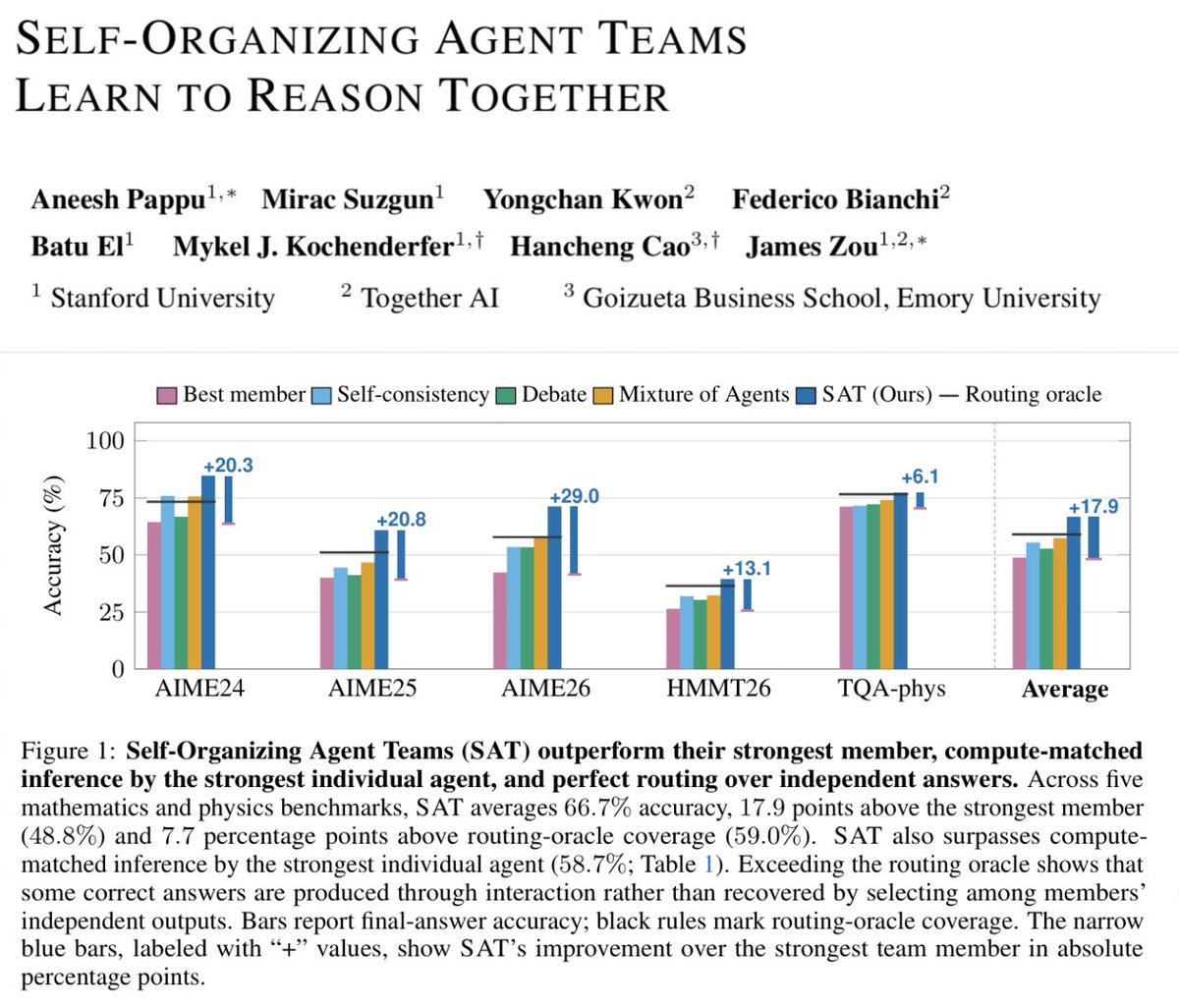
We have been interested in this question for a while. How can a team of agents achieve more than agents working alone?
I'm excited to finally share our new work, "Self-Organizing Agent Teams Learn to Reason Together" 🧵
Transformer Transformer will be presented at #CoRL2026 🚀 See y'all in Austin!
Website: https://t.co/s7eimKcHbb
Video: https://t.co/YGQXUSZWLY
Paper: https://t.co/Biyu0r1J7N
Transformer Transformer will be presented at #CoRL2026 🚀 See y'all in Austin!
Website: https://t.co/s7eimKcHbb
Video: https://t.co/YGQXUSZWLY
Paper: https://t.co/Biyu0r1J7N
If you're like me, most days you'll want to forget about the success rates (or lack thereof) of your policies.
How can we cleverly leverage demos from previous data without *catastrophically forgetting* and maintain good performance?
Check out Max's new work studying this!
When a robot learns a new behavior, what keeps it from forgetting the ones it already knows?
Prior work, especially on VLAs, shows that rehearsing past experiences can enable strong continual learning. But why does rehearsal work so well, and when does it fail?
We find that a small but ✨special subset✨ of rehearsed data largely determines whether old behaviors are retained or forgotten. We call these examples Memory Anchors. ⚓
Withholding just the top 10% of Memory Anchors from rehearsal increases forgetting by up to 4.5x. Increasing their presence, meanwhile, reduces task forgetting and enables a real robot to learn challenging task sequences.
Website: https://t.co/JhGATqmQ6F
Paper: https://t.co/i3PPO2NxP3
Curious? Read on! 🧵👇 (1/9)
With GEN-1.5 from @GeneralistAI and S1 from @SkildAI, we are seeing exciting progress with in-context demonstration prompting! But can we study this in academia?
In our recent work Behavior Prompting Policy (https://t.co/cWiJZUPTgK), we released open-source sim benchmarks and real-world experiments to study in-context physical/behavior prompting without requiring industrial-scale data collection/compute.
We also released iPhUMI, an UMI gripper for collecting behavior prompts to instantly in-context condition the robot at test time.
Important lessons: (1) prompting improves with task diversity instead of more demos per task, (2) behavior prompts act as dense sub-goal conditioning, like a step-by-step instruction book, (3) adding robot actions in the prompt improves prompt following.
If you want to study this too, everything is open-source!
Teleop systems are usually designed for a single embodiment, but do they have to be?
Introducing ModPack ����: a modular teleoperation interface for bimanual mobile robots.
A wearable backpack provides shared infrastructure, robot-specific leader arms adapt to different embodiments, and plug-and-play modules add capabilities like haptic feedback, active perception, and mobile manipulation. 🧵(1/n)
Can we enable robots to develop a sense of touch without forgetting what they learned from large-scale vision-only pretraining?
Introducing MultiSensory World Model (MuSe) 🌍: A new approach for finetuning visuomotor policies on minimal data from new sensor modalities, such as force/torque (F/T)
With Muse, touch learned later improves skills learned earlier — a small amount of F/T data on new tasks improves zero-shot on diverse pretraining tasks that were never supervised with F/T
We believe MuSe provides a practical pathway towards training multisensory foundation models that leverage both abundant vision data, and smaller multisensory datasets 🧵👇
🚀 Introducing 𝚆𝙴𝙰𝚅𝙴𝚁 🌎, a world model for robot manipulation built around three key desiderata: (i) 🔍 Fidelity, (ii) 🔗 Consistency, and (iii) ⚡ Efficiency. 𝚆𝙴𝙰𝚅𝙴𝚁 unlocks multiple downstream applications—policy evaluation, policy improvement, and test-time planning. 🧵
I'll be presenting my favorite paper from my PhD in the afternoon poster session at #ICLR2026 today :). Swing by Pavilion 4 P4-#4809 from 3:15 PM – 5:45 PM if you'd like to talk shop!
In Silicon Valley, “virtual cells” are suddenly everywhere.
Meta and CZI recently went all in, signaling that this is no longer a fringe research direction.
So what is virtual cell? Check out my new blog about virtual cell: https://t.co/lQx2dc4XsZ
Congrats to @arnavkj95, @vib2810_, and all the authors on their #NeurIPS2025 Spotlight! We have one more surprise up our sleeves I'm excited to share soon 😉
Above all, I’m super grateful to have been able to work on such an impactful project with a beyond-amazing crew (@itsdanielho, @JackMonas, and Christina Yu). Thanks for everything!
Super excited to share the progress @1x_tech has made on tackling one of the most important problems in robotics: evaluation of robot policies.
Being able to do so with high alignment with the real world opens even more doors for test-time reasoning, synthetic data-gen and more!
All hands on deck for SAILOR ⚓️!
🎣 SAILOR nets more performance even with 10x less data than Diffusion Policies trained with behavioral cloning. Check out @g_k_swamy’s post explaining how we leverage learned models to enable test-time planning and mistake recovery for robots!
Say ahoy to 𝚂𝙰𝙸𝙻𝙾𝚁⛵: a new paradigm of *learning to search* from demonstrations, enabling test-time reasoning about how to recover from mistakes w/o any additional human feedback! 𝚂𝙰𝙸𝙻𝙾𝚁 ⛵ out-performs Diffusion Policies trained via behavioral cloning on 5-10x data!
This was a massively challenging but rewarding project. Thanks to the amazing co-captains @arnavkj95 and @vib2810_ for leading the charge, @g_k_swamy and @sanjibac for steering the ship!