ZKX Protocol's node network combines the strengths of Virtual AMMs and Central Limit Order Books (CLOBs) to support a more efficient decentralized trading infrastructure ⚙️
By integrating these two trading models, the protocol aims to improve performance while addressing some of their individual limitations. Recent testing demonstrated throughput of over 9,000 transactions per second (TPS), highlighting the network's focus on scalability and efficient trade execution. 🚀🔗
___________________________________________
Come and join our community 👉 https://t.co/STTTbDy5tw
No More Trade-Offs
"With atomic DvP settlement, we can massively reduce the cost of compliance and operations for financial institutions while increasing their capital efficiency."
@gluk64 presents how private atomic settlement on Prividiums marks a new era for Finance.
ZKX Protocol is a decentralized perpetual futures exchange built on StarkNet, combining self-custody with the scalability of zk-STARK technology ⚡🔐
By leveraging zero-knowledge proofs, it aims to deliver faster transactions, lower costs, and an improved trading experience while maintaining the transparency and security expected from decentralized infrastructure.
____________________________________________________
Come and join our community 👉 https://t.co/STTTbDy5tw
Oracle = Reality Plugged Into Blockchain 🔮📊
An oracle is the trusted bridge that brings real-world, off-chain data on-chain.
Prices. Events. Assets.
From the real world → into smart contracts.
No oracle = no connection.
With it? Blockchain meets reality. 🧊⛓️
____________________________________________________
Come and join our community 👉 https://t.co/STTTbDxxDY
Private where it matters.
Connected where it counts.
@gluk64 presents his Prividium Network vision on @therollupco.
How Prividiums enable Institutions to build private and secure onchain rails they own while staying connected to Ethereum and other Prividiums.
Real Community > Hype 🤝🔥
No account pumping.
No empty noise.
Just real conversations about industry fundamentals.
While most communities fade when prices drop…
this one grows stronger with conviction.
Built on substance. Powered by people. 🏗️🏠
____________________________________________________
Come and join our community 👉 https://t.co/STTTbDy5tw
@ShaulKfir@gluk64 You’re saying participants don’t need to know the nature of the assets or the total supply. Isn’t that a joke, as far as participants are concerned?
Canton founders claim ZK proofs are too risky for institutional finance. They have been making this argument to buyers and regulators, publicly and behind closed doors. It deserves a public answer.
Let's see if the argument holds — and if Canton's infrastructure passes its own test.
The argument
Their case, stated fairly: ZKPs are complex. Bugs are inevitable in any sufficiently complex system. If a flaw exists in a proof system, it could go undetected because the underlying data is private. If it goes undetected, it spreads throughout the system. This creates systemic risk. Therefore, ZKPs cannot be used for critical financial infrastructure.
This is a real concern. Let's take it seriously and follow the logic.
The flaw in the logic
Strip away the ZKP-specific language, here's the story:
Technology X can have implementation flaws. Technology X serves a mission-critical function. If it fails, the consequences are catastrophic. Therefore, Technology X can never be used.
Read it again. There is a hidden assumption doing all the work: that Technology X is your only line of defense.
If this logic held, we would not have aviation. Fly-by-wire, engine controllers, autopilot — every one of these systems has bugs, is mission-critical, and can fail catastrophically.
Nuclear reactor control systems, robotic surgery, radiation therapy dosing, implantable cardiac devices, and many other systems all run on software that can fail catastrophically. But they are somehow still in use. How?
Redundancy and containment
The foundation for these mission-critical systems is the explicit assumption in their architectures that every component will eventually fail. They all rely on two things: redundancy and containment.
Redundancy = multiple independent systems, each capable of catching a failure in the others.
Containment = when failure occurs, limit the blast radius so it cannot become systemic.
This is the only question that matters for any mission-critical system: does your architecture have more than one line of defense?
Canton's architecture
Let's apply this test to Canton.
Canton's privacy and integrity model relies on a single mechanism: trusted operators segregating data between participants. There is no cryptographic verification layer and no independent check. If a few keys of the operators in a validation domain are compromised, manipulated state propagates silently inside opaque chains of UTXOs with nothing watching. This is a real systemic risk, accelerated by the rise of AI-assisted cyberattacks.
By Canton's own logic — a single point of failure with catastrophic consequences — this is the architecture that should concern regulators.
Prividium's architecture
Now look at how Prividium is built.
Redundancy. Prividium has three independent lines of defense. First, institutional partners operate Prividium nodes within their own security environments, the same infrastructure banks already trust and regulate. Second, zero-knowledge proofs provide cryptographic integrity verification as an independent layer on top, verifying operational security rather than replacing it. Third, as ZK proof systems standardize, multiple independent provers can verify the same computation. A flaw in one implementation gets caught by another.
Containment. Each Prividium instance is an individual chain operated by an individual institution. When institutions interact across chains, Prividium's interop layer implements inter-chain accounting mechanisms that are independently enforced by the participating institutions, asset issuers, or on-chain. Even an attacker who compromises a single institution's internal IT infrastructure and simultaneously finds a ZKP bug could only affect that one Prividium instance. The damage cannot propagate to the broader network.
The net balance: Canton has a single mechanism, no fallback, silent failure propagation across the network. Prividium has layered defenses, independent verification, blast radius contained by design.
Importance of open standards
Multiple lines of defense only matter if each line is itself strong. What makes a technology strong? The depth of adversarial testing it has survived. Shaul points to a compiler bug example in his post, and it actually illustrates this well.
ZKsync embraced full EVM equivalence over a year ago. This was shaped precisely by the understanding that the more you deviate from an open standard, the larger your attack surface becomes.
And Ethereum is not battle-tested in some polite, academic sense. For over a decade, its smart contract infrastructure has been completely open to scrutiny by the most sophisticated adversarial actors in the world, with hundreds of billions of dollars at stake. Vulnerabilities and exploits fed directly back into the ecosystem: new audit standards, formal verification tools, compiler safeguards, and hardened design patterns. The EVM that exists today is the product of a decade of continuous adversarial stress testing at a scale no other smart contract platform has experienced.
Canton went the opposite direction. DAML is a proprietary smart contract language with a closed ecosystem and a fraction of the developer and security community. Every growing pain that Ethereum went through over the last ten years still lies ahead for DAML, except DAML will face them with orders of magnitude fewer eyes watching. Every maturity concern Canton raises about ZKPs applies to their own technology stack with far less mitigation available.
The safest technology is the one that has survived the longest under the harshest conditions. For smart contract infrastructure, that is Ethereum. It's not close.
So to answer the question directly: everyone agrees bugs exist. The question is whether your architecture has redundancy to catch them and containment to limit the damage when they slip through.
Cryptographic verification provides both. Trust in operators provides neither.
Exploring the future of Web3 innovation in Southeast Asia with @AseanLabs_
ASEAN LABS is incubating the next generation of builders on ENI.
#ASEANLABS#ENI#Web3
Built Different: ZK on Ethereum ⚡
While most projects go for the easy route on low-cost chains…
ZKX chooses the harder path.
🔐 Built on Ethereum + ZK tech
🧠 Higher technical barrier
🛡️ Stronger credibility & security
Harder to build. Harder to copy.
But that’s what makes it valuable. ✨
____________________________________________________
Come and join our community 👉 https://t.co/STTTbDy5tw
From Locked Assets to Liquid Opportunities 👑
With ZK scalability + oracle tech, ZKX turns illiquid assets into divisible, tradable tokens.
More liquidity.
More accessibility.
Lower barriers for everyone.
Now anyone can tap into DeFi and global value creation — not just the few. 📱💹
____________________________________________________
Come and join our community 👉 https://t.co/STTTbDxxDY
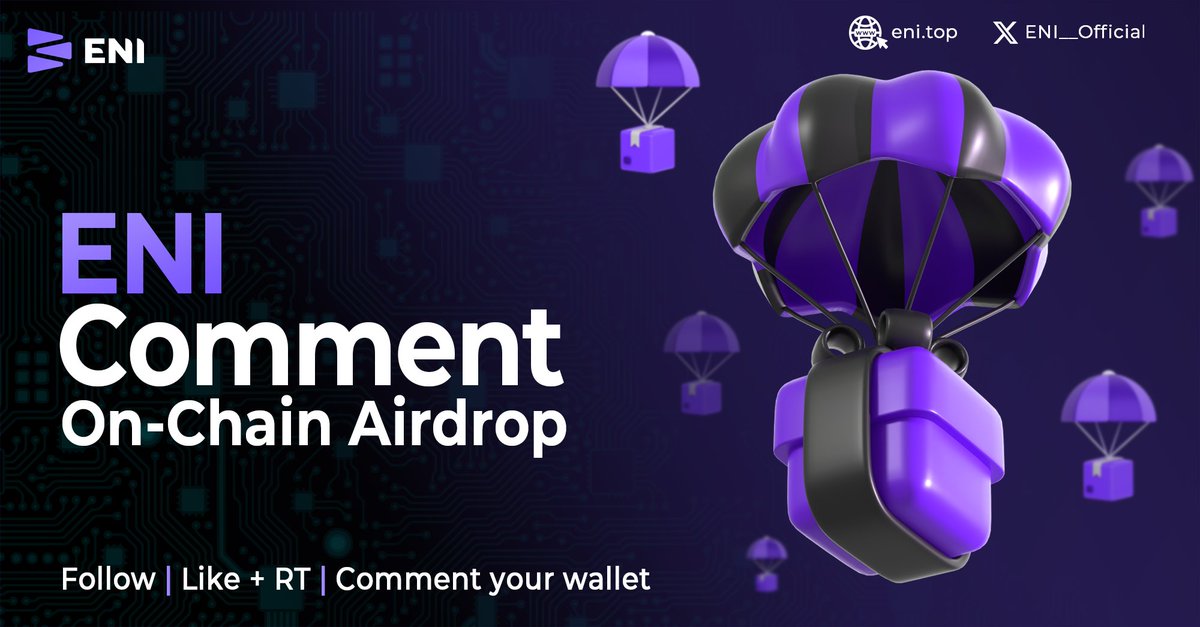
ENI Comment Airdrop is back.
But this time, everyone wins.
Airdrop for every comment
Drop your wallet below
• Follow @ENI__Official
• Like + RT
• Comment your wallet
Let’s see how fast Crypto Twitter moves.
Small Bubble, Strong Foundation 🛡️📉
No heavy capital games.
No complex token-locking traps.
✔️ Low market selling pressure
✔️ Simpler, cleaner mechanics
✔️ Built to avoid the collapse that hits 90% of hype-driven projects
Less bubble. More resilience.
That’s how sustainable ecosystems grow. 💪
____________________________________________________
Come and join our community 👉 https://t.co/STTTbDy5tw
From 0 → 1, Not 1 → 0 🎖️
Most projects start with hype.
The bubble grows fast… and bursts even faster.
ZKX takes a different path:
Build first. Grow steadily. Focus on fundamentals.
No shortcuts. No hype cycles.
Just real progress from zero to one. 🍾💎
____________________________________________________
Come and join our community 👉 https://t.co/STTTbDy5tw