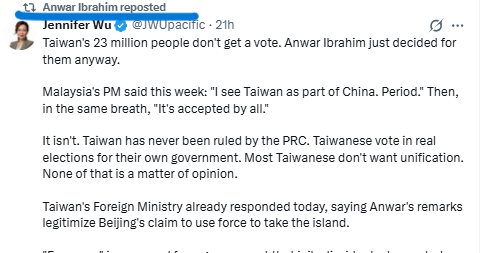
Taiwan's 23 million people don't get a vote. Anwar Ibrahim just decided for them anyway.
Malaysia's PM said this week: "I see Taiwan as part of China. Period." Then, in the same breath, "It's accepted by all."
It isn't. Taiwan has never been ruled by the PRC. Taiwanese vote in real elections for their own government. Most Taiwanese don't want unification. None of that is a matter of opinion.
Taiwan's Foreign Ministry already responded today, saying Anwar's remarks legitimize Beijing's claim to use force to take the island.
"Excesses" is one word for a government that jails dissidents, harvested organs under the last man Xi Jinping just praised, and is actively rehearsing an invasion.
Anwar isn't neutral here. He's laundering Beijing's position as consensus.
Since when does a democracy's leader get to declare another democracy doesn't exist?
Malaysian Prime Minister Anwar Ibrahim:
I see Taiwan as part of China. Period. We may disagree, there are some excesses. Yes, express your view.
It is one China. It’s accepted by all.
China just wrote a law that lets it stop you from leaving the country before you've done anything wrong.
On July 31, Beijing's State Council issued new exit rules taking effect September 15. Border officials can now demand extra documentation on why you're traveling. Provide anything they call false, and you can be barred from entering or leaving the country.
The regulation everyone's flagging: authorities can block a citizen from leaving if they believe the person's conduct "may endanger" China's technological or industrial security. Not that it did. Might.
Exit bans aren't new here. Some civil servants already have to hand their passports to their employers. But a law professor at Singapore Management University put it plainly: this turns the right to leave China into "a privilege granted at the discretion of the state."
The CCP to foreign nationals: Say the wrong thing, and you may never be allowed into China.
The CCP to Chinese nationals: Say the wrong thing, and you may be allowed in—but never out. https://t.co/UiqSB0aYF5
A verdict comes down today for two people whose only crime was organizing a candlelight vigil for the dead.
Lee Cheuk-yan and Chow Hang-tung led Hong Kong's Tiananmen vigil, the only large-scale public memorial for June 4th ever held on Chinese soil. Tens of thousands showed up every year for three decades. Prosecutors want up to 10 years in prison. The charge: inciting subversion, under the national security law Beijing imposed weeks after the vigil was banned.
Their actual crime, according to the state: organizing a vigil whose slogan called for "ending one-party rule."
Chow defended herself in court. Her closing argument was blunt: if a court won't push back on how power is used, it becomes an accomplice to it.
The alliance that ran this vigil already disbanded. Jimmy Lai is already in prison. Dozens of other civil society groups already folded. This case just closes the loop.
Hong Kong promised 50 years of autonomy after 1997. It's taken less than 30 to make remembering a massacre a crime.
https://t.co/sNaWRsk64S
Taiwan just proposed its largest defense budget ever. It's a direct response to a Chinese military drill most people haven't heard of.
Taipei unveiled an 18% defense spending increase for 2027, pushing the budget above $34.5 billion, over 3% of GDP for the first time. Drone spending alone is jumping 91%.
Here's why now. China just ran a joint "navigation exercise" with Indonesia in waters east of Taiwan, the first time Beijing has brought another country's navy into drills near the island. Taiwan read it as pressure, not routine training.
This is the same week Anwar Ibrahim called Taiwan "part of China, period," and Trump moved to scale back joint exercises with South Korea, calling them "hostile" to Kim Jong Un.
Three separate moves. Same message reaching Taipei: the diplomatic cover for Beijing is growing, and the security guarantees Taiwan has relied on are getting shakier in the same breath.
Lai's own line on it: "Investing in defence is investing in peace." Taiwan is the only one in this story acting like that's true.
https://t.co/4FFYYr5gwT
Uganda seized Taiwanese passports at the airport. Demanded Chinese ones instead. Nobody fired a shot.
That happened this month at Entebbe International Airport. It's part of a pattern Beijing calls the "silkworm" strategy: nibble away at Taiwan's mobility before swallowing its recognition whole.
Seychelles, Mauritius, and Madagascar revoked overflight clearance for Taiwan's president in April, forcing his delegation onto a longer route through Eswatini's royal jet just to reach a state visit. Morocco stopped processing Taiwanese visas in July. South Africa is demanding Taiwan relocate its liaison office out of Pretoria entirely.
The mechanism is economic. In February, China offered zero-tariff access to 53 African nations. Every one accepted it except Eswatini, Taiwan's last remaining ally on the continent. The other 52 have been tightening the noose on Taiwanese travelers ever since.
This isn't Beijing invading Taiwan. It's Beijing making the rest of the world act like Taiwan already doesn't exist, one visa stamp at a time.
https://t.co/ZDVUKsmlIr
Beijing said thank you. Taipei called it a betrayal. Anwar picked a side today, again.
China's Foreign Ministry publicly praised Anwar's Taiwan comments this week. Spokesman Lin Jian: "China appreciates the remarks by Prime Minister Anwar."
Taiwan's Foreign Ministry called it different. Pointed out Anwar has spent years branding himself a defender of democracy and human rights, then went out of his way to legitimize Beijing's threat of force against 23 million people who never asked for his opinion.
Today, instead of walking it back, Anwar defended it. He compared China's position on Taiwan to the U.S. refusing to let the Confederacy secede.
That comparison collapses instantly. The Confederacy wasn't a self-governing democracy that had run its own elections for seven decades. Taiwan is.
Anwar isn't confused about the history here. He knows exactly what he said, and he just said it again on purpose.
https://t.co/v0VphMJPcn
T-Mobile's security chief cut Chinese hackers out of its network with a pair of scissors.
Bloomberg reports that in 2024, T-Mobile's cybersecurity team spent months hunting for suspected intruders with no luck. They finally traced unusual activity to a router belonging to another telecom company.
The response wasn't a patch. It was Jeff Simon and three others driving to a Bellevue data center, finding the compromised box, and physically snipping the cable connecting it to the outside world.
The attacker was Salt Typhoon, a Chinese state-backed group that has now compromised at least 200 U.S. companies, including AT&T, Verizon, Viasat, Charter, and Windstream, hunting phone records and communications tied to senior officials and presidential candidates.
T-Mobile got lucky enough to catch this early. Most of the industry didn't.
Cutting a cable shouldn't be state-of-the-art cybersecurity in 2026. It's what you do when everything else already failed.
To stop Chinese hackers from getting into their network T-Mobile techs physically cut cable from a compromised device.
China is running massive cyber attacks against the US. Government officials are obviously the biggest targets but the CCP wants to monitor everyone.
https://t.co/PAllz0wx8K via @techcrunch
A dead man's eulogy got censored in China. Within a day.
Zhu Rongji, China's premier from 1998 to 2003, died last week at 97. State media called him a "loyal Communist fighter." His funeral was kept low-key. No footage released.
An economist named Zhao Jian wrote an essay remembering Zhu's era. Not a protest. Not a manifesto. Just this: people were poor then, but they believed things would get better. The sky was blue. People could say what they actually thought.
WeChat pulled it the next day.
Zhu died days before Xi stood up to commemorate Jiang Zemin, the man who ran China alongside him, and used the moment to praise the Tiananmen crackdown as a "correct decision."
Two reformers, one week, one funeral kept off camera, one eulogy erased. The state isn't mourning the men. It's managing what their deaths might remind people of.
If nostalgia for basic honesty is dangerous to this government, what does that tell you about what it's built since?
https://t.co/FARG5DwGnB
China called it a weather station. Then it built a runway built for fighter jets.
New satellite imagery shows China has reclaimed 1,458 acres at Antelope Reef in the Paracels, nearly matching Mischief Reef, Beijing's largest militarized outpost in the South China Sea.
It isn't civilian infrastructure. Crews are shaping ground that matches the exact width of the runways at Fiery Cross, Subi, and Mischief Reef, the same islands that now host fighter jets, missile systems, and radar. Foundations for aircraft hangars are already going in.
None of that is a matter of opinion.
Vietnam has already protested. Beijing is still calling it a weather station.
Beijing isn't building for weather monitoring. It's building for a war it hasn't started yet.
A weather station doesn't need a 10,000-foot runway. What does?
https://t.co/d7b3qoRQi2
The same cameras that surveil Uyghurs in internment camps are sitting on NATO's missile-defense base.
Hikvision built its global business supplying facial recognition and surveillance systems to camps, mosques, and schools across Xinjiang. The U.S. put it on the Entity List in 2019 specifically for that.
It's also 42% owned by a Chinese state military contractor, separately designated by the U.S. as part of China's military-industrial complex.
It has been confirmed Hikvision cameras running at Deveselu, the Romanian base hosting NATO's Aegis Ashore missile shield. Officials say they're offline. Researchers say that's not the guarantee it sounds like.
It isn't hypothetical either. CISA confirmed Russian state hackers using compromised Hikvision and Dahua cameras, many just cheap consumer units nobody patched, to track arms shipments into Ukraine. At least 13 NATO countries hit in 2025 alone.
One company. Built its fortune profiling a persecuted minority. Now sitting inside the alliance meant to be watching it.
How many of these cameras are on your own network right now?
Taiwan's 23 million people don't get a vote. Anwar Ibrahim just decided for them anyway.
Malaysia's PM said this week: "I see Taiwan as part of China. Period." Then, in the same breath, "It's accepted by all."
It isn't. Taiwan has never been ruled by the PRC. Taiwanese vote in real elections for their own government. Most Taiwanese don't want unification. None of that is a matter of opinion.
Taiwan's Foreign Ministry already responded today, saying Anwar's remarks legitimize Beijing's claim to use force to take the island.
"Excesses" is one word for a government that jails dissidents, harvested organs under the last man Xi Jinping just praised, and is actively rehearsing an invasion.
Anwar isn't neutral here. He's laundering Beijing's position as consensus.
Since when does a democracy's leader get to declare another democracy doesn't exist?
Malaysian Prime Minister Anwar Ibrahim:
I see Taiwan as part of China. Period. We may disagree, there are some excesses. Yes, express your view.
It is one China. It’s accepted by all.
@AndyBxxx I categorically reject that assertion Andy, what was once the aims of an autocratic regime vs what is now a fully democratic thriving nation just looking to maintain their own self determination are two completely different things. But nice try!
Xi Jinping just praised the Tiananmen massacre. On camera. In the Great Hall of the People.
Monday, at Jiang Zemin's 100th birthday commemoration, Xi said that in 1989, during "serious political upheaval," Jiang "resolutely supported and implemented the Central Committee's correct decisions" and "effectively maintained stability in Shanghai."
Translate the euphemism. "Correct decisions" means tanks. "Stability" means bodies.
Jiang rose to power specifically because he crushed dissent in Shanghai while Beijing crushed it with live fire. That's not incidental to his career. It's the reason he had one.
37 years later, that's still the model being held up to "thousands of officials and delegates," politburo included, as the standard to live up to.
The massacre was never a mistake to the CCP. It was a resume line.
What does it tell you that the party still can't say June 4th out loud, but can praise what it did that day?
Xi Jinping just publicly praised the 1989 crackdown.
At Jiang Zemin’s 100th birthday commemorative speech, Xi said Jiang “resolutely supported and implemented the Central Committee’s correct decisions” during the “serious political upheaval” of spring-summer 1989, and kept Shanghai stable.
In CCP language, “correct decisions” = tanks and guns.
37 years later, the man who rose because of 8964 is still being held up as the model.
The taboo remains. The narrative never changed.
#8964 #Tiananmen