@TELUSsupport We need functioning phones in case of emergency. Our Volunteer fire dept cannot even call/receive this is 2nd time this year! This needs to be addressed! @FrankCaputoKTC
@CBCKamloops@TELUS is cutting off residents and volunteer fire depts from emergency aid during #forestfirebc season with known faulty towers and no permanent fix in sight while premium prices being charged. Repeated outages. @FrankCaputoKTC
It’s #forestfire season and @TELUS leaves rural residents without any phone coverage for emergencies for 3rd time this year. Faulty Equipment and zero accountability while premium fees are paid. #vavenbybc
@CBCKamloops@TELUS is cutting off residents and volunteer fire depts from emergency aid during #forestfirebc season with known faulty towers and no permanent fix in sight while premium prices being charged. Repeated outages. @FrankCaputoKTC
It’s #forestfire season and @TELUS leaves rural residents without any phone coverage for emergencies for 3rd time this year. Faulty Equipment and zero accountability while premium fees are paid. #vavenbybc
@GlobalBC@telus is cutting off vital communications during #forestfires in the #norththompson due to known faulty equipment with zero fixes. Residents and volunteer fire dept without service 3rd time this year for days at a time .
It’s #forestfire season and @TELUS leaves rural residents without any phone coverage for emergencies for 3rd time this year. Faulty Equipment and zero accountability while premium fees are paid. #vavenbybc
It’s #forestfire season and @TELUS leaves rural residents without any phone coverage for emergencies for 3rd time this year. Faulty Equipment and zero accountability while premium fees are paid. #vavenbybc
@koodo I am your customer, and Telus is not responding to our reports. I have ZERO service since 5pm yesterday. We lost power - it was back on at 3am, but we still have no cell service. #noservice Can you please report to @TELUSsupport
@TELUSsupport@TELUSsupport Vavenby, B.C. still without cell service even though power is back on since 3am. Our FB group indicates no one in town has cell service, but your website says no outages? We have reported and called in. #noservice
@TELUSsupport@TELUSsupport Vavenby, B.C. still without cell service even though power is back on since 3am. Our FB group indicates no one in town has cell service, but your website says no outages? We have reported and called in. #noservice
@TELUSsupport Your tower in Vavenby BC has been out since the @bchydro power outage. I have reported as you seem to not know of this on your outage map.
@TELUSsupport Yes, I am. I keep reporting, but your website says there are no reported outages. We have likely over 100 of us without service, and everyone who has a landline and who is calling in is told there are no outages. Yes, yes, there are. Can you please get on this?
Anyone else fall for the #BlackFriday SCAM from @Endy ? $570 free sleep bundle with purchase of mattress. But what arrived was cheap polyester crap that is barely worth $100. Endy only sells organic cotton. WTF? ‘Bait and Switch’ buyer beware. Lost customer.
*Share this post widely.
Open letter to, @PierrePoilievre, @LeslynLewis, @MelissaLantsman, @Roman_Baber, @RachaelThomasMP and et al @CPC_HQ - A public response is respectfully requested.
My co-applicant, Karl Harrison & myself, Brian Peckford, Maxime Bernier, Nabil Ben Naoum and 6 million of our fellow Canadians would like to know if at any point you plan to finally stand up in the HoC to speak up and publicly address our landmark lawsuit against Justin Trudeau's heinous and vindictive vaccine travel mandates?
Our ongoing lawsuit is one of the most important legal challenges in recent Canadian history. The Canadian legacy media have been ordered to never report on it, under any circumstances, despite all of the bombshell evidence which was uncovered by our legal teams during the cross examinations of 16 of the government's very own medical experts and senior public health officials, which exposed the Trudeau Government's lies regarding their fabricated reasons/rationales for invoking said mandates.
We are currently potentially facing unprecedented judicial injustice due to the blatant biases and partisanship of our seemingly heavily compromised and skewed so called 'justice system', yet all of you at the CPC continue to hide in the shadows and remain silent on this very serious and important issue, and we'd like to know why?
I would hazard a guess that at least one of you observed the proceedings via Zoom, or at the very least had someone attend on your behalf to watch and report back to you with a summary. If this was in fact the case, your response would be very much appreciated, or at the very least it might act as a show of good faith and acknowledgement to the 6 million Canadians who's lives and livelihoods were heavily impacted and negatively affected by Trudeau's tyrannical, 100% unscientific, and as our evidentiary record cleary demonstrates, nothing more than politically motivated mandates.
You all have an opportunity to do the right thing here and prove once and for all to ALL Canadians that you care and are in fact supportive of fighting for and protecting Canadians charter rights, should you choose to do so.
We await your response - Thank you.
FYI: On Wednesday October 11th, 2023 our lawsuit broke a Canadian record for the largest number of people ever registering to watch a Federal Court of Appeal hearing. The Court Zoom team confirmed that 19,000+ Canadians had registered to watch the hearing live.
SUMMARY OF OUR RECENT HEARING IN THE FEDERAL COURT OF APPEAL IN OTTAWA
Travel Vaccine Mandate Challengers in Court to Contest Previous Mootness Ruling.
"Challengers to the now-repealed travel vaccine mandate pleaded before the Federal Court of Appeal on Oct. 11 to overturn a previous court decision declaring their case was moot.
Four different groups of appellants made their case in front of a panel of three judges, each taking various approaches to challenge the previous ruling made by Justice Jocelyne Gagné in October last year.
Quebec lawyer Nabil Ben Naoum, who represents himself, sought to impress upon the appeal judges what it meant to not be vaccinated during the mandate period from October 2021 to June 2022.
He argued that those who didn’t receive a COVID-19 vaccine were captive within Canada due to planes, trains, and commercial passenger marine vessels being off-limits. The U.S. also blocked access to non-vaccinated travellers at that time.
The only way for unvaccinated Canadians to leave the country was to "paddle in a row boat across the ocean," said Mr. Ben Naoum. He added that this “sub-class” of unvaccinated citizens was akin to Cubans under Fidel Castro.
Mr. Ben Naoum also asked how the government could withhold fundamental human rights, hand them back at the eleventh hour, and then claim the issue is moot and shouldn't be examined by the court.
The federal travel vaccine mandate was lifted on June 20, 2022, and eight days later the attorney general (AG) filed a mootness motion in order for the cases not to be heard by the court.
Justice Gagné essentially agreed with all the arguments presented by the government. She declared that the applicants had “substantially received the remedies sought,” given the mandate had been repealed.
This issue of there being no public interest is an angle that was tackled by the counsels representing other parties in the mandate challenge in order to question Justice Gagné’s ruling. There is therefore “no live controversy to adjudicate,” she wrote. “There is no important public interest or inconsistency in the law that would justify allocating significant judicial resources to hear these moot Applications. ”'Significant' Public Interest
Other parties include businessmen Karl Harrison and Shaun Rickard, who were the first to file a challenge to the mandate in December 2021, PPC Leader Maxime Bernier, and former Newfoundland premier Brian Peckford and co-applicants.
Attorney Sam Presvelos, representing Mr. Harrison and Mr. Rickard, pleaded that Justice Gagné had made three errors in her decision, including that she did not consider the “significant” public interest in the judicial applications.
Justice George Locke, who was presiding the hearing, asked to clarify whether Mr. Presvelos wanted him to accept that Justice Gagné made her ruling without having the public interest in mind. “How could that be?” he asked.
Mr. Presvelos pointed to Justice Gagné’s decision, which said the “important public interest” is “alleged.”
Mr. Presvelos argued that the case is larger than the rights of the appellants or the general public who remained unvaccinated, which numbers in the millions.
He said he believes that Canadians would be “very interested” to know whether or not a medical procedure could be imposed as a condition to access federally regulated services.
Allison Peijovic, a lawyer with the Justice Centre for Constitutional Freedoms representing Mr. Bernier and Mr. Peckford, centred her arguments around jurisprudence on the issue of mootness, established in Borowski v Canada (AG) in 1989.
Challengers want the court to determine whether the imposition of the travel mandate was constitutional, given the impacts on mobility rights and the security of the person as it pertains to bodily autonomy. She argued that Justice Gagné did not fully analyze her clients’ applications against that jurisprudence, which addresses issues of whether a live controversy between parties remains.
Constitutionality
Ms. Peijovic remarked that her client Mr. Peckford is the only living signatory of the Charter of Rights and Freedoms. He attested that the interim orders implementing the mandate violated his charter rights.
Ms. Peijovic said the court must pronounce itself on the matter, otherwise, Canadians remain in “limbo.” If they don’t know where the court stands on the lawfulness of the mandate, she said some are wondering whether they should move out of Canada.
She said the appellants want to know whether their freedom to leave Canada is conditional on taking a novel medication still undergoing testing.
COVID-19 vaccines were brought to market under special authorization without having gone through full clinical trials. Pfizer also used different processes to manufacture the product that was used in clinical trials and the one that was widely distributed across the world.
Justice Canada senior general counsel J. Sanderson Graham assured the Federal Court of Appeal that no errors were made in this case.
Mr. Graham agreed with the appellants’ argument that the government has left open the door to bring back mandates in response to circumstances, but he said the court could not “engage in speculation” or pass judgement on speculation. “We can only look at what happened,” he said, and the measures were repealed.
Because of that, there are no live controversies, said Mr. Graham, and the function of the court is to decide “real disputes” that affect the rights of individuals.
He said that Justice Gagné was right in her interpretation of Borowski and the economy of judicial resources. There is no tangible relief that can be provided to the applicants, he said.
If the panel of judges, which Justices George Locke, Nathalie Goyette, and René Leblanc, sides with the appellants, the case will be sent back down to federal court to be heard. If it upholds the mootness ruling, appellants could decide to go to the Supreme Court.
Appellants want to have their day in court, having collected thousands of pages of evidence from government witnesses and experts, on everything from the approval process for vaccines in Canada to ethical considerations being applied before imposing a mandate.
The evidence collected shows that the Transport Canada official in charge of crafting the travel mandate policy had not considered whether it was ethical to implement it. There was also no recommendation of public health authorities to impose a mandate, said the official during cross-examination."
Noé Chartier
Author
Noé Chartier is a senior reporter with the Canadian edition of The Epoch Times. Twitter:
@NChartierET
#canpoli #onpoli @CTVNews@CP24@CBCNews@globalnews@nationalpost@globeandmail@TheTorontoSun@Harry__Faulkner@brianlilley@CityNewsTO
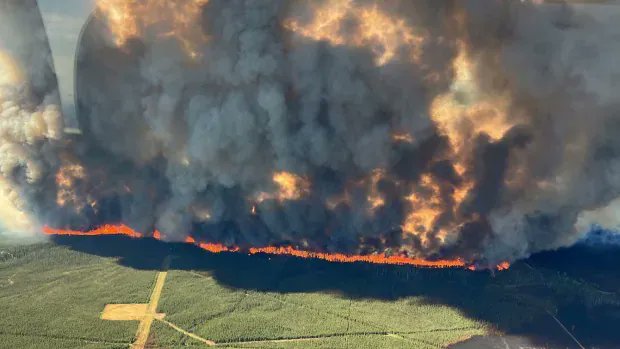
It's been a trying few days for our nation, hasn't it, Canada? And no, I'm not just talking about the wildfires. Those are truly devastating, and my thoughts are with the displaced families. But, amidst this chaos, I've come across some rather concerning rhetoric. Scan through social media, and suddenly, there's this crescendo about the "Climate crisis" and how these wildfires are direct offspring of this crisis. When you delve a bit deeper, you realize there’s an underlying agenda. The powers-that-be are subtly suggesting that handing them the reins is the solution. That they, namely Justin Trudeau and Chrystia Freeland, are our last hope to salvage this planet.
Funny, isn't it? This is the same government that has often faltered, and now they're pitching their newfound competence to tackle the global "climate crisis"? It's laughable.
Oh, and please, spare me.
I’ve made this point before, and I’ll reiterate: As long as Canada continues its dance of exporting coal and indulging in a merry import fiesta with China, I’m not buying this high-and-mighty stance the feds are taking. Their impassioned speeches, filled with hyperbolic rhetoric and dripping with self-righteous indignation. Their sanctimonious outcry? Pure poppycock
But before we dive deep into the numbers, and trust me, they're revealing, let's take a step back and see the bigger picture. While Canada's leaders revel in theatrical displays of concern, Mother Nature, it seems, has been busy painting a canvas of her own. And as we'll see, the strokes of her brush are vast, unrelenting, and leave little room for political spin.
Here's something that'll really make you raise an eyebrow. In our current age, where we're awash in a tide of misinformation and conveniently cherry-picked statistics, I'm about to arm you with some raw, unvarnished numbers. In 2023, up to this point, British Columbia has seen a jaw-dropping 1,610,260 hectares devoured by wildfires. Now, here's where it gets interesting. A chorus of voices from the left - yes, the very same folks proudly waving their Ukraine flags out of one window and, bewilderingly, wearing masks alone in their cars out of the other - are telling you this is unparalleled.
Let's get down to the bare facts, the raw data, and break through the smokescreen. For those who dare twist the narrative, allow me to present the stark, undistorted numbers for the fires in British Columbia over the last decade:
In 2022, we had a total of 1,801 fires scorching 135,235 hectares, costing taxpayers an estimated $411.9 million. Human activity caused 578 of these, while nature, through lightning, was responsible for 1,200.
2018 and 2017 are particularly troubling years. In 2018, fires raged across a colossal 1,354,284 hectares, with a cost of $615 million. 2017 wasn't much better, with 1,216,053 hectares burned at a whopping cost of $649 million. Shockingly, a considerable chunk of these fires, in both years, was human-induced, reminding us of our role in these disasters.
I could go on, year by year, highlighting the persistent and rising issue. 2019 saw 825 fires, 2020 had 670, 2021 witnessed 1,647, and so forth. But what's glaringly clear, my friends, is this: fire incidents, the hectares they consume, and the subsequent costs are not just numbers on a page. They represent real threats, real loss, and tangible evidence of both nature's fury and, sadly, human negligence.
So the next time someone tries to spin you a narrative based on selectively presented data, you arm yourself with these facts, and ask yourself, "What's really going on, and who's truly responsible?" speaks for itself.
Now, as we sit here in the midst of media hype and public concern over wildfires, it's worth taking a moment to remind ourselves that wildfires are, in fact, nothing new. We've seen them throughout history, and some on scales you might not even believe.
Let's go back to the summer and early fall of 1950. There was a fire known by many names - the Chinchaga fire, the Wisp fire, Chinchaga River fire, and simply Fire 19. This particular blaze scorched an astonishing area of between 1,400,000 hectares and 1,700,000 hectares. To put it in perspective for you: that's up to 4,200,000 acres. For those keeping track, it remains the single largest recorded fire in North American history.
What's more interesting? This massive fire produced a colossal smoke cloud, known as the "1950 Great Smoke Pall", that was seen across not just eastern North America, but even Europe.
This wasn't just another forest fire, my friends. The Chinchaga firestorm is documented as the biggest firestorm in North American history. It produced the world's largest smoke layer in our atmosphere.
So the next time someone tells you that wildfires are an unprecedented catastrophe, remind them of the Chinchaga. History has its way of repeating, and it’s crucial that we remember it accurately.
In recounting such historic fires like the Chinchaga, it becomes clear that our environment has been tried and tested by Mother Nature's fury time and time again. But what makes the present situation alarming isn't just the magnitude of past wildfires. The current forest conditions, coupled with certain policies and natural disturbances, have primed our lands to be even more susceptible to catastrophic events. As we delve into recent reports, this looming threat becomes evident.
In the carefully worded 2003 BC wildfire report, a glaring and fundamental issue leaps off the page: the relentless buildup of forest fuel. It paints a picture of our forests becoming densely packed tinderboxes, brimming with combustibles. This accumulation, ladies and gentlemen, doesn't just make a fire likely; it makes it ferocious, uncontrollable, and alarmingly threatening to homes, communities, and the very fabric of our daily lives. What's more, this alarming fuel buildup, according to the report, is making it a Herculean task to even give communities a heads-up about the imminent fire dangers they face. And, as if the situation wasn't dire enough, enter the Mountain Pine Beetle, wreaking havoc and leaving behind decimated forests that, believe it or not, didn't even burn in 2003.
In a study foreshadowing the devastating wildfires that have engulfed British Columbia in 2023, researchers Talucci, Meigs, Knudby, and Krawchuk shed light on the intricate relationship between bark beetle outbreaks and wildfires, two primary forces shaping North American forests. Conducted in the subboreal forests of central interior British Columbia, the research examined how mountain pine beetle outbreaks amplify the ferocity of wildfires. Through meticulous analysis of three significant fires from 2012 to 2014, advanced satellite imagery and field observations unveiled vast expanses of land dominated by a lethal combination of dead vegetation, remnants of pine beetle devastation, intertwined with resilient live vegetation. This mix has proven to be a powder keg for high-intensity fires. Although climate factors like drought play a pivotal role, it's this interplay of dead beetle-afflicted trees with living counterparts that stands out as a crucial catalyst for these ferocious blazes. Alarmingly, the legacy of the bark beetle, as underscored by this research, will reverberate in our forests for decades to come, altering not only our natural landscapes but the very socio-ecological fabric of our communities. The poignant revelation here isn't merely about the trees we've lost, but the volatile fuel matrix left in their wake. With wildfires continuing to ravage these compromised terrains, understanding and confronting this dual peril is paramount.
To my loyal readers, I must pose a question: If Prime Minister Justin Trudeau and his Liberal colleagues truly harbor deep concerns over climate change, then why, may I ask, are there no evident preparations in place? Our forest management, which stands as the first line of defense against escalating wildfire threats, remains chronically underfunded. If we are genuinely preparing for a climate-induced calamity, why haven't we significantly fortified our firefighting capabilities? Why do we persist in exporting coal, even as we champion green energy initiatives? Why are we still engaging in massive imports from China, the globe's primary greenhouse gas emitter?
The underlying reason is painfully evident: we're dealing with a leadership vacuum. It's all too easy to fan the flames of fear, sow division, and embark on spending sprees. But, when the smoke clears, we're left with the chilling realization that our safety hasn't been fortified — all thanks to their glaring inefficacy. Rather than incessantly sounding the alarm on climate change, perhaps it's high time we prioritized proactive and tangible solutions to address impending disasters.
Wrapping things up, dear readers, let's be absolutely straightforward: If a "carbon" tax were the magic bullet to halt the climatic catastrophe, British Columbia would have been disaster-free long ago. But here we are. As 2025 approaches, perhaps it's time we transition from passive concern to active preparation. Now, I understand that "proactive forest management" doesn't have the same gripping allure as a dramatic headline like "Climate Apocalypse Imminent!" But it's high time we prioritize pragmatic, grounded strategies over sensationalized rhetoric.
#cdnpoli
@ChrisWickNews Since I can see your love for Canadian politicians shining through every tweet - 😁 Have you heard of how @BC_Housing is funding slumlords, evicting the most vulnerable and forcing people to live in partially demolished, mould-filled homes? https://t.co/YNvmlFGn8S