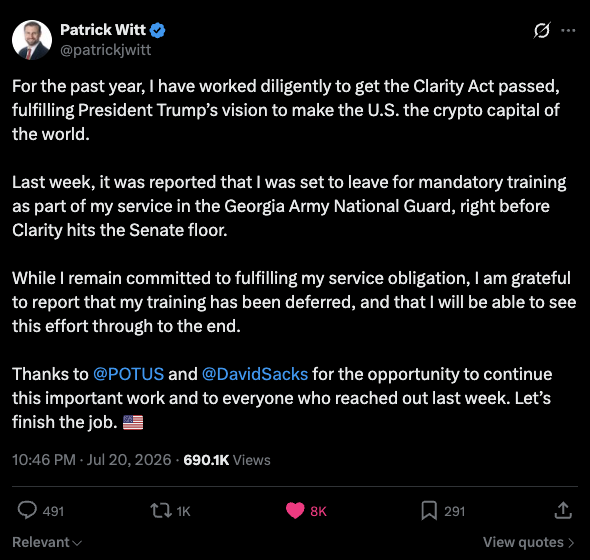
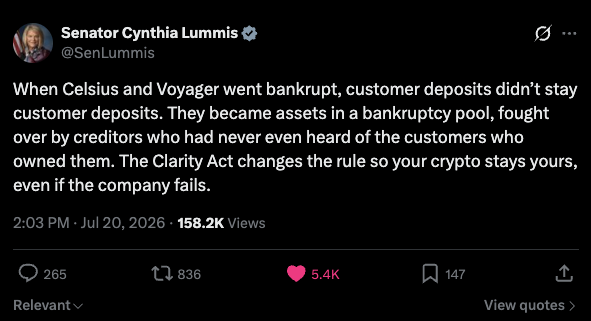
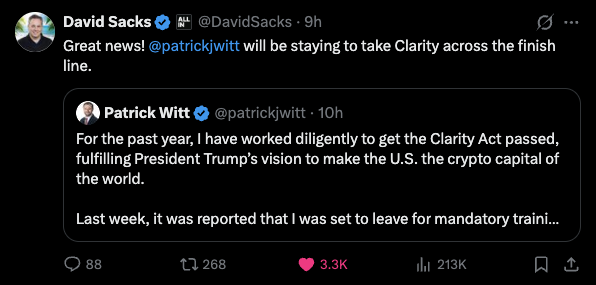
The Senate has had CLARITY for a year.
Since then, lawmakers have negotiated hundreds of pages of changes, reached agreement on SEC and CFTC nominations, and secured unprecedented ethics commitments. The crypto and banking industry have compromised as well.
That’s how legislation is supposed to work. No one gets everything. Everyone gets most of what they need.
At this point, the only thing left isn’t negotiation—it's whether some group will try to stall or block legislation that already has broad bipartisan support.
Millions of Americans own crypto and are watching. It’s time to call the vote.
16 things that will be normal in 3 years and sound insane today
1. Somebody's entire job is making sure your agents don't do dumb things.
2. Kids grow up assuming any adult who types is old, the way we assume anyone who prints emails is old.
3. You get an itemized bill for what your agents bought last month and it reads like an expense report from a small company.
4. Someone you've never met sells you a business that runs itself, and you never learn what the code does.
5. Your doctor's first opinion comes from a model, and the human's job is deciding whether to trust it.
6. Job posts will say "must be able to manage agents" the same way they used to say "proficient in Excel."
7. The best-paid person at a company will be whoever's best at explaining the business to machines.
8. Your company has more agents than employees, and HR manages both.
9. Companies start hiding how few employees they have, because a lean team reads as fragile to enterprise buyers.
10. Your calendar fills with meetings you didn't schedule, because your agent and their agent worked it out.
11. The CV dies and gets replaced by a body of work an agent can verify in 4 seconds.
12. You interview an agent before you hire it. Give it a fake task, watch how it handles the weird cases, then decide.
13. Losing your job means losing your agents too, and it's kinda scary losing your best agents.
14. "Made by a person" becomes a label on products, and there's a certification body for it.
15. You'll have a folder of agents the way you have a folder of apps
16. Getting a human on the phone becomes a paid tier, and people gladly pay it.
Capitalism is a powerful force for good. It benefits everyone, especially those who lean in and help build the future.
But it’s under attack (again). Wealth taxes, price controls, government-run grocery stores, asset seizures. Fear is being used as a political lever and an excuse for control. I’ve seen this play out before, it leads nowhere good.
I lived in Buenos Aires in 2008 when the Argentine government seized $30B in private pensions to ‘protect’ citizens from the financial crisis. Then they froze access to the dollar and nationalized companies. Within a decade, inflation was over 50%. The elites had miraculously moved their money, leaving regular people to take the financial hit.
Politicians are selling collectivism out of the same playbook used by Argentina, Venezuela, and the former Soviet Union: promise protection, concentrate power, tighten the fist. And the costs fall on the poorest people in society who are unable to protect themselves.
Capitalism isn't perfect. But it’s far better than every alternative that’s been tried. Millions of people making independent decisions, with the free market rewarding the best ideas, will out-build any central planner.
If you're wondering why the market is green today:
The ethics clause on the CLARITY Act appears to be resolved.
That single provision, the conflict-of-interest rule around government officials' crypto holdings, is what held this entire bill hostage for months. Democrats pushed hard for it while Trump kept filling his bags with one crypto scheme after another and dumping on retail.
But it now seems like real progress has finally been made, with the White House reportedly conceding to language described as "more aggressive than anything seen before."
Next up: a Senate floor vote before Congress leaves for August recess on Aug 7th.
Why this is arguably the single biggest catalyst crypto and especially alts have right now (and maybe ever had):
CLARITY ends the decade-long jurisdictional war between the SEC and CFTC and permanently codifies which assets are commodities into federal law. No future administration can undo it with a memo. It replaces a decade of "regulation by enforcement" with actual written rules.
What that unlocks:
Institutional capital that has been stuck on the sidelines. Pension funds, sovereign wealth funds and the largest asset managers can't hold unclassified assets for compliance reasons. Remove that barrier and they can finally allocate using the exact same frameworks they use for equities and bonds.
JPMorgan itself literally called this the trigger that opens the floodgates.
On top of that, we get real developer protection, which means more innovation from talent that finally isn't scared away anymore.
And real user protection, with rules that would have made any FTX-like collapse structurally impossible. The same kind of collapse we're still suffering from reputationally to this day.
And here's the tell: look how much the market moved on just a small procedural win like this. Now imagine what happens when the whole thing actually passes.
For reference, when the GENIUS Act was signed last July, total crypto market cap crossed $4 trillion for the first time.
CLARITY is bigger. Much bigger.
When starting a company, most people shy away from truly hard problems and go for base hits thinking it will be easier.
The opposite is true. Fewer people attempt the hard problems so there is less competition, and great people are more likely to join you on an impactful mission. Instead, start with something you feel in your bones must be possible or different in the world, even if it's not a business.
Then work backwards from there toward what steps will be required, and see how you can get your first dollar of revenue on an early step which enables the broader vision.
BREAKING: 🇪🇺 EU plans to require passport for internet access 🚨
Agenda: block VPNs to enforce it.
"The new age verification system cannot be bypassed via VPN."
A digital passport. For the internet.
Enforced by blocking the tools that protect your privacy.
This is what the trajectory looks like.
Cash banned above €10,000.
Bitcoin requires ID above €1,000.
MICA, DAC8 and travel rule for mass surveillance.
BREAKING:
The EU is planning to require a passport to access the internet.
And they want to block VPNs to enforce it.
"The new age verification system cannot be bypassed via VPN."
Read that again.
A digital passport. For the internet.
Enforced by blocking the tools that protect your privacy.
This is what the trajectory looks like.
- Cash banned above €10,000.
- Bitcoin requires ID above €1,000.
- Privacy coins banned.
- MiCA eliminating 90% of crypto firms.
And now internet access tied to your identity.
With VPN circumvention specifically blocked.
Every layer of digital privacy.
Being dismantled one regulation at a time.
While America debates zero capital gains on Bitcoin.
Europe is building a system where every click, every transaction, every website visit.
Is tied to your passport.
This is not consumer protection.
This is digital authoritarianism.
And they're not hiding it anymore.
If the socialists had their way, Elon would have had his paypal profits taken and redistributed for the greater good.
The world would never have seen Tesla, nor SpaceX.
And the world wouldn't know it, because they were uncreated, and thus unseen.
Imagine the companies that don't exist, because Washington destroyed them before they were born.
The K-shaped economy is playing out in real-time.
If you're not on the right side of it, I'd be very worried.
AI is splitting every industry into two camps:
a) People who are genuinely great at their craft are becoming exponentially more valuable.
b) People who were average are becoming virtually worthless overnight.
Anyone can build a website in 10 minutes with AI now.
If you were a mediocre web designer, you're done.
Anyone can write decent copy with Claude.
If you were an average copywriter, the market doesn't need you anymore.
But here's the other side of the K-shape:
The truly great web designer is now 10x more productive and commands higher rates than ever.
The elite copywriter who uses AI to strategize, think, and come up with great ideas is now worth more than ever.
The uncomfortable question to ask yourself:
Am I genuinely great at what I do - or was I just good enough to get by?
Because "good enough" no longer has a market.
The window to move from the bottom of the K to the top is still open.
But it won't be forever.
"Where do you set your stops?"
Everyone seems to be looking for the perfect, clean answer to this question...but i have to say first that markets are so messy. Nothing is just "oh stoploss at 10% every time!"... like it doesn't work like that.
It's fluid and highly nuanced. So many variables. Your risk. Vehicle. Volatility. Time horizon. Level of conviction. Size. Market conditions. Desired reward. I could go on forever.
Your exact stoploss style is unique to YOU as a human being...your personality + experience, gut feel, intuition.
The real questions that matter when setting stops are:
- will I respect it if it gets hit?
- will I be mentally fine if it gets hit?
- am I sizing appropriately for this stop distance?
^ bookmark + ask yourselves those before trades.
Other stuff is kinda noise + you'll learn as you go.
Before the internet, your access to information was your local library or university. Now, everyone in the world gets the same wikipedia and google.
Crypto's promise is to do the same thing for finance. Instead of having to take your local bank's rate, you should be able to borrow from or lend at the best global rates. Instead of taking your local broker's coverage set as the constraint set, you should get access to global opportunities.
The value prop is clear; time to grow.
Fun fact of the day:
If you don't think inflation has been the biggest problem in the world over the last century, you have been miseducated by people who get paid by inflation.
Zcash pumped and now Near, Venice, Railgun, et al. are in a race to build the mostly widely adopted privacy tools and protocols. For a moment really enjoy this return to cypherpunk roots, it’s nice to actually be rooting for everybody for once
Different categories of tokenized assets have scaled at very different rates.
Asset-backed credit hit $1 billion in market cap in just 185 days. Specialty finance crossed the same threshold in under two years.
At the other end of the spectrum, venture capital took more than seven years to reach $1 billion, while active strategies took nearly as long.
More complex structures with longer time horizons take more time.
Happy Bitcoin Pizza Day! 🍕
In celebration, we are giving away 10,000 $S to one lucky winner.
To enter, you must:
- RT this post
- Comment your favorite pizza order
Winner will be announced in 24 hours.
Goodluck!