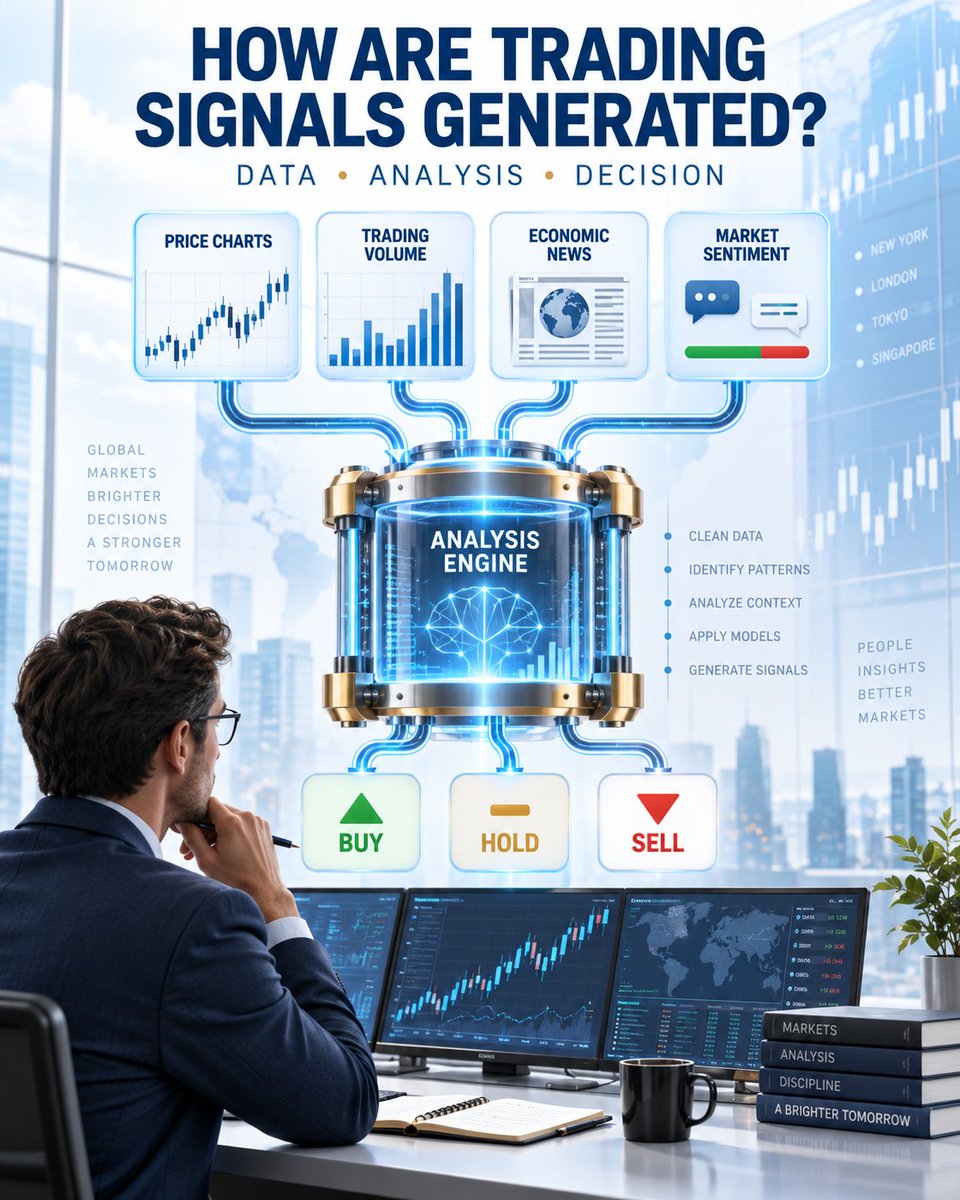
Launching a model does not end the research. Live results must be checked for signal decay, data drift, higher costs and new risk exposures. Markets evolve; monitoring keeps the strategy accountable. https://t.co/yfpIBAbtPi #QuantFinance
A signal without risk controls is incomplete. Before acting, define the timeframe, position size, stop level and maximum portfolio exposure. Signals can support decisions, but uncertainty never disappears. https://t.co/yfpIBAbtPi #RiskManagement#Trading
Paper alpha can disappear after commissions, spreads, market impact, financing and short-borrow fees. The faster a strategy trades, the harder those costs can bite. The result that matters is net, executable and risk-adjusted. https://t.co/yfpIBAbtPi #Trading
Market direction isn’t the only source of opportunity. A market-neutral strategy focuses on whether selected long positions outperform selected shorts—even when both rise or fall together. Explore the relative-value logic: https://t.co/yfpIBAbtPi #QuantFinance
Pairs trading assumes a relative-price relationship will recover. Mergers, regulation or business changes can create a new equilibrium instead. The critical skill is recognizing when divergence is structural. https://t.co/yfpIBAbtPi #StatisticalArbitrage#TradingRisk
Momentum can fail violently when yesterday’s losers rebound and crowded positions unwind. Volatility scaling, diversification and exposure limits matter as much as the signal. Read more: https://t.co/yfpIBAbtPi #RiskManagement
Pairs trading is not simply buying one correlated asset and selling another. The long-term relationship must remain stable, the spread must be testable, and execution costs must leave room for return. https://t.co/yfpIBAbtPi #MeanReversion
A small statistical edge can disappear after spreads, slippage, borrowing fees and market impact. In Stat Arb, execution quality and realistic cost assumptions can matter as much as the signal itself. https://t.co/yfpIBAbtPi #AlgoTrading
Factor investing sits between traditional active and passive approaches: rules-based, transparent and intentionally tilted toward selected stock characteristics. Understand the framework, limitations and risks: https://t.co/yfpIBAbtPi #PortfolioStrategy
A strong backtest is only the beginning. A strategy must survive costs, slippage, changing market regimes, and live monitoring. Sustainable quant trading depends on process—not one secret indicator.
https://t.co/yfpIBAbtPi
#AlgorithmicTrading#RiskManagement
Backtests are only the beginning. Real systematic trading must account for costs, slippage, liquidity, execution quality and model drift—then compare live results with expectations.
https://t.co/yfpIBAbtPi
#AlgorithmicTrading#Fintech
From portfolio construction to credit risk, quantitative models help financial institutions compare scenarios before committing capital. Their real value is not certainty, but structured decision-making. https://t.co/yfpIBAbtPi #FinancialModels#Investment
AI is expanding quantitative finance by analyzing larger datasets, extracting signals from financial text, and updating forecasts faster.
But explainability, governance, and human approval remain essential.
https://t.co/yfpIBAbtPi
#AIinFinance#KAELAI
AI can scan markets and generate signals at speed, but complexity does not equal certainty. Market shifts, weak data and execution delays can change the result. Independent analysis remains essential.
https://t.co/yfpIBAbtPi
#AITrading#FinancialMarkets
The future of financial AI depends on more than autonomy.
Reliable data, limited permissions, human review and complete audit trails will determine whether AI agents become trusted infrastructure or remain experiments.
https://t.co/yfpIBAbtPi
#ResponsibleAI#FinTech
AI autonomy needs enforceable boundaries. Protect agent memory, restrict tools, use short-lived credentials and keep complete audit trails. High-impact or irreversible actions should always require human approval.
https://t.co/yfpIBAbtPi
#AIGovernance#ResponsibleAI
A trustworthy AI agent should show what data it used, which rules applied, and why it acted. Traceable decisions, continuous evaluation, and human override turn automation into a dependable risk management capability.
https://t.co/yfpIBAbtPi
#EnterpriseAI#RiskIntelligence
The future of financial research is not AI versus analysts.
It is AI handling high-volume search, comparison, and monitoring—while people remain responsible for interpretation, risk assessment, and decisions.
https://t.co/yfpIBAbtPi
#FinancialMarkets#AgenticAI
The most capable AI agent is not the one with the most tools. It is the one that selects the right tool, uses it safely, checks the outcome, and knows when to stop for human review.
https://t.co/yfpIBAbtPi
#ResponsibleAI#Automation
The more an AI agent remembers, the more governance matters. Access controls, retention limits, updates, and deletion rights turn memory from a technical feature into a trustworthy enterprise capability.
https://t.co/yfpIBAbtPi
#ResponsibleAI#AgenticAI