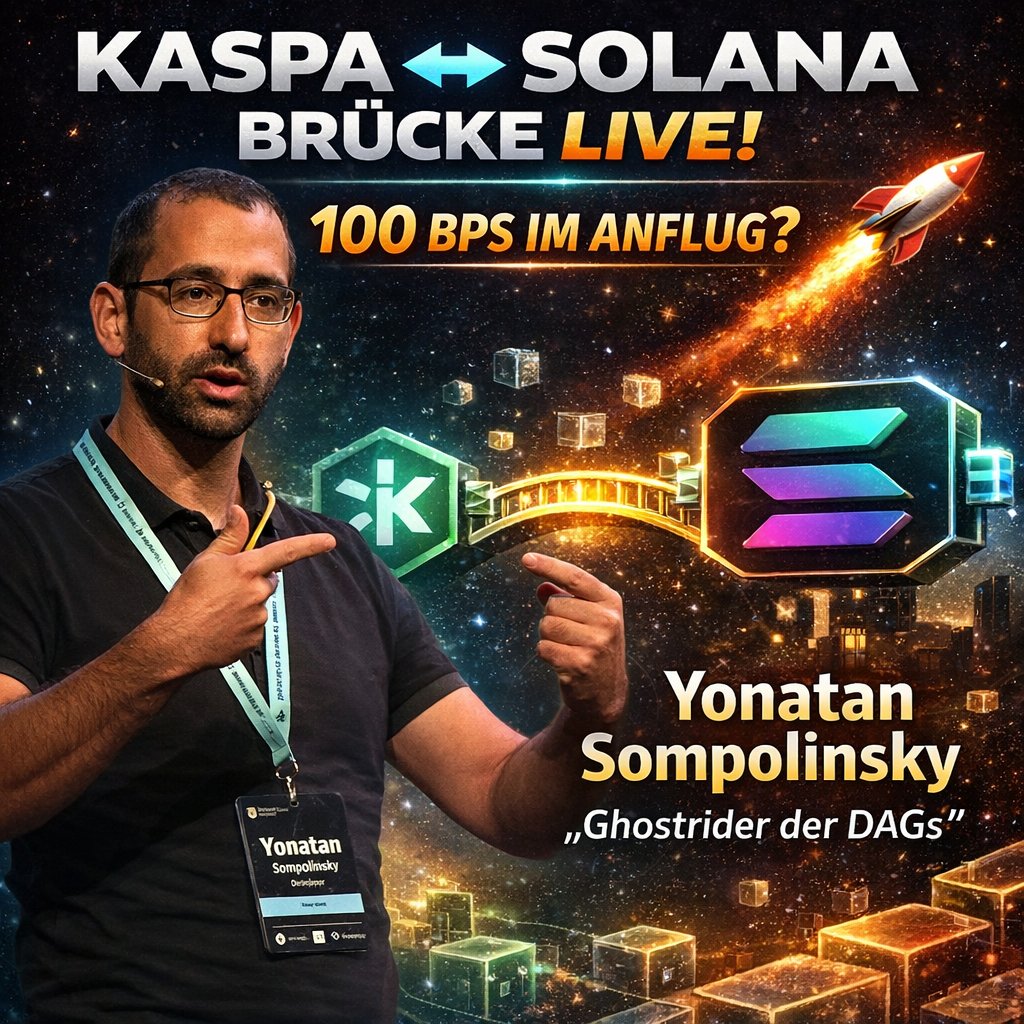
KASPA eskaliert – Brigde zu SOL & 100 BPS im Anflug!
#Kaspa verbindet sich mit #Solana.
Liquidität + Ökosystem Möglichkeiten!
Die erste $KAS ↔️ $SOL Bridge ist offiziell LIVE – powered by @dymension.
Doch das ist erst der Anfang…
Ist Yonatan Sompolinsky verrückt geworden?
Der „Ghostrider der DAGs“ peilt mit Kaspa 100 Blöcke pro Sekunde (BPS) an.
Was viele für technisch unmöglich hielten, soll Q3 2026 Realität werden!
Mit der finalen #DAGKnight Mainnet Implementierung!
Warum 100 BPS alles verändert:
< 1 Sekunde Einbindung
Kein „pending“ mehr.
Fast Echtzeit Transaktionen.
Durchsatz auf Visa-Niveau
TradFi-Speed, ohne zentrale Gatekeeper.
Proof of Work neu definiert
PoW muss nicht langsam sein!
Kaspa zeigt: Hochfrequent + sicher + dezentral ist möglich.
Roadmap Update von @hashdag:
25–40 BPS bis Q3 2026.
100 BPS im Blick bis 2027.
1 BPS = Warm-up.
10 BPS = Proof of concept.
100 BPS = Gamechanger.
„Das Ziel ist es, die physikalischen Grenzen der Internettopologie zu erreichen.“
Genial oder Wahnsinn?
In dieser Branche gewinnt meist der, der „verrückt“ genug ist, Konsens neu zu denken.
#KAS baut. Schritt für Schritt.
Und jetzt auch mit direkter Brücke zu #SOL.
Die nächsten 18 Monate werden spannend. 👀
Mr. @hashdag is a true legend. No noise, just action and responsibility when it counts.
I trust his vision, but my conviction in $KAS is even bigger.
There will come a time when the crypto world depends on $Kas. Bookmark it.
In his recent talk, @hashdag articulated a comprehensive vision for Kaspa that goes beyond throughput metrics. He moved past technical specifications to define a core thesis: How Kaspa becomes true "Internet Money."
Currently, most blockchains operate as isolated mathematical silos, decoupled from off-chain reality. Here is a technical breakdown of the talk's key points.
1/ Breaking the Isolation: Internal Validity vs. External Reality
Current blockchains optimize strictly for internal cryptographic correctness but lack awareness of external context. Yonatan argues that to function as genuine Internet Money, the protocol must interact trustlessly with real-world events. For instance, upon significant market news (e.g., equity index changes), the chain must be capable of ingesting and reacting to that data immediately.
2/ The Latency Constraint of Nakamoto Consensus
Consider a high-velocity financial event (e.g., MicroStrategy’s inclusion in an index) that impacts asset valuation instantly. On Bitcoin, achieving probabilistic finality for a reactive transaction takes ~60 minutes. In the context of high-frequency internet finance, this latency is prohibitive. Kaspa aims to compress consensus and state reaction times to the moment the event occurs—effectively, a single Internet Round Trip Time (RTT).
3/ 100 BPS as a Statistical Security Parameter
High block rates are not merely for throughput; they provide statistical certainty.
Think of it as majority sampling:
• 10 samples (blocks) per second leaves a non-negligible margin for minority variance or manipulation.
• 100 samples (blocks) per second drives the probability of sampling the honest majority to ~100%.
High BPS enables rapid convergence, making the system resistant to tampering through granular, high-frequency sampling.
4/ High-Definition PoW: The Technical Moat
While PoS is often touted as the modern standard, Yonatan asserts that only Proof-of-Work (PoW) allows for the unforgeable, granular sampling of the honest majority in real-time without susceptibility to manipulation. This capability—High-Definition PoW—is a unique technical moat of the DAG structure that other consensus mechanisms cannot natively replicate.
5/ Future Utility: Native L1 Atomicity & Logic Execution
This architecture transforms miners into decentralized attestors of external state. It enables conditional transaction execution ("If Event A, then Action B") with zero-latency atomicity directly on Layer 1. This eliminates reliance on centralized exchanges or asynchronous bridges, allowing for instantaneous, trustless financial reactions.
6/ MEV Auctions for Execution Safety
To prevent miners from front-running transactions based on privileged knowledge of external events, the system proposes embedding MEV auctions. This mechanism ensures fair transaction sequencing via open bidding, protecting user intent and delegated strategies from exploitation by the consensus layer.
7/ Conclusion: The Nervous System of Value
Kaspa is not merely architecting a "faster Bitcoin." It is designing a reactive settlement layer—a nervous system—capable of synchronizing with physical reality and executing financial logic instantly. This defines the thesis of "Real-Time Decentralization" (RTD), the prerequisite for a true Internet of Value.
$KAS #Kaspa #Layer1 #PoW #DeFi #BlockchainArchitecture #MEV
@binance,
Thanks for including me in the top 100 blockchain people list, appreciate the signal!
I must decline the Dubai invite though. I do not wish to disrespect, but many of the award voters are avid kaspians who rooted for my kaspa status at least as much as for my research. Let them win or count me out.
Crypto has turned from a euphoric cypherpunk project to a house-friendly casino. You may not be the culprit, but as a top player you hold the lion’s share of the responsibility to correct this, and the October crash your USDe oracle glitch helped trigger adds to what needs to be addressed.
There are three classes of crypto, as @mert put it recently: commercial crypto, casino crypto, cypherpunk crypto. <<Binance should hold a privilege policy for the latter.>> A TBTF CEX should know better and play a different game with hardcore crypto projects.
When binance lists a green frog three weeks post its “launch” but skips a fair-launched-Nakamoto-Consensus-100ms-upgrade-ATH-top-20-the-only-nonbitcoin-marathon-mined project, this is not merely binance rationally calculating; it is also binance molding the market in a way that is alas misaligned with the roots of the movement.
You may feel that kaspa’s sovereign money thesis is boring – that bitcoin is already money and that implementing an internet-speed bitcoin is useless - fine. Wrong but fine. But what’s the thesis for the green frog?
Money is a classic chicken-and-egg product. It is a scam up until one moment before tipping point, “most of the value comes from the value that others place in it.” Considering your resources and influence, I think it's safe to say you can serve as both the egg and the chicken and make it worth your while to push sound attempts towards tipping point.
@cz_binance tweeted recently that “strong projects will be listed.” But binance is part of what defines "strong", it bears responsibility for the market’s compass and impulse and definition of strong. It is not a read-only entity.
Binance listing fees are legit, they are just unfit for category cypherpunk. Kaspa devs and early supporters fairly mined less than half what satoshi and hals mined. We don’t have a 20% ZEC-style founders’ reward or protocol-enforced dev fund; this is not a jab at ZEC and the wonderful @Zooko, who was crashing in my car on a late Thursday back in the low ZEC MC days – if somebody deserves to win it is zooko – but assuming binance is not taking a maxi bet, it should revisit its relationship with hardcore crypto.
We are here through bull and bear, ICOs NFTs XYZs; and we are the source of confidence that restores faith and capital inflow post meme-induced or CEX-induced crashes.
Please fix this.
Thanks again,
hashdag
cc @michaelsuttonil
Exhibit A: Binance Innovation Zone
Exhibit B: 10 bps Nakamoto Consensus
🚨 BREAKING: IS A $KAS LISTING ON https://t.co/UlCkV2S09k IMMINENT? ⚡️
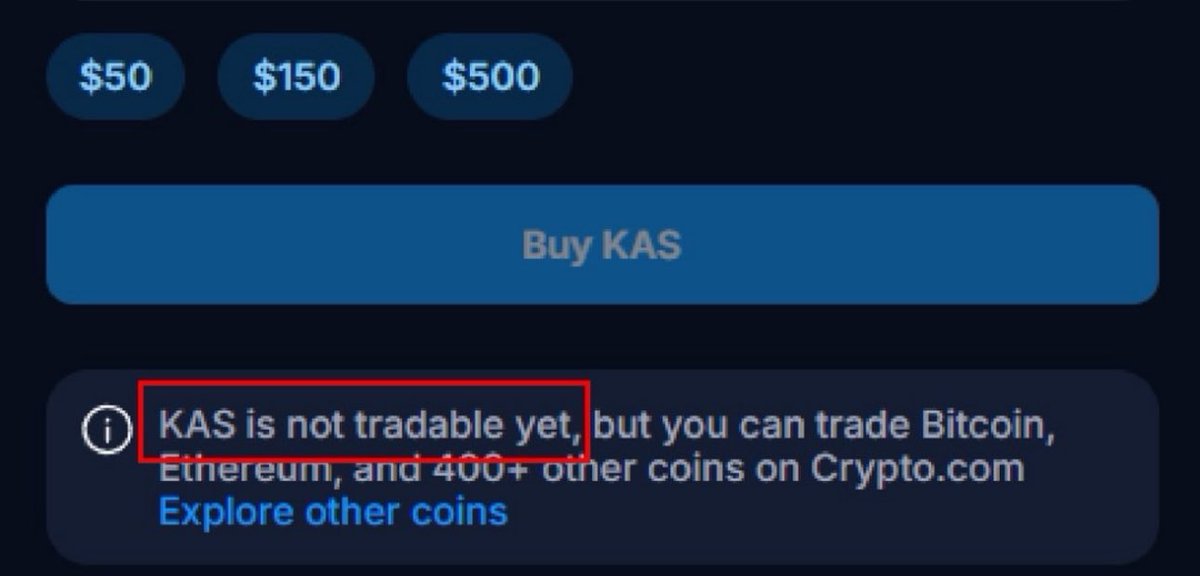
👀 Kaspa ($KAS) taucht jetzt sichtbar in der https://t.co/wWoQ4UOutj App auf –
mit Kursanzeige, aber (noch) der Hinweis:
“KAS is not tradable yet.”
Das müsste bedeuteten:
💡 Der Coin ist bereits im System integriert, aber der Handel noch deaktiviert.
Und wer die Plattform kennt, weiß – so etwas passiert nicht zufällig.
🔥 Sobald der Schalter umgelegt wird, dürfte ein massiver Zufluss an neuem Kapital folgen.
Denn: Millionen Nutzer sehen $KAS jetzt schon in ihrer App!
Kaspa war nie ein „gekauftes Listing“.
Kein VC, kein Pre-Mine, kein Insider-Deal.
Nur Proof of Work. Reale Nachfrage. Reale Adoption.
Und jetzt?
Der nächste Dominostein steht bereit. 🚀
Was denkt ihr — Soft Launch oder Countdown zum Listing? 👇
#Kaspa #KAS #Crypto #CryptoNews #Listing #ProofOfWork #CryptoCom #CCA #CashClubAcademy
MARA announces they’re mining $KAS…
6 months later, “Kaspa” vanishes from their balance sheet, replaced with “other digital currencies.”
Then suddenly? Zero holdings! Nothing! Silence!
Not a single mention of $KAS again.
Fast forward to last month, boom, they’re now holding a “substantial” amount of “other digital currencies.”
Oh really?
1. You seriously don’t think that’s $KAS?
2. Why the disappearing act? Why hide it?
3. Who told them to shut up about Kaspa?
Feels like someone doesn’t want you to know what’s coming.
Stay sharp. 🧠👀
🚨 JUST IN: #Kaspa Smart Contracts Launching August 31 via @kasplex L2 Mainnet
Kaspa is set to activate smart contracts with the launch of the Kasplex Layer 2 mainnet on August 31. This upgrade brings new utility to the $KAS ecosystem, enabling decentralized apps and expanding network capabilities.
Kasplex Testnet progress update
We're excited to share that our L2 testnet is approaching a significant milestone of 1.5 million blocks today.
Our L2 generates blocks immediately upon detecting transactions in the L1 txs payload, demonstrating the efficiency of our integration with $KAS infrastructure.
With an average of 4 txs/block, we estimate approximately 6 million transactions have already been processed on the L2 network.
This volume provides valuable insights into our system's performance under realistic conditions.
Current testnet status:
- The network is running stable with daily upgrades being deployed seamlessly. Our team has identified no critical showstoppers that would prevent L2 deployment on Kaspa mainnet.
- We're currently in the fine-tuning phase, optimizing performance parameters and ensuring maximum reliability.
- The consistent stability and throughput we're observing validates our technical approach and brings us closer to mainnet deployment.
We continue to monitor all metrics closely while implementing incremental improvements based on testnet data.
More updates coming soon as we progress toward mainnet readiness.