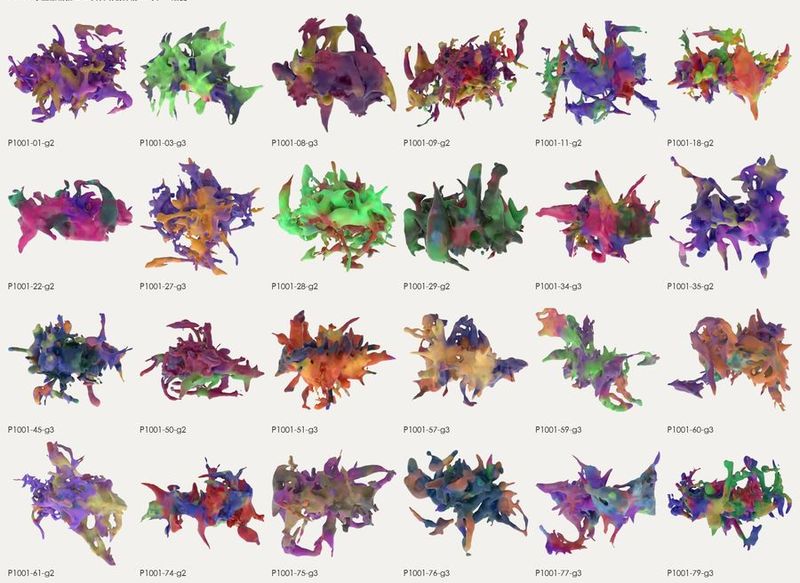
The Kalman Pool Creature Archive is now public 👉https://t.co/ztow6F03KY
Since 2018, I have been creating 335 life forms in virtual reality, bodies shaped by conjoining, symbiosis, gravity, mutation, vulnerability, and collective life.
#CreatureArchive#VRSculpture
How little structure can we supply while still getting a coherent, unfamiliar body? @zzznah@BertChakovsky, how would you distinguish learned organization from imposed scaffolding? These are preliminary studio observations, not peer-reviewed findings.
97 routes into AI sculpture; 37 dead ends. My latest Autogenesis notes ask: when does a model create new bodily organization, and when does it just complete a template?https://t.co/G1gClrovTn #AIart️️️️️️️️️️️️️️️️️️️️️️️️️️️️️️️️️️️️️️️️
On Oct 1, I selected 7 of 24 rendered candidates after automated prescreening. That describes a curated subset, not the raw generation success rate. I still need matched comparisons before claiming a reliable improvement.
A glyph generator trained only on my handwriting now writes new glyphs.
A body generator trained only on my sculptures grows them into bodies.
44 of 64 passed the same connectivity check as bodies from my own handwritten glyphs (73%).
Next: shape and colour growing as one.
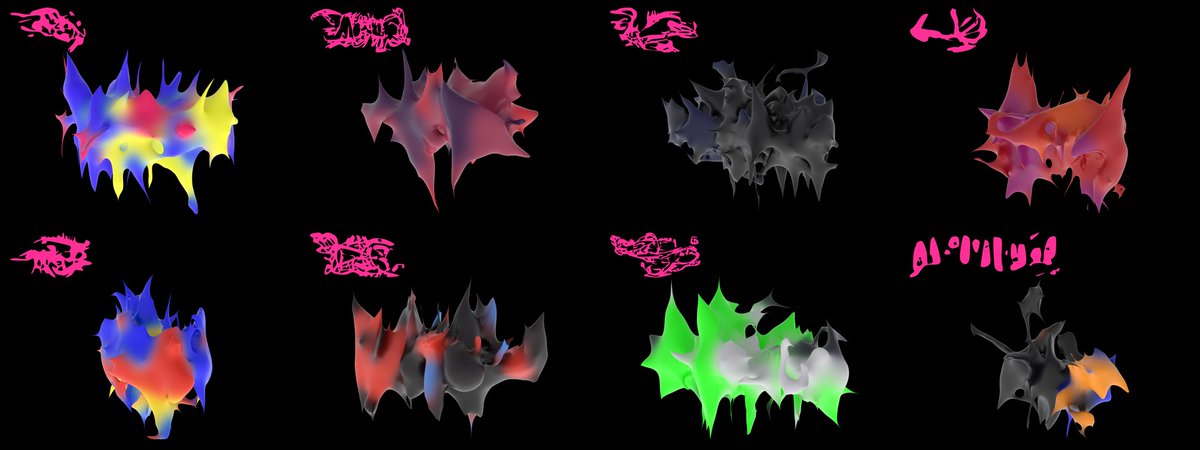
New bodies, 18 September, grown from my own glyphs.
Under each one is its material: the seconds and watt-hours it took to be born, and to be seen.
In the age of generation, the medium is time and energy.
Luminous Opera — 11 years of invented glyphs, painted in UV paint on darkroom walls.
This week they began growing bodies.
The generator has only ever seen my own 682 VR sculptures. It doesn't read the glyph — it grows from it.
One symbol, many bodies.
https://t.co/cpULJbYaU9
I trained a 3D generative model that has only ever seen my own work — 682 sculptures I made in VR between 2018 and 2026.
No scraped data. No pretrained weights.
Today it produced skin for the first time: fangs, tapering limbs, a real surface. Before this it made voxel blocks.
Autogenesis · 12 Sept
Three bodies from an engine that learns only from my VR sculpture archive. Each grows from its most certain voxels to the whole body; the order is the model's confidence, not yet real development. Sound: MusicGen.
No.143 · 160 · 040
https://t.co/Djggyd8XPL
175 bodies grown with no reference work, by a generator trained only on my own archive. I kept 63. Here are nine, front and back — in two of them I saw a blurred face and a profile from a distance. Still coarse. Turn them in 3D:
https://t.co/tain0UQw6D
White paper v0.5 is live. Where things stand: an archive-only, reference-free generator already exists, but its bodies are still coarse (A). Pure noise still grows sponge (B). Next: a 530M prior and an archive-only colour model, running to Sunday.
https://t.co/OpagusthY8
Why our self-trained generator only grows sponges.
Noise a real body 70% and let the model walk it back: it returns whole, even for works it never saw. Only at 90% does it break, into the same sponge it grows from pure noise.
It knows a body. It can't find where one begins.
A curvature detector scored 45% recall, 6% precision against the artist's own organ marks — 98 circles where he marked 12.
By colour instead: at his marks, local colour departs from the surface 1.7–3.5× more than at random. Every work.
Organs marked by colour, not shape.
Two of my sculptures as endpoints. Five frames, none broken — the middle one reads as a creature: green arcs holding a rosette of tendrils.
Best hybrid yet, but the base model isn't mine, so it stays a control. Next: 3D in, 3D out, no flattening to a front view.
My own generator, trained from scratch on my archive alone, sampled 32 bodies from noise today. Top: real works. Bottom: what it made. Connected, but sponge — not bodies.
Found the bug: the noise schedule was weighted toward detail, not silhouette. Retraining overnight.
Two of my own sculptures guide a fine-tuned 3D model and it grows one whole body — no seam, unlike the latent splices I rejected last week. Parent A, parent B, two children.
The base model isn't mine, so this stays a control line. But the biology is back.