To the Gold reval guys. If Judy Sheldon concludes that China has more AU than the US [They do].
The US would make China stronger than themselves in a revaluation scenario. Therefore it is unlikely to happen, apart from a final act of desperation to extends its fiat/debt system when in death throes for a few more weeks.
🚨 WOW! Ripple board director and former U.S. Treasurer Rosie Rios:
“I’m on the board of Ripple. Ripple is XRP. I joined because #XRP serves a purpose.”
She’s also mentioned twice that she’ll be working with Donald Trump soon. 🇺🇸👀
#XRP#Ripple#XRPL
As major networks like XRPL begin prioritizing verifiable identities and spending controls for AI agents, the industry is clearly shifting toward machine-driven commerce. This industry-wide validation highlights the exact need for the deterministic, machine-speed settlement layer that Yellow is building.
The $7 Billion That Didn’t Arrive
XRPL just posted about $7 billion in RWA transfer volume over 30 days, and I’ve already seen that number treated like $7 billion of new money showed up on the network.
That’s not what the number means.
Transfer volume measures how much value moved. It doesn’t tell you how much capital is actually sitting there.
The current data shows about $498.8 million in distributed RWA value on XRPL. Represented asset value is much higher at about $4.45 billion. The same data shows about $7.03 billion in 30-day transfer volume and only 286 RWA holders.
Those are completely different measurements.
If I move the same $10 million asset between accounts ten times, I can create $100 million of transfer volume without adding another dollar of capital.
That’s why transfer volume can get very large compared with the amount of assets actually sitting on the network.
Represented value is different too. Some assets use XRPL as a record or representation layer even though the full economic value isn’t necessarily distributed as tokens people are holding and trading on XRPL. Distributed value is much closer to the amount of tokenized asset value actually sitting in that distribution layer.
This is where people get themselves into trouble with RWA numbers. They see a giant transfer figure and assume billions of dollars just poured into XRPL.
It could be the same assets moving several times. It could be institutions moving large positions between a small number of accounts. It could be settlement activity. It could be assets being issued, transferred, redeemed and moved again.
The 286-holder number is a good reminder of how concentrated some of this activity still is. A small number of holders moving large positions can create a lot of notional volume. That doesn’t make the activity fake. $7 billion moving through the network is real activity. You just have to understand what that number is telling you.
For me, the useful picture is all of it together. About $498.8 million distributed, about $4.45 billion represented, about $7.03 billion transferred over 30 days, and 286 RWA holders. That tells you XRPL is moving a lot more value than it currently has sitting there as distributed RWA capital.
I’d rather understand that than turn a transfer number into a fake capital-inflow headline.
As more people enter the industry it’s important to re-note these facts. Thanks for reiterating these partnerships and connections. We also know of interoperability brought by flare-networks:native network, ethereum:0x467719ad09025fcc6cf6f8311755809d45a5e5f3 network and $QNT network. All providing different roles to expand blockchain interoperability
$XRP
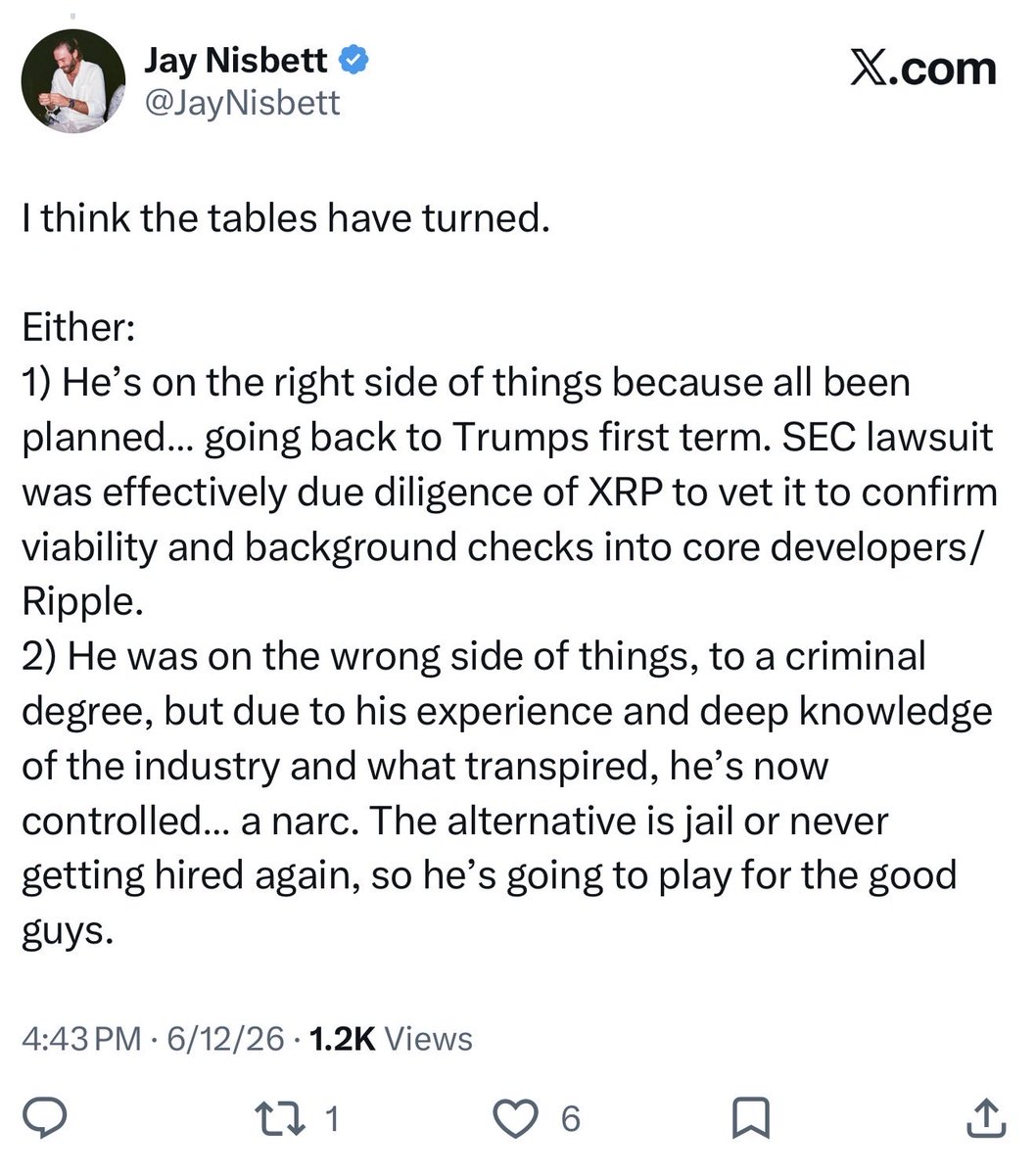
I’ve talked about Jay Clayton before…
Is it possible that this is the role in which Clayton finds himself? He’s not anti crypto, the opposite. Not the executioner… more like a drawbridge operator. He mans the bridge that allows people past the moat of regulatory capture.
This could likely lead the market to believe AI regulatory capture is coming, but likely never will. It could very well be a regulatory freeze. And if Jay Clayton leads this charge, and similar events as to what happened with Ripple and crypto under his guidance occur with AI… I would think it is a fairly high probability that what I outlined could carry weight.
If the US saw XRP (then) as a potential path out of the economic situation we are seeing (now)… it would only work as a repricing vehicle / financial infrastructure rails / fraud & abuse prevention tech if they 1) owned enough supply, 2) XRP price remained low enough for the world to adopt it (which hinges on legal clarity) and 3) understand the risk of it as a potential option for doing so.
The SEC lawsuit helps facilitate all of those things. Jay Clayton may not have been executing XRP as much as he was operating the bridge to be positioned as it needed to in order to get into the castle.
Legal Clarity was definitively provided by the SEC lawsuit and its outcome. This caused the market to view it as over supplied and create a low price which is advantageous for repricing. And in the process, the US Government has all the time in the world to vet the tech and understand whether it’s a viable vehicle.
I can’t help think about the timeline of events.
Jeffrey Epstein died in 2019.
COVID.
Trump lost the 2020 election.
Between 2020 and Biden’s inauguration in 2021, this lawsuit against XRP comes out, from Jay Clayton who was on the way out of running the SEC.
Leon Black is ousted from Apollo Management due to $170m worth of payments to Epstein.
Jay Clayton takes Leon Black’s board seat, between April 2021 - 2025
2025 Jay Clayton becomes the head of SDNY… the same SDNY which prosecuted Epstein.
Now he’s head of AI…
He’s hated on for being mentioned in Epstein docs but you haven’t seen the context to understand to make a good judgement yet.
Think about how sporadic it was that the last thing he did was protect XRP by giving it the opportunity through the lawsuit to be provably unique compared to Bitcoin and others. But only after losing 2020 election.
Since Trump lost 2020. Rather than allowing Democratic’ leadership to decide the crypto industry’s future… they gave a free pass to Bitcoin and Ethereum (giving the illusion of being “safe” and “chosen”) and sued Ripple IN A WAY THAT STRATEGICALLY ALLOWED CONTINUED GROWTH.
While the lawsuit was short term negative, it was a Hail Mary to prevent the next administration from doing something they couldn’t control. Like, “Okay, we lost. How can we put this plan on ice, until we win next election?”
The lawsuit WAS NOT regulatory capture for ETH/BTC as much as it was regulatory containment for XRP. Which is why the first thing the new SEC does until this admin is dismiss their appeals. Both Ripple and SEC did.
Which begs the question… since @bgarlinghouse and recently said at KU that he was considering closing up shop after the SEC sued. Why didn’t he?
BEFORE the suit came - he met with SEC officials (Jay Clayton) multiple times… so if you are to believe what I am speculating (Clayton is acting on good side, lawsuit was protection /putting a pause until 24 election, etc.) you should also believe that this amount of planning would require the coordination of Brad and Larsen through out the process.
Which makes perfect sense to have them named in the lawsuit, which is completely out of the ordinary… The lawsuit provides cover for consistent coordination. The lawsuit guided the process through to the other side.
Clayton could have been the bridge operator, not the executioner.