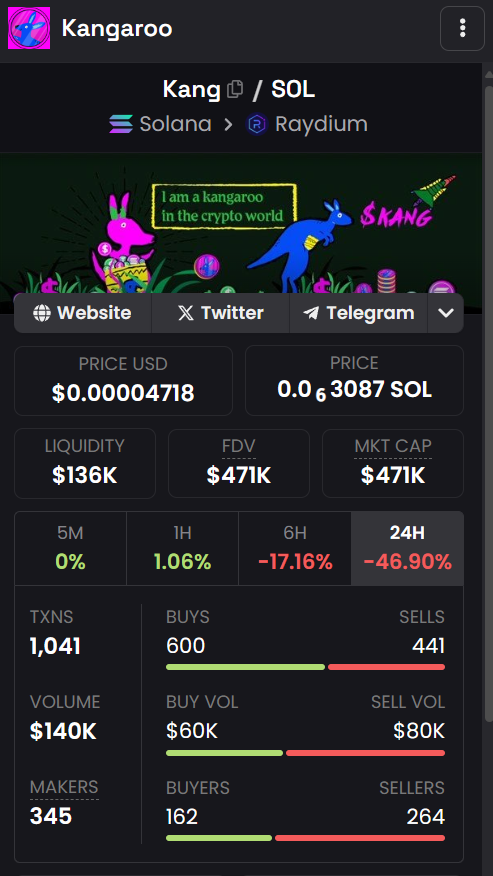
$Kang launched
starting a social experiment in pursuit of kangaroos
12 o'clock on April 11, 2024 GMT
Check the contract on Solana below
4nUCxsqkcUnaHgxrsXQRR8M6rU1hQrnKw8Z9C3LfVyW9
@WhaleFUD@cz_binance@cz_binance We love you, CZ. Who dares to say that the previous bull market had nothing to do with you? Mr. CZ has always been active in blockchain and will be cultivating new blockchain talents. He could have rested, but he hasn't stopped, 🙏
#BNB#Binance
Continuous construction: The current market capitalisation of $Kang is $470,000, and the trough will not last long.
We will soon surpass our ATH market capitalisation of $1.4 million.
Seeing some confusion about SWQoS.
There are (will be) 3 ways to improve transaction inclusion likelihood on Solana.
1) Priority Fees: Used when compute/inclusion is the bottleneck. Akin to jacking up gas fees on other networks, global by nature.
2) Local Fee Markets: Used when state contention – multiple people trying to do the same thing – is the bottleneck. Local by nature
3) Stake Weighted QoS: Sybil/spam discrimination engine, which can be used in addition to PF/LFMs or as a standalone. Global by nature.
On Solana, it won't be an either-or approach. These functions will provide operators optionality – multiple ways to accomplish similar goals, depending on their setup, priorities, and configuration. Not to mention other nonprotocol solutions like mev relayers.
Without a doubt, the V0.5 version getting deployed now will have externalities that will have to be addressed through additional protocol governance over time. But, I thin it's better to ship something and adjust once everyone is able to look at the same real-world data.
For absolute clarity, there is...
- no change in the cost to run a validator
- no change in the stake to run a validator (still 1 SOL)
- no change in who can run a validator (still permissionless)
- no change in the fees or rewards a validator is able to collect natively
🫡