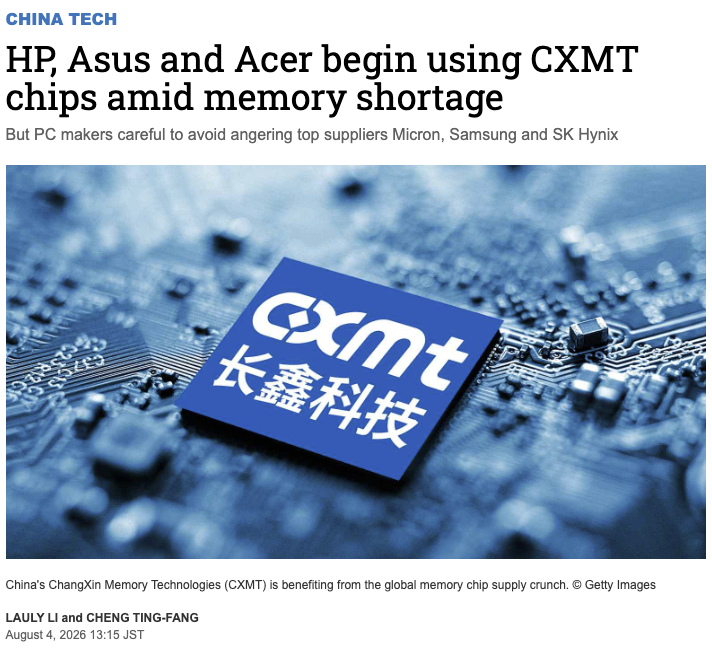
HP, ASUS AND ACER BEGIN LIMITED USE OF CXMT DRAM - NIKKEI
The PC makers have started using small volumes of China’s CXMT memory chips in budget notebooks sold outside the U.S. after completing qualification around midyear.
The move is being driven by a severe memory shortage as AI infrastructure consumes more supply. Still, adoption remains limited because CXMT is prioritizing Chinese customers, while PC makers are reluctant to upset Samsung, SK Hynix and Micron, which collectively control more than 90% of the DRAM market.
CXMT is also on a Pentagon list of companies alleged to have links to China’s military, although it is not subject to an outright U.S. trade blacklist.
Despite being a newer supplier, CXMT’s DRAM is reportedly no cheaper than Samsung’s, and customers have been unable to secure supply beyond the current quarter. The limited adoption still marks a meaningful entry for CXMT into the global PC supply chain.
Two years ago, a former OpenAI researcher sat down on a podcast and calmly mapped out everything happening in markets right now.
Then he ended on one question. This week the market answered it, with his own fund.
In 2024, Leopold Aschenbrenner told Dwarkesh Patel that AI was an industrial process, and walked through the math:
A gigawatt data center by 2026, "the power of the Hoover Dam," costing tens of billions.
10 gigawatts by 2028. More power than most US states.
A trillion-dollar cluster by 2030, drawing over 20% of US electricity.
Roughly $1 trillion of total AI investment by 2027.
It sounded like science fiction. Then Google guided capex to $200B. Tesla started building a chip fab. Nuclear startups began raising nine figures to power data centers.
The map held.
But the clip ends with a sentence that aged differently than the rest: "These are forward-looking investments. The question is, do they pay off?"
He raised a hedge fund on his own answer. It hit $20 billion in two years and was up 439% through June, per the FT.
In July the market repriced that question. The fund fell 67%, and Ken Griffin's Citadel bought its book as it raced to meet margin calls, per the WSJ.
He asked the question two years early.
The answer came back with a margin call attached.
Two years ago, Leopold Aschenbrenner argued he was one of few people in the world who saw the future clearly.
In a sprawling, 165-page essay that became required reading in Silicon Valley, the former OpenAI researcher positioned himself as a kind of prophet for the coming age of artificial super intelligence.
But this week, the limits of Aschenbrenner’s vision were on display when the AI-themed hedge fund he runs — named Situational Awareness, also the title of his viral June 2024 manifesto — ran into the harsh reality of tumbling semiconductor stocks and Wall Street margin calls.
Full story: https://t.co/klLULuU9j1
I'm starting to get interested in tech stocks again.
Our core portfolio is up +0.75%
$SPY is down -1.46%
$QQQ is down -8.48%
$XLK is down -10.14%
Right now, I am eye'ing positions into technology. I will look to start trimming profits in financials, healthcare, in the near future.
I am very happy that we've managed to survive strongly. I'm getting ready for the big buy soon.
Wait for my signal.
$NVO is taking the European market from $LLY faster than you can say “semagltudide.”
Deliveries of Novo’s Wegovy pill are already being fulfilled in Europe. The first doses are expected in Germany by August.
This is all you need to do to make millions in the stock market. Save this. Screenshot it. You will need it.
1. VIX above 35: buy aggressively
- High-beta tech, growth, small caps
- Every single time the VIX spiked above 35 since 2018 was a generational buying opportunity. COVID bottom. Oct 2022 bottom. Tariff crash. If you bought when everyone else was panicking, you made a fortune.
2. VIX 25 to 35: start scaling in
- Quality tech, financials, industrials, cyclicals
- This is where smart money starts building positions. Not all at once. Gradually. The fear is real but the opportunity is bigger.
3. VIX 15 to 25: hold
- Balanced: tech + defensives, dividend growers
- This is normal. Stay positioned. Don't chase, don't panic. Let your winners run.
4. VIX below 15: reduce exposure
- Rotate to: utilities, healthcare, staples, bonds
- This is when everyone is comfortable. Nobody is hedging. Nobody is worried. That's exactly when you should be.
- Every major crash in market history was preceded by the VIX sitting below 15 for weeks.
Right now the VIX is at 16. We're in the hold zone. Stay positioned but stay alert.
Bookmark this. The next time the VIX spikes above 35, don't freeze. Buy.
Tech is currently underperforming. There is a rotation happening into healthcare, biotech, financials, industrials, utilities, energy, and staples.
• This rotation lasts about ~77 days.
• So expect technology to take a breather and rest until September 18, 2026.
After the rotation finishes, tech sector 30 days later is +5.6% avg, 60 days later: +8.4% avg, and 90 days later: +9.4% avg.
This is not the time to panic, but to build your tech watchlist. Take your time building your positions.
Rotations don't end bull markets - they create amazing entries.
BOFA: HEDGE THE RALLY
Bank of America is urging investors to hedge further S&P 500 gains, warning the recent rally is losing momentum and could give way to a “three-wave correction” through September.
Technical strategist Paul Ciana sees the index falling as low as 6,850—about 8% below current levels—and warns that even new highs could be a “head fake” before a broader pullback.
Goldman Delta 1 head Rich Privorotsky: “The market’s central premise has been that compute is scarce. If scarcity persists, prices should remain firm and justify continued capex. If supply rises and rental prices continue to drift lower, that is a direct challenge to the shortage narrative. The first place that pain shows up is hardware. ORNN H100 index rolling over last couple days worth watching. The beneficiaries are the companies selling the complete platform and monetizing usage rather than simply selling picks and shovels. My working conclusion remains that hyperscalers are the structural winners through this phase. The first moment they demonstrate they can deliver equivalent output with lower spend, the market will reward them. The bigger risk sits further upstream in the hardware and infrastructure stack where expectations remain built around persistent scarcity."
My dear followers.
Never sell your WINNERS fully like $MU, $NVDA, $SNDK, $NBIS, $CRWV, etc.
Remember, winners keep winning. They will be included into major indices like $SPY, $QQQ, etc.
What does this mean? This means that MILLIONS of passive investors continue to pour money into your WINNERS every single paycheck.
Do NOT be scared of the markets. CHANGE your mentality. You will be RICH with me in the future.
Leopold Aschenbrenner is up nearly 700% on $SNDK since disclosing a $12.9M stake.
He first revealed the position in November 2025 at around $250/share.
A bottom is getting close. Survive with me.
I EXPECT a rotation back into technology and AI within the next few days for at LEAST a relief rally.
A lot of instruments are coming down to its "algo-level."
Nuclear like $CCJ, AI like $ARM, gold miners like $NEM, etc.
This algo-level is when banks/big money start to position lightly again.
I'm starting to see defensive sectors like healthcare, ex. $LLY, making bearish divergence on the daily timeframe.
A pullback in defensives will be BULLISH for technology.
We're still a few % points away, but it makes sense to start shopping SLOWLY.
What to do?
1. Markets can still come down a few % points lower. Short-term cycle is STILL bearish pressure. But you can start buying slowly into your AI names - no need to time it perfectly.
2. BALANCED portfolio. I still have exposure across AI, defensives (healthcare, utilities, and staples), and laggards like software, restaurants, and clothing apparel.
Take your TIME. You will get some RELIEF soon. 🧡
Remember, our portfolio stays STRONG during red days. And OUTPERFORMS during green days.
My dear followers. Here is some GOOD news.
If EVERYONE expects a crash, that expectation gets "priced in" ahead of time.
This REDUCES the likelihood of a sudden crash.
Prices adjust GRADUALLY, instead of a crash.
Air comes out SLOWLY rather than exploding down.
The markets does NOT crash just because people talk about it. It crashes when the unexpected hits an UNPREPARED crowd.
So what to do?
1. No need to time it perfectly!!!!
- Crashes are rare (true 20%+ drawdowns aren't annual events), and being out of the market waiting for one often costs more in missed gains.
- BUILD your positions SLOWLY, buy every day into your favorite names!!
2. BALANCED portfolio
- AI winners will help outperform. Laggards + defensives will help ABSORB the big red days. So instead of being down -10%, you're only down -1%!
3. STOP thinking short-term
- A year from now, you will laugh about this period of time
Remember this, RED is temporary.
Markets are DESIGNED to go up.
- Retirement saving flows (401K, IRAs, pensions)
- Corporate buy backs
- Passive investing from millions of people around the world
- TAX incentives for those that contribute regularly
Do NOT worry my followers.
You will be JUST fine.
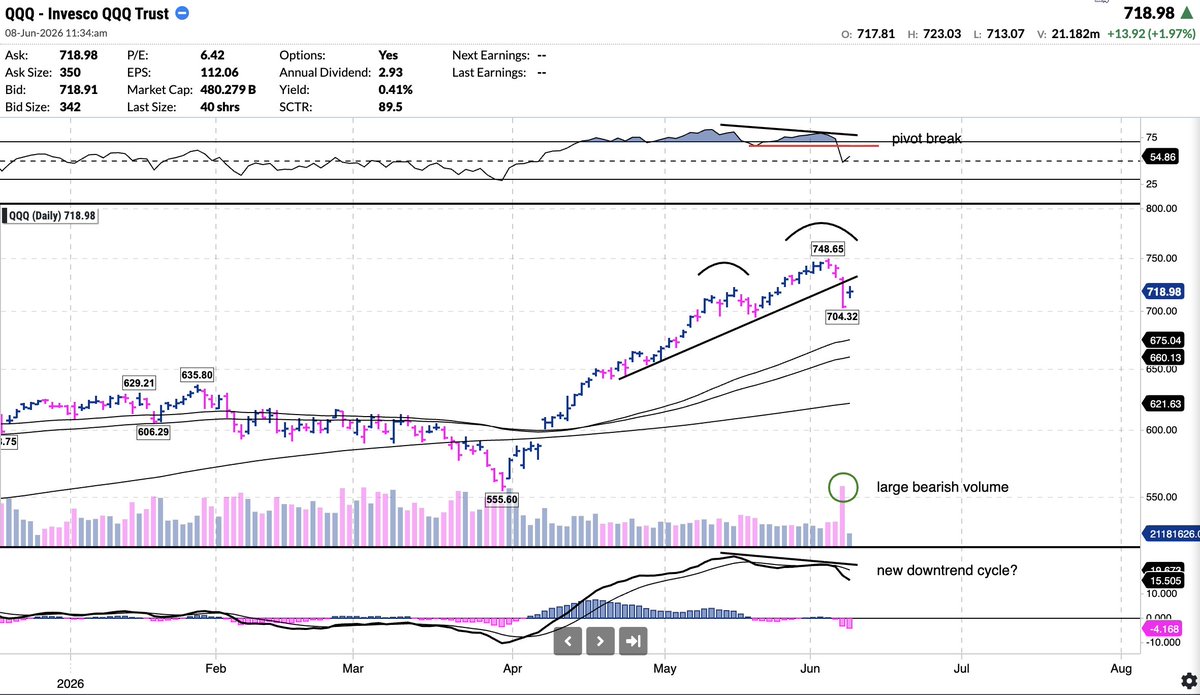
Today is a great BOUNCE for the $QQQ and technology as a whole.
But, we are still NOT out of the woods yet.
I am staying BALANCED in my portfolio.
1. AI winners 40%
2. Laggards 15%
3. Defensives 15%
4. Hedges 15%
5. Cash 15%
I will be a BIG buyer at better levels. I NEVER chase highs. I only buy LOW on great stocks.
Keep building your positions SLOWLY. We have all the time in the world together.