#PT582#SK 1/2 I feel like this should definitely be a precaution. Some people who get tattoos truly have no idea what the ink is made of. Then there are those that are avid tattoo getters that know exactly what is in the ink. I think this could become a question that is asked:
@AlexJacobs_SPT According to physiopedia, it can be done for 7 days a week for 4-6 weeks. The total pulse duration time is at least 4 minutes with the off time decreasing as time goes on. The goal is to get the shoulder to contract and reduce the sublux.
#PT582#AJ In a quick search, I saw that both are helpful in the prevention. However I did see that NMES does not tend to have lasting effects after treatment is stopped. I would use both, but strength training would be more emphasized to ensure that the training would last
#PT582#AS In a quick search, I found different results. One article says there is a benefit in doing both rather than PT alone. One article I found says that intensive PT after a PRP injection did not show any significant changes or benefits over just the PRP injection itself.
#PT582#EB Hippotherapy would be a great way to interact with a pt with DS. I feel that it would help improve reactive and anticipatory balance as they are having to learn to stay on the horse and how to react when the horse moves as it is not always known how the horse will move
@SptTaryn Crunches or even planks would be appropriate as long as they did them successfully in clinic first! I think there is a lot that goes into feeling they were safe to do at home, like their mentality and they ability to do the exercises successfully in the clinic with no assistance.
#PT582#TM The research I found was having them using their prosthetic, which is a good step to have them be on all 4s. I searched and found other techniques using bolsters and balls to train the position, such as plank with leg propped up, then taking bolster away when stable!
#PT582#DA There is not much research on using aquatic therapy for heart disease. I found one article that stated that aquatic aerobic and strength is found to be safer for CHF and CAD pts. It also states that CVS pts may feel more comfy and have better ROM in the water.
#PT582#KJ Research states that aerobic, resistance, and mind-body exercises improve the levels of depression and symptoms. Exercise has also shown to reshape the brain structure and activate different brain areas that haven’t been activated; therefore improving neuroprocessing
#PT582#MH dry needling is one of many treatments that are used to treat trigger points and pain. From the research I read, the use of dry needling is beneficial in reducing muscle tension and trigger points. I personally would probably only use it if SMT was not as benefit
#PT582#KD It is known that mental imagery(MI) is beneficial but the degree is unknown. A study showed that MI activates the neural patterns similar to those activated when performing the motion. MI improved motor function in post stoke pts when combined with motor therapy.
#PT582#LB it is seem that athletes who use BFR alone enhance hypertrophy and strength. BFR combined with HL training can provide even more stimulus for muscular improvement. It is also being seen that BFR can help reduce pain in irritable tissues when used prior to competition!
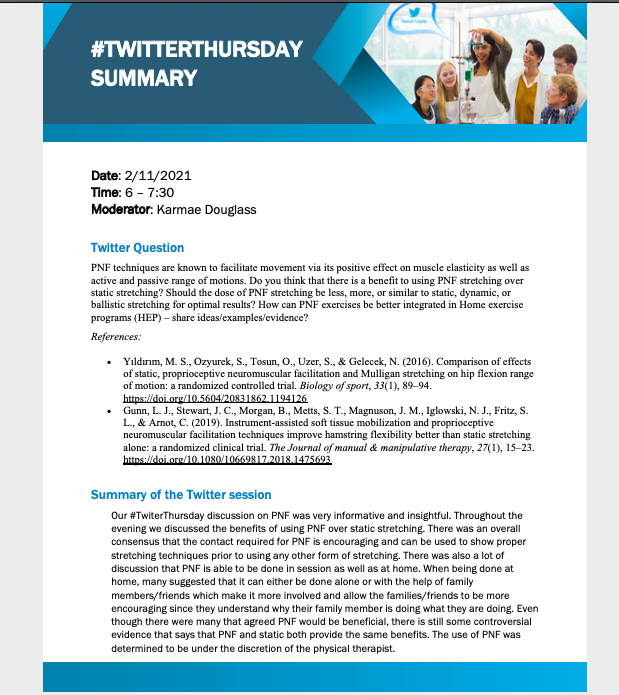
@AnnaLeighSPT That is a great idea to include others as long as they are showed properly! Do you think you would ever (1) use PNF for your patients? (2) show a family member so they can do it at home? #PT582#KD
@jacquedompier I really liked this study when I read it! There are benefits of both static and PNF. I agree that “it depends”. The patients needs come first and if they would benefit from PNF more, it would be good to use it over static! #PT582#KD