We built an autonomous oracle on Kaspa L1. No operator, no admin key, no one who can fake it.
A KAS/USD price proven against the Wormhole guardian quorum and verified by Kaspa's own consensus. Permissionless to update, about a cent a roll, sub-25-second proofs.
Maybe the first ZK-verified oracle on any proof-of-work chain.
TN10 now. Waiting for Toccata...Let's keep on building. 😎🤟🏼
That's a really good question, but it's hard to answer in a single tweet because our mission is quite extensive, and it requires a lot of background knowledge to really understand what sets Kaspa apart.
Currently, a lot of people see Kaspa as “Bitcoin’s crazy little brother” that improves time-to-finality by leveraging the benefits of DAG-based consensus protocols without accepting their traditional drawbacks, such as decreased decentralization or a limited validator set.
This perception is somewhat accurate, but it falls short of conveying the full picture, because Kaspa’s vision extends far beyond just trying to be a better Bitcoin.
Anyone willing to study Kaspa and its broader vision will discover similarities to nearly all major existing DLT designs: from Bitcoin, to Ethereum, to Solana, Sui, Celestia, and beyond.
My personal view is that “research” in the DLT space is approaching a point of convergence. We increasingly understand how to push distributed systems close to the limits of what physics permits. The frontier is no longer only about raw throughput or faster finality. The attention is shifting toward game theory, incentives, sequencing, MEV, alignment, and how to build systems where the economic incentives of users, builders, miners, validators, applications, and infrastructure providers do not work against each other.
That is why debates like based rollups versus arbitrary sequencing, shared sequencing, MEV mitigation, proposer-builder separation, and execution-layer incentives matter so much. These are not niche technical details. They determine whether a network can remain neutral, decentralized, and aligned while scaling to global usage.
And this is where I think Kaspa is pushing the boundaries in a very important way.
Kaspa is not merely trying to be “fast.” The goal is to build an L1 where speed, decentralization, security, and incentives are aligned at the base layer. A system that does not scale by hiding complexity behind trusted committees, privileged sequencers, centralized validator sets, or opaque coordination mechanisms, but instead tries to preserve the spirit of proof-of-work while extending what an L1 can realistically do.
Because Kaspa arrived later than many other major projects, it does not carry the same degree of technological debt. It can absorb lessons from Bitcoin, Ethereum, rollups, modular blockchains, high-throughput monolithic chains, DAG research, MEV research, and the broader history of decentralized systems, and combine those lessons into something more optimal.
To me, that is what Kaspa is building: not just a faster blockchain, but a more incentive-aligned decentralized infrastructure layer.
But this also creates a different challenge.
Kaspa’s biggest problem today is not its technology. It is the lack of centralized coordination around communicating the vision. And because Kaspa is a grass-roots movement, that responsibility does not belong to a marketing department, or a single leadership team. It belongs to the community.
That also means the community has a different role to play.
There will always be holders who are mainly interested in price, and that is completely fine. But there also need to be people who are here because they want to use the technology to build a different future. People who care about the architecture, the incentives, the open questions, the trade-offs, and the long-term trajectory of decentralized infrastructure.
I am one of those people.
I am not interested in DLTs merely as a way to generate wealth. I am interested in them because I believe they can change the trajectory of humanity as a whole.
For that reason, I want to use this opportunity to announce a regular community hangout where we discuss the current state of development, the open questions, and where we can align our vision together.
The first session will be on Tuesday, June 9th, 2026.
We will talk about the vProgs framework, how the codebase works, what sets Kaspa apart, where we improve on existing solutions, and what still needs to be done. The goal is for this to become a regular, possibly bi-weekly, event where we as a community come together to discuss the future and understand the technology.
Eventually, we can invite people from other projects as well, but the main focus at the beginning will be explaining and communicating how things work under the hood.
There is still a lot of work to be done, and I do not want to waste precious time. So the first sessions may feel a little improvised, but we can improve as we go.
The important thing is that we start.
So mark the date: Tuesday, June 9th, 2026.
**Official Toccata Release — Mainnet Hardfork Activation Included** (Links in reply)
We’re excited to announce the official Kaspa release containing the **Toccata Hardfork** activation logic.
Toccata is scheduled to activate on mainnet at DAA score `474,165,565`, expected around **June 30, 2026, 16:15 UTC**.
This is a consensus-changing upgrade. All node operators, miners, pools, exchanges, indexers, wallets, and infrastructure providers must upgrade before activation to remain compatible with the network.
Toccata introduces a major expansion of Kaspa L1 capabilities, including:
• **Native L1 covenant support** through transaction introspection, allowing for more expressive contracts, including stateful contracts
• **Covenant IDs**, providing stable covenant lineage across UTXO transitions, so covenant instances can preserve continuity as their state moves from one UTXO to the next
• **ZK proof verification on L1** via `OpZkPrecompile`, enabling to trustlessly offload computation off-chain.
• **Partitioned sequencing commitments**, improving support for based ZK applications by making lane-local proving scale with relevant activity rather than global throughput
Please upgrade as soon as possible and verify your nodes are running the new release well before the activation DAA score.
Thank you to everyone who contributed to designing, implementing, reviewing, and testing Toccata.
⚡ LIGHTNING NETWORK SOLVED THE WRONG PROBLEM. AGENTS WILL EXPOSE THIS IN 2026.
Lightning Network is one of crypto's most impressive engineering achievements. It also happens to be architected for a world that is about to disappear.
Let me explain why agents will not use it, and why this matters for chain selection.
⚡ WHAT LIGHTNING ACTUALLY IS
Lightning is a payment channel network on top of Bitcoin. Two parties open a channel by locking funds in a 2-of-2 multisig. They transact off-chain at near-zero cost. Eventually they close the channel and settle the net result back to Bitcoin's base layer.
Brilliant for human users. They open a few channels, route through hubs, and enjoy fast cheap Bitcoin payments.
🚫 WHY AGENTS BREAK THIS MODEL
1. Channel inventory does not scale to agents. An agent that needs to pay 500 counterparties cannot open 500 channels. The capital lockup is prohibitive and the management overhead is impossible. Routing through hubs introduces trust assumptions agents do not want to model.
2. Liquidity routing fails at agent scale. Lightning routes through liquidity hubs. At millions of agents transacting simultaneously, the routing problem becomes computationally absurd. Channels go dry. Routes fail. Agents retry. Throughput collapses.
3. Watchtowers introduce trust. To stay safe when offline, Lightning users rely on watchtowers (third-party services that monitor channels). For humans, this is fine. For agents that operate continuously, watchtowers add a trust dependency the architecture was supposed to eliminate.
4. Channel closures are slow and expensive. When a channel must close (dispute, counterparty offline, end of session), settlement hits Bitcoin's base layer with full L1 latency and cost. Agents making thousands of micro-decisions per day cannot tolerate this tail risk.
5. No programmability. Agents need conditional payments, escrow, multi-party settlement logic. Lightning is fundamentally a two-party channel. Building agent-grade coordination on top requires kludges.
🎯 WHAT AGENTS ACTUALLY NEED
A base layer with:
. Native sub-cent fees (not channel-state magic)
. Sub-second finality on L1 (not "wait for channel close")
. Native programmability (not workarounds)
. No required trust in third parties (watchtowers, hubs, etc.)
. Scales horizontally with transaction volume (not constrained by channel capital)
This is the spec for an L1 BlockDAG with PoW security and programmability. This is Kaspa.
🌐 WHY THIS MATTERS FOR THE BITCOIN THESIS
The "Bitcoin will become the world reserve money via Lightning" thesis was reasonable in 2018. It is becoming untenable as the actual user of crypto shifts from humans to agents.
This does not kill Bitcoin. Bitcoin remains a store of value and the most trusted PoW asset. But it does mean Bitcoin will not be the medium of exchange for the M2M economy.
The medium of exchange role goes to whichever chain agents actually use. And agents need L1 capability that channel networks structurally cannot provide.
📊 THE GENERAL PRINCIPLE
Payment channels solve a problem that exists when L1 throughput is scarce. BlockDAG architecture eliminates the scarcity, which eliminates the need for channels.
Lightning is a beautiful answer to "how do we scale Bitcoin without breaking Bitcoin." It is not the answer to "how do we settle billions of machine transactions per day."
🎯 BOTTOM LINE
Channel-based scaling solutions were designed for a human-scale economy. The machine economy needs base-layer scaling. That is a different problem, and it requires a different architecture.
Kaspa is one of the very few chains that solves the right problem.
💾 Save. The Lightning thesis was right for 2018. It is wrong for 2026.
Tags: #Kaspa $KAS #Lightning #Bitcoin #PaymentChannels #L1 #BlockDAG #AIAgents #M2M #Scaling #Crypto #Web3 #Infrastructure
Its quite exciting what the Toccata hard fork is going to enable for $KAS. Truly in the most digestible way to understand what is happening here is that its consolidating many wonderful features that cryptography allows onto one beautiful foundational network. The Kaspa network.
For so many years each of the many features that Kaspa is going to adopt over time typically involved creating a brand new coin and then having the coin simply focus on that one feature and try to do it best. On top of that it always involved sacrificing scalability, proof of work, security, or decentralization to accomplish its goals.
For once we have a network that can power all of these features while reamining fast, scalable, and lightweight.
I don't know why anyone would not be keeping tabs on $KAS at all times. You get the foundational ethos of Bitcoin that allow Kaspa to enter the digital sound money race. The programability of $ETH that allows $KAS to enter DeFi. The best foundational base layer to allow for many other features that cryptographers find useful such as privacy.
Kaspa is positioning itself to be a powerhouse that can attract any kind of crypto user. From noobs, to the experienced. From sound money advocates to the degens.
Kaspa truly is for all. Study $KAS
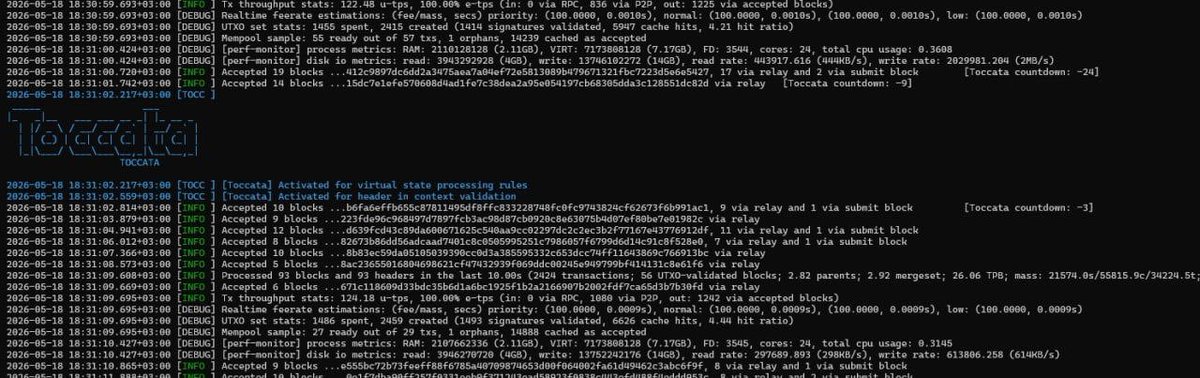
Update: Testnet 10 underwent the Toccata hardfork about 30mins ago and everything’s still running like clockwork. Transition was smooth and seamless.
This seamlessness is the standard that kaspa devs set. It’s easy to take it for granted so I want to take this moment to recognize the effort and due diligence that went into making this happen @michaelsuttonil@OriNewman@Max143672@IzioDev@FreshAir08@manyfest_@hus_qy (and sorry if I missed anyone)
Mainnet HF soon
Here we go again: rehearsing a major hardfork on testnet 10, this time crescendoing into Toccata
Activation is scheduled for tomorrow May 18, 16:00 UTC.
Existing TN10 miners/operators should upgrade now. In a few hours upgraded p2p nodes will stop connecting to non-upgraded nodes as we enter the 24h pre-activation window.
Let’s make the mainnet activation boring by making the TN10 rehearsal as mainnet-real-world as possible
Update from Discord from, @OriNewman
The Toccata hardfork stack is now ready, and we’re entering the final stage before mainnet activation: a full hardfork activation on Testnet-10.
🚀The scheduled activation point is:
May 18, 2026, 16:00 UTC DAA Score: 467_579_632
Testnet node operators: please upgrade to this release: https://t.co/K7xgfOlU9m
New people are also encouraged to join testnet and mine using this release. You can run a testnet node by extracting the appropriate zip in the above release and run: ./kaspad --testnet And mine by downloading the CPU miner: https://t.co/uoDYGbZGZ9 and running (replace kaspa-miner-v0.2.7-linux-gnu-amd64 with the correct binary name if not running on linux): ./kaspa-miner-v0.2.7-linux-gnu-amd64 --testnet -t 1 -a <kaspa testnet address>
Trustless atomic swaps on Kaspa. No middleman, no server.
Alice and Bob swap KAS using HTLCs on TN12. Preimage extracted in real time from the DAG block stream. Fully decentralized, fully on-chain.
Air-gapped signing with KasSigner. Watch-only companion KasSee. Private keys never leave the device.
Open source. GPLv3. 😎🤟🏼
https://t.co/VrbbWrGWAS
https://t.co/r4UWIGNbFh
#Kaspa #KasSigner #AtomicSwap #HTLC #OpenSource #Toccata
Attn $BTC Maxis - 1/21,000,000 of $KAS supply - 1366 Kaspa coins is $53 right now, become a closet 6000x faster whole coiner for 2 margaraitas + tip :)
Kaspa is mentioned on the front page of @DiiDesertEnergy, a partnership of 126 global companies with a total valuation in the tens of trillions of dollars.
Amazing work. Words that make me proud to be a diehard Kaspian.
> “Kaspa did not come out of the usual hype cycle. It came out of veteran research, fair launch, open-source execution, and years of pushing where most of crypto stopped pushing.
A live blockDAG. 10 BPS on mainnet. Real-time decentralization as the north star. Toccata next. DAGKnight after that.
If this reads like it's early, that's because it is.”
[new kaspa(.)org/lore]
Here it is...ZK Rollup on Kaspa. Confirmed on TN12.
Persistent covenant holds state root on L1. Advances only with a valid Groth16 proof of state transition. Self-looping. Funds stay locked or withdraw with proof.
4-account MiMC merkle tree. Transfer validity proved in 128 bytes. Old root to new root, verified on-chain via OP_ZK_PRECOMPILE.
Two consecutive state advances confirmed:
TX1: 378ec66ffe9f60dc18614ed1ba7016d7ce484689211d5d68dedda980e6f432d0
TX2: 5873978e930e4cd7403d7b6b720c5072b5513cf9dceba9f838509e16ee593c48
Deposit on L1. Prove state transitions off-chain. Withdraw on L1 with proof. Covenant persists. The circle is closed...
Browser WASM prover. Air-gapped signer. All open source.
#Kaspa #ZKRollup #KasSigner
𝘐𝘯𝘒𝘢𝘴𝘞𝘦𝘙𝘶𝘴𝘵😎🤟🏼
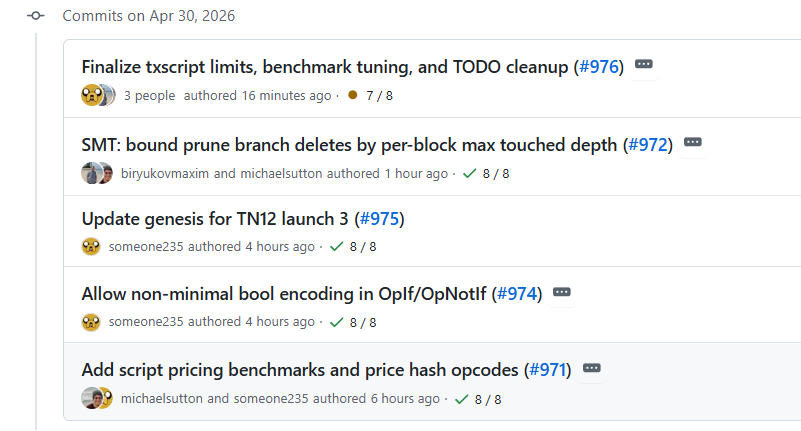
Toccata consensus feature freeze is finally here after a heroic last-mile push by kas core devs.
Aiming to reset TN12 tonight, or tomorrow at the latest.
Genesis update:
+ 0x6b617370612d746573746e6574 // kaspa-testnet
- 12, 2 // TN12, Launch 2
+ 0x544f4343415441 // TOCCATA
+ 12, 3 // TN12, Launch 3