If you are under the age of 30, important to recognize that you literally have another 40 years ahead of you to compound your wealth and career
Too many young people are in a rush to figure out their life and enjoy the spoils of gold today
You are maybe just 10 to 15% of the way through your career. Just take some time to enjoy it and soak it all in
Do what you are doing well today instead of trying to figure out what’s next a decade from now
If you currently work in finance as a junior analyst and are wondering how you can use AI to become more productive, I highly recommend you read this first
Warren Buffett said anything above 200% means "you are playing with fire."
It just hit 232%.
Highest reading in the history of the American stock market.
The metric is called the Buffett Indicator. He called it "probably the best single measure of where valuations stand at any given moment." It divides total stock market value by GDP.
At 232%, investors are paying more than double what the entire economy produces.
Buffett's response: sold $134 billion in stocks. Built a $334 billion cash pile. Then resigned.
He has done this exact move twice before.
1999: sat on $28 billion cash. Media called him washed. Nasdaq was at 5,000. Eighteen months later it was 1,100. 78% crash. Apple went from $4.50 to $0.50. Amazon from $107 to $7. Buffett bought everything at pennies.
2007: raised cash to $44 billion. Everyone said housing never goes down. Lehman collapsed. Buffett walked into Goldman Sachs with a $5 billion check and demanded 10% preferred dividends plus warrants. Made $3.7 billion on one trade because he was the only person in the room with cash.
2025: $334 billion. 7.6x his 2007 position. In treasury bills. Earning 5%. Waiting.
Meanwhile your financial advisor just emailed you saying the worst is over. S&P rallied 10%. CNBC is celebrating.
One of them manages $1.1 trillion. The other sells advertising.
The Buffett Playbook at your scale:
→ Raise cash to 20-30% of your portfolio. Trim positions that ran 200%+. Taking profit at the highest valuation in market history is not timing the market. It's arithmetic.
→ Park the cash in 3-month T-bills at 5.2%. Fidelity, Schwab, Vanguard. $0 commission. Same rate Buffett is earning on $334 billion right now.
→ Set limit orders 30-40% below current prices on companies you actually want to own long-term:
AAPL at $145 (currently ~$210)
MSFT at $280 (currently ~$410)
GOOG at $120 (currently ~$175)
AMZN at $135 (currently ~$195)
Market drops? You buy automatically at your price.
Market doesn't drop? You're earning 5.2% instead of sitting at peak valuation praying.
→ Hedge with what BlackRock is buying: GDX (gold miners at widest discount to spot in 20 years), FCX (copper for AI infrastructure), CCJ (uranium — demand mandated to triple, supply 7,000 tonnes short).
Your advisor's fee is a percentage of your invested assets. Cash in T-bills doesn't generate their 1% management fee. Every dollar you move to safety is a dollar that stops paying them.
When they say "stay the course" — ask yourself whose course.
Buffett has 82 years of pattern recognition and the largest cash position in Berkshire's history. Your advisor has a commission structure. They are giving you opposite advice for opposite reasons.
every week i break down what institutional money is actually doing and how retail investors can position around it. former banker. not a guy selling you a course.
https://t.co/1j7Dmb4qHR
(the buffett indicator just hit the highest reading in american history. he said 200% means playing with fire. it's at 232%. he's sitting on $334 billion cash. he did this twice before. both times the market crashed within 18 months. your advisor told you to stay the course. his fee depends on you staying invested. buffett's returns depend on buying cheap. opposite advice. opposite incentives.)
A career in finance looks attractive from the outside.
Good pay.
Prestige.
Smart people.
But what most people don’t see is what it actually takes to build something meaningful in this space.
Because finance will test you in ways you don’t expect.
Early on, it feels like you don’t know anything.
You’re in rooms where people speak in terms you’ve never heard before.
You’re working on models you barely understand.
You’re expected to have opinions… when you’re still figuring things out.
And honestly, that phase can be uncomfortable.
But it’s also where everything starts.
Because finance is one of those careers where clarity compounds over time.
At the beginning, everything looks complex.
After a while, patterns start to show:
– You begin to understand how businesses actually make money
– You see what drives good vs bad investments
– You learn that numbers don’t lie… but they can definitely mislead
And slowly, you get sharper.
You can explore many paths in finance.
You can go into:
– Investment banking
– Asset management
– Private equity
– Corporate finance
– Consulting
– Venture capital
And they all require slightly different skill sets.
But they all reward one thing:
Clear thinking.
Not just working hard.
Not just being “good with numbers.”
But being able to look at a situation and say:
“Here’s what actually matters.”
Because a lot of people in finance are busy…
…but not all of them are effective.
Another truth:
Your career in finance is less about what you know…
…and more about how you think.
Two people can learn the same concepts.
One memorizes formulas.
The other understands why they matter.
Five years later, they’re in completely different places.
That’s the difference.
Also, finance is a long game.
You don’t become exceptional in 6 months.
It takes years of:
– Seeing deals
– Making mistakes
– Getting things wrong
– Learning from better people
But if you stay consistent, something clicks.
You start to trust your judgment.
You stop second-guessing every decision.
You begin to add real value in conversations.
And that’s when opportunities open up.
Not because you chased them…
…but because you became someone worth betting on.
One more thing:
Don’t build a finance career just for the money.
Yes, the money is good.
But if that’s your only reason, you’ll burn out quickly.
Because the hours can be long.
The pressure can be real.
The expectations don’t drop.
You need to actually enjoy:
– Understanding businesses
– Breaking down problems
– Thinking about decisions and outcomes
That’s what sustains you.
At the end of the day, a career in finance is not about Excel, models, or titles.
It’s about developing a way of thinking that helps you understand how the world works…
Through money.
And once you truly get that…
You’re not just building a career.
You’re building an edge.
there's fuck you money, but then there is fuck you skills. you can be so skilled that you don't actually have to care about what people think. you'll be fine no matter what
This WSJ chart comparing the decline in US and international stock markets reflects the underlying economic reality:
While the global economy is reeling from the Middle East War, the US is relatively better positioned.
This is especially true for energy where the US is primarily managing price spikes, whereas many others face the dual threat of rising costs and actual supply shortages.
#economy #markets #middleeastwar #stocks #energy #oil @WSJ
This sentence by Dostoyevsky hits so hard.
“You sensed that you should be following a different path, a more ambitious one, you felt that you were destined for other things but you had no idea how to achieve them and in your misery you began to hate everything around you.”
This is not receiving enough attention:
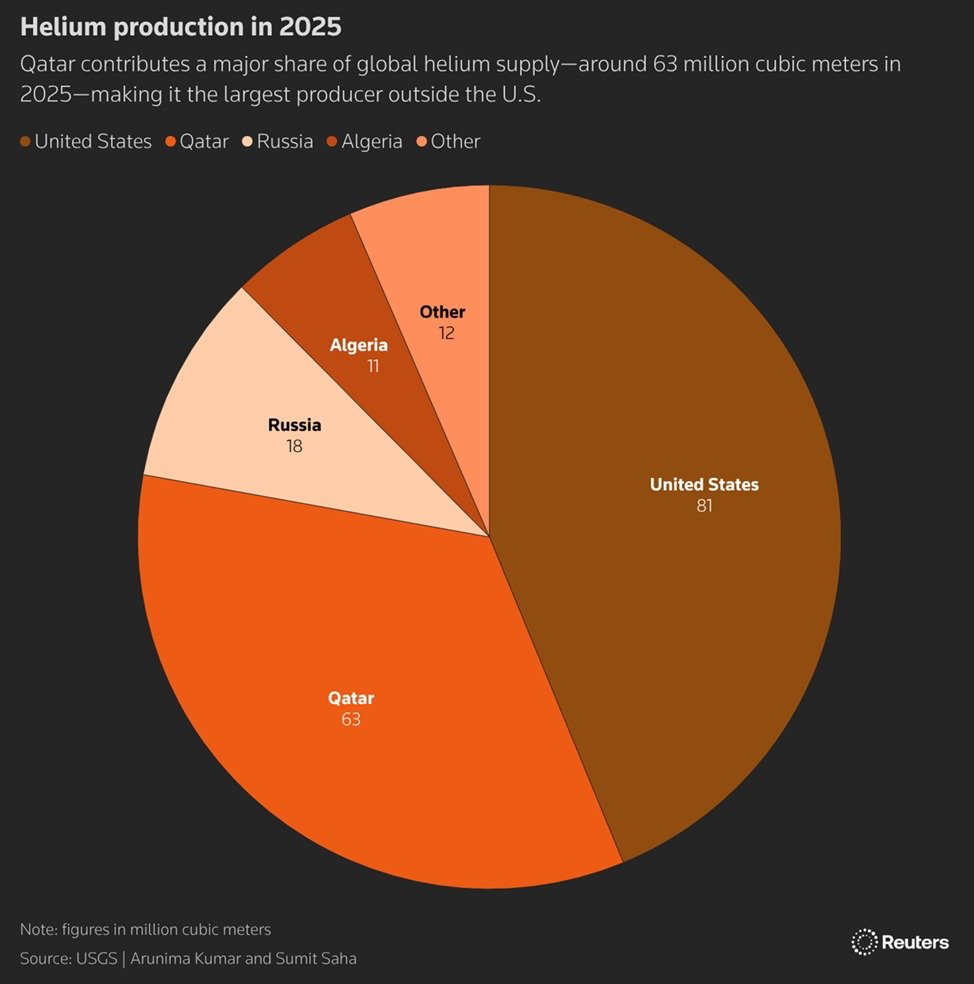
Qatar is the world's 2nd-largest helium producer, supplying ~33% of global output, at 63 million cubic meters in 2025.
When Qatar's Ras Laffan facility, the world's largest LNG export plant, shut down due to the Iran war, helium supply was cut, as helium is extracted as a byproduct of natural gas processing.
As a result, the market is now losing ~5.2 million cubic meters of helium per month, with almost no spare capacity globally, as helium evaporates during storage and must reach end users within ~45 days.
The disruption has already DOUBLED helium prices since the Iran war began.
If disruptions last 60 to 90 days, prices could surge another +25% to +50%, potentially exceeding $2,000 per thousand cubic feet, over 4 times early 2026 levels.
The Iran war is disrupting far more than oil and gas.
Top 10 most disruptive industries over the next decade:
• Space
• Drones/Robotics
• AI & Compute
• Rare Earth & Critical Minerals
• Energy & Batteries
• EVs & eVTOL
• Advanced Manufacturing
• Biotech & Longevity
• Cybersecurity & Quantum
• Defense Technology