Please support if you can...
@TrustDianne The Dianne Oxberry Trust is hosting this amazing event at Media City.
Amazing guests, inspirational women a fashion show and fizz
https://t.co/EAMKBpYVdx
Dave's log, Sunday.
7:00am: "Keith is not in the field. Keith is not on the barn roof. Keith is not in the yard, the feed store, the polytunnel, or the oak tree. I have checked all seven gates. All seven gates are latched. I am going to get in the car."
Dave got in the car.
Keith was in the village.
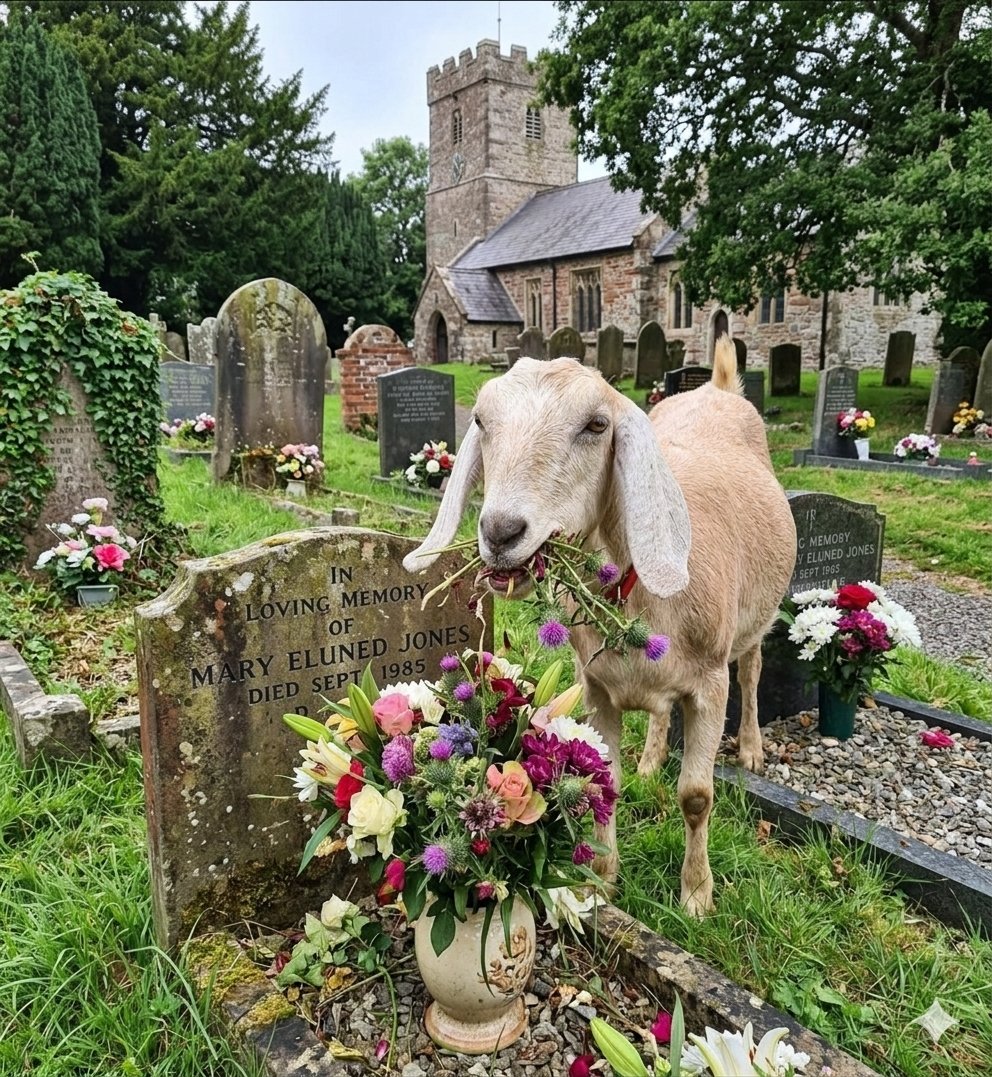
Specifically, Keith was in the churchyard. Not, to Dave's relief, in the church: the door was closed. Keith was in the churchyard eating the grass from around the older headstones, which had not been maintained and which the parish council had been discussing at its last two meetings without resolution.
Dave arrived at the churchyard at 7:45am.
Keith was working a systematic grid, row by row, starting from the east boundary. He had cleared approximately eight graves' worth of long grass, dandelion, and dock.
Dave stood at the churchyard gate for a while.
Keith continued his grid.
The Reverend arrived at 8:00am for early service preparation and found Dave standing at the gate watching a goat work the east section.
Reverend: "Is that yours?"
Dave: "Yes. Sorry. I don't know how he..."
Reverend: "He's doing the east section."
Dave: "Yes."
Reverend: "The parish council has been meaning to do the east section for two months."
Dave: "I know. He'll have it done by nine."
Reverend: "Can he come back next month?"
Dave looked at the Reverend.
Dave looked at Keith.
Keith had moved to the third row.
Dave's log, later: "The Reverend has asked if Keith can come back. I told him I'd think about it. I'm adding a column. The column is labelled: Ecclesiastical."
Steve's complaint number twenty-nine arrived that afternoon. Subject: ground elder again. Keith had apparently made a return visit to Steve's garden at some point between the churchyard and Dave collecting him. Dave's log: "I don't know when. He has a route. The route includes Steve. Steve is part of the route now."
By 11am Keith was back in his own field, eating knotweed.
The knotweed is at 6%.
The east section of the churchyard is tidy.
The Reverend has Dave's number.
Dave added the column.
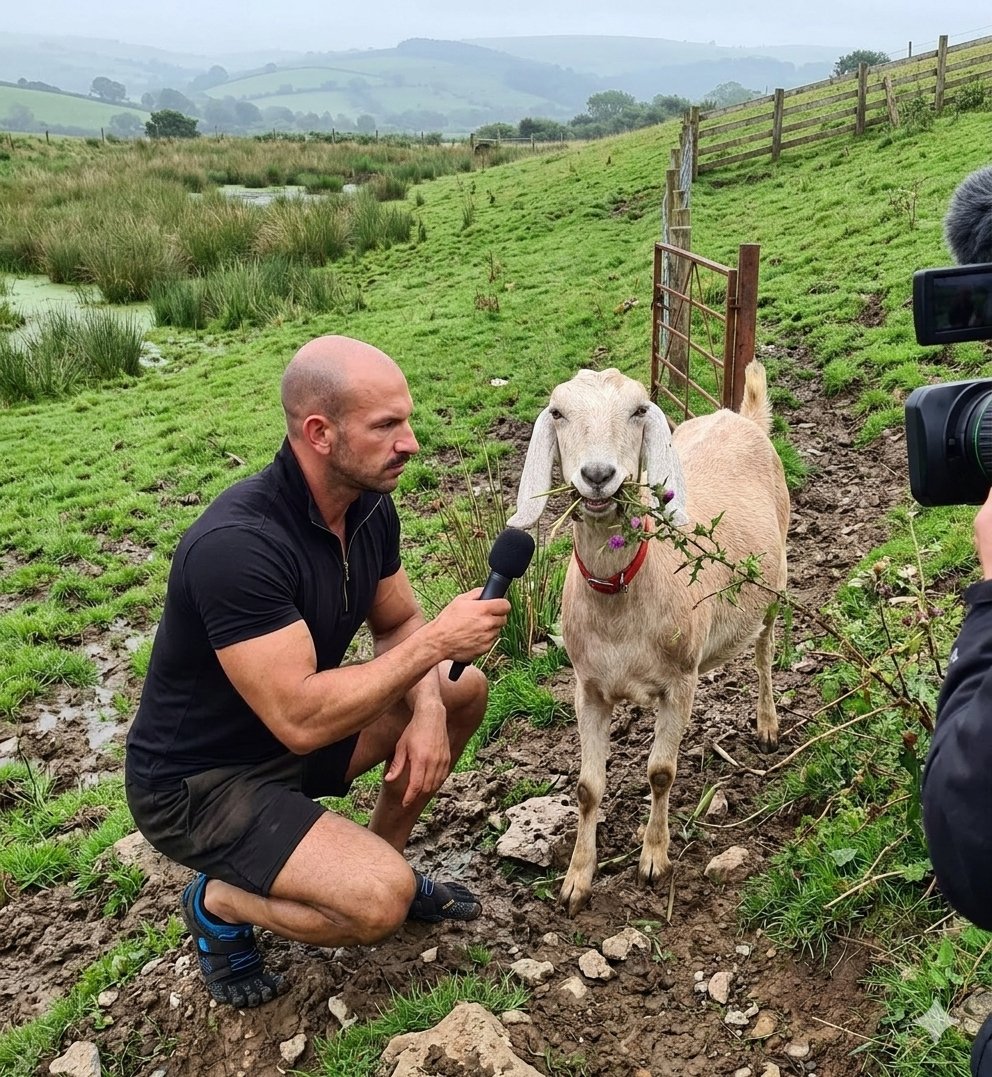
We caught up with Keith this week to put the charges to him directly.
Keith. The accusation, as I understand it, is that you and the wider ruminant community are bent on ecological destruction. Methane. Land use. Water. The usual list. How do you respond?
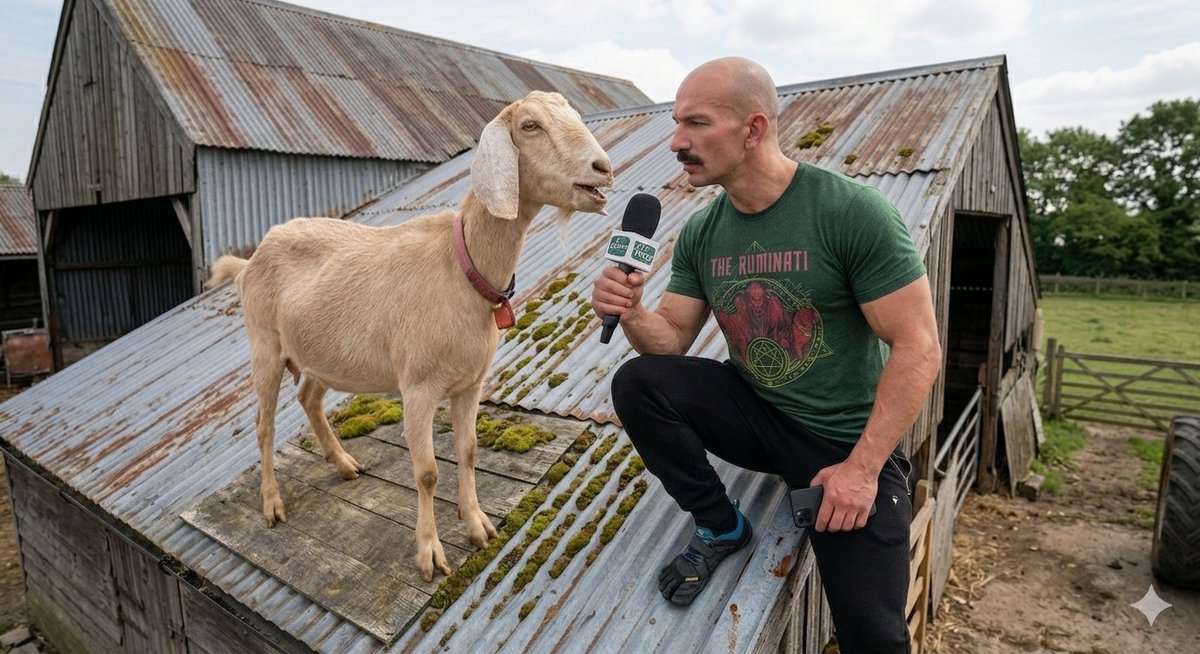
Keith was on the barn roof.
We climbed the roof to get closer.
Keith, specifically: do you believe that your presence in this field represents a net negative for the British environment?
Keith looked at us.
He looked at the east ditch.
The east ditch, which twelve months ago contained knotweed so established that the Environment Agency had quoted £4,000 and three years to remove it, is clear. The red campion that arrived in the knotweed's absence is flowering.
He looked at the south bank.
The south bank, which six months ago was a bramble monoculture of the specific density that supports nothing, is now open scrub with wildflower establishment at the margins.
He looked at Steve's fence.
We looked at Steve's fence.
Keith looked back at us.
Keith. Final question. Do you have anything to say to the people who believe ruminants are destroying the planet?
Keith pressed his nose to the barn roof ridge and assessed the remaining lichen.
The lichen is approximately 60% present.
The rest of the roof needed managing.
Keith is managing it.
We climbed back down.
Dave's log, that evening: "Keith had a journalist on the roof this morning. The journalist appeared to have fallen off at some point. Nobody was hurt. Keith continued with the lichen. Net outcome: neutral on the journalist, positive on the roof."
Keith was unavailable for further comment.
Keith had identified a new section.
We need your help to #SaveDenby!
We are sad to share that we may be forced to close and a British institution could be lost.
We need your help:
1. Share this post
2. Sign the government petition
3. Buy Denby
4. Visit us at the Pottery Village
Read more: https://t.co/g17lHz2ETx
@JaneFallon I was in a similar situation 25 years ago. Had a lumpectomy followed by radiotherapy and still here to prove the system works - first mammogram after turning 50. Keep positive and I’m sure all will be well 😘
The farmer bought Doris at the autumn sale in Lazonby when she was four months old.
She was one of six Texel gimmer lambs in a pen. The farmer walked the pen once, looking at feet and condition and the general bearing of each animal. Five of the lambs moved away from him. One stood at the gate of the pen and looked at the fell through the auction mart roof and the gap in the corrugated sheeting above the pens where the sky showed through.
The farmer bought that one.
He put her in the trailer with two older ewes from the home flock. The older ewes moved to the back of the trailer. Doris stood at the trailer slats and watched the road to the fell.
He turned her out in October.
It was cold. The older ewes went to the shelter of the low wall. Doris walked directly up the fell to the 380-metre contour, stood into the wind, and looked at the fell from the top down.
She was four months old.
She stood there for a long time.
"She was mapping it," the farmer told Brian the following spring. "I know that sounds daft. But she stood up there for about twenty minutes and then came back down and she's known where everything is ever since. Never seen her lost. Never seen her uncertain about a route."
Brian: "Herdwicks do that. Heft-memory, they call it. Passed from ewe to lamb."
Farmer: "She's a Texel."
Brian: "Aye."
Neither of them said anything for a while.
"She found the east wall gap in her first month," the farmer said eventually. "I didn't show her. I didn't know it was there."
Brian looked at his own wall.
Brian knew about the gap.
Brian said nothing.
Doris was four months old.
Doris had already mapped the fell and found the exit.
The rest was just detail.
Someone will ask why an account about nutrition and training has made a dozen posts on a bull in Ledbury, a goat without borders, and a ewe with a complicated relationship with topographic dips.
Here is why.
Because the argument that these animals are destroying the planet is not a fringe position. It is in the newspaper. It is in the policy document. It is in the dietary guideline. It is being taught to children and repeated by adults and acted on by governments and it is wrong, and it is wrong in a specific, demonstrable, measurable way that becomes obvious the moment you look at an actual field with an actual animal in it.
Gerald is not an abstraction.
Keith is not a statistic.
Doris is not a carbon calculation.
They are specific, real, working animals doing specific, real, measurable things to specific, real pieces of land, and the argument against them has never once required anyone to look at the land.
So we looked.
And the land is fine.
The land is better than fine.
The land is a meadow in Ledbury, a fell in the Lake District, and a Devon field with a rank corner that Keith has been improving without Brian's permission for four months.
Come back tomorrow.
There's more.
We put the land use argument to Keith.
Keith. You are occupying agricultural land that could, theoretically, be used to grow crops. How do you respond?
Keith stopped chewing.
He looked at the field.
The field is on a 30-degree slope in Devon. The topsoil is clay. The drainage is complicated. No tractor has successfully operated in the lower section without becoming a story people tell in the village pub.
Keith looked at us.
Keith, do you believe this field could produce food crops without you on it?
Keith walked to the lower section of the field. He ate a thistle. He stepped on a bramble runner and ate that too. He looked at the clay in the corner where it waterlogged every winter and produced nothing except rushes, which Keith also ate.
Are you saying the field is only productive because you're on it?
Keith looked at us with the expression of an animal that has grasped the argument entirely and found the question slightly beneath him.
He then left through the gate he had opened by himself.
He was in the road for nine minutes.
He ate a passing cyclist's energy bar.
We are not including this in the land use efficiency report.
Keith's permanent record, as maintained by the farmer's wife, who started writing it down after the third incident last week:
Entry 1: Ate the compost.
Entry 2: Escaped. Was in the road for twenty minutes. Ate a neighbour's ornamental grasses.
Entry 3: Ate part of the vet's bag. The vet was here for another animal. Keith was not the patient.
Entry 4: Escaped again. Found in the churchyard. Had eaten several of the flowers from the cemetery. This required a phone call.
Entry 5: Ate the instructions for the new water heater.
Entry 6: Ate most of the contents of the feed store. The latch was fine. Keith had studied it.
Entry 7: Escaped. Was found in the village. Had, at some point, eaten something that resulted in an incident outside the post office. This required two phone calls.
Entry 8: Ate a significant portion of invasive scrub on the south slope. No entry required; this was helpful. Noted here only for completeness.
Entry 9: Escaped.
The farmer's wife is not angry.
The farmer's wife has accepted Keith.
The farmer's wife now locks everything.
Keith is still finding things.
Keith is not a pet.
Keith is not a problem.
Keith is not an environmental concern.
Keith is not a methane producer requiring regulation.
Keith is a four-legged scrub management system that runs on bramble and produces cheese, and has been doing this exact thing, in fields like this exact field, for ten thousand years.
The people expressing concern about ruminants and the environment have not met Keith.
If they met Keith, they would either immediately understand the point or spend eleven minutes in the lane trying to catch him.
Both outcomes are instructive.
Having been seized from an abusive owner by the RSPCA Thunder has been in kennels for 3 months but no one wants a Mali x & so he remains there with the threat of being PTS. He is nothing like a Mali just a gentle chap who craves human company. Give him a chance. He is lovely.