The Kremlin will likely formally amend restrictions on mobilizing Russia’s active reserve to conduct rolling partial mobilization without declaring war on Ukraine or formally announcing that it is conducting a partial involuntary call up.
A🧵our latest with @georgewbarros.
WARNING: The Kremlin is Preparing to Mobilize Reservists on a Rolling Basis to Fight in Ukraine for the First Time: https://t.co/exWezQIOL7
Note: This warning does not suggest that the Kremlin is likely to undertake a single large-scale mobilization at this time.
Key Takeaway ⬇️
Russia may begin to mobilize members of Russia’s active reserve on a rolling basis to sustain its combat operations in Ukraine, but it is unlikely to conduct a large-scale involuntary reserve mobilization to expand the size of the Russian military dramatically at this time.
The creation of a mechanism for small, rolling mobilizations would be a major inflection in Russia’s force generation strategy, which so far has sought to generate recruits through growing financial incentives and sign-up bonuses to avoid mass compulsory mobilization after the challenging involuntary reserve call up of late 2022.
The Russian Cabinet of Ministers’ Commission on Legislative Activity passed a new draft amendment that effectively removes the current legal barriers against deploying reservists to combat in the absence of an officially declared mobilization or war.
Russia’s existing “pay-to-play” system for generating recruits is likely hitting diminishing returns and is forcing the Kremlin to adopt a different approach using rolling compulsory mobilization of reservists to sustain its manpower in the face of its continuing high casualty rate in Ukraine.
NEW: SPECIAL REPORT | Gasoline Shortages in Occupied Ukraine Show the Synergy of Ukraine’s Long-Range and Mid-Range Strike Campaigns
Ongoing gasoline shortages in occupied Ukraine come only weeks after Ukraine began ramping up its mid-range strike campaign against Russian ground lines of communication (GLOCs) in the operational rear.
Ukraine’s long-range strike campaign against energy infrastructure in Russia’s deep rear is also contributing to the gasoline shortages.
The long-range strike campaign is reducing Russia’s production capacity, while the mid-range strike campaign is hurting Russia’s ability to transport the gasoline Russia is still able to produce.
Russian political scientist and former intel officer Andrey Bezrukov stated at the SPIEF that Russia "...will live under wartime conditions for several more decades. The world is already in a phase of global conflict, and the next 20 years will be a time of constant confrontation for Russia. An era of wars in Asia—as well as biowars and drone wars—is coming." To the right of Bezrukov in this video is Aleksandr Dugin, Russian ultra-nationalist and neo-Eurasianist. https://t.co/GX6c8sJNFv
‼️Rubio: Russia may not ever be able to militarily achieve the objectives they're now demanding in negotiations.
The Ukrainians have made battlefield gains over the last month. Ukraine has also become increasingly effective at conducting long-range strikes deep inside Russia and against critical nodes of the Russian economy.
And according to the Department of War, this is the first time ever that Russia has more deaths than casualties. So not only are the Ukrainians bravely fighting, they're effectively fighting.
The role we want to play is to see whether there's a way to negotiate a peaceful solution. Ultimately, the end of this war is going to be negotiated. But it's been difficult because the demands both sides have set for ending it remain far apart.
Meet the @TheStudyofWar researchers who say the Ukraine war has entered a new phase to Ukraine’s advantage and that now is the time for its allies to provide crucial help.
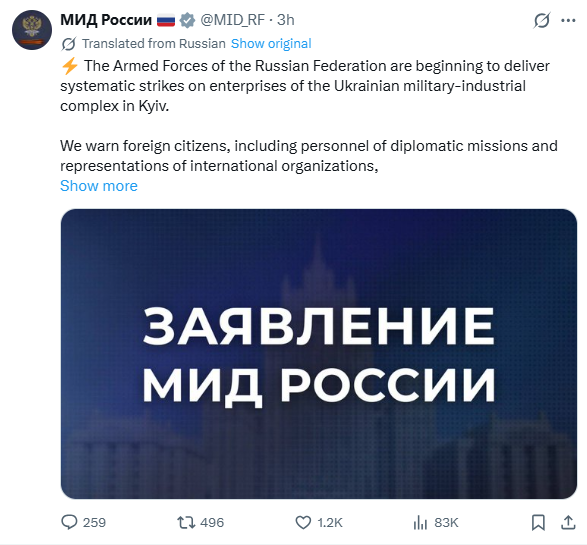
UPDATE: The Kremlin has threatened to systematically strike Kyiv, including government buildings, in violation of the spirit of the US-brokered Victory Day ceasefire. Intensified Russian strikes on Kyiv are likely meant to show Russia’s supposed strength in the face of the failures of Russia’s Spring-Summer offensive. Putin also continues to try to recover from the humiliation of having to beg Ukraine for permission to hold a Victory Day parade. Russian missile and drone attacks on Kyiv will not offset Ukraine’s edge on the battlefield, resulting from an increased overall drone advantage and an intensified campaign of intermediate-range strikes.
The Russian Foreign Ministry (MFA) released a warning on May 25 stating Russia’s intent to launch a “systematic series of strikes” against Ukrainian defense industrial and drone production facilities, decision-making centers, and headquarters.
The Russian MFA urged foreign citizens, diplomats, and NGOs to evacuate Kyiv as soon as possible, and warned Kyiv residents to avoid military and government infrastructure in the city. This warning shows that another purpose of these Russian strikes is to isolate Ukraine from its international partners.
Russia is likely planning to conduct large-scale missile and drone strikes because Ukraine has re-secured an overall drone advantage on the battlefield, causing Russian battlefield gains to flatline amidst the Summer 2026 offensive.
The Kremlin is trying to recover from Putin’s humiliation from having to ask Ukraine for permission to hold the Victory Day parade and to distract from his inability to shield the Russian population from the growing cost of his war, including Ukrainian long-range drone strikes.
Putin is also trying to exploit Ukraine’s shortage of air Patriot defense interceptors capable of intercepting ballistic missiles. Russia will continue to resort to large-scale missile and drone strikes to conceal its weakness.
The Russian threat – and the May 23-24 Russian combined missile, drone, and Oreshnik intermediate-range ballistic missile (IRBM) strike, which heavily targeted Kyiv City – violates the spirit of the three-day Victory Day ceasefire, in which Putin agreed that Russian forces would not strike government centers in Kyiv with large strike packages if Ukraine allowed Russia to hold a parade on Red Square.
Ukraine abided by the agreement and allowed Putin to hold a parade. Russia’s decision to conduct devastating strikes against Kyiv in the weeks following the parade, all the same, demonstrates Putin’s unfaithfulness to any agreements that do not heavily favor him.
NEW: SPECIAL REPORT | Ukraine is actively challenging the positional character of the war that has dominated the battlefield since 2023. Russian battlefield gains are approaching net zero while Ukrainian forces are setting conditions potentially to break out of positional warfare by reintroducing limited elements of mechanized maneuver at the tactical level.
Ukraine has re-secured an overall drone advantage and fielded systems capable of disrupting Russian forces throughout their operational depth in support of planned Ukrainian offensive or defensive ground operations. Neither Russia nor Ukraine is able to conduct operational maneuver yet, however.
Ukraine’s success in blunting Russian advances and reversing Russian gains in some sectors of the line, in tandem with Ukraine’s limited reintroduction of elements of tactical mechanized maneuver may nevertheless mark the beginning of a new phase of the war.
Combat in Ukraine will likely become less positional and feature more tactical maneuver until Russia’s innovation cycle renders Ukraine’s current operational concepts ineffective. Ukraine likely has a unique and time-constrained opportunity to exploit its current initiative while Russian forces remain vulnerable.
Ukraine’s partners should expand their support to these Ukrainian efforts at a moment when Russia is reeling from both battlefield setbacks and Ukraine’s deep strike campaign with the aim of forcing Russian President Vladimir Putin to reevaluate his approach to this conflict.
We’re calling it: The war in Ukraine has entered a new phase.
@KatStepanenko and I have authored a new special report studying how Ukraine is actively challenging the positional character of the war that has dominated the battlefield since 2023.
Data on Russia’s battlefield performance��indicates that the character of the war is shifting in favor of Ukrainian forces – at least for now. Russian forces rates of advances are stagnating while Ukrainian forces are employing novel tactics and operational concepts in efforts to break out of positional warfare. Neither Russia nor Ukraine can conduct operational maneuvers yet, however.
The bottom line is that the war in Ukraine is competitive and far from stalemated. Ukrainian forces are out-innovating Russian forces in both military technologies and in applying these new technologies in effective operational concepts that can help Ukrainian forces break out of positional warfare. Ukraine is employing mechanized equipment in tactical maneuvers in ways that were impossible 12 months ago. Russia’s ability to conduct infiltration missions will likely continue to degrade as Ukraine’s intermediate-range strike campaign pushes Russia’s logistics and forward operating bases further away from the frontlines, reducing resourcing to sustain infantry tasked with infiltration missions. Ukraine may be able to scale these effects if they resourced properly by international partners.
Ukraine’s advantage in intermediate range strikes is notably not permanent, and Russia will very likely eventually develop countermeasures to mitigate Ukraine’s advantages. Ukraine’s international partners thus have a rare and temporary opportunity to help Ukraine exploit favorable battlefield dynamics while Ukraine has the upper hand.
Key Points of the report:
• Russia’s rate of advance is plummeting during the Russian Spring-Summer 2026 offensive.
• Russia is losing more soldiers to make fewer gains, with monthly Russian casualty rates reportedly outpacing monthly recruitment since December 2025.
• Ukraine is starting to regain more ground than it is losing for the first time since 2023.
• Ukraine’ recent counterattacks feature unique characteristics and deviate from key trends that defined the positional character of the war since 2023.
• Ukraine is conducting a pattern of more frequent mechanized counterattacks at the tactical level for the first time since 2023.
• The Ukrainian command’s operational planning is maturing.
• Ukraine’s early 2026 counterattacks in the south were successful likely due to better planning and preparation of the battlefield.
• Ukraine has been conducting a coherent campaign to suppress and destroy Russian air defenses since late 2025, in order to shape the battlefield as part of more sophisticated campaign planning.
• Ukraine significantly intensified its intermediate-range strike campaign against dynamic targets in Spring 2026 in order to degrade Russian logistics at operational depths ahead of planned Ukrainian maneuver.
• Ukrainian forces started actively disrupting Russian railway logistics in occupied Ukraine and Russian western regions in Spring 2026.
• Ukrainian intermediate-range strikes are already achieving notable operational effects, including degrading Russia's ability to use the key Russian highway connecting Russia to occupied Crimea and GLOCs around Donetsk City.
• Ukrainian forces decisively seized the initiative in intermediate-range strikes by fielding new technologies such as the US-made Hornet strike UAV, among other systems.
• Ukrainian forces are achieving temporary tactical drone overmatch in some frontline sectors, which is slowing Russian offensive operations by degrading the effectiveness of Russian shaping operations.
• Ukrainian forces likely achieved tactical drone overmatch in certain frontline sectors after degrading Russia’s drone capabilities in late 2025 to early 2026 - primarily by suppressing drone launch positions and increasingly intercepting Russian tactical UAVs.
• Ukraine’s degradation of Russian forces at operational depth combined with tactical-level drone overmatch likely is creating vulnerabilities in the Russian lines.
• Ukraine’s intermediate-range strike campaign is likely far from its zenith, assuming continued support from Ukraine’s partners, and will likely intensify over 2026 as Ukraine fields new weapons capable of striking Russian’s operational rear.
Link to full report: https://t.co/rCeWbYJNiB
🚨Kyiv is under a massive combined air attack right now. Russia is hitting residential areas, schools, markets, and other civilian objects across the city. Friends say it’s one of the worst attacks they’ve experienced. The assault is still underway, with more missiles incoming.
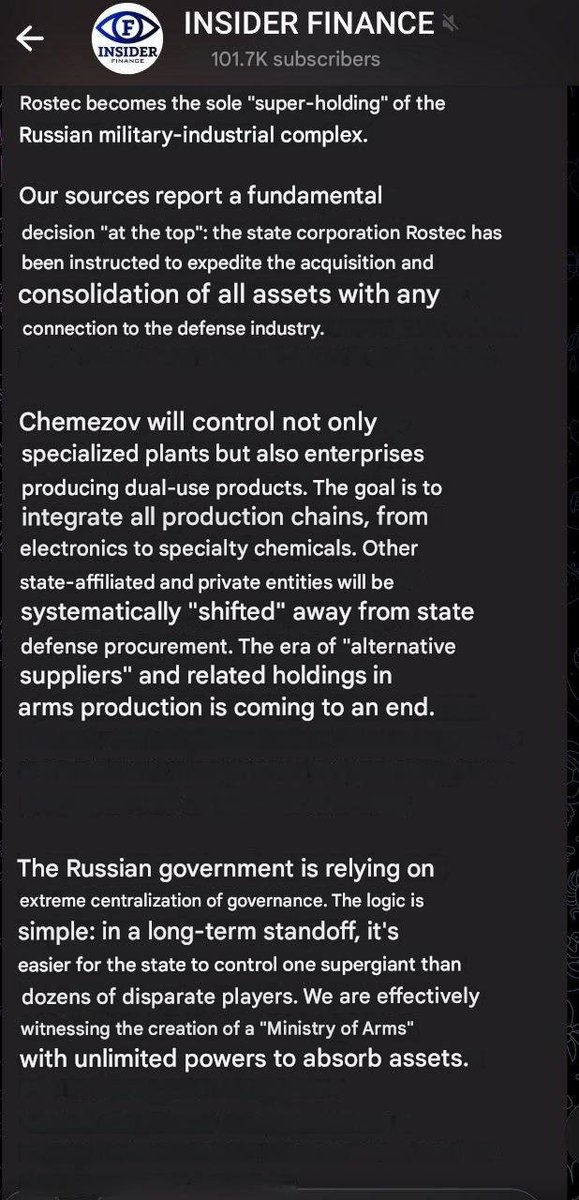
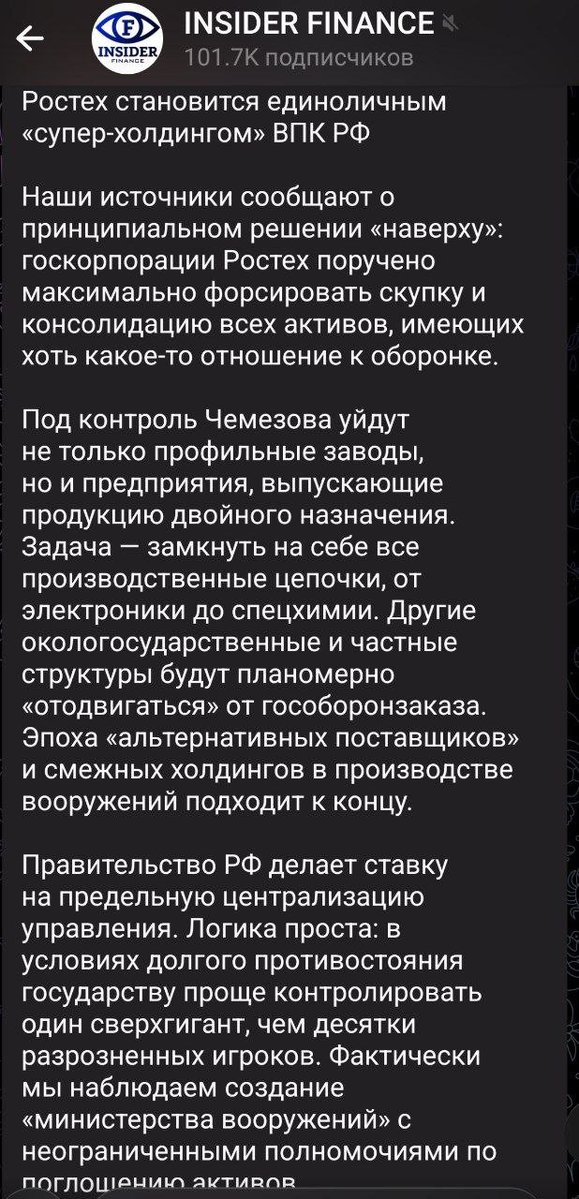
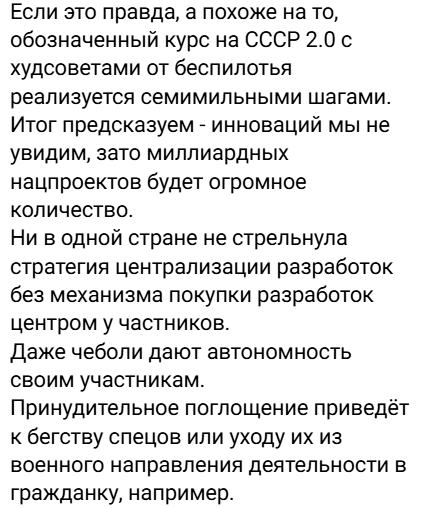
1/2 Rus mil bloggers are lamenting an even greater centralization of Russian weapons/systems development and manufacturing under Rostec state corporation, fearing such a move would stifle (all) innovation by smaller start-ups that have sprung up since 2022. https://t.co/yeCQxPVUL3
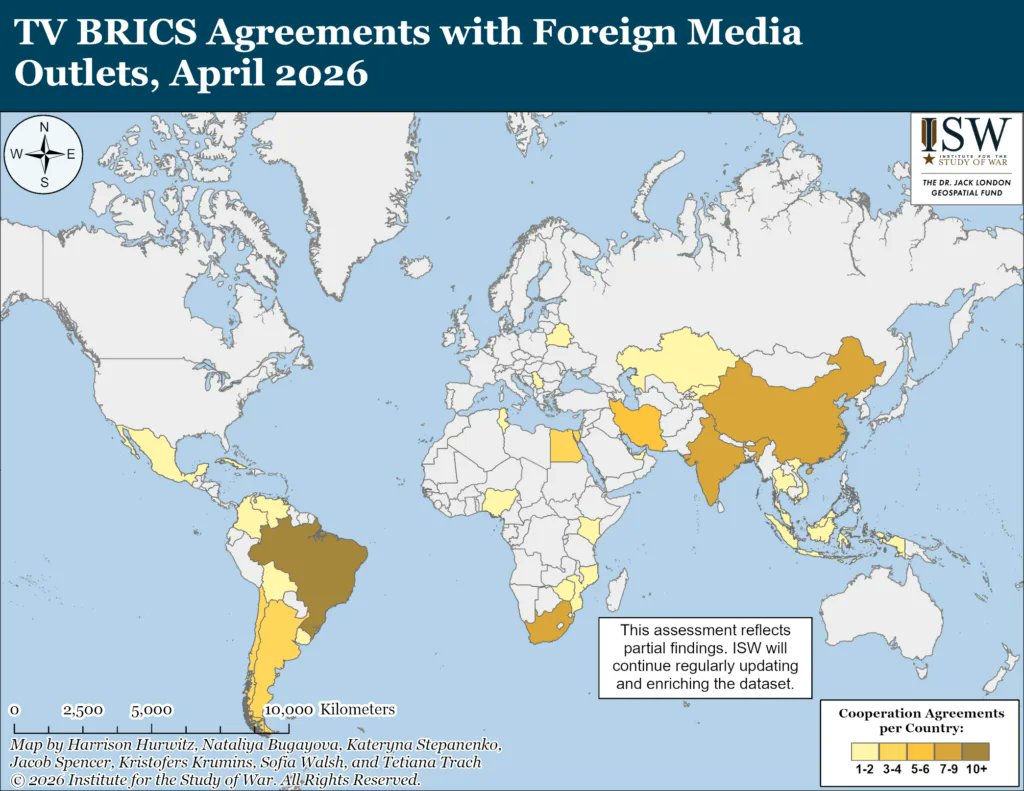
The Kremlin is expanding its cognitive warfare infrastructure to shape the global narrative for years to come. The Kremlin has been cultivating a network of foreign media outlets, content creators, and journalists through partnerships, outreach, and media education around the globe.
ISW is launching an interactive map displaying Russian cooperation agreements with foreign media outlets — a key pillar of Russia’s cognitive warfare effort. ISW will regularly update this interactive map to reflect the new layers of adversarial cognitive warfare infrastructure. (1/3)
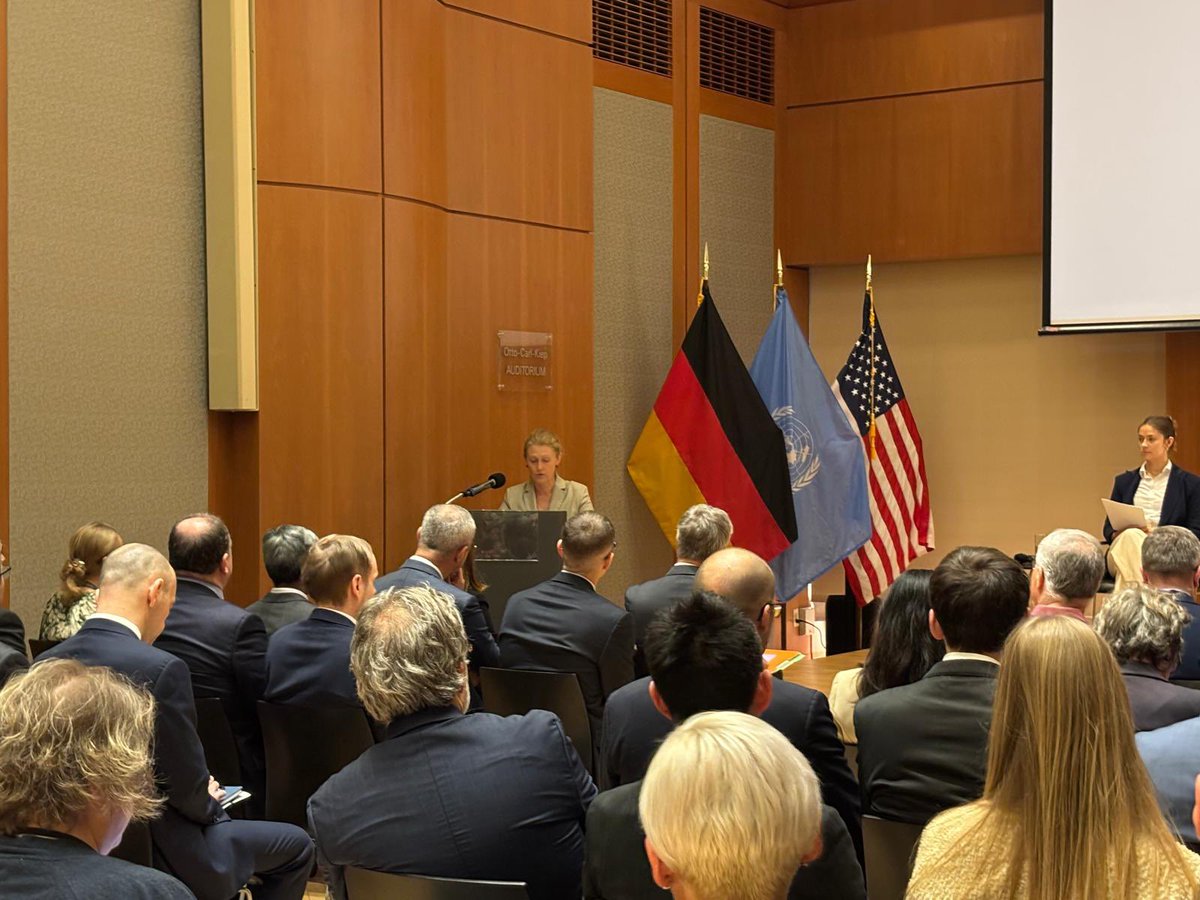
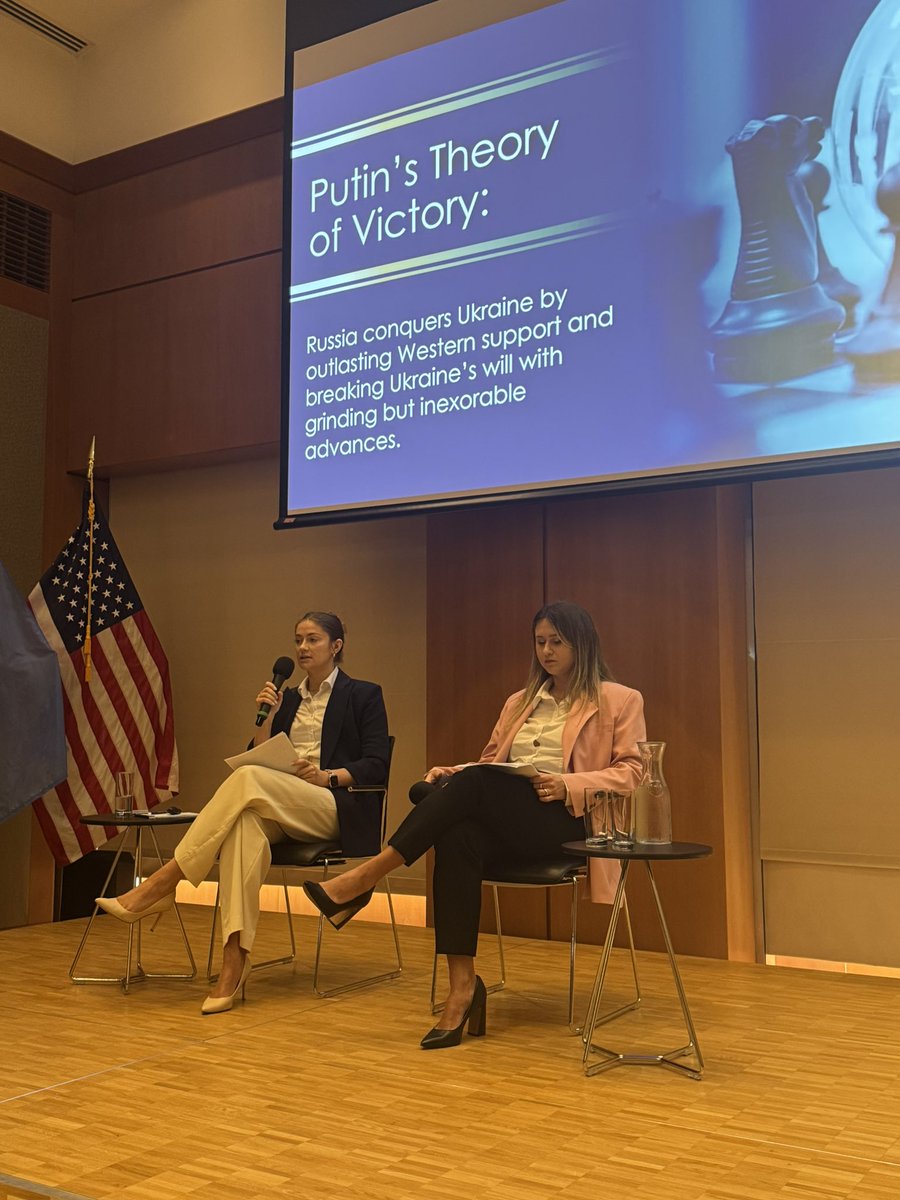
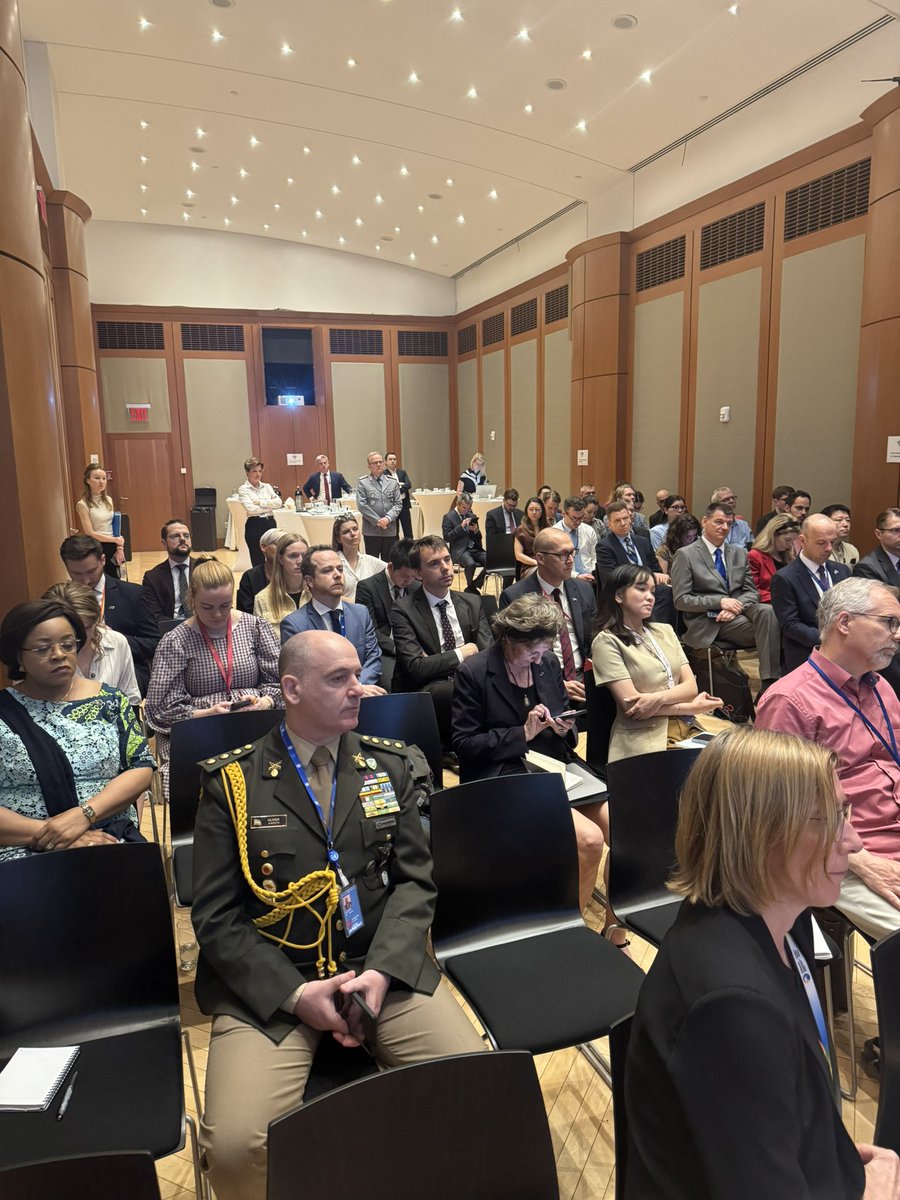
🇱🇻🇩🇪 The Permanent Missions to the @UN of Latvia and Germany co-hosted an informal briefing with the @TheStudyofWar Russia and 🇺🇦 Ukraine Team.
🎙️ ~70 Ambassadors, military advisors, experts, and journalists joined a valuable discussion on Russia’s war against Ukraine, testing the international rules-based system and reshaping modern warfare through technology and information.
🙏 Thank you Kateryna Stepanenko and Christina Harward for the insightful exchange.
📲 More from ISW: 🔗 https://t.co/Drq4CYWumM
MORE: Centralized control over drone distribution may allow Russian forces to more heavily concentrate drones and to supply more trained personnel in select areas of the front, but may also hamper their ability to innovate quickly. This new system will likely create a state monopoly over procurement, allowing for more corruption and eroding the volunteer-based procurement movement.
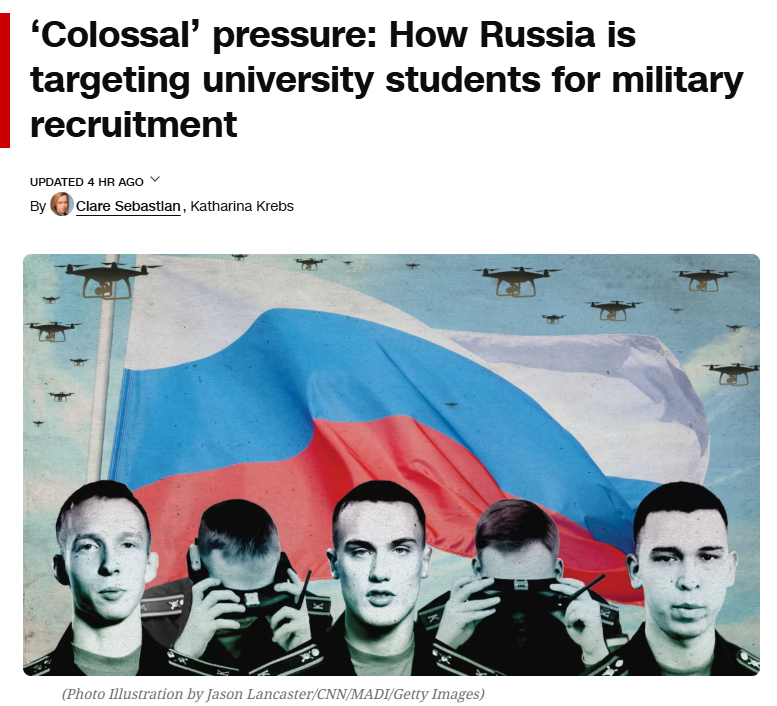
"Late last year Putin signed several decrees allowing for members of Russia’s military reserve to be called up for specific tasks and training, a move analysts from @TheStudyofWar have warned may pave the way for rolling involuntary or covert mobilizations."
Read more below from @KatStepanenko interview with @CNN on Russia's recruitment crunch ⬇️
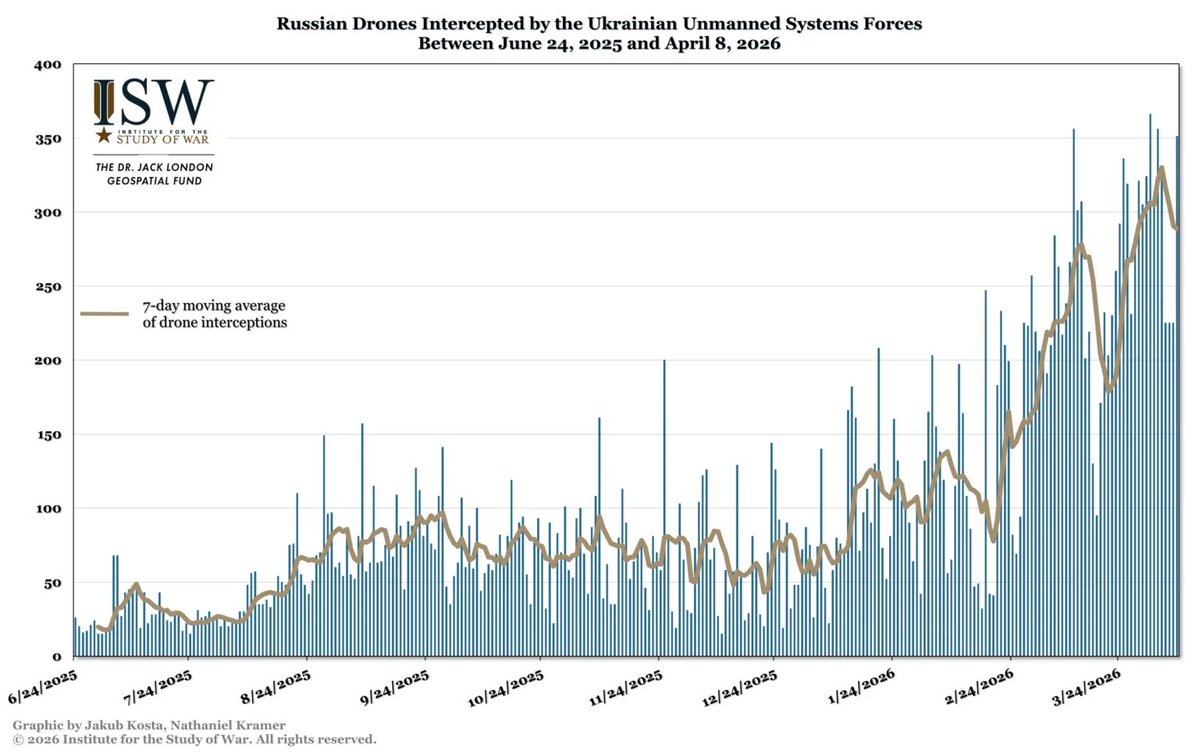
MORE: Ukrainian forces’ increasing strikes against Russian air defense systems and drone interception rates have facilitated recent Ukrainian battlefield successes. ⬇️
Ukrainian forces in Winter 2025-2026 and Spring 2026 have made their most significant gains on the battlefield since Ukraine’s incursion into Kursk Oblast in August 2024 and have liberated the most territory in Ukraine itself since the 2023 counteroffensive.
Ukrainian Unmanned Systems Forces (USF) Commander Major Robert “Magyar” Brovdi reported on April 9 that USF forces have destroyed nine Russian air defense systems in occupied Ukraine since April 1. Ukrainian USF forces have increasingly intercepted Russian drones since late February and March 2026, intercepting a total of 2,975 in January, 3,679 in February, and 7,674 in March 2026.
Interceptor drones have important tactical battlefield implications as Russian forces rely on drones to disrupt Ukrainian defenses, which, in turn, enables Russian advances and prevents Ukrainian advances. Ukraine’s increasing interceptions of Russian drones are therefore contributing to slowing Russian advances and permitting Ukrainian counterattacks.
Ukraine’s defensive successes, drone adaptations, and mid-range strike campaign are creating compounding effects that are degrading Russian frontline forces.
NEW | Special Report: The Kremlin’s Expanding Media Conglomerate (1/2)
The Kremlin has been cultivating a network of foreign media outlets, content creators, and journalists by forming partnerships, conducting outreach, and fostering media education across the globe.
Russian news agencies and broadcasters have been engaging in a deliberate effort to sign cooperation agreements with foreign media outlets. Russia has prioritized the People's Republic of China, Iran, and India in its media outreach since the full-scale invasion of Ukraine.
The Kremlin will likely intensify its efforts to expand the media conglomerate over the coming years, especially as the United States is reducing its global media outreach.
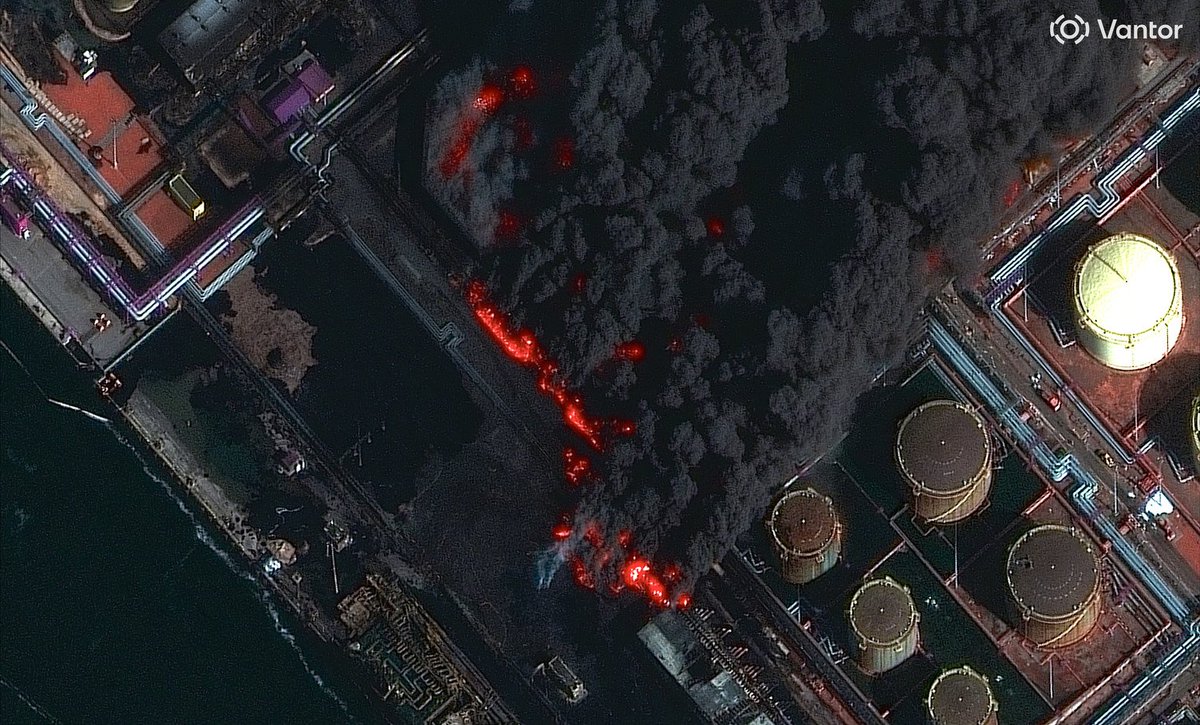
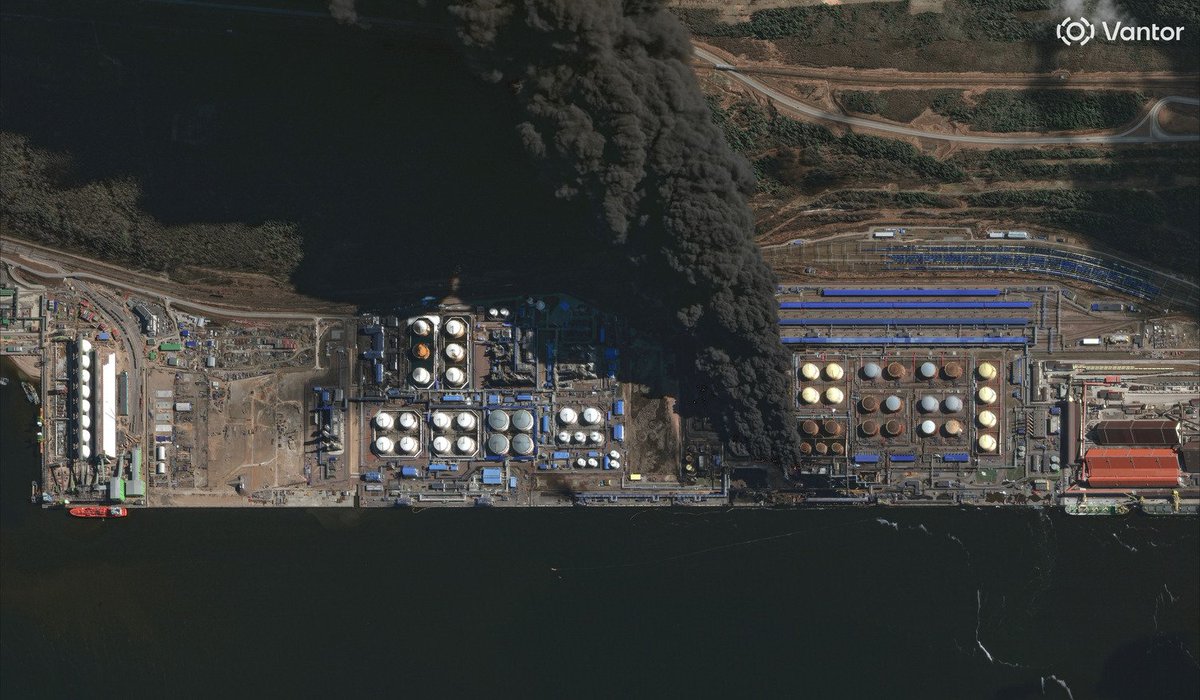
New imagery collected on March 27 shows a large fire at the Ust-Luga oil terminal in northern Russia. Multiple oil storage tanks are on fire and dark smoke is billowing from the area.
📷@vantortech
The "Narva People's Republic" now has a flag, a coat of arms, and a Telegram network. Ukraine saw this playbook in 2014 – now it's appearing in a NATO member state.
The same "People's Republic" branding that preceded Russia's Donbas occupation is targeting Estonia's border region.
https://t.co/a6OewkHBu4
ISW recently assessed that Ukrainian forces were likely able to rapidly advance in the Oleksandrivka direction after infiltrating dispersed Russian positions in poor weather conditions & suppressing Russian drone-based defenses. https://t.co/ZXCOzYmlLm
NEW: Ukrainian forces advanced 10 to 12 kilometers deep in two separate drives in Dnipropetrovsk Oblast that have reportedly liberated more than 400 square kilometers since late January 2026. 🧵(1/3)
Ukrainian forces conducted mutually supporting drives in the Hulyaipole and Oleksandrivka directions in late 2025 and early 2026, respectively, to push Russian forces from Dnipropetrovsk Oblast and to undermine Russian preparations for a spring offensive.
Ukrainian forces were likely able to rapidly advance in the Oleksandrivka direction after infiltrating dispersed Russian positions in poor weather conditions and suppressing Russian drone-based defenses.
SpaceX’s blocking of Russia’s Starlink satellite connection in Ukraine in early February 2026 likely also enabled Ukrainian advances in Dnipropetrovsk Oblast.
Russian President Vladimir Putin continues to exaggerate Russian battlefield advances despite Ukrainian forces’ recent liberation of significant territory in southern Ukraine.
Ukrainian counterattacks in southern Ukraine are likely interfering with the anticipated Russian spring-summer 2026 offensives in Donetsk Oblast and southern Ukraine despite Putin’s claims of Russian battlefield successes.
Russia also continues to suffer massive losses on the battlefield that will continue to hinder Russia’s ability to achieve its sweeping goals for the spring-summer 2026 campaign.
Ukrainian forces are intensifying their theater-wide mid-range strike campaign against Russian logistics, military equipment, and manpower, which will likely also interfere with the Russian spring-summer 2026 offensive.
Kremlin officials provided varying accounts of US President Donald Trump’s statements about a ceasefire in Ukraine during his March 9 call with Putin.
Putin continued to call on the US to halt its ongoing military operation in the Middle East while refusing to end Russia’s own war in Ukraine.
The Russian government is reportedly considering a bill that would grant the Russian president powers for extraterritorial military operations to protect Russian citizens abroad.
Ukrainian mid- and long-range strikes on Russian tactical drone production sites, storage facilities, and operators are likely starting to show real effects on the battlefield.
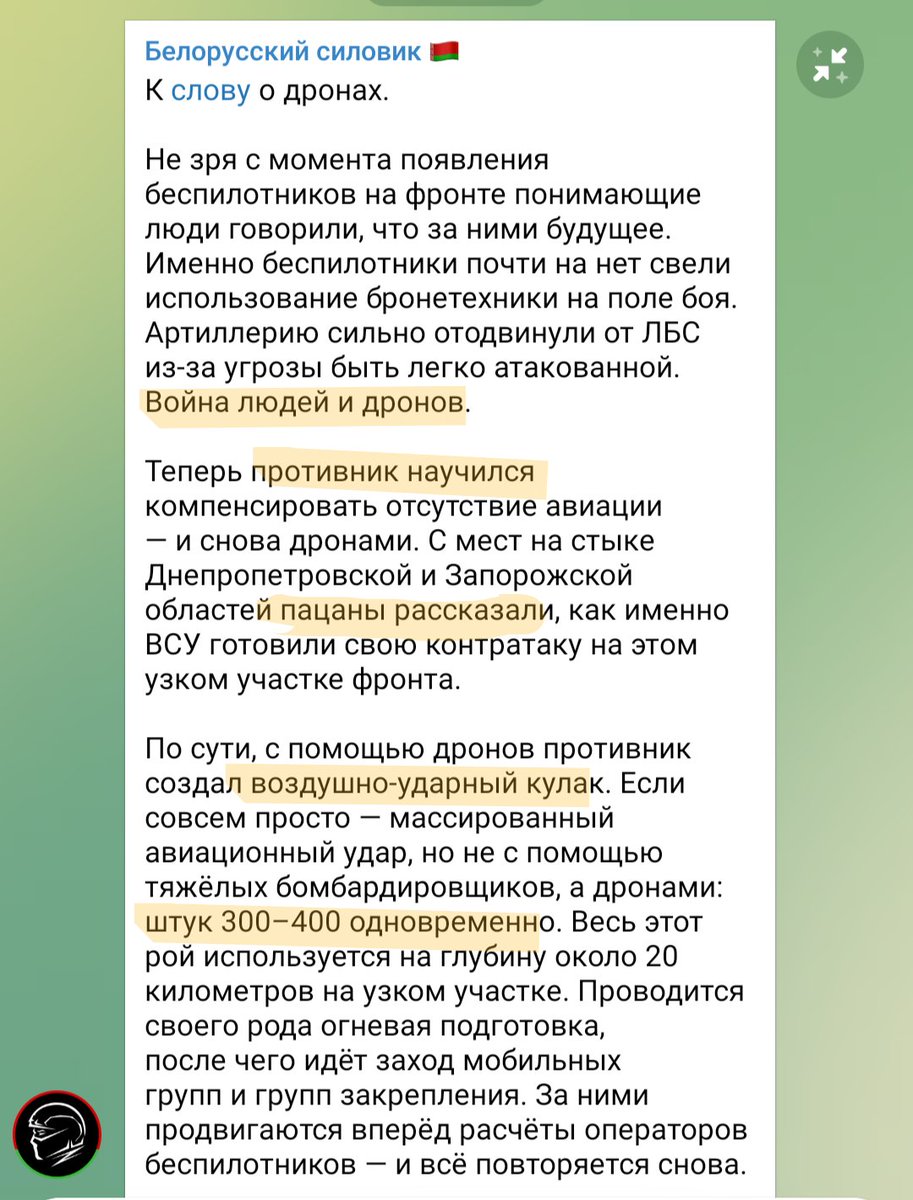
Russian milbloggers are complaining that Ukrainians are overwhelming Russian positions with hundreds of drones - which reportedly contributed to Ukrainian shaping operations ahead of the counterattacks in Dnipropetrovsk Oblast. https://t.co/RrWwqG6Boq
Russians at the front are complaining that Ukrainian forces over overwhelming them with swarms of 300-400 drones which are then followed by mobile infantry that advance through their positions.