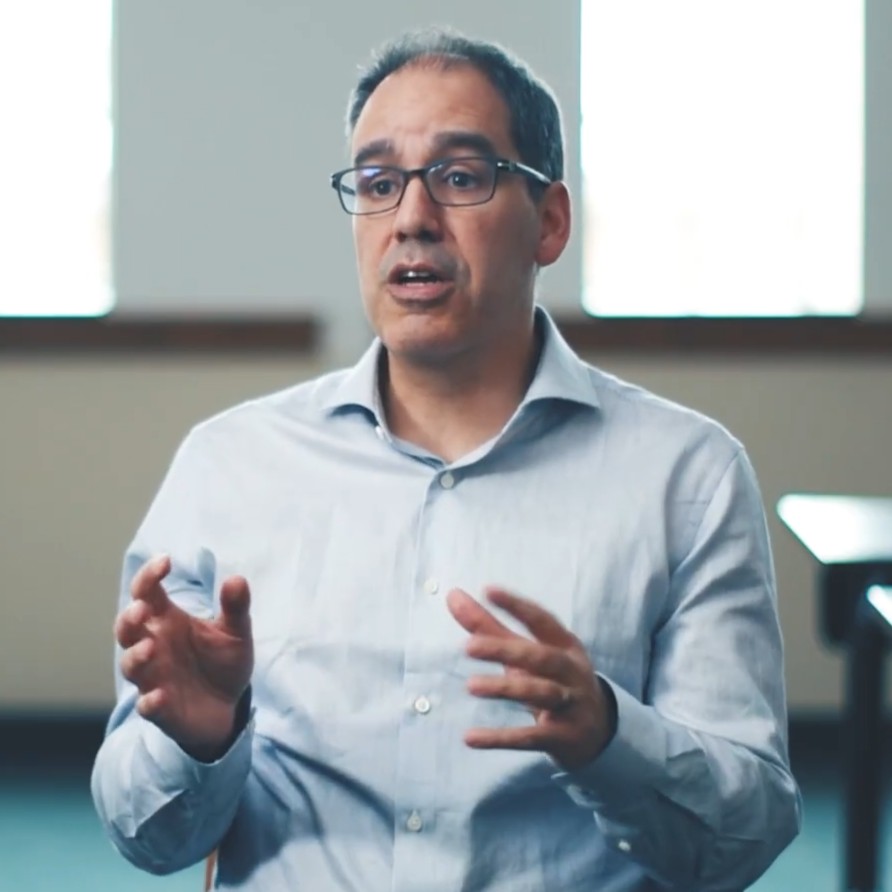
Morocco and Tunisia present very different challenges for researchers studying democratic change. What can their political trajectories tell us about the strengths and limits of forecasting?
On Kellogg’s Global Stage podcast, political scientist Hamid Ait El Caid joins Jorge Ruiz to discuss research comparing five forecasting models in North Africa and the Middle East, and why interpreting their results requires local knowledge and human judgment.
Listen wherever you get your podcasts: https://t.co/VoWDPgSalh
@jorgerure
#Democracy #ArtificialIntelligence
Bank bailouts can soften a banking crisis while increasing the government’s risk of default.
In “Optimal bailouts in banking and sovereign crises,” Kellogg faculty fellow César Sosa-Padilla (@cesarspa1) and coauthors examine this trade-off. Their model finds that although bailouts ease crises when they occur, having the option available leads to more frequent government defaults and lower output and consumption overall.
Published in the Journal of International Economics.
Read more: [https://t.co/PIpc5kjpXe
#Economics #Banking #SovereignDebt
AI is opening new possibilities for studying how democracies develop, endure, and decline. What can these approaches tell us, and what questions do they raise?
A special four-episode series of Global Stage features speakers from the AI-driven Modeling & Forecasting for Democratic Development and Decline (AIM4D) International Conference, held at Notre Dame October 15–17, 2026.
Start with conference conveners and Kellogg faculty fellows Michael Coppedge and Dmitry Zaytsev, who discuss the promise and challenges of bringing AI into democracy research.
🎧 Listen here or wherever you get your podcasts: https://t.co/Fl3b0j1Z5g
#Democracy #AI #GlobalStage
With 128 students enrolled this fall, Kellogg Developing Researchers is now the largest undergraduate program in our institute’s history, and growing connections with @KeoughGlobalND are creating more opportunities to learn research by doing it.
Keough faculty across the School can now request paid student research assistants for specific projects, while Master of Global Affairs alumni are helping undergraduates connect research methods to professional practice.
Through workshops and opportunities to contribute to faculty projects, KDR gives Notre Dame students a place to start researching and build their skills.
Read the story, including how students and faculty can get involved: https://t.co/aVVWxQ9Id3
#UndergraduateResearch #NotreDame #KeoughSchool
Industrial decline can change who earns a household’s income and how its members vote.
In “Breadwinner backlash: The Gendered Effects of Industrial Decline,” Kellogg faculty fellow @ProfRickyClark and his coauthors find that men’s job losses, combined with women’s growing share of the workforce, can increase support among both men and women for right-wing movements promising a return to traditional gender roles.
Published in the American Journal of Political Science, the study draws on decades of US labor market and voting data.
Read more: https://t.co/UYGPYnX0HU
#PoliticalScience #Gender #PoliticalEconomy
What happens when obeying elected leaders means helping them undermine democracy?
In “Military Responses to Democratic Erosion,” published in Security Studies, Kellogg visiting fellow Risa Brooks and her coauthor identify six ways militaries respond, from actively partnering with leaders to blocking their antidemocratic efforts.
The article offers a framework for understanding those choices and raises a difficult question: What are the risks of relying on militaries to protect democracy?
Read more: https://t.co/5HmV0XIZC3
Congratulations to Kellogg faculty fellow Katie Jarvis, winner of the Carol Gold Best Article Award from the Coordinating Council for Women in History!
Her award-winning article in the Journal of Modern History examines how ordinary Parisians used new local courts during the French Revolution to reshape everyday credit practices, potentially helping lay the groundwork for nineteenth-century capitalism.
Read the article: https://t.co/TCNPKNTKl0
#FrenchHistory #HistoricalResearch
You are invited a staged reading of scenes from "Medusa" by Ximena Carrera, in a new English-language translation by the author, directed by Susan E. Bowen on Monday Nov 9, 6:30–8:00pm in the Hesburgh Center Auditorium.
This 2010 winner for Best Play from the Chile Drama Critics Circle considers three women who served as informants during the military dictatorship in 1970s Chile.
The reading will be performed by three professional Chicago actors: @ayssette Muñoz, @Claudia0922 Quesada, Spencer Diaz Tootle, as well as Notre Dame student Ryan Madrid ’29.
The reading will be followed by a conversation about "Dramaturgas Chilenas: Plays by Chilean Female Writers in the Early 21st Century" (Methuen Drama, 2026), a collection of five new, English-language translations of works by prominent and award-winning, female playwrights from Chile, moderated by Kellogg Faculty Fellow Anne García-Romero (@a_garciaromero).
This event is presented by the Department of Film, Television, and Theatre, with cosponsorship by the Kellogg Institute and the Franco Family Institute for Liberal Arts and the Public Good.
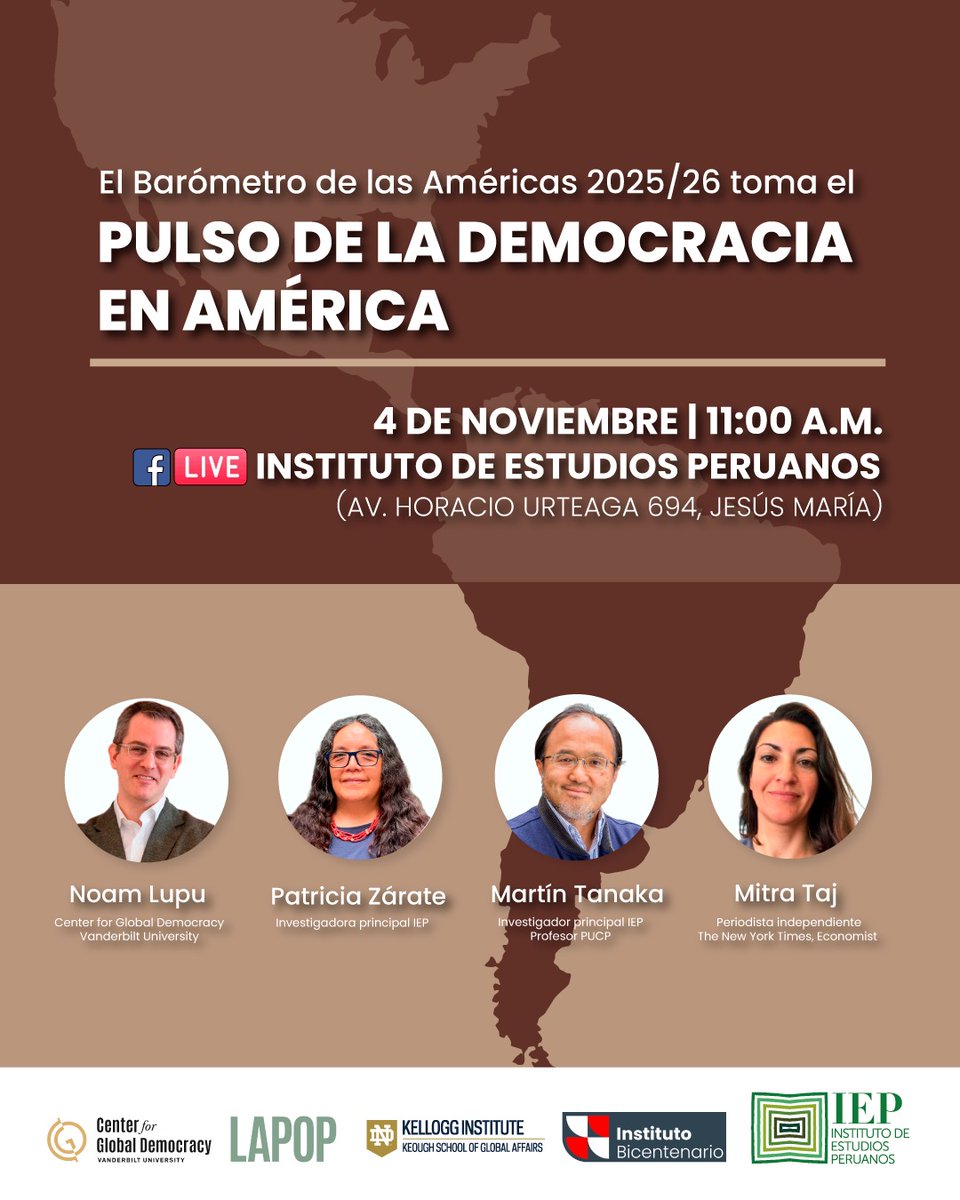
Este 4 de noviembre, a las 11:00 a.m., se presentará los resultados del informe regional del #BarómetrodelasAméricas: Pulso de la democracia 2026.
Participan: Noam Lupu, Patricia Zárate, Martín Tanaka y Mitra Taj.
📚El Barómetro de las Américas es una herramienta única que permite evaluar las experiencias del público con la gobernabilidad democrática. El último estudio se desarrolló en 21 países de América.
⭕️ Sigue el evento a través del Facebook Live del Instituto de Estudios Peruanos.
Este evento es posible gracias al @VU_CGD, @KelloggInst, #InstitutoBicentenario, @IEPeruanos
Can borrowing more help a government lower its borrowing costs?
Research coauthored by Kellogg faculty fellow César Sosa-Padilla (@cesarspa1) finds that issuing debt to build international reserves can reduce sovereign risk premiums. But timing matters: governments facing the risk of being unable to refinance their debt should first reduce debt, then build reserves as their financial position improves.
“International Reserve Management Under Rollover Crises,” coauthored with Mauricio Barbosa-Alves and Javier Bianchi, appeared in the Quarterly Journal of Economics.
Read more: https://t.co/SReJ1t1z4z
#Economics #SovereignDebt
What has Francis Fukuyama changed his mind about since “The End of History?”
On Democracy Paradox, the Stanford scholar reflects on his intellectual journey and a question that has become central to his work: what happens to democracy when governments fail to deliver?
He joins Justin Kempf to discuss his memoir "In the Realm of the Last Man," the appeal of strongmen, and why defending democratic ideals requires attention to the everyday work of governing.
Listen: https://t.co/xZ0t5hrQEF or wherever you get your podcasts.
@FukuyamaFrancis
#Democracy #DemocracyParadox
Congratulations to Kellogg Doctoral Student Affiliate Alejandro González Ruiz on his new online analysis for the Journal of Democracy!
In “Why Latin America’s Losers Won’t Concede,” he examines how close elections, social media, and political movements built around individual leaders encourage candidates to reject credible results, and why strong electoral institutions cannot protect democracy alone.
Read his analysis: https://t.co/CocXo44yad
#Democracy #LatinAmerica #ElectoralIntegrity
What does it take to understand democracy? At Kellogg, that question brings together scholars whose research spans public bureaucracies, courts, corruption, international organizations, and relationships among countries.
Each offers a different view of how power operates, how institutions serve citizens, and how people hold governments accountable. Together, their work helps us see dimensions of democracy that any single discipline or research focus might miss.
The first article in our “Spectrum of Democracy” series features six Kellogg faculty fellows whose research shows why studying institutions and governance requires this breadth of inquiry.
Read “The Spectrum of Democracy: What Makes Institutions Work?”: https://t.co/yIayWatn1K
#Democracy #Governance #GlobalDemocracy
Understanding democratic backsliding means looking beyond the presidency.
@KeoughGlobalND faculty member @l_gamboag, a Kellogg faculty fellow, and former Kellogg visiting fellow @rachel_schwartz examine how legislators, judicial officials and other actors drive – or resist – democratic erosion in Latin America.
Their study, “New Forms of Democratic Erosion in Latin America,” draws on five country case studies to propose a framework for understanding these struggles: who is involved, what strategies they use, where they compete and what they seek to achieve.
By unpacking an often oversimplified problem, their work lays a foundation for future research and efforts to develop more effective responses.
Read their study in Cambridge University Press’s Elements in Politics and Society in Latin America series: https://t.co/c8Peo4AS60
“Either way you slice it, I think this has really bad implications for criminal violence, really bad implications for human rights and really bad implications for democratic institutions.”
Kellogg Institute Visiting Fellow Manuel Meléndez-Sánchez spoke with The New York Times about the spread of Salvadoran President Nayib Bukele’s security model across Latin America.
His analysis highlights the risks of trying to replicate El Salvador’s crackdown in countries with different conditions: leaders could erode democratic institutions and civil liberties without achieving the same reductions in violence.
Read “The Bukeleization of Latin America Has Arrived” - https://t.co/Q5Y8LMCOIn
Join us today in Hesburgh Auditorium at 4:30pm for what promises to be a lively talk: "From Individuals to Institutions: How the US Military Approaches Accountability for Organizational and Wartime Outcomes" by Kellogg & ONDISC Visiting Fellow Risa Brooks, the Allis-Chalmers Professor of Political Science at @MarquetteU.
@_MUPoliSci
The "Review of the 2025 Year of Elections: Inclusivity, Transparency and Trust," published by International IDEA and the Electoral Integrity Project, includes a note by Doctoral Student Affiliate Alejandro González Ruiz. Alejandro examines how civil society organizations helped address gaps in electoral oversight in Bolivia’s 2025 elections through media monitoring, fact-checking, and efforts to flag disinformation. Read it online here: https://t.co/WZxnyvbZhr
¿Qué nos dicen los nuevos datos del #BarómetroDeLasAméricas sobre la democracia en 🇨🇴?
Acompáñanos en Bogotá para conocer los hallazgos de 2026 junto a @NoamLupu, director de @VU_CGD.
📅 29 de octubre | 9:30 a. m.
🔗 https://t.co/k5Uc2WFvLX
@KelloggInst@KeoughGlobalND
A desinformação eleitoral ameaça a confiança na democracia. Como a sociedade civil pode reagir? No Global Stage, Flávia Pellegrino (@flapellegrino), do Pacto pela Democracia, conversa com Alejandro González sobre as lições do caso brasileiro: https://t.co/SMZfnFGjqz
Join us online now for the public keynote panels of the inaugural AI-Driven Modeling & Forecasting for Democratic Development and Decline (AIM4D) Conference at the University of Notre Dame.
Highlights include the official launch of the AIM-3D Public Portal, a celebration of the Varieties of Democracy (V-Dem) Project's 10th anniversary, and a roundtable exploring the future of democracy research and AI-driven social science. These keynote and panel sessions are open to the public.
Catch the livestream (or post-event video) at: https://t.co/G7Y6ez9R2f