🔥 InterLink's latest $ITLG update outlines a strategy that connects ecosystem development with token economics.
Two key elements stand out.
1️⃣ Buybacks and burns
InterLink Labs plans to continue allocating part of its reserves to buy back and burn ITLG, following a strategy similar to the approach already used for $ITL.
More significantly, InterLink has stated that all revenue generated from ITLX will be used to buy back and burn ITLG, drawing a comparison with Hyperliquid's $HYPE model.
The intended mechanism links ecosystem revenue to the permanent removal of tokens from circulation.
However, the actual impact will depend on ITLX's revenue generation, the volume of tokens purchased and burned, and how the mechanism is implemented over time. A burn mechanism alone does not guarantee an increase in token price.
2️⃣ Treasury partnerships and ecosystem expansion
InterLink Labs and the InterLink Foundation also intend to expand their Digital Asset Treasury partnerships in the next phase, once ITLG officially becomes transferable.
These plans form part of a broader strategy to develop the ecosystem while supporting both ITL and ITLG.
The bigger picture?
InterLink is emphasizing a builder-first approach: expand the ecosystem, develop practical utility, strengthen partnerships, and connect platform activity with its token strategy.
For the community, the most important developments to watch will be actual implementation, ITLX revenue, buyback-and-burn execution, utility adoption, and the transparency of future updates.
Long-term growth is not built on announcements alone. It requires consistent execution.
InterLink has outlined its direction. The next chapter will be about delivering on it. 🚀
#Interlink #ITLG #ITL
📢 The latest $ITLG update highlights two important priorities: meaningful participation and expanding utility.
For the current distribution round, InterLink is prioritizing users who have completed Level 1 verification and maintained a good mining rate, whether through individual or group mining.
This makes verification and consistent mining activity important considerations for participants. Users whose current metrics are low should work on improving them, while staying informed about the applicable distribution requirements.
But distribution is only one part of the bigger picture.
InterLink's ambition is for ITLG to become highly active in terms of transaction volume, with a broader holder base and greater accessibility than $ITL.
Its planned utility spans several areas of the ecosystem:
🔹 ITLX
🔹 Financial services
🔹 Social features
🔹 Gaming
Additional use cases are also expected to be researched and developed.
This direction suggests that InterLink wants ITLG to be more than a token people simply accumulate. The objective is to integrate it into activities across the ecosystem, creating more opportunities for users to interact with it.
The long-term question is how effectively these utilities will be implemented and adopted. Sustainable participation depends not only on distribution but also on whether users have meaningful reasons to use a token.
Verification establishes participation. Utility creates opportunities for continued engagement.
#Interlink #ITLG #ITL
🚨 Understanding the evolution of $ITLG starts with one important detail: its supply structure.
Under InterLink's updated direction, ITLG will exist in three states:
🔹 ITLG in App (off-chain)
🔹 ITLG on-chain
🔹 vITLG
These are not intended to represent three independent token supplies. They are different states of the same token, with a total supply that will remain fixed at 100 billion.
The principle is straightforward: when ITLG moves from one state to another, the corresponding amount must be locked and bridged. This allows the token to move between environments while maintaining a unified supply structure.
Why does this matter?
A clearly defined token structure is important for transparency, accounting, and understanding how assets move within an ecosystem. Rather than viewing each state as an entirely separate pool of tokens, users should understand how each state fits into the broader ITLG framework.
As InterLink continues developing its ecosystem, understanding these fundamentals will help the community better follow future developments.
The real story isn't just the number of tokens. It's how the system is designed to manage them.
#Interlink #ITLG #ITL
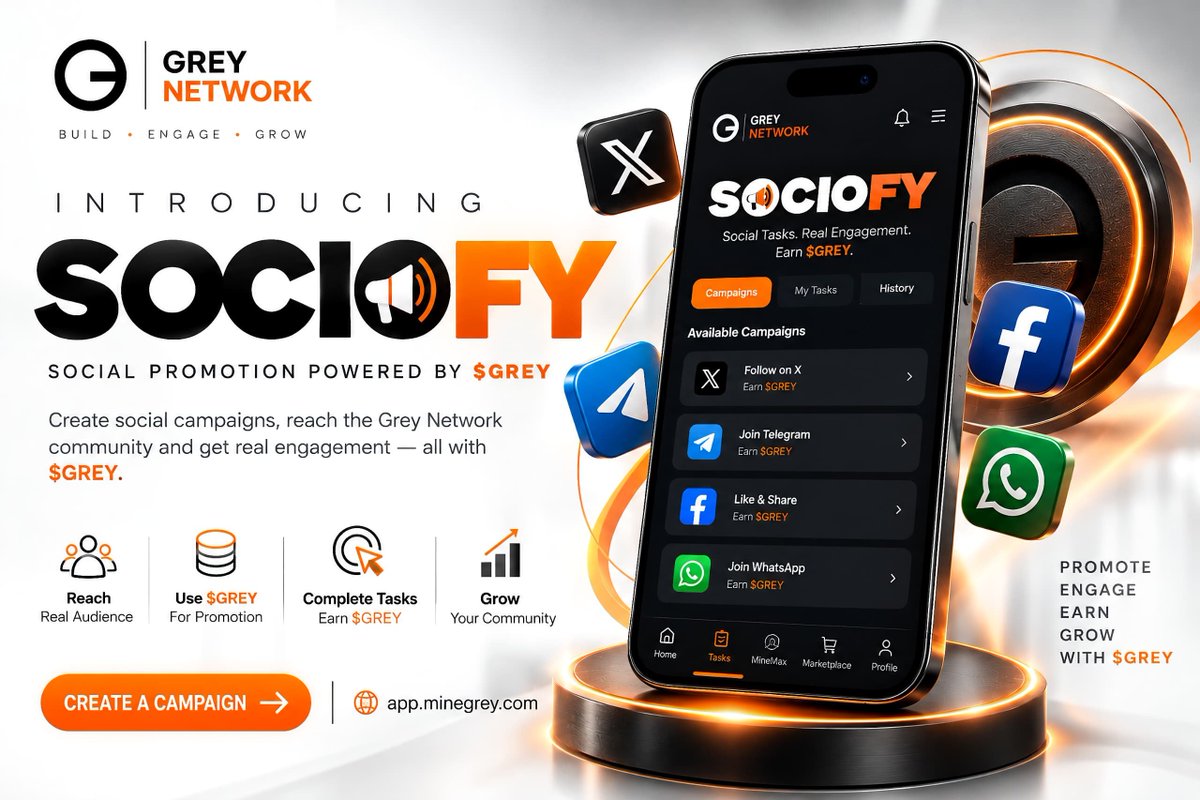
🚀 𝗜𝗡𝗧𝗥𝗢𝗗𝗨𝗖𝗜𝗡𝗚 𝗦𝗢𝗖𝗜𝗢𝗙𝗬
Getting real attention for your social content, community or platform often means paying for promotion with fiat, USDT or other widely used currencies. With SOCIOFY, Grey Network is taking a different approach.
✨ Sociofy allows anyone to create social campaigns and put them in front of the Grey Network community. Whether you want more people to follow your account, engage with your posts, join your community, or complete other supported social actions, you can create a campaign and reward participants entirely with $GREY.
The strength behind Sociofy is the Grey Network community itself. The thousands of comments, reposts, likes and other interactions across our own social channels reflect just how active and supportive this community is. Sociofy now opens that same active community to anyone who wants to bring real attention to their own campaigns. At launch, Sociofy supports campaigns across X (Twitter), Telegram, Facebook, and WhatsApp, with more platforms planned as the feature expands.
𝗛𝗢𝗪 𝗜𝗧 𝗪𝗢𝗥𝗞𝗦
Advertisers select a supported platform and campaign type, provide the required link, and set their campaign budget using $GREY. The amount allocated determines how many participants the campaign can reach, allowing advertisers to adjust their budget according to their needs, starting from a minimum campaign budget of 1,000 GREY. Every campaign goes through an admin review before going live. Once approved, it becomes available for Grey Network users to participate in.
By tapping the TASKS button on the homepage and switching to the SOCIOFY tab, participants can browse available campaigns, complete the required social action, and submit the requested evidence. After verification and the applicable review period, rewards are credited directly to their Tasks balance.
𝗠𝗢𝗥𝗘 𝗨𝗧𝗜𝗟𝗜𝗧𝗬 𝗙𝗢𝗥 $𝗚𝗥𝗘𝗬
Sociofy creates another practical use for $GREY coins within the Grey Network ecosystem. Advertisers use $GREY to gain social reach and engagement, while community members earn $GREY for completing campaign activities. It also builds on the utilities previously outlined for $GREY, with more use cases underway as $GREY continues to take a central role in powering the Grey Network ecosystem.
Every campaign budget is distributed transparently: 95% goes directly to participants as rewards for completing the campaign activities, 3% is distributed among validators, while the remaining 2% goes to Grey Network as its advertising service fee. Each Validator Node represents one share of the Validator allocation, meaning a validator with 3 Nodes receives 3 shares.
With Sociofy, promotion, engagement, and rewards come together inside one ecosystem, powered by $GREY. Welcome to SOCIOFY.
The future is GREY NETWORK. 🩶
The Power is COMMUNITY. 🧡
— https://t.co/PlAqlMcUca
Today is one of those days where I just want to chill in bed and tell everything else to go to hell... but then I remember that the world doesn't revolve around me, and my papa no be Dangote... na so I jump, open my laptop😁😁
The internet changed how information moves.
Blockchain changed how digital value can move.
The next challenge is connecting people, value and economic activity into experiences that feel natural to everyday users.
That is where InterLink's broader ecosystem vision becomes compelling.
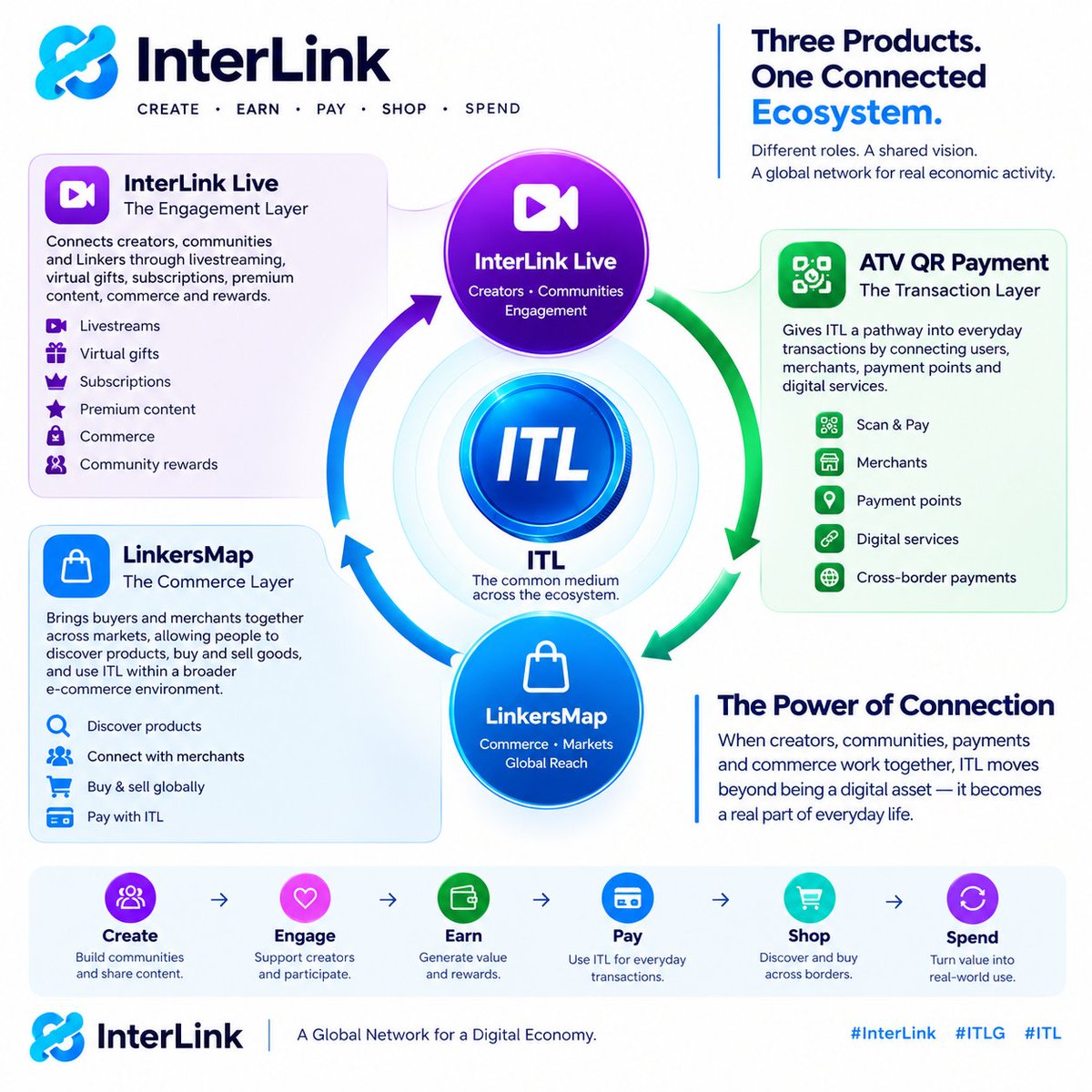
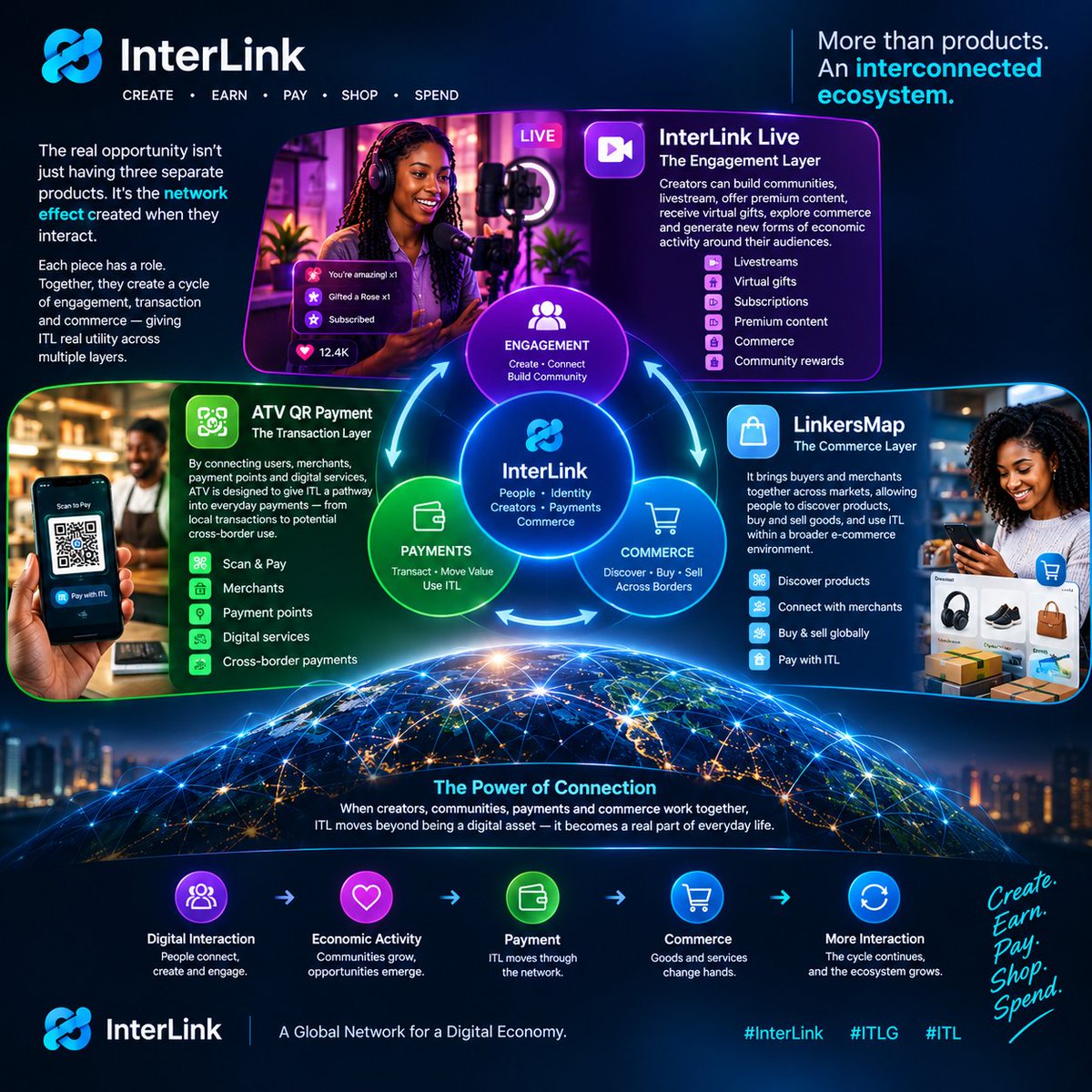
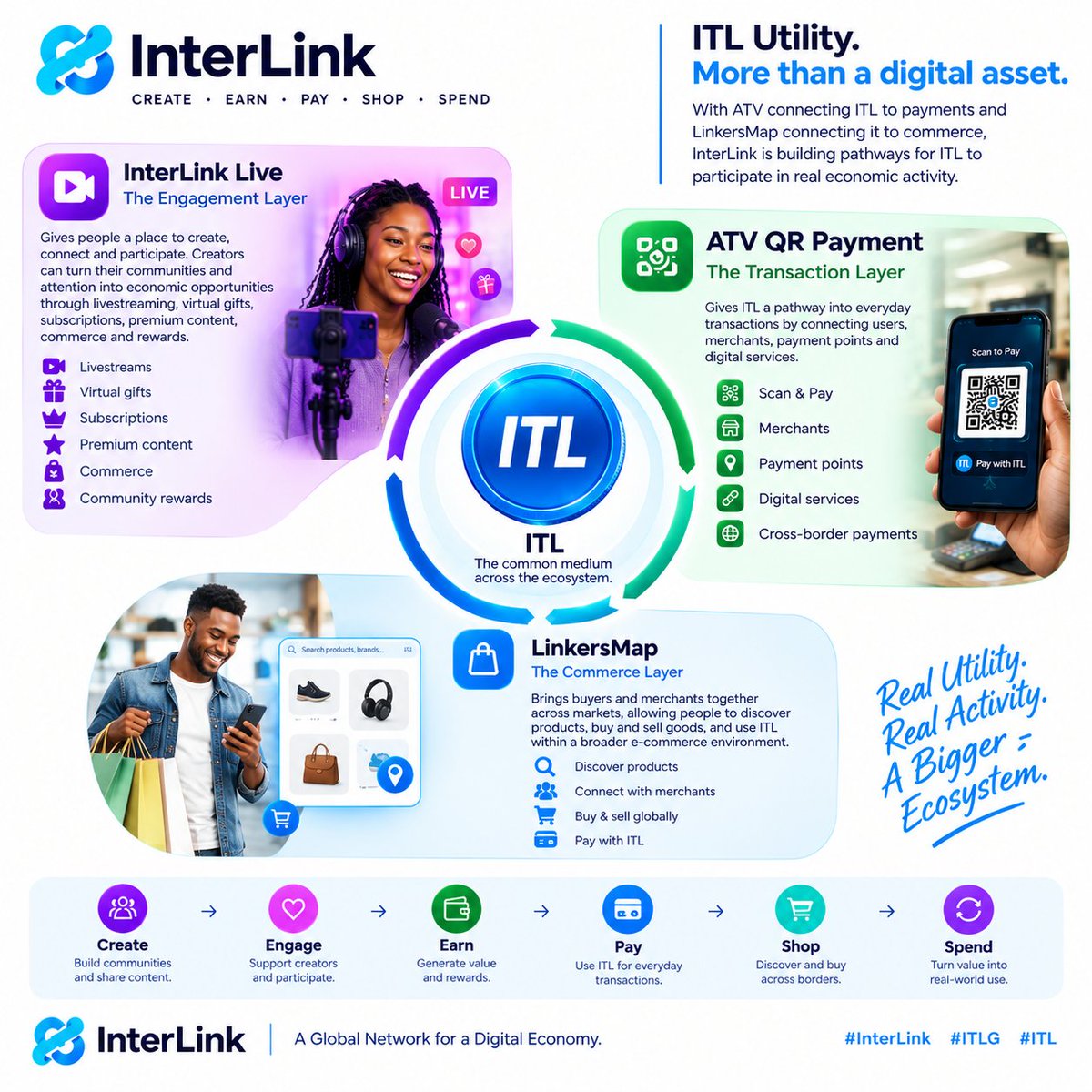
Imagine a network where a person can discover a creator, join a community, support that creator, participate in digital experiences, make payments and eventually purchase products — without each activity existing in a completely separate ecosystem.
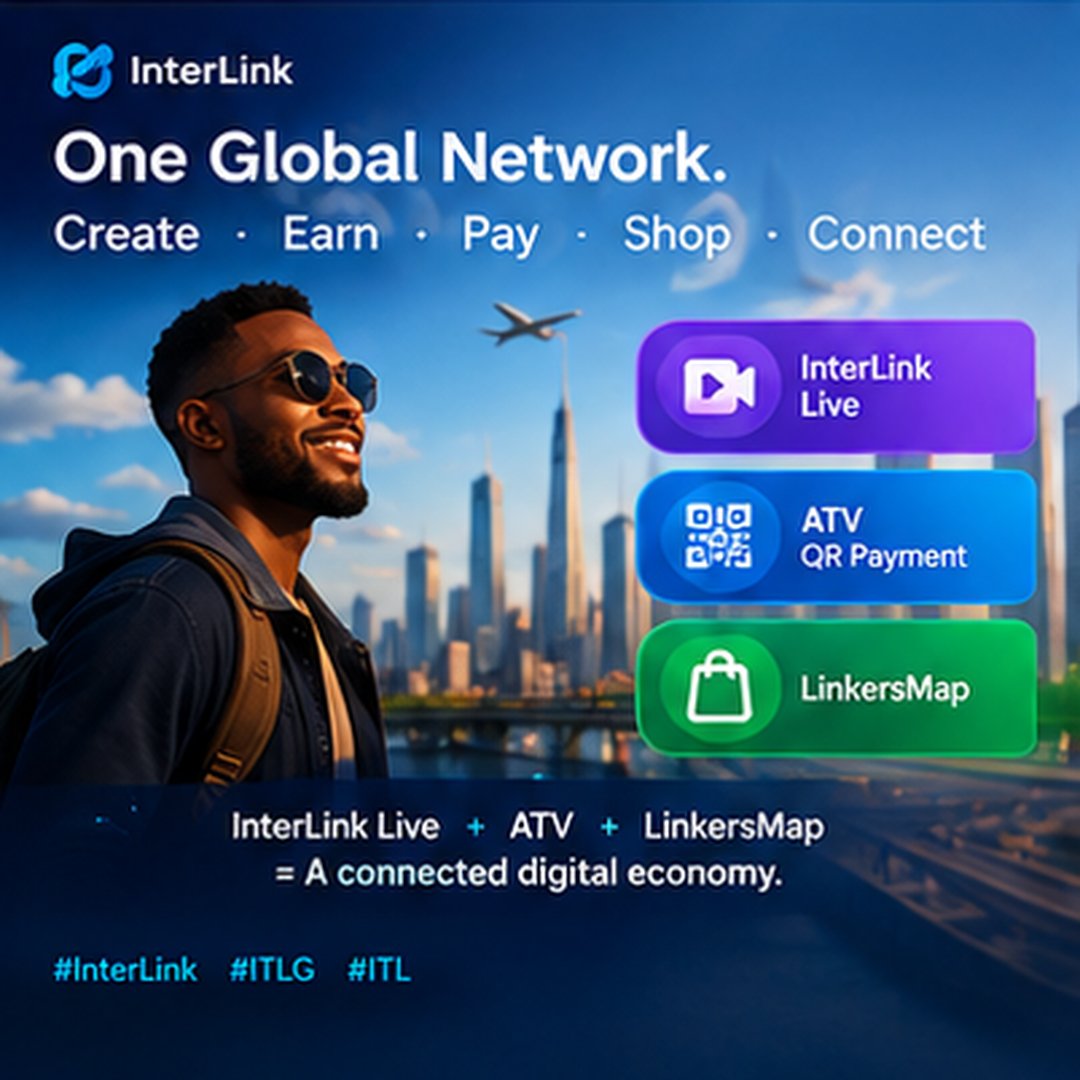
That's the direction represented by:
🎥 InterLink Live — the creator and engagement layer.
💳 ATV QR Payment — the transaction and payment layer.
🛍️ LinkersMap — the commerce and marketplace layer.
And at the center is the broader role envisioned for ITL.
The important distinction is between having utility and having interconnected utility.
A token may have a use case.
A platform may have users.
A marketplace may have merchants.
But when those pieces interact, every new participant can potentially contribute value to multiple parts of the network.
A creator isn't just a content producer.
They can become a source of community activity.
A user isn't just an audience member.
They can become a participant, customer and transacting user.
A merchant isn't just a seller.
They can become part of a global network of buyers and services.
And a payment system isn't just a checkout mechanism.
It can become the bridge connecting economic activity across the ecosystem.
That's the bigger idea:
Build the network → connect the participants → create activity → enable transactions → expand commerce.
InterLink isn't simply describing a collection of products.
It's describing the architecture of a potential global digital economy.
#InterLink #ITLG #ITL
Attention is one of the most valuable resources on the internet.
But attention alone isn't an economy.
It becomes economically meaningful when there are mechanisms that allow people to participate, exchange value and transact.
This is where the InterLink vision takes an interesting direction.
InterLink Live can capture attention through creators, livestreams and communities.
But the journey doesn't have to end with content.
Virtual gifts, subscriptions, premium content, commerce and community rewards can turn engagement into economic activity.
Then comes the next question:
Where does that value move?
ATV QR Payment is designed to provide a pathway into transactions — connecting users, merchants, payment points and digital services through ITL-enabled payments.
And where can transactions lead?
Commerce.
LinkersMap is designed to connect buyers and merchants across borders, allowing people to discover products and participate in buying and selling while incorporating ITL into the marketplace.
So the bigger journey becomes:
Attention → Engagement → Value → Payment → Commerce.
That's a much more interesting proposition than simply creating another social platform, another payment tool, or another marketplace.
It's about connecting the stages of economic activity.
If these layers can successfully reinforce one another, the network can potentially become more valuable as participation grows.
More creators bring more communities.
More communities create more activity.
More activity creates more transactions.
More transactions create more opportunities for merchants.
More commerce creates more reasons for people to remain active.
That's how an ecosystem can develop a self-reinforcing economic loop.
#InterLink #ITLG #ITL
A lot of digital ecosystems are good at one thing.
Some are built around content.
Some around payments.
Some around commerce.
But the real opportunity appears when the gaps between these activities disappear.
That is what makes the InterLink direction interesting.
InterLink Live can turn creators and communities into engines of engagement.
ATV QR Payment can provide the transaction infrastructure connecting users, merchants and services.
LinkersMap can extend that activity into a marketplace where buyers and sellers can interact across borders.
The important part is the middle:
Attention creates activity.
Activity creates transactions.
Transactions create commerce.
Commerce creates more reasons to participate.
ITL sits within this broader journey as the payment and economic medium envisioned across the ecosystem.
The result is a model where a user doesn't necessarily need to leave one disconnected environment every time their activity changes from social interaction to payment or commerce.
That's the difference between building individual applications and building an ecosystem architecture.
The long-term question is not:
“How many products can InterLink launch?”
It's:
“How deeply can those products connect?”
Because connectivity is where network effects begin.
#InterLink #ITLG #ITL
The real test of an ecosystem isn't how many products it has.
It's how many meaningful connections those products create.
Consider what happens when digital interaction and economic activity stop living in separate silos.
A person discovers a creator on InterLink Live.
They join the community.
They engage with content.
They support the creator through the available platform mechanisms.
That attention becomes economic activity.
Now imagine that the same broader ecosystem provides pathways for ITL payments through ATV QR Payment.
The user isn't only interacting digitally anymore.
There is a bridge toward transactions.
Then comes LinkersMap.
The user can discover products, connect with merchants and participate in cross-border commerce.
Now the journey extends again:
Discover → Engage → Participate → Transact → Shop.
And the merchant side benefits from the same connectivity.
More users can mean more potential customers.
More commerce can mean more transaction activity.
More creators and communities can mean more engagement.
More engagement can bring more participants into the network.
This is the concept that stands out to me in the InterLink roadmap:
connectivity creates utility.
InterLink Live addresses the social and creator side.
ATV addresses the payment side.
LinkersMap addresses the commerce side.
ITL provides a common thread across these experiences.
The vision isn't simply to give people another place to watch, another way to pay, or another marketplace to browse.
It's to create an environment where these activities can connect.
That is a fundamentally different way of thinking about an ecosystem:
Not separate products competing for attention.
But connected experiences feeding activity into one another.
Create. Connect. Transact. Trade. Repeat.
#InterLink #ITLG #ITL
One way to understand the InterLink vision is to look at the people inside the network.
A digital economy doesn't grow from technology alone.
It grows when different participants have reasons to interact.
Creators need audiences.
InterLink Live gives creators a space to build communities through livestreaming, virtual gifts, subscriptions, premium content, commerce and rewards.
Users need places to discover, participate and transact.
They can engage with creators, support communities, discover products and participate in the broader ecosystem.
Merchants need customers.
LinkersMap is designed to connect merchants with buyers across markets, creating a broader environment for discovering and exchanging goods.
Payment infrastructure needs both sides of a transaction.
ATV QR Payment is designed to connect users, merchants, payment points and digital services, giving ITL a pathway into everyday payments.
And sitting across these experiences is ITL.
The significance of this model isn't that every participant does everything.
It's that each participant can contribute something different to the network.
A creator brings attention.
A user brings participation.
A merchant brings products and services.
A payment layer facilitates transactions.
Commerce creates opportunities for exchange.
When these activities connect, the network becomes more than the sum of its individual components.
That's the bigger economic idea behind InterLink:
People don't just use a network. They participate in it.
And the stronger the connections between participants become, the more places there are for economic activity to happen.
#InterLink #ITLG #ITL
A digital economy needs more than a blockchain.
It needs places where people can participate, create value, exchange value, and spend that value.
That’s what makes the direction of InterLink interesting.
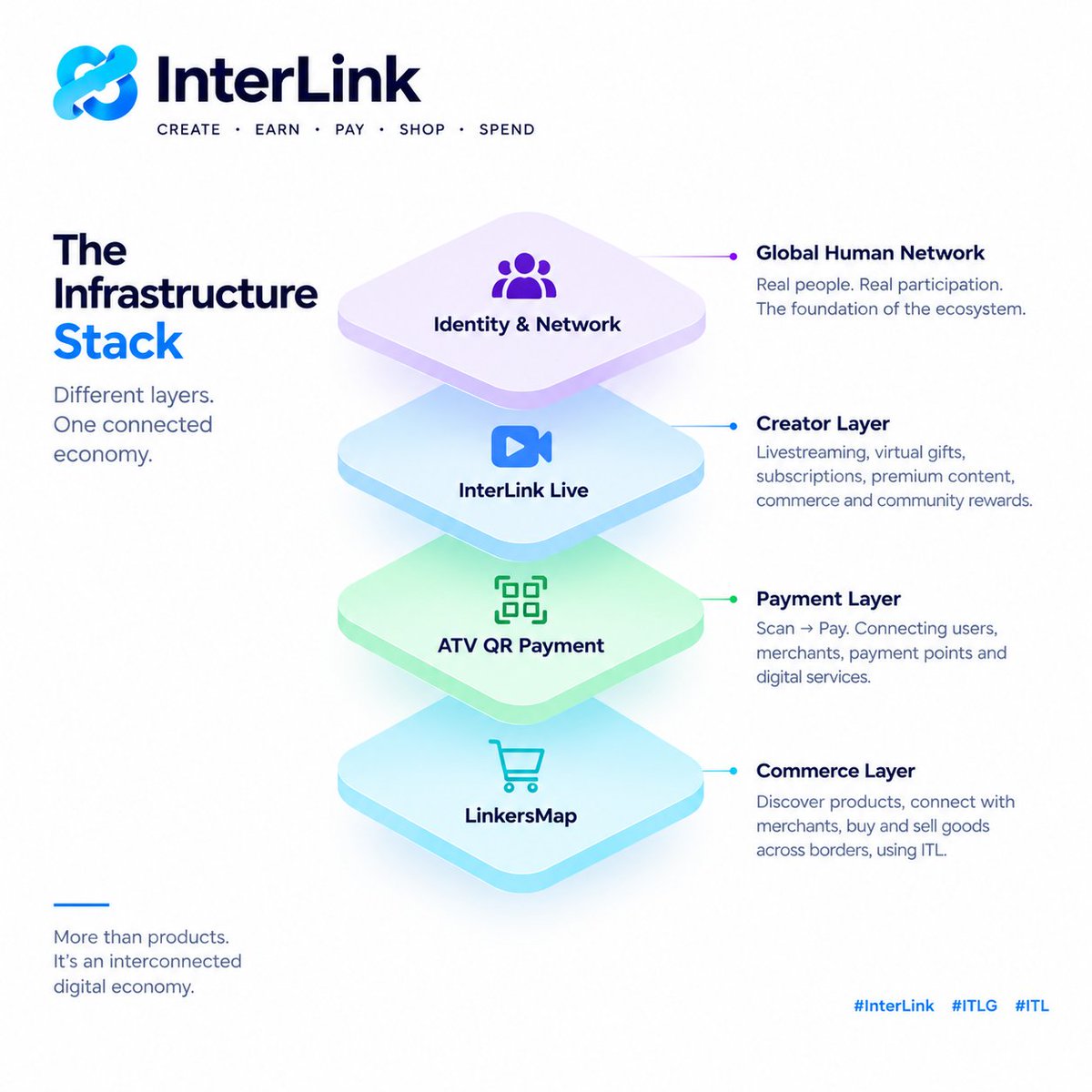
Think of the ecosystem as layers:
Identity & Network
The foundation is a global Human Network designed around real people and their participation in the ecosystem.
Creator Layer — InterLink Live
This is where attention, communities and content generate activity. Creators can livestream, build audiences, receive virtual gifts, offer subscriptions and premium content, and explore commerce and community rewards.
Payment Layer — ATV QR Payment
This connects digital value with transactions. The simple experience is scan → pay, while the broader vision is a network connecting users, merchants, payment points and digital services.
Commerce Layer — LinkersMap
This connects buyers and merchants across markets, creating a marketplace where products can be discovered, bought and sold, with ITL incorporated into the commerce experience.
The important point is that these aren't isolated destinations.
Each layer can create demand for the next.
Creators generate communities.
Communities generate activity.
Activity creates transactions.
Transactions connect to merchants.
Merchants create more opportunities for commerce.
Commerce brings more reasons for users to participate.
That is how infrastructure can begin becoming an economy.
The interesting question isn't simply what each product does on its own.
It's what becomes possible when the layers are connected.
#InterLink #ITLG #ITL