BREAKING: An Anthropic researcher says AI will likely leave “pretty much all humans on Earth” permanently unemployable and dependent on government welfare.
Tao Lin, who works on safeguards for Anthropic’s Claude models, said in an interview with Palisade Research that he expects “broadly superhuman AI,” as good as or better than the best human expert in almost every field, by around the end of 2027.
He said people would eventually “need to strictly rely on government welfare to sustain themselves.” But he doesn’t expect mass unemployment by 2027. He sees a gradual transition in which workers first lose their current roles and move into temporary jobs, partly because “there aren’t enough robots yet.”
“People should be angry at me and everyone else developing AI,” Lin said.
Anthropic Researcher Tao Lin: Pretty much all humans on earth will become permanently unemployable because of AI
"It's very likely that pretty much all humans on earth will become permanently unemployable"
"And will need to strictly rely on government welfare to sustain themselves"
"Human employment will go away."
We are deeply sorry for the disruption this incident has caused our customers and partners. We know the trust they place in our services and take that responsibility extremely seriously. We are seeing broad recovery and stability across our services.
This was a technical issue not related to cyber or AI / agents. The incident was introduced by an issue during an earlier network capacity upgrade that surfaced following a recent network change. We have addressed the underlying issue and continue to restore service to remaining customers and regions.
Given the scale of demand, we restored services gradually, validating stability at each stage. While this took longer, it helped ensure a stable restoration.
We will provide a full post-incident report once our review is complete.
Review bombing is when you buy a game with progressive themes you know you already hate, just to play 30min and leave a negative review.
This is people who bought the game, played it and felt misled by the dev team for not disclosing GenAI usage
Consumers can do that you know
House House isn’t the first studio to hide their AI use and they won’t be the last -
But the fact that they hid it at all means they know it’s bad & that they shouldn’t use it, just in case that wasn’t obvious.
10 lines of debugging that coulda been done by a human lol
Btw the bug they couldn’t solve was cracked under 3hrs after the article was released
And coming from a studio who’s alr made it clear they’re okay w lying why should i believe they only used it for 10 lines of code
KEEP SHAMING AI, IT'S WORKING
KEEP SHAMING AI, IT'S WORKING
KEEP SHAMING AI, IT'S WORKING
KEEP SHAMING AI, IT'S WORKING
KEEP SHAMING AI, IT'S WORKING
KEEP SHAMING AI, IT'S WORKING
Congrats, Democrats. You wanted the power, now you've got it. So here's the bill, due by February:
Gas under $2.
Free healthcare.
Free food.
Free college.
Every last Epstein file released.
And don't even try blaming Trump anymore. You run the show now. Every broken promise from here on has your name on it. Let's see you deliver. 🇺🇸
ChatGPT has now a big problem.
Researchers at Oxford exposed a massive threat to large language models.”
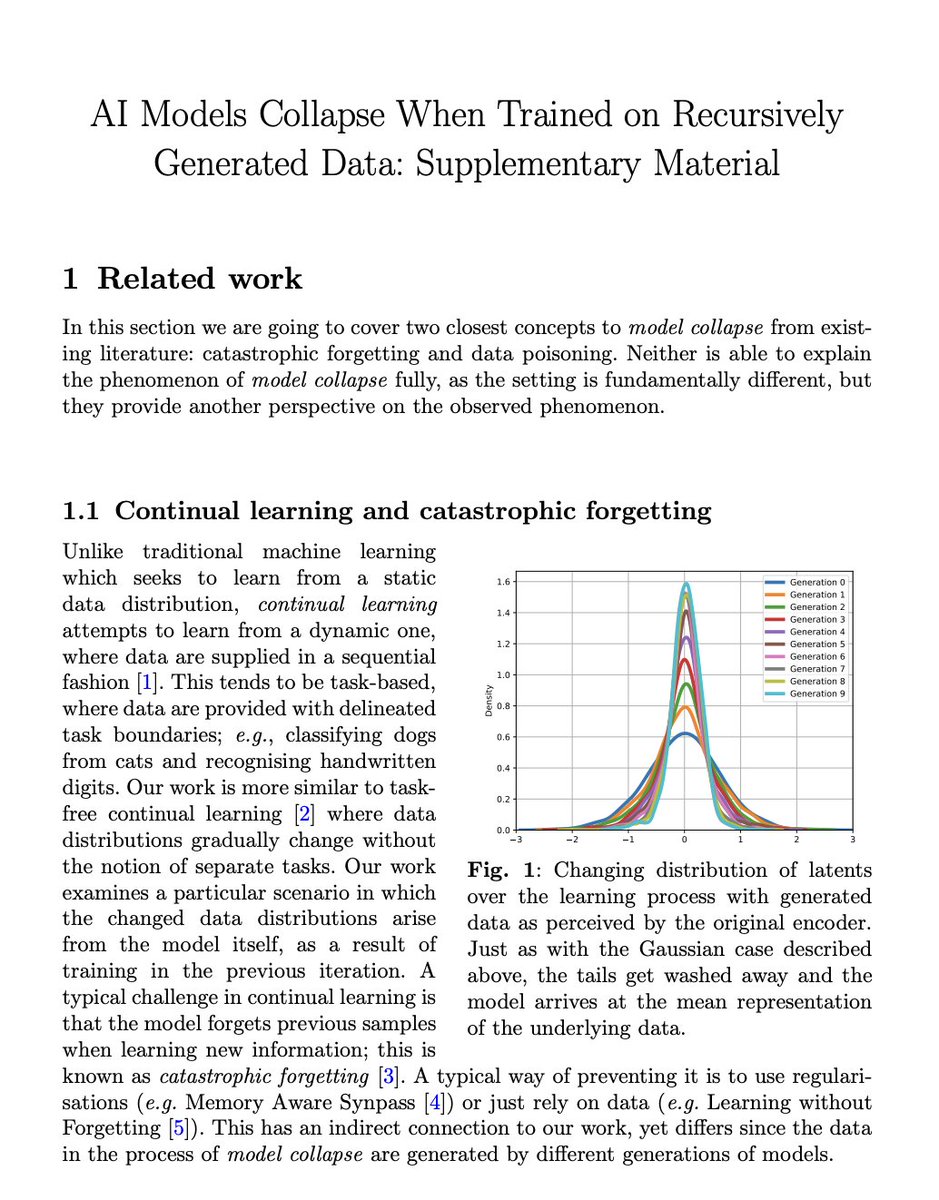
It’s called "Model Collapse."
And it explains why the internet is about to become a toxic waste dump for Large Language Models.
Right now, AI companies are scraping the entire web to train their next-generation models.
But there’s a massive problem.
The internet is no longer just human data. It is rapidly filling up with AI-generated text, images, and code.
What happens when an AI trains on data generated by another AI?
A new paper in Nature just gave us the answer. And it is terrifying.
When AI models are recursively trained on AI-generated data, they suffer from irreversible brain damage.
The researchers found that the model starts forgetting the "tails" of the original data distribution. The rare, weird, unique, and complex human nuances completely disappear.
It's like making a photocopy of a photocopy.
Every generation loses resolution. The output gets flatter, blander, and more generic, until the model completely collapses in on itself.
For years, we thought the biggest bottleneck for AI was compute, getting enough H100 GPUs from Nvidia.
This paper proves the real bottleneck is us.
If we keep flooding the internet with synthetic AI slop, we will poison the very data pool required to build smarter models.
The ultimate irony? We thought AI was going to make human creators obsolete.
Instead, this research proves that verified, genuine human data is about to become the most valuable commodity in the tech industry.