“A humble person thinks about his own sin more often than another’s sin. He also sees his own sin as more important to deal with than the sin of others.”
- Stuart Scott
God is so merciful.
“Their heart was not steadfast toward Him;
they were not faithful to His covenant.
Yet He, being compassionate, atoned for their iniquity and did not destroy them;
He restrained His anger often
and did not stir up all His wrath.”
- Psalm 78:37-38
So much of the Christian life can be boiled down to two simple truths.
1. You are no longer your own. You belong to Christ.
2. You are no longer 𝘰𝘯 your own. He gave you the church.
Much of pastoral counseling—for all its knotted complexity—boils down to three things:
1. This is what God accomplished in his Son. Will you rest in it?
2. This is what God promises in his Word. Will you wait for it?
3. This is what God commands in his Word. Will you obey it?
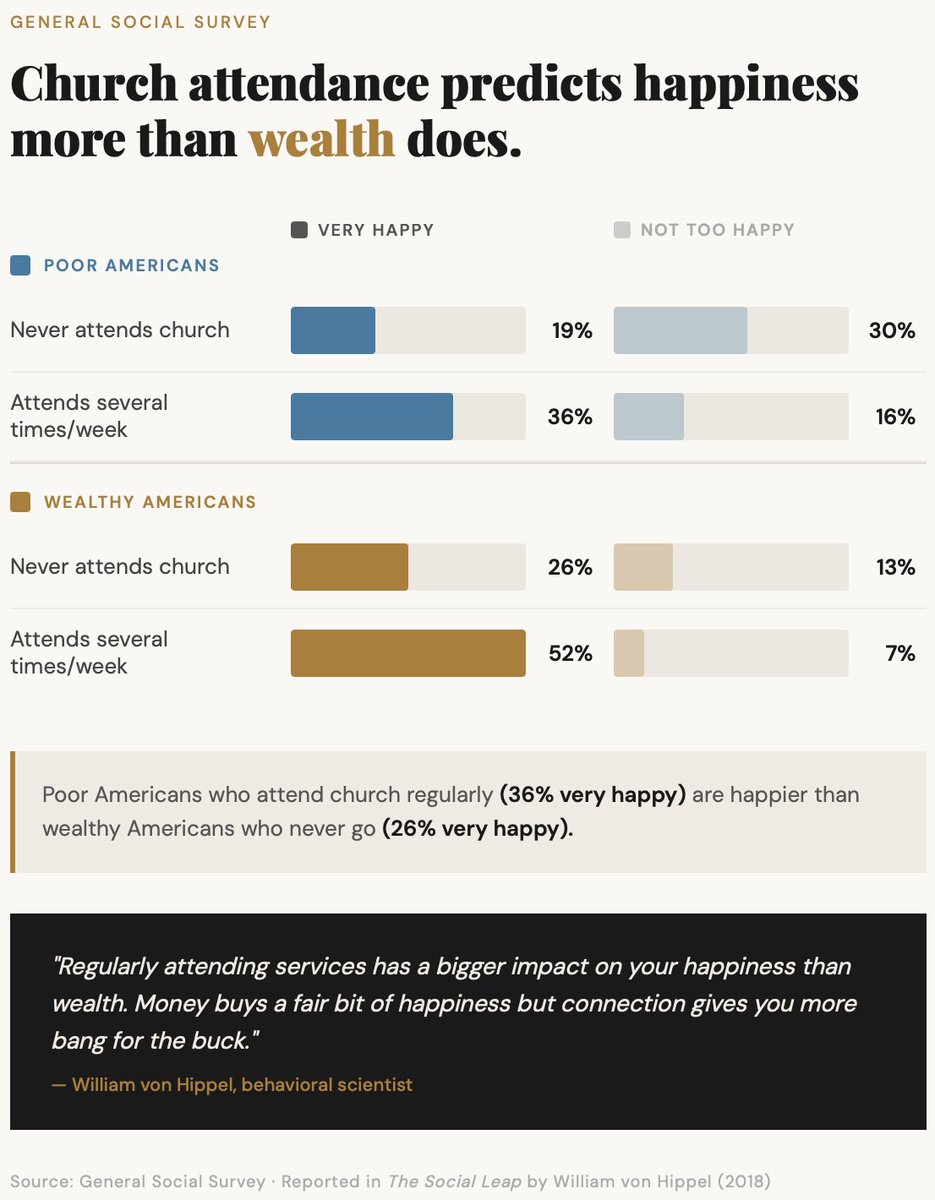
Poor Americans who attend church regularly are happier than rich Americans who never go.
Behavioral scientist William von Hippel thought he'd made a coding error. He hadn't.
"Regularly attending services has a bigger impact on your happiness than wealth," he writes. "Money buys a fair bit of happiness but connection gives you more bang for the buck."
What's happening? Rich people already have most of what money buys. What they lack is what churches provide for free: weekly, repeated contact with people who know your name.
Von Hippel is direct about the cost: "I suspect that wealthy, educated urbanites are paying a steeper price for their lifestyle than they realize. Many of us have paid too great a price in connection for our increased autonomy."
Theological drift is real. Theological isolation is also real.
Back in the 80s and 90s, those of you who used anything besides hymns or hymnals with a piano and or organ, who were not King James or TR only, who listened to secular rooooock music during the week, drank any form of alcohol, went to the cinema, experimented with these new “small group” ideas, or lowered dress standards from suits and allowed women to wear pants, even at home (etc., etc.), I would have needed to separate from each and every one of you because of your theological drift.
Also, if you were part of these “liberal” denominations like the SBC, or held what were considered heretical views like being “Reformed,” covenantal, having elder rule, or even worse, being “post or mid trib,” you were also on a short list for theological drift and compromise. At best, you were a “new evangelical” living in sin and compromise. At worst, maybe not even a true believer. We fundamentalists were the frozen chosen.
So conversations and accusations about theological drift need to be evaluated for their merit, not their intensity. The warning of theological drift is legitimate as it often manifests in the counseling room (see Andy Stanley’s church) because of relational loyalty. But the warning must also be evaluated for the possibility of theological exclusivism within the “holy huddle." Faithful believers should be free to disagree with one another as they pursue and minister Christ.
We short-change worship when we make it exclusively about singing.
We also short-change singing when we make it exclusively about worship (e.g. Eph 5:18-21; Col 3:16; etc).
If your church is growing, roles are going to change. People will shift. Seats will move.
If you don’t understand this, growth will create tension instead of momentum.
🧵Here are 4 hard truths every leader needs to know:
"Christ's blood is able to save any sinner" - Bunyan
Adulterers
Blasphemers
Cowards
Deceivers
Doubters
Drunks
Gluttons
Gossips
Hypocrites
Idolaters
Liars
Moralists
Murderers
Perverts
Racists
Slanderers
Thieves
No matter where you've been or what you've done, Jesus can save you.