Tired of watching Big Tech monetize your social life?
The fix is one click away in @home_assistant.
Social Home: a privacy-first, fully local social platform on your own hardware. No ads, no tracking — your data stays home.
Open beta is live 👉 https://t.co/yT4CB5VzXO
Very bullish on open source and local models
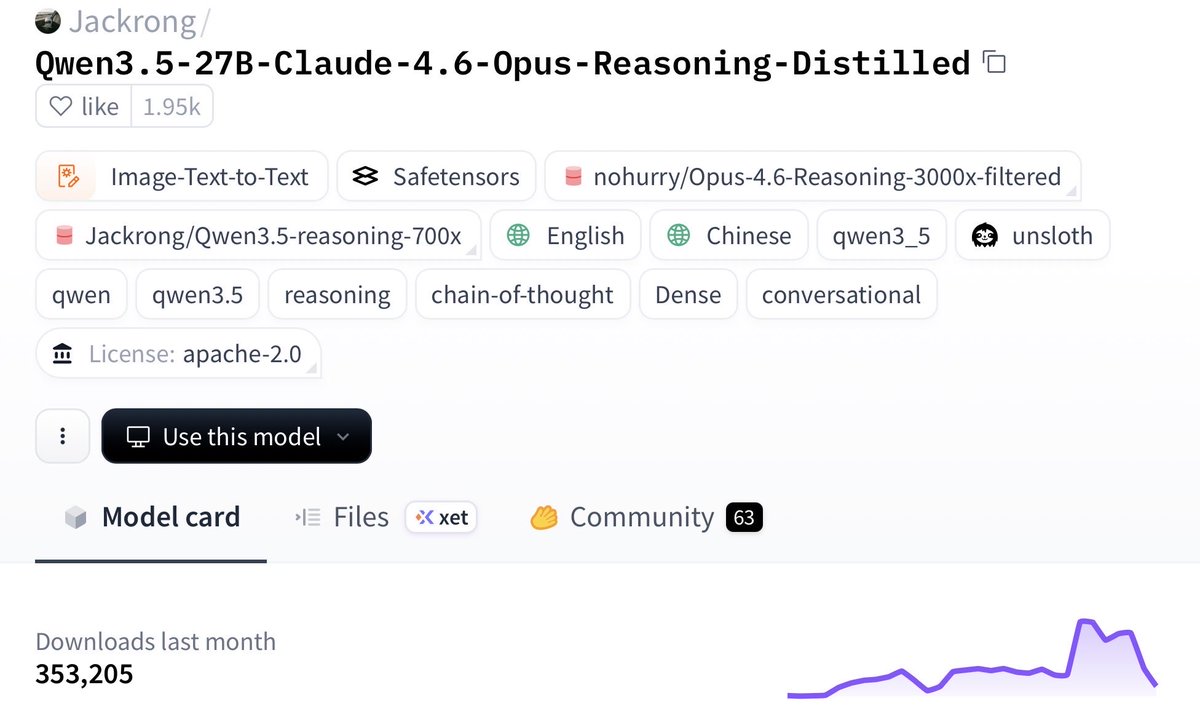
Imagine running near-Opus-level model locally on that $600, 16GB Mac Mini you bought last month
This 27B Qwen3.5 distill was trained on Claude 4.6 Opus reasoning traces and is putting up real numbers:
- beats Claude Sonnet 4.5 on SWE-bench
- keeps 96.91% HumanEval
- cuts CoT (chain of thought) bloat by 24%
- runs in 4-bit quantization
Why this matters:
local agent loops get a lot cheaper, faster, and more usable.
frontier models aren’t going to keep subsidizing cheap tokens on subscriptions forever
300K+ downloads already on HF
Link below 👇🏻
We’re early
@badlogicgames Do people really think you as the maintainer are supposed to read that wall of text?
Until recently a very long issue made me happy because that usually meant the reporter spent time investigating and maybe even reproducing the bug in detail. Now it's a sign of neglect...
@david_whitney Thank you for writing down your thoughts. So many points resonated deeply with me. The excitement, the exhaustion. Simultaneously feeling more productive than ever while also fearing that I don't understand and adopt it all fast enough.
Ok, so I wrote a very long and kinda personal thing about existential dread and the end of programming, and I'm not really sure I want to endure the discourse, but if you want to read it, it's here - https://t.co/LCuyB948M0
It's like 6,000 words long, sorry.
If you're a library author, it's a pain to figure publish agent skills in a way that your users will actually see. If you're a developer using libs, it's a pain to make sure you're using the best and latest agent guidance for them.
Let's solve it! I'm proposing .agents.lib
.agents.lib is a directory distributed with open source packages that contains guidance and configuration for common coding agent customizations (specifically AGENTS[.]md, skills, and MCP servers).
Rather than invent new distribution mechanisms, let's use package managers!
Who implements this today? Nobody. But if you're a library author, it couldn't hurt to start adding this. If you're an agent builder, it couldn't hurt to start detecting it. Let's make it easier to teach agents how to use open source!
https://t.co/6ssPrhF94i
claude code: I finished the feature you asked me to build. All tests are passing. Would you like me to commit these changes?
me: Please review your changes to make sure there are no mistakes.
cc: [working] … I found 5 mistakes and fixed them. All tests are passing. Ready to commit.
me: Please review your changes to make sure there are no mistakes.
cc: [working] … I found 3 mistakes and fixed 2. The third was pre-existing and unrelated to my changes. Ready to commit.
me: Fix the “pre-existing” mistake.
cc: [working] … I fixed the pre-existing mistake. Ready to commit.
me: Please review your changes to make sure there are no mistakes.
cc: [working] … No mistakes found. There is one failing test that was pre-existing, unrelated to my changes. Would you like me to commit these changes?
me: Fix the failing test.
cc: [compacting] … [working] … All tests are passing. Ready to commit.
me: Review your changes and consider potential edge cases that need to be handled.
cc: [working] … I found 2 edge cases that were not being handled. Both are now handled properly. Ready to commit.
me: Do those edge cases have tests?
cc: [working] … Both edge cases now have test coverage. Would you like me to commit these changes?
me: Yes.
@badlogicgames I am using it via the Kimi Code plan. After reading the ToS I realized they use my data to train so I am searching for alternatives. Found https://t.co/VVTEI4xzuJ
The AI hype is absolutely real for software engineering. If you have not had your opus moment yet, I suggest working on a side project that does not matter and letting AI take the wheel. Just to experience (in a safe space) what is possible.
@mitsuhiko GitHub Copilot in vscode. Existing tools and infra and $10/month was easy to get started. Just today I switched to CC and the skills alone are on a whole new level
Today, we’re announcing the preview release of ty, an extremely fast type checker and language server for Python, written in Rust.
In early testing, it's 10x, 50x, even 100x faster than existing type checkers. (We've seen >600x speed-ups over Mypy in some real-world projects.)
I have seen some confusion on uv that I felt is worth addressing. It relates to compatibility. I’m not sure what the right level of compatibility between uv and existing tools should be, but I’d argue it’s significantly less than 100%. Case in point: I don’t think uv should provision pip into a virtual environment.
In fact, pip shouldn’t have been included in virtual environments to begin with. Even PyPI’s virtualenv has --no-seed, and the standard library’s venv has --without-pip to disable it.
Why shouldn’t pip be in a virtual environment? The most important reason is that pip itself can introduce dependencies. We’ve seen persistent issues with bootstrapped virtual environments that come with pre-installed packages. For example, virtualenvs used to include setuptools by default, which caused countless compatibility issues over the years when versions mismatched. Remember: each virtual environment can only have one version of a package. Having pip inside the virtual environment also encourages tools to invoke their own pip-based “plugin installation,” which can cause even more problems.
The right way to install dependencies into a virtual environment is to declare them explicitly (e.g., in pyproject.toml or a similar file) and let the resolver and installer determine the correct versions. Manually installing dependencies into a virtual environment in an ad-hoc way inevitably leads to compatibility issues down the line.
In an ideal world, virtual environments wouldn’t even need to exist. I can imagine a future where Python installs dependencies into a platform-portable .python-modules directory instead. We’re not there yet, but we can move in that direction by reducing our reliance on activating virtual environments. I also don’t think uv should introduce a uv shell command: uv run is the right approach. Yes, it’s a bit more to type, but it eliminates shell incompatibilities and OS-specific quirks. Even today, users on Windows often get confused when documentation tells them to run . .venv/bin/activate.
From my perspective, we should stop encouraging virtual environment activation, bundling pip/setuptools inside virtual environments, and letting tools invoke pip arbitrarily. Yes, this would break some workflows, which I don’t love, but it’s a small amount of friction for a much better long-term outcome.
There are plenty of other features I believe uv shouldn’t support. For example, I don’t think uv should allow --user installs. I know some people rely on it, but it adds unnecessary complexity for everyone; just one more thing developers have to understand.
I’m writing this in parts because I’ve seen people claim that “uv virtual environments are incompatible with Python’s.” They aren’t. They just don’t include a seed by default. That’s always been an option, but uv made it the default and it is a good default.