It’s true, Amazon can make you a millionaire… BUT TREAD CAREFULLY.
Some tips from a top 500 Amazon seller:
There is lots of opportunity on Amazon right now.
I’m a known Amazon fba hater.
But the reality is most brands need to be there.
And competion has been crushed.
China changed tax reporting, so Chinese sellers lost 50% of their built in advantage. They are finally paying taxes
Tariffs and increased fees have pushed out the low end sellers. Years of burnout have lead to lots of them just giving up.
And new seller interest is literally at a 20 year low. Aggregators can’t raise money. The “automated fba brand builders” are all in jail. No one is selling the dream anymore.
Bottom of the market.
Great time to start- when everyone thinks it’s pointless.
Here is what I am seeing:
the top 3 categories are pet, bedding, and fashion.
I think pet and bedding are still the easiest categories
Why? There aren’t mega brands that own the space. Name 3 dog toy companies. Name 3 bedding brands.
Open ocean, huge category.
The play right now is to build a real brand, on dtc, move to Amazon, and win on brand terms.
Then use those brand terms to move into organic, and win over the category.
If someone can do it in pet- be it toys, supplements, or accessories, it’s a multi billion dollar brand.
Avoid the dead end products.
That’s garlic presses and hangers and the other classic Amazon alibaba products.
Those have been fully optimized and the factories now own the listing.
The true play is to build a brand, in a good category, and take shelf space from the squatters.
Take what you are good at-
Branding, product, ads.
Find someone good at Amazon.
Build the branded search game.
Capture it on Amazon.
Then move sideways.
I’m doing it right now and it’s working.
Just wish I had the time to do it in more categories!
I've been part of MDS since 2019. We were doing about 5m/year when we joined. Found my people within MDS & learned from people much smarter than me. Seeing others grow rapidly was inspiring and we figured out how to grow alongside them. If you are in DTC looking for community...
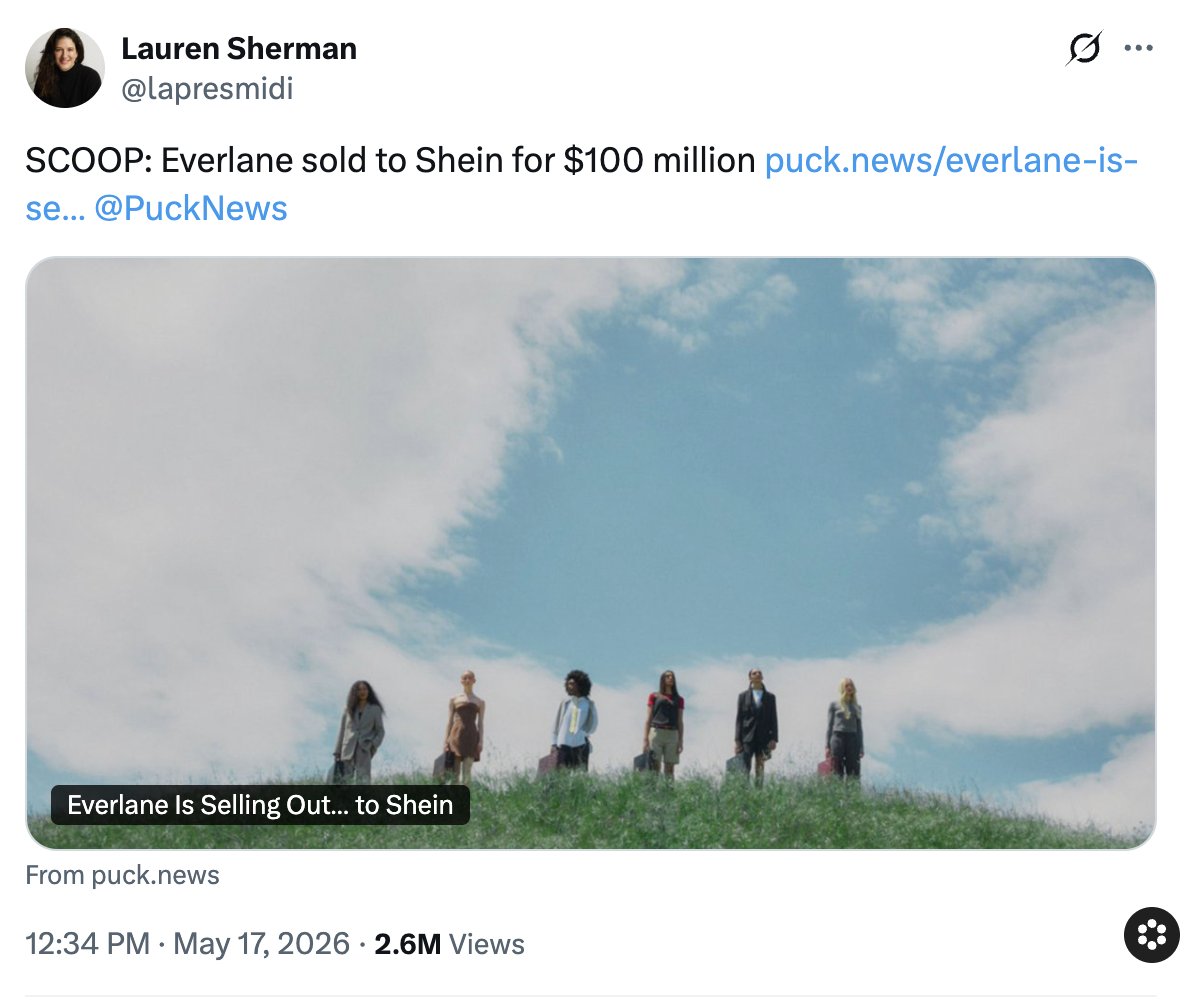
What no one is saying about Everlane's sale to Shein:
politically-adjacent brand positioning is a dead end, whether you are pandering to the left or to the right.
Everlane built their brand platform on "radical transparency".
In 2012 that was refreshing. A decade later, it became politicized, even though that was never the intention.
When you tie your brand to one of these politically-coded stances, the loudest and most extreme adherents will hold you to an impossible standard and criticize your every move online, loudly.
Again, it doesn't matter if you're right-coded or left-coded.
People use online political debates to escape an unsatisfying reality, and to regain a sense of power and status when their real life offers little/none.
So, by "taking a stand", your brand is putting itself at the mercy of blackpilled yappers who are highly unlikely to buy anything from you.
Obviously Everlane couldn't have predicted this when it chose to center "radical transparency" in 2011.
But if you're thinking of making something similar the core of your brand's identity–
whether you're "sustainable", "organic" or "made in the USA"–
think twice...
@NeuEveSupp just got mentioned on Wired!
The power of kindness! This is what happens when you help others!
Since the founding of NeuEve, we have always devoted all of our energy towards helping others.
Occasionally, out of gratefulness, others have helped us back.
This is something that I have tried to tell every other business person I have ever met: that kindness is a strength not a weakness.
You don’t have to be a ruthless taker to be a business person.
Thank you so much to the anonymous patient “Farrah” for sharing her story with Wired’s reporter @ejdickson !
https://t.co/jpjYaNG7jy
#kindnesswins
Amazon changed my life.
Like many entrepreneurs, I started with little more than a product idea, hard work, and the belief that Amazon was one of the greatest business opportunities ever created. For years, it gave small brands and independent operators the ability to build real companies without needing investors, retail buyers, or massive teams.
That is why I care so much about where the marketplace is heading.
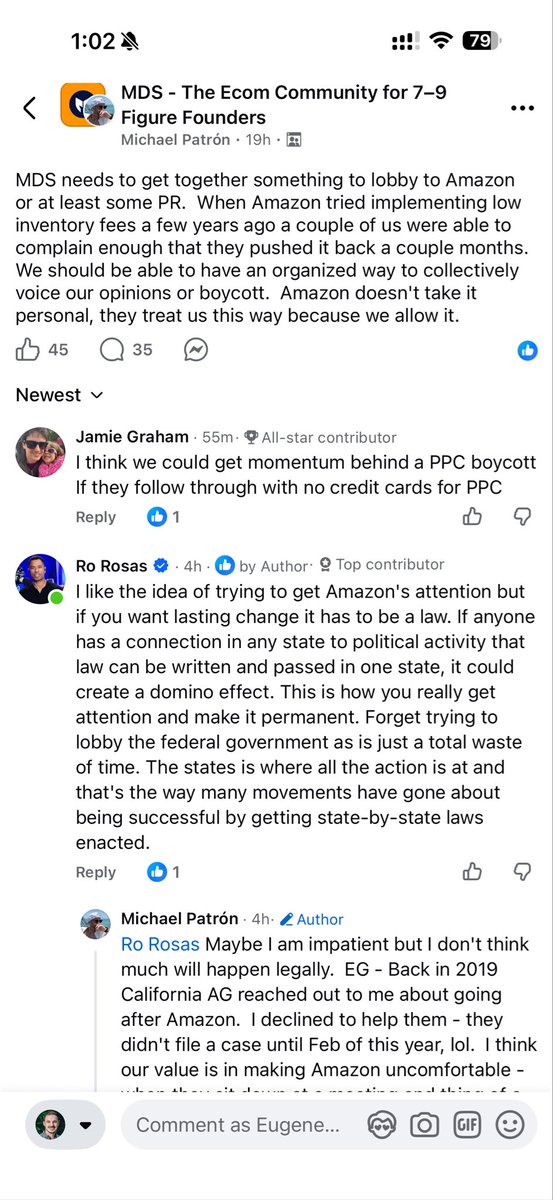
This is bigger than any one brand, seller or business, so with the help of the MDS a new campaign is coming.
SOS: Save Our Sellers.
We are starting SOS: Save Our Sellers to bring attention to the growing pressure many sellers are feeling inside the Amazon ecosystem. This is not an anti-Amazon campaign. It is the opposite. Amazon helped create thousands of businesses, jobs, brands, and life-changing opportunities. We want that to continue.
Many of todays billion dollar brands and MDS successes came from Amazon. Brands like Anker, Utopia Bedding, Nutricost, MaryRuth, Physician’s Choice, Kitsch, DRMTLGY, and many others.
But many sellers believe the economics of operating on the platform are moving in the wrong direction. Fees keep rising. Advertising has become harder to avoid. Cash flow is getting tighter. Operational costs keep stacking. Each change may have its own explanation, but sellers only have one P&L.
And that P&L is getting squeezed from every direction.
Over the coming weeks, I’ll be sharing stories, examples, screenshots, and data from real sellers who have built serious businesses on Amazon. Some will be public. Some will be anonymous. The goal is not to attack Amazon. The goal is to have a serious conversation about the long-term health of the marketplace.
Because when sellers have enough margin to reinvest, customers win, Amazon wins, and opportunities are created.
Sellers need breathing room to keep building, improving, hiring, launching, and innovating.
This is the beginning of that conversation.
SOS: Save Our Sellers.
Save the marketplace.
Reverse the curve.
Every CEO goes through 4 phases
Think of it like a sports career
You start on the court. You end in the owner's box
And the ones who can't make the transition become the bottleneck that kills their own company...
Phase 1: The Star Player, Revenue: $0 - $1m (the early days)
In the beginning, you are the business
You're jumping for every ball
Scoring, defending, running the plays
Sales? You.
Marketing? You.
Customer support, product, operations? All you
And it works. Because at this stage, nobody can outwork a hungry founder with something to prove
The goal here is simple - find product-market fit. Get to the point where it feels like you're wearing a meat suit in a dog park
The trap though?
You can fall in love with being the star player. The adrenaline & the identity of "I built this with my own hands"
You have to let go of this mentality for Phase 2
Phase 2: The Player-Coach, Revenue: ~$1m - $10m
You've got a small team now. Maybe 5-15 people. But you're still on the court
You're coaching up your team while doing a ton of the work yourself. You're writing copy, closing deals, jumping on support tickets - and somehow also trying to manage people, set goals, and build culture
This is where most founders get permanently stuck
Because delegation at this stage is brutal
You know you can do it better. You know it's faster if you just handle it yourself
What matters here:
Your proudest moment can no longer be YOU hitting the game-winning shot. It has to be watching your player hit it
Most founders understand this intellectually
Very few actually make the change
Phase 3: The Coach, Revenue: ~$10m - $50m
This is where it gets real
You put the ball down & step off the court entirely. You're on the sideline now - clipboard in hand, assembling the best possible team
Your job is hiring the offensive coordinators, the defensive coordinators, and building systems that run the business without you touching a single play
This was my sweet spot - I loved being the coach. Close enough to the game to feel the energy. Far enough to see the full picture
At this stage, your focus shifts to these 3 key areas:
1. Aim - Your Aim is your opinion. The specific mountain you've decided to climb, why that mountain, and why now
2. Army - Army is your people. Your executive team. You as the General. And the culture you create
3. Assets - Cash + resource allocation.
Phase 4: Politician, Revenue: ~$50m+
This is where I tapped out
As AppSumo approached $50m, everything became a game of telephones
Four or five steps removed from the actual work. You're essentially a mini politician running a mini city
I used to walk into the office and know every single person by name.
Then one day, I was chatting with an employee, and they asked me my name. When I said "Ayman," they went wide-eyed - "Ayman? Like... the CEO?"
That was a surreal, gut-check moment for me. I didn't like not knowing everyone at the company. I didn't like that my words were being analyzed like a political speech - "What did Ayman really mean by that?"
I told Noah - we're doubling year over year, I'm not planning on leaving anytime soon, but I know how long it takes to hire a CEO
We should probably start the search now because I have a feeling we're going to need one by the time we hit $100m
Staying past that point would have meant holding the company back
Each phase requires you to kill the identity that made you successful in the previous one
The star player has to stop scoring
The player-coach has to stop playing
The coach has to stop coaching individual players
The politician has to stop coaching entirely
If your business is stuck, ask yourself one question:
Which phase am I in - and which phase does my company need me to be in?
If the answer is different, that's your bottleneck
And it's not the market, your team, or even your product
It's you
8- being tall doesnt matter.
being lean does.
you have no control over your height.
and it honestly is just cope to care.
im 5 8 or 5 9, and height has never been a factor in anything I do.
but you need to try to be physically strong.
everyone needs to be able to do a pull up
7- dont wait around for someone to invite you on their adventure.
you have to make the life you want.
its okay to leave everyone behind to go do something cool.
dont feel obligations to people who are trying to hold you back.
Most landing pages are still way too boring. With AI you can make completely novel LPs with WILD animations.
Let the user click to throw a phone in your phone case vs the competitors to see how they stack up protection wise.
A price is right type minigame to see how much better you are priced.
Click to reveal what happens to someone who is taking your supplement vs sketchy ones on amz after 30 days
etc...
My community has $15b of yearly sales on Amazon with 800+ members.
These are small businesses. They employ real Americans and support local communities.
They do not have large margins to absorb shocks.
Every year Amazon squeezes them more and supports overseas Chinese sellers instead of local American businesses.
Now Amazon is hitting sellers with even more of a squeeze all back to back:
https://t.co/Xc1IeD5QHd has moved many sellers to DD+7
Meaning funds are held until 7 days after delivery, not simply paid out on the old cadence.
https://t.co/YkUKQvr0Uo just added a 3.5% fuel/logistics surcharge on fulfillment fees.
https://t.co/L9WWJUDkr8 top it off now Amazon Ads charges will be pulled directly from disbursements rather than floating on a credit card.
That combination matters.
Amazon already forces sellers into an environment where ads dominate visibility.
So now the same platform that pressures brands to spend more on ads is also tightening payout timing and pulling more cash out before sellers ever see it.
For a very large business, this is just a minor annoyance. But for a small business making payroll just got 50x harder.
Less cash on hand means:
less inventory
more stockouts
more debt
more strain on small teams
and ultimately a worse customer experience
This is not “supporting small business.”
It is starving the brands that create so much of the value customers come to Amazon for.
@WSJ@business@nytimesbusiness@BusinessInsider@ReutersBiz@CNBC@APBusiness
If you’re covering Amazon, local communities hit by a hard economy and large companies trying to squeeze hardworking Americans hit me up.
A Chinese video by “Laohu Talks World” is going viral online, breaking down how Iran could try to target the F-35 Lightning II using existing equipment by simplifying the problem step by step.
The speaker argues that air combat isn’t realistic given Iran’s aging fleet, including decades-old Grumman F-14 Tomcats, and instead focuses on ground-based air defense.
He contrasts large systems like the S-300 and Bavar-373 with smaller, mobile systems like the Majid air defense system, arguing that lighter, decentralized setups using infrared tracking could be harder to detect and survive longer.
The video is part of a wider phenomenon from China as the Middle East conflict unfolds: civilians are volunteering, without pay, their technical skills on social media to help Iran counter U.S. military power.
At the same time, the destructive and inhumane impact of sanctions, war, and aggression on the lives of the resilient Iranian people must not be underestimated. The continuation of military aggression and recent bombings profoundly affect people’s lives, attitudes, and perspectives. This reflects a fundamental human truth: when war inflicts irreparable harm on lives, homes, cities, and futures, people will not remain indifferent toward those responsible.
This raises a fundamental question: Exactly which of the American people’s interests are truly being served by this war? Was there any objective threat from Iran to justify such behavior? Does the massacre of innocent children, the destruction of cancer-treatment pharmaceutical facilities, or boasting about bombing a country “back to the stone ages” serve any purpose other than further damaging the United States’ global standing?
Iran pursued negotiations, reached an agreement, and fulfilled all its commitments. The decision to withdraw from that agreement, escalate toward confrontation, and launch two acts of aggression in the midst of negotiations were destructive choices made by the U.S. government—choices that served the delusions of a foreign aggressor.
Attacking Iran’s vital infrastructure—including energy and industrial facilities—directly targets the Iranian people. Beyond constituting a war crime, such actions carry consequences that extend far beyond Iran’s borders. They generate instability, increase human and economic costs, and perpetuate cycles of tension, planting seeds of resentment that will endure for years. This is not a demonstration of strength; it is a sign of strategic bewilderment and an inability to achieve a sustainable solution.
Is it not also the case that America has entered this aggression as a proxy for Israel, influenced and manipulated by that regime? Is it not true that Israel, by manufacturing an Iranian threat, seeks to divert global attention away from its crimes toward the Palestinians? Is it not evident that Israel now aims to fight Iran to the last American soldier and the last American taxpayer dollar—shifting the burden of its delusions onto Iran, the region, and the United States itself in pursuit of illegitimate interests?
Is “America First” truly among the priorities of the U.S. government today?
I invite you to look beyond the machinery of misinformation—an integral part of this aggression—and instead speak with those who have visited Iran. Observe the many accomplished Iranian immigrants—educated in Iran—who now teach and conduct research at the world’s most prestigious universities, or contribute to the most advanced technology firms in the West. Do these realities align with the distortions you are being told about Iran and its people?
Today, the world stands at crossroads. Continuing along the path of confrontation is more costly and futile than ever before. The choice between confrontation and engagement is both real and consequential; its outcome will shape the future for generations to come. Throughout its millennia of proud history, Iran has outlasted many aggressors. All that remains of them are tarnished names in history, while Iran endures—resilient, dignified, and proud.
Iranian President’s Letter to the American People tonight:
To the people of the United States of America, and to all those who, amid a flood of distortions and manufactured narratives, continue to seek the truth and aspire to a better life:
Iran—by this very name, character, and identity—is one of the oldest continuous civilizations in human history. Despite its historical and geographical advantages at various times, Iran has never, in its modern history, chosen the path of aggression, expansion, colonialism, or domination. Even after enduring occupation, invasion, and sustained pressure from global powers—and despite possessing military superiority over many of its neighbors—Iran has never initiated a war. Yet it has resolutely and bravely repelled those who have attacked it.
The Iranian people harbor no enmity toward other nations, including the people of America, Europe, or neighboring countries. Even in the face of repeated foreign interventions and pressures throughout their proud history, Iranians have consistently drawn a clear distinction between governments and the peoples they govern. This is a deeply rooted principle in Iranian culture and collective consciousness—not a temporary political stance.
For this reason, portraying Iran as a threat is neither consistent with historical reality nor with present-day observable facts. Such a perception is the product of political and economic whims of the powerful— the need to manufacture an enemy in order to justify pressure, maintain military dominance, sustain the arms industry, and control strategic markets. In such an environment, if a threat does not exist, it is invented.
Within this same framework, the United States has concentrated the largest number of its forces, bases, and military capabilities around Iran—a country that, at least since the founding of the United States, has never initiated a war. Recent American aggressions launched from these very bases have demonstrated how threatening such a military presence truly is. Naturally, no country confronted with such conditions would forgo strengthening its defensive capabilities. What Iran has done—and continues to do—is a measured response grounded in legitimate self-defense, and by no means an initiation of war or aggression.
Relations between Iran and the United States were not originally hostile, and early interactions between the Iranian and American people were not marred with hostility or tension. The turning point, however, was the 1953 coup d’état—an illegal American intervention aimed at preventing the nationalization of Iran’s own resources. That coup disrupted Iran’s democratic process, reinstated dictatorship, and sowed deep distrust among Iranians toward U.S. policies. This distrust deepened further with America’s support for the Shah’s regime, its backing of Saddam Hussein during the imposed war of the 1980s, the imposition of the longest and most comprehensive sanctions in modern history, and ultimately, unprovoked military aggression—twice, in the midst of negotiations—against Iran.
Yet all these pressures have failed to weaken Iran. On the contrary, the country has grown stronger in many areas: literacy rates have tripled—from roughly 30% before the Islamic Revolution to over 90% today; higher education has expanded dramatically; significant advances have been achieved in modern technology; healthcare services have improved; and infrastructure has developed at a pace and scale incomparable to the past. These are measurable, observable realities that stand independent of fabricated narratives.