We’re very excited to share BoltzGen — a biomolecular binder design model that matches state-of-the-art folding and turns that capability into generalizable binder design!
Unlike prior tools, BoltzGen spans nanobodies, miniproteins, peptides, and cyclic scaffolds and designs binders for proteins, nucleic acids, small molecules, and more. A declarative specification language (binding sites, covalents, structure groups, secondary structure, design masks) lets you steer generation toward precise objectives. With multiple wet-lab partners, we validated across diverse targets. On 9 novel protein targets (no similar bound complexes in PDB), testing ≤15 designs/target yielded nanomolar binders on 6/9 for nanobodies (67%), mirrored by protein designs. We also show functional peptide designs (including disordered regions) and support for challenging modalities like disulfide-stabilized peptides and small-molecule binders.
The entire stack is open-source (MIT): weights, training & inference, and a full design pipeline.
🚀 Model & code: https://t.co/GHYOQehXT6
🤗 Slack community: https://t.co/fKG9xLSueu
🧠 Blog: https://t.co/XAGC2vcSfV
📄 Manuscript: https://t.co/s7GWk2utcu
Join us for live presentations, demos, and discussions: • MIT (Cambridge) — Thu Oct 30: https://t.co/gJf6XMCvhI• London — Thu Nov 6: https://t.co/K88swTd0yU It’s been a huge pleasure working with the Boltz team, and special thanks to @HannesStaerk for leading the project!
Original post from Hannes:
https://t.co/5DMGpLzXp9
@PetarV_93 Great explanation @PetarV_93 That paper is interesting but IMO the situation considered is a bit constrained. In practice, good features are all you need for message passing GNNs to solve DP etc
Our paper shows neural networks can learn surprisingly good representations with noisy labels. Pre-training and fine tuning with a good architecture structure is the key #Neurips2021
https://t.co/D8QB1QKYhH
#Neurips2021 How does a Neural Network's Architecture Impact its Robustness to Noisy Labels?
https://t.co/ZIrUKxg7C2 (Arxiv version will be updated soon)
Joint work with @mozhi_zhang@KeyuluXu@johnpdickerson, and Jimmy Ba
Our following 3 papers on graph learning will appear at #ICML2021. Details will follow!
Convergence and implicit acceleration of GNNs
https://t.co/oBayNAWaFF
GraphNorm for accelerating training
https://t.co/2yPo9vJoD1
Graph adversarial networks (GAL)
https://t.co/hMKhdVRx3w
3/3 GNNs are vulnerable to information leakage attacks on social networks etc. We propose GAL with minimax games to protect the sensitive information.
https://t.co/hMKhdVRx3w
w/ @LiaoPeiyuan@hanzhao_ml@rsalakhu@StefanieJegelka
Our following 3 papers on graph learning will appear at #ICML2021. Details will follow!
Convergence and implicit acceleration of GNNs
https://t.co/oBayNAWaFF
GraphNorm for accelerating training
https://t.co/2yPo9vJoD1
Graph adversarial networks (GAL)
https://t.co/hMKhdVRx3w
2/3 We evaluate and understand what normalization methods work the best for GNNs. Our GraphNorm consistently improves the training and generalization of GNNs.
https://t.co/2yPo9vJoD1
w/ @tianle_cai
1/3 GNNs are implicitly accelerated by skip connections and more depth. We also show gradient descent training linearized GNNs converge to global minima.
https://t.co/oBayNAWaFF
w/ Kenji Kawaguchi, @mozhi_zhang@StefanieJegelka
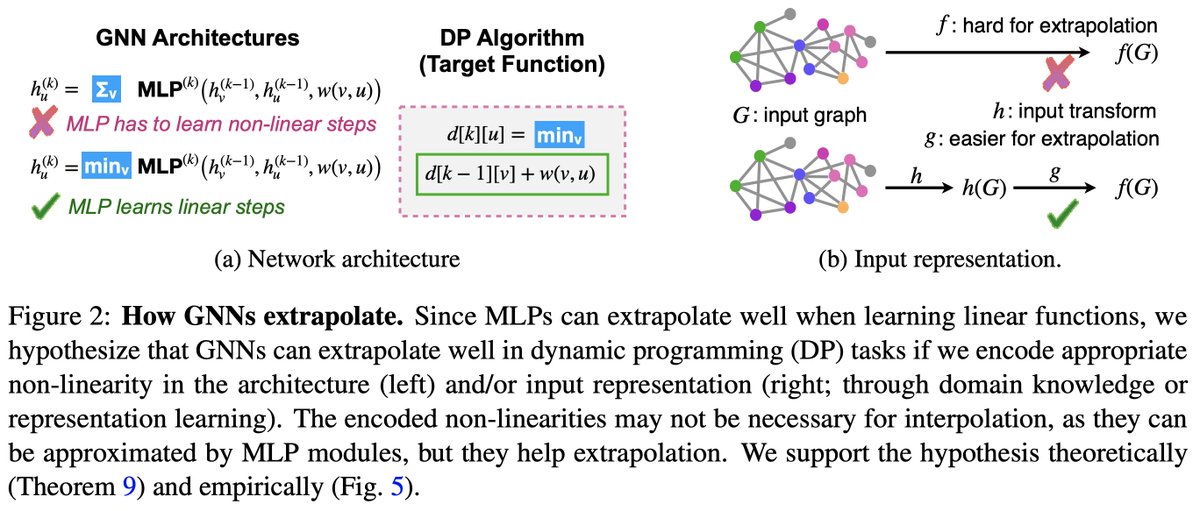
Today's notes on "How Neural Nets Extrapolate: From Feedforward to GNNs" (https://t.co/0Ir8Elcymp) by @KeyuluXu, @StefanieJegelka Ken-ichi Kawarabayashi @SimonShaoleiDu@mozhi_zhang@jingling_li. Read to learn why and when GNNs extrapolate. https://t.co/4pyxcLEjrm
How do neural networks extrapolate, i.e., predict outside the training distribution? We study MLPs and Graph Neural Networks trained by gradient descent, and show how a good representation and architecture can help extrapolation.
https://t.co/Vf2GNnS0QS
ICLR's h5-index is 203 and ranks 17 among all scientific publication venues (ahead of NeurIPS, ICCV, ICML).
203 ICLR papers of the last 5 years have gathered more than 203 citations.
Pretty amazing for a conference that started in 2013.
https://t.co/3BVHHgW8Q4