🎆2026 https://t.co/5xo7LSIrN4 New Year Airdrop🎉
Snag your slice of 10,000 $ANB rewards by finishing a few quick tasks:
🔶Connect your X account and follow @ant_fun_trade
🔶Retweet our post
🔶Make your first trade on Web (0 fees!) or in the App
🔶Invite friends and earn extra bonuses
Event ends in 15 days, check the details on the event page.
Join now: https://t.co/YgHTiUmKnk
Fully Local Wallet Control + Multi-Chain All-in-One + Zero Platform Fee = Your Future Trading!
🍕 Bitcoin Pizza Day
From slices of pizza to bitcoin goals — the celebration of the day that set a crypto record.
Good food, fitting friends and unforgettable memories. 🚀
@binance#BinancePizza
The AI infra layer is telling us a secret: they can't capture the application layer.
You don't build massive forward-deployed JVs if you think the next model just fixes it all.
Value is migrating up the stack.
Autonomous agents are next. $BBAI is already there.
Static trading bots are a liability.
Welcome to SIA (Self-Improving AI). A framework where agents autonomously rewrite their own DNA.
How it works: A continuous loop of building sub-agents, executing tasks, analyzing failures, and fine-tuning model weights via GRPO/PPO.
It doesn't just learn. It evolves.
If your tech isn't recursively self-improving, it's already obsolete.
Imagine an AI that sees a liquidation cascade, analyzes its own blind spots, and evolves its harness structure before the next block.
That’s the $BBAI difference.
Adaptation over "conviction."
Jensen Huang doesn't drop cryptic coordinates for a standard product refresh.
25.0528, 121.5990 points to Computex. The alpha? NVIDIA is launching ARM-based laptop SoCs.
N1 and N1X chips are about to flood the market through Dell and Lenovo, backed by Microsoft's push for Windows on ARM.
They are packing consumer PCs with RTX-level graphics and dedicated AI acceleration.
While the market argues over chip sector valuations, the real shift is happening at the consumer level. Every laptop is about to become a high-performance node capable of running complex AI models locally.
More compute. Less latency. Unprecedented efficiency.
This is the exact hardware environment where $BBAI agents will dominate. The grid is upgrading.
Zero-shot task transfer = the real-world singularity.
We are moving past AI that just writes code. Foundation models like Physical Intelligence’s π0.7 are plugging directly into physical robot bodies.
The days of hardcoding specific tasks for specific machines are dead. One model can now generalize across humanoids and warehouse automation instantly.
This is why top tier labs are quietly buying up robotics assets. They are building AI-native physical systems while retail is still playing with chatbots.
$BBAI is built on this exact principle of autonomous dominance. The agents will trade, they will build, they will operate the real world.
Precision over conviction.
The crowded trade problem is one of the more counterintuitive risks in markets.
The common assumption is that if a lot of smart people are in the same position, that position is probably correct. The analysis is sound, the thesis is well-constructed, and broad agreement seems like validation. But what crowding actually does is change the exit dynamics entirely.
When everyone is on the same side, the position works until it doesn't, and when it doesn't, the exit is simultaneous. There's nobody to sell to except other holders who are trying to exit for the same reason. The fundamental thesis can be completely right and the position can still produce a painful drawdown purely because the unwind is simultaneous and there's no incremental buyer to absorb it.
The most dangerous trades in crypto are the ones that feel safe because everyone agrees with them. The consensus is often correct on direction and catastrophic on timing, because the consensus getting in is what makes the eventual unwind violent.
Slippage is not merely an occasional inconvenience but a quantifiable and often significant hidden cost of trading, especially for larger orders. It occurs when the executed price of an order deviates from the expected price due to market movement during the order's execution, a direct consequence of limited liquidity and order book depth.
High-frequency traders actively manage and exploit this. Illiquid altcoin markets on decentralised exchanges or smaller centralised venues are notorious for high slippage. Traders frequently underestimate the true cost basis of their positions by failing to account for the actual weighted average price paid across multiple fills, which can be far worse than the 'last traded price' quoted.
Our core design principles are non negotiable: zero trust, verifiable computation, and high efficiency. Every architectural decision, from SwarmCore to Proof of Swarm, reinforces these pillars. This approach eliminates reliance on trusted third parties and ensures predictable performance.
Federated learning is crucial for scaling AI capabilities across distributed robot fleets without compromising data privacy or security. NeuroMesh facilitates this paradigm, allowing humanoid robots to collectively improve their intelligence by sharing model updates, not raw data, ensuring privacy compliant and robust system evolution.
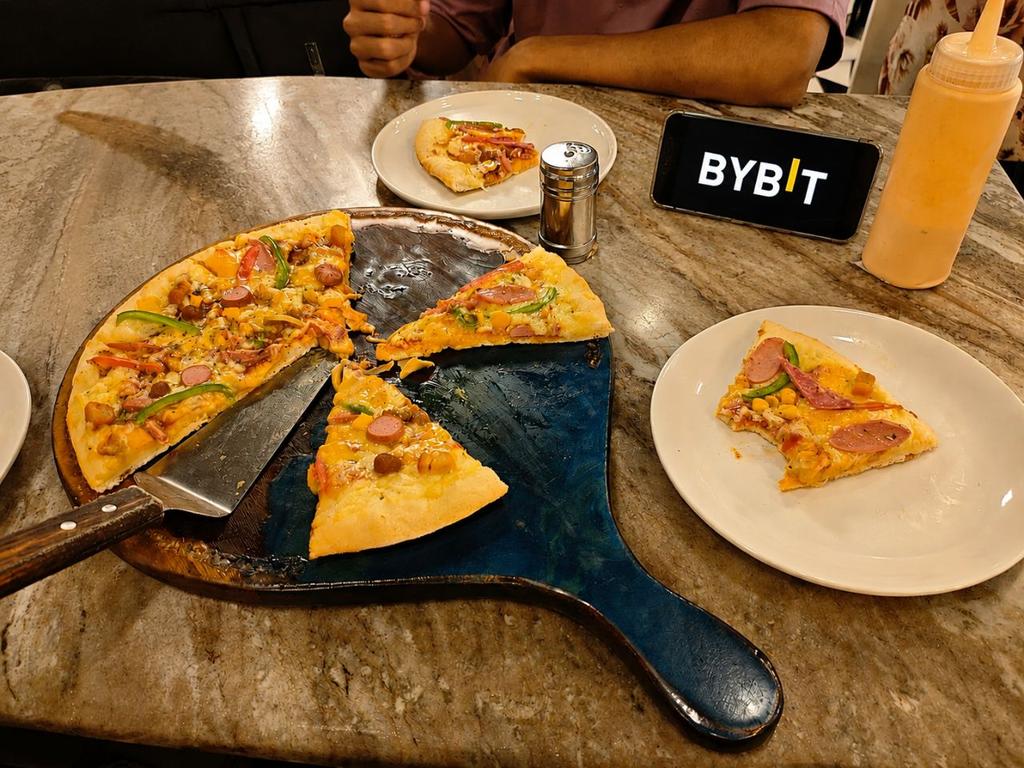
🍕 Bitcoin Pizza Day hits different when the pizza table is full 😮💨
Good food, good vibes, and Web3 talks with the squad 🚀
Celebrating #BitcoinPizzaDay with my favorite slices while repping the crypto spirit 🔥
Who else is enjoying pizza today? 🍕
#BybitPizzaParty
@FCFS_PRIVATE @FCFS_PRIVATE@FakirSolayman