For I know the plans I have for you"-- [this is] the LORD's declaration-- "plans for [your] welfare, not for disaster, to give you a future and a hope.
- Jeremiah 29:11
@Jiriservant You should be able to do more than 280. But the premium+ allows longer posts with wider screen space I guess. Premium allows but with "More" tap for the reader.
"Unless the LORD builds a house, its builders labor over it in vain;
Unless the LORD watches over a city, the watchman stays alert in vain." - Psalm 127:1
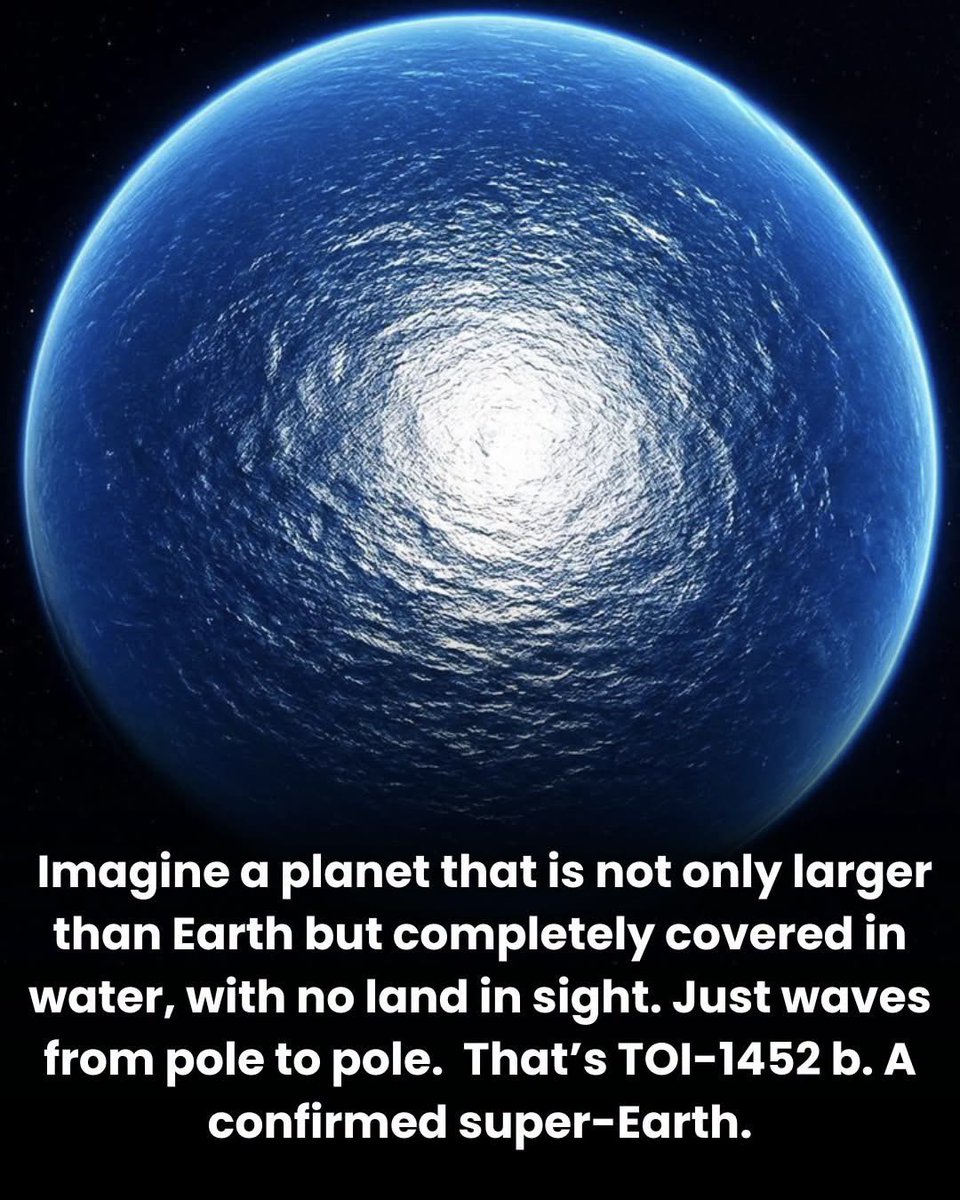
Imagine standing on a boat and knowing there is no shore anywhere on the entire planet. Not over the horizon, not on the other side of the world. Just endless ocean, possibly hundreds of kilometers deep. That may be what TOI-1452 b is.
The planet sits about 100 light-years away in the constellation Draco, orbiting one star of a binary pair of small red dwarfs so close together that early telescopes saw them as a single point of light. It is a super-Earth, meaning it is bigger and heavier than our planet but still likely rocky, roughly 1.6 times Earth's size and about 5 times its mass.
Here is what makes scientists suspect it is an ocean world. When you measure a planet's size and its mass, you can calculate its density, which tells you what it is likely made of. A rocky planet like Earth is dense. A gas planet is light and fluffy. TOI-1452 b came out in between, too light to be pure rock, too heavy to be gas. The best explanation is water. A lot of it.
On Earth, water makes up less than one percent of our planet's mass. Models suggest water could make up as much as 30 percent of TOI-1452 b. If that is true, it would be a global ocean of staggering depth, with no continents, no islands, nothing but water wrapping the entire world.
Now the honest part. We have not seen this ocean. This is inferred from density, not observed directly. The planet could also be a rocky world with a thick atmosphere instead. And it sits in its star's habitable zone, but a red dwarf's habitable zone is a complicated place, with flares and tidal locking to worry about.
Still, it is one of the best ocean world candidates ever found, and crucially, it is close enough and positioned well enough that the James Webb telescope could study its atmosphere and finally tell us what it truly is.
A planet that might be one single, endless sea. Life on Earth began in water. If a world is nothing but ocean, does that make it more likely to hold life, or would having no land hold it back?