🦔UC Berkeley's computer science department just posted its worst failure rates in years. 35.3% of CS 10 students got F's in spring 2026, up from under 10% in prior semesters. Professor Dan Garcia says the primary driver is a "vast increase in academic dishonesty" through LLMs. Students use AI to complete assignments, never learn the material, then fail exams. His office hours, once full, are now empty.
My Take
Companies are firing experienced engineers while the pipeline that produces new ones is being gutted by the same technology. Students use AI to bypass the hard part of learning, show up to exams without the understanding, and fail. One professor discovered a student's linear algebra class had an "open AI" policy for homework and exams. That student then couldn't do basic linear algebra in the next course.
Both ends of the workforce are eroding at the same time. Senior engineers are getting cut to fund AI spending. Junior engineers are graduating without the skills because AI did their coursework. And the companies spending trillions on these tools haven't connected those two facts yet.
Hedgie🤗
Environmental activist Erin Brockovich has launched a new online tool to help communities monitor and respond to the rapid expansion of AI data centers across the United States.
The Brockovich AI Data Center Reporting website allows residents to report and map operational facilities, projects under construction, and rumored developments. Since its launch, the map has already received over 2,700 submissions, with Texas emerging as the current hotspot.
One of the most controversial projects is a massive 3-gigawatt data center planned by MSB Global in Sulfur Springs, Texas. The 1,600-acre development has sparked strong local opposition and multiple lawsuits due to its enormous environmental impact.
The initiative shines a light on growing public concern over the massive resource demands of AI infrastructure. A single large data center can consume up to 5 million gallons of water per day, roughly the same amount used by a town of 50,000 people, while their enormous electricity needs are driving up energy costs for regular households.
If you’ve seen or heard about a data center project in your area, you can help by submitting information to the map.
CEOs are quietly realizing the AI replacement plan has a problem.
Two problems, actually.
One: the token costs for running AI agents are now exceeding what they were paying the employees they fired.
Two: when the tokens run out, the AI stops. Just stops. No continuity. No workaround. Just a spinning wheel where your workforce used to be.
You fired humans to save money and bought a subscription that bills you into a corner.
The employees you let go knew what to do when things broke.
The AI just invoices you for the outage.
And then there’s the permission problem nobody wants to talk about.
To do its job, the AI agent needs access. Full access. Your systems, your patents, your contracts, your future plans. Everything you spent years building, handed over to a process that has no loyalty, no discretion, and no skin in the game.
You didn’t hire a replacement.
You gave a stranger with no soul the keys to everything you own.
Enjoy.
1/ First time I watched Fight Club, I was a teenager. I thought it was the coolest thing ever put on film.
I watched it again recently in my forties. I finally understood what it was actually about. And almost everyone I know who loves it is still watching it the way I did at 17. 🧵👇
Erin Brockovich has launched a website and has begun tracking all data centers in America and logging resident complaints
In just 1 week it’s already logged 1,690 resident complaints
For this who don’t remember
Erin Brockovich was the paralegal responsible for winning out a case against PG&E, Hinckley in California, because their wastewater runoff was seeping into rural areas and creating a lot of health issues for, for the surrounding neighborhoods
That case brought in a $333 million settlement that went to the families affected by the situation because a lot of them either had staggering medical bills due to their tap water was no longer safe
So why is this important, well residents all over America are reporting their tap water and river water is being heavily polluted by data centers
Her map of data centers is new, she just launched it
The website features an interactive US map showing operational, under-construction, and proposed AI data centers, overlaid with community-reported complaints
Residents can submit reports with details, photos, and locations. Within days of launch, it received a surge of submissions over 1,600 in the first week, and reports of 1,800+ from 47 states shortly after
Common Resident Complaints Being Logged
- Water usage
- Raising utility bills for residents
- Noise pollution: Constant 24/7 humming from fans, generators, and cooling systems disrupting sleep, daily life, and wildlife.
- E-waste from frequent hardware upgrades, pollution including PFAS concerns
SICKENING: AOC Just showed off the Georgia drinking water from Meta's AI Data Centers. Thank you @AOC:
"This is the current drinking water in Morgan County, Georgia. Right after a data center was constructed, the metadata center was constructed, the only difference between the clean water and this was that data center. I have another one as well. So this wasn't just one well, these wasn't just one family's situation. This is what the drinking water now looks like next to that data center. And I think both of us can agree that neither one of these things are drinkable. These families now have to ship, in a rural area, have to ship water to their house in order to cook and bathe themselves."
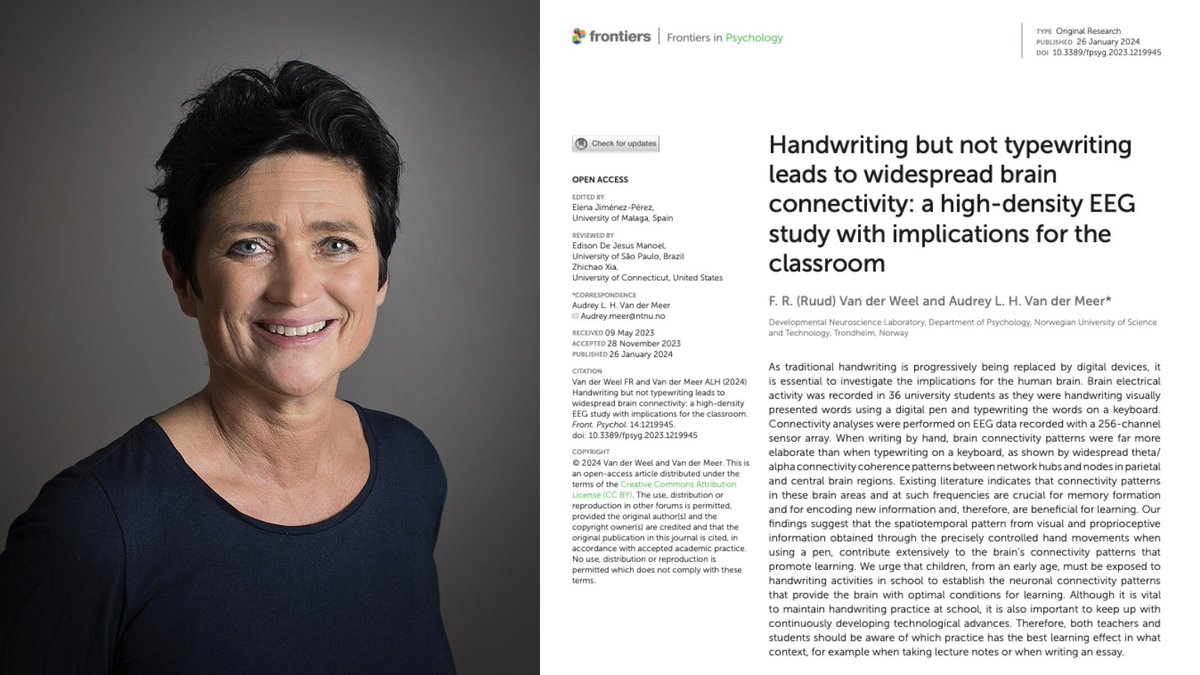
A Norwegian neuroscientist spent 20 years proving that the act of writing by hand changes the human brain in ways typing physically cannot, and almost nobody outside her field has read the paper.
Her name is Audrey van der Meer.
She runs a brain research lab in Trondheim, and the paper that closed the argument was published in 2024 in a journal called Frontiers in Psychology. The finding is brutal enough that it should have changed every classroom on Earth.
The experiment was simple. She recruited 36 university students and put each one in a cap with 256 sensors pressed against their scalp to record brain activity. Words flashed on a screen one at a time.
Sometimes the students wrote the word by hand on a touchscreen using a digital pen, and sometimes they typed the same word on a keyboard. Every neural response was recorded for the full five seconds the word stayed on screen.
Then her team looked at the part of the data most researchers had ignored for years, which is how different parts of the brain were communicating with each other during the task.
When the students wrote by hand, the brain lit up everywhere at once.
The regions responsible for memory, sensory integration, and the encoding of new information were all firing together in a coordinated pattern that spread across the entire cortex. The whole network was awake and connected.
When the same students typed the same word, that pattern collapsed almost completely.
Most of the brain went quiet, and the connections between regions that had been alive seconds earlier were nowhere to be found on the EEG.
Same word, same brain, same person, and two completely different neurological events.
The reason turned out to be something nobody had really paid attention to before her work. Writing by hand is not one motion but a sequence of thousands of tiny micro-movements coordinated with your eyes in real time, where each letter is a different shape that requires the brain to solve a slightly different spatial problem.
Your fingers, wrist, vision, and the parts of your brain that track position in space are all working together to produce one letter, then the next, then the next.
Typing throws all of that away. Every key on a keyboard requires the exact same finger motion regardless of which letter you are pressing, which means the brain has almost nothing to integrate and almost no problem to solve.
Van der Meer said it plainly in her interviews.
Pressing the same key with the same finger over and over does not stimulate the brain in any meaningful way, and she pointed out something that should scare every parent who handed their kid an iPad.
Children who learn to read and write on tablets often cannot tell letters like b and d apart, because they have never physically felt with their bodies what it takes to actually produce those letters on a page.
A decade before her, two researchers at Princeton ran the same fight using a completely different method and ended up at the same answer. Pam Mueller and Daniel Oppenheimer tested 327 students across three experiments, where half took notes on laptops with the internet disabled and half took notes by hand, before testing everyone on what they actually understood from the lectures they had watched.
The handwriting group won by a wide margin on every question that required real understanding rather than surface recall.
The reason was hiding in the transcripts of what the two groups had actually written down.
The laptop students typed almost word for word, capturing more total content but processing almost none of it as they went, while the handwriting students physically could not write fast enough to transcribe a lecture in real time, which forced them to listen carefully, decide what actually mattered, and put it in their own words on the page.
That single act of choosing what to keep was the learning itself, and the keyboard had quietly skipped the choosing and skipped the learning along with it.
Two studies. Two countries. Same answer.
Handwriting makes the brain work. Typing lets it coast.
Every note you have ever typed instead of written went into your brain through a thinner pipe. Every meeting, every book highlight, every idea you captured on your phone instead of on paper was processed at half depth.
You did not forget those things because your memory is bad. You forgot them because typing never woke the part of the brain that would have made them stick.
The fix is the thing your grandmother already knew.
Pick up a pen. Write the thing down. The slower road is the faster one.
100 billion for a tunnel.
No money for OSAP.
10 million for strippers.
No money for healthcare.
29 million for a private jet.
No money for education.
THIS IS FISCAL CONSERVATISM.
Every time they are in office they rob us blind. Feather their little nests like Mike Harris did. Kickbacks, gifts, missing funds. It's not a one off. Mike Harris opened the door in Ontario to privatized long term care. When he left office he just "happened" to be made CEO of a long term care company and owns a few of his own. Andrew Scheer paid for his kids private education and a minivan from party funds until he was caught. Now Doug Ford is telling us we are broke while buying a private jet for his use. It's not a bug, it's a feature. The Conservatives will watch people suffer while enjoying their perks. The suffering only adds to their pleasure. @fordnation
Ontarians are being told there’s “no money” for public healthcare, education, housing even our jail system is falling apart.
But somehow, there’s $26 MILLION for a luxury jet.
Let that sink in.
And now the push to expand Billy Bishop Airport starts to make a whole lot more sense. Who is that really for?
Because it’s not for the people waiting in ERs, struggling to pay rent, or watching classrooms get more crowded every year.
This is about convenience at the top not the needs of everyday Ontarians.
At this point, there’s no real difference between Doug Ford and Donald Trump:
priorities that favour optics, power, and privilege over people.
Doug Ford says fair grocery prices are “socialism.”
But turns around and buys 26 million luxury jet on the public dime?
Totally normal. Totally fine. Nothing to see here.
Apparently helping families afford food is a problem
but splurging on high-end perks isn’t.
NEW: The Ford government is moving $4B in taxpayer money from a tariff relief program into a private investment fund.
The finance minister argues it will spur economic growth & create future jobs. But critics say it is public money desperately needed in schools and hospitals.
Doug Ford doesn’t want another Robyn Doolittle moment: Doug Ford watched his brother Rob get absolutely torched by one relentless investigative reporter, Robyn Doolittle at the Toronto Star. She caught the mayor lying about crack cocaine, and it nearly destroyed the whole family. Now look at what’s happening: Tina Yazdani, one of the only Queen’s Park reporters who actually grilled this government, gets fired by CityNews. Two of her toughest Ford stories? Quietly scrubbed from the website. And right on cue, Doug’s rushing through changes to bury his own phone records and exempt his office from Freedom of Information retroactively. He learned exactly what happens when a good journalist gets too close to the truth. He doesn’t want to live through it again. This isn’t about modernizing anything. This is a Premier trying to make sure nobody ever exposes him the way his brother got exposed. @CityNewsTO@fordnation
BC Premier @DavidEby calls separatists seeking US support 'Treason' 💯
"If you are crossing a border, to seek the support of a foreign government, to break up our country....that is the definition of Treason"
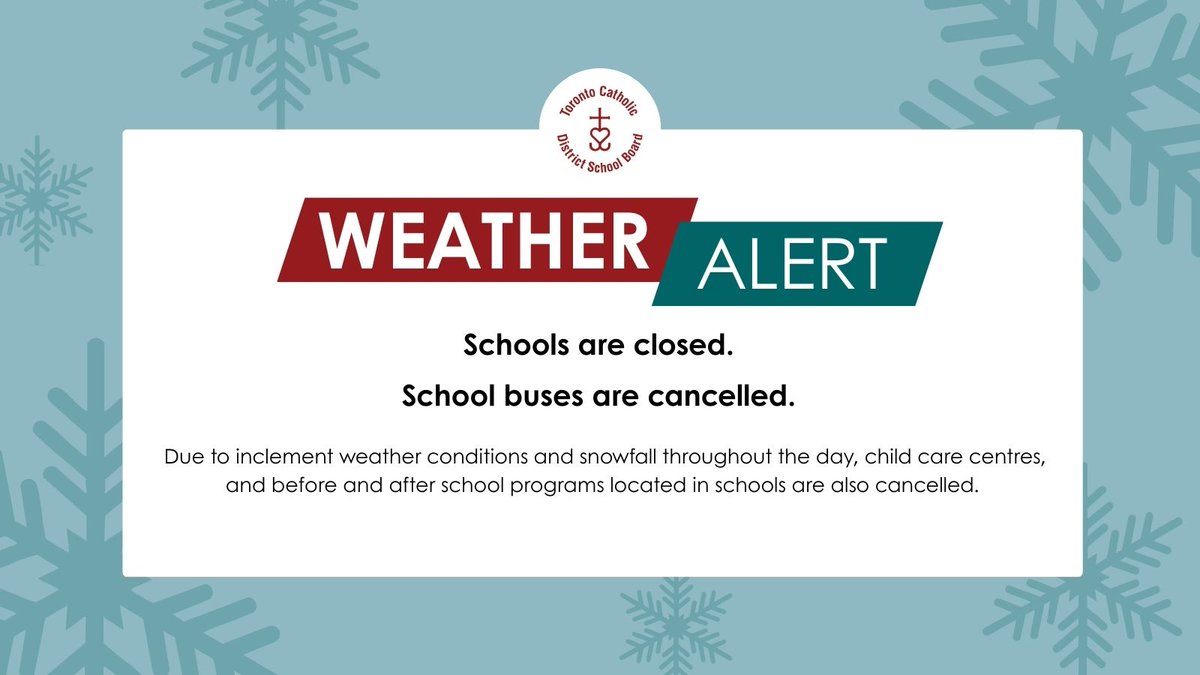
Inclement Weather: All schools are closed today due to weather conditions.
Bus transportation, child care centres, and before and after school programs located in schools are also cancelled.
A message from a Kindergarten teacher:
After forty years in the classroom, my career ended with one small sentence from a six-year-old:
“My dad says people like you don’t matter anymore.”
No sneer. No malice. Just quiet honesty — the kind that cuts deeper because it’s innocent. He blinked, then added, “You don’t even have a TikTok.”
My name is Mrs. Clara Holt, and for four decades, I taught kindergarten in a small Denver suburb. Today, I stacked the last box on my desk and locked the door behind me.
When I started teaching in the early 1980s, it felt like a promise — a shared belief that what we did mattered. We weren’t rich, but we were valued. Parents brought warm cookies to parent nights. Kids gave you handmade cards with hearts that didn’t quite line up. Watching a child sound out their first sentence felt like magic.
But that world slowly slipped away. The job I once knew has been replaced by exhaustion, red tape, and a kind of loneliness I can’t quite describe.
My evenings used to be filled with construction paper, glitter, and glue sticks. Now they’re spent filling out digital reports to protect myself from angry emails or lawsuits. I’ve been yelled at by parents in front of twenty-five children — one filming me with his phone while I tried to calm another child mid-meltdown.
And the kids… they’ve changed too. Not by choice.
They arrive tired, anxious, overstimulated. Their tiny fingers know how to swipe a screen before they can hold a crayon. Some can’t make eye contact or wait in line. We’re expected to fix all of it — to patch the gaps, heal the trauma, teach the curriculum, and document every move — in six hours a day, with resources that barely fill a drawer.
The little reading corner I once built, full of soft beanbags and paper stars, was replaced by data charts and “learning metrics.” A young principal once told me, “Clara, maybe you’re too nurturing. The district wants measurable results.”
As if kindness were a weakness.
Still, I stayed. Because of the small, holy moments that no spreadsheet could measure —
a whisper of, “You remind me of my grandma.”
a shaky note that read, “I feel safe here.”
a quiet boy finally meeting my eyes and saying, “I read the whole page.”
Those tiny sparks were my reason to keep showing up.
But this last year broke something in me.
The aggression grew sharper. The laughter in the staff room turned to silence. The light went out of so many eyes. I watched brilliant teachers — my friends — vanish under the weight of burnout, their joy replaced by survival.
I felt myself fading too, like chalk on a board that’s been wiped one too many times.
So today, I began my goodbye. I pulled faded art off the walls and tucked thirty years of handmade cards into a single box. In the back of a drawer, I found a letter from a student from 1998:
“Thank you for loving me when I was hard to love.”
I sat on the floor and cried.
No party. No applause. Just a handshake from a young principal who called me “Ma’am” while checking his notifications.
I left my rocking chair behind, and my sticker box too. What I carried with me were the memories — the faces of hundreds of children who once trusted me enough to reach out their hands and learn. That can’t be uploaded. It can’t be measured. It can’t be replaced.
I miss when teachers were partners, not targets. When parents and educators worked side by side, not in opposition. When schools cared more about wonder than numbers.
So if you know a teacher — any teacher — thank them. Not with a mug or a gift card, but with your words. With your respect. With your understanding that behind every test score is a heart that cared enough to try.
Because in a world that often overlooks them, teachers are the ones who never forget our children.