Sensex and Nifty rebounded after Monday’s profit booking as Brent crude eased and the rupee strengthened. Nifty reclaimed 25,600, with FMCG, Pharma and Private Banks leading sector gains.
– Sensex rose 1.82% to 83,938.28, while Nifty gained 1.85% to close at 25,819.25.
– Nifty Midcap 100 gained 0.30% to 61,584.75, while Nifty Smallcap 100 fell 0.44% to 19,229.35. Bank Nifty rose 1.79% to 63,703.25.
– Nifty FMCG led with a 3.79% gain, followed by Pharma at 2.38% and Private Bank at 2.21%. Nifty IT rose 1.12%, while Metal fell 2.04% and Media dropped 4.44%.
– HINDUNILVR was the top gainer, up 6.08%, while TATASTEEL was the top loser, down 2.27%.
– USD/INR fell 0.33% to 92.49, while India VIX held steady at 17.70.
Trade setup: Nifty may consolidate between 25,300 and 26,000, with a move above 26,000 opening the way to 26,373 and a break below 25,300 pointing to the 25,000–24,800 zone.
The Quiet Climb in Car Prices: Small Hikes, Big Reason
Picture a Sunday afternoon in a car showroom. A family has been circling the same hatchback for twenty minutes when the salesperson leans in with a line every car buyer has heard: “Sir, prices are going up from the first.”
It’s a classic sales line. This time it also happens to be true. Tata Motors Passenger Vehicles and Hyundai have announced increases effective 1 December. What stands out is how small they are.
The Size of the Nudge
Tata’s increase averages 0.5% across its entire portfolio of cars and SUVs, petrol, diesel and electric. Hyundai’s is up to ₹8,000 across select models and variants. Maruti Suzuki already raised prices from 22 November, with an estimated volume-weighted average increase of around 0.31%, the company said in its filing to the stock exchanges.
To put it in rupees, take a car with an ex-showroom price of ₹10 lakh. That’s an illustration, not a quote. A 0.31% increase adds ₹3,100, and a 0.5% increase adds ₹5,000.
Why a Small Hike Still Makes News
Because it keeps happening. Tata’s coming revision is preceded by a 0.5% increase on its petrol and diesel range from 1 April and one of up to 1.5% from 1 July. Maruti said its increases since January total about 1.4%.
One way to read it: carmakers are taking a staircase, not a jump. Each step is too small to notice, and together they add up.
The Paradox: A Full Showroom, a Thinner Profit
Carmakers are selling more than ever, yet some are earning less. Maruti’s September-quarter revenue rose 26% to ₹53,355 crore, but net profit fell 26% to ₹2,466 crore, with higher commodity costs, adverse forex movements and losses on mutual fund investments weighing on it. It also posted its highest-ever quarterly sales volume of 6,96,654 units.
Think of a restaurant where every table is booked, but ingredients have got more expensive. A busy kitchen doesn’t mean a fatter profit.
The cost pressure is real across the industry. SIAM, the carmakers’ body, says commodity prices remain a key concern, and it is watching developments in West Asia. Business Today adds that steel and copper costs remain elevated. Carmakers are passing on only a portion of the increased costs to customers.
Why They Can Nudge Prices: Demand
Buyers are still turning up. Domestic passenger vehicle wholesales rose 12.4% to 5,28,384 units in October, and April-October sales rose 25.5%. Business Today attributes the past year’s record sales mainly to lower taxes after the GST rate cut.
So the tax cut lowered prices, and commodity costs are now nibbling at some of that relief.
Why Small Steps Still Matter
For first-time buyers, affordability is what decides. Business Today notes that further increases could erode affordability, a key driver of car ownership. A few thousand rupees is little on a car, but it’s one more step up a staircase some buyers already climb carefully.
Back to the Showroom
So was the salesperson right? On the date, yes. On the urgency, that’s for the family’s budget, not the calendar. The amounts are small next to the car’s price, and a dealer’s offer can matter as much as the hike.
Three questions are worth asking: how much this exact variant’s price has changed, whether the price is locked at booking or billing, and what the final on-road cost comes to.
The Takeaway
“Prices go up on the 1st” is true and incomplete. The fuller version is that costs are rising, carmakers are passing on a slice at a time, and demand is strong enough to allow it. The staircase is the part worth watching.
Sources: Business Standard, PTI, IANS, SIAM, Business Today.
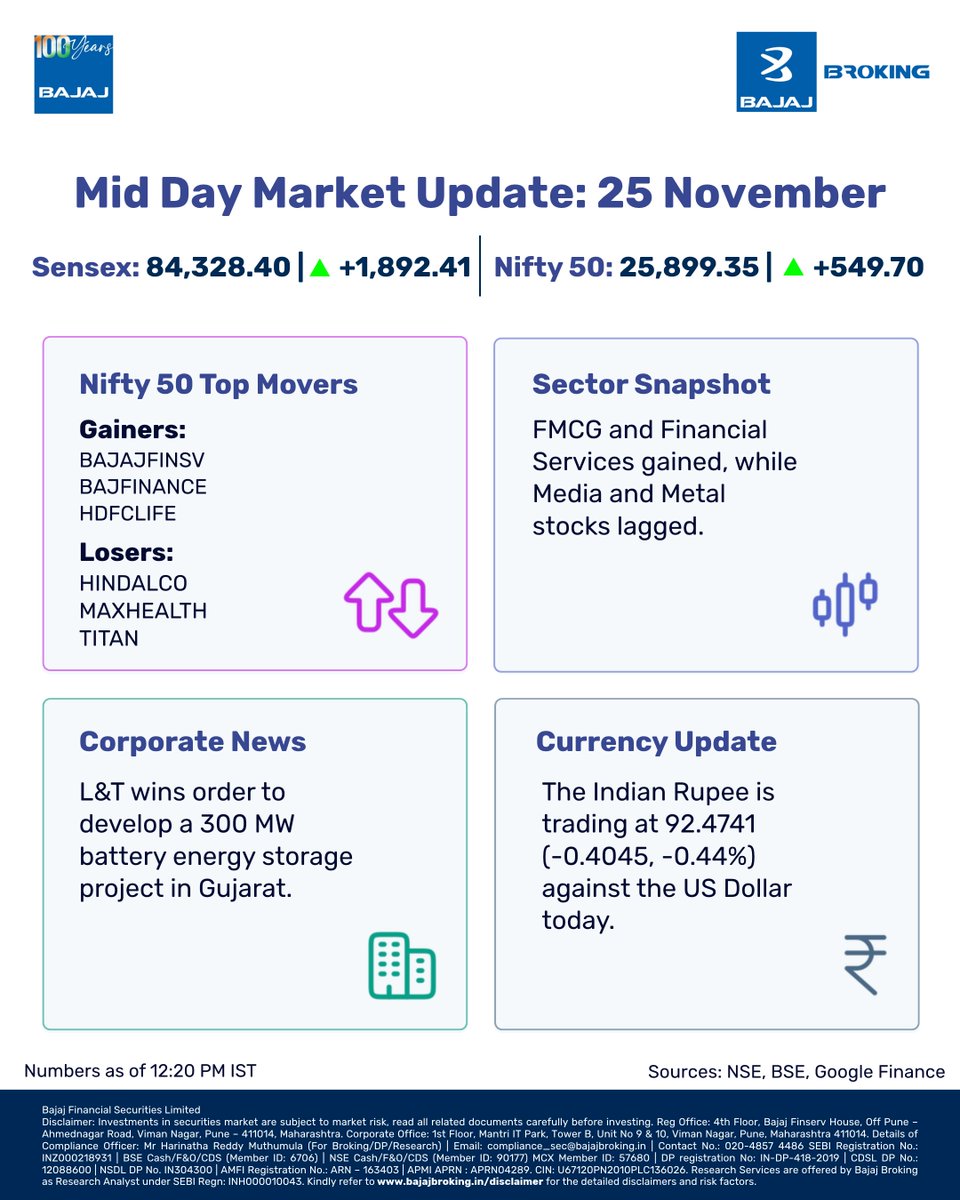
Markets traded higher at mid-day on 25 November.
– Sensex rose 1,892.41 points to 84,328.40, while Nifty 50 gained 549.70 points to 25,899.35.
– Nifty FMCG and Nifty Financial Services 25/50 led the gains, while Nifty Media and Nifty Metal saw the steepest declines.
– BAJAJFINSV, BAJFINANCE and HDFCLIFE were among the top gainers, while HINDALCO, MAXHEALTH and TITAN were among the top losers.
– L&T won an order to develop a 300 MW battery energy storage project in Gujarat.
@Danish8889@BajajBroking The problem is what in India some people work for 1 or 2 months just to buy things for which their parents wont get for them. India has the biggest market for call center.
When Royal Enfield turned 100, it was fighting to stay alive. At 125 years, it sold over 12 lakh motorcycles in a single year.
This is the story of the oldest motorcycle brand in continuous production.
The needle factory: In 1891, Bob Walker Smith and Albert Eadie bought George Townsend & Co. in Redditch, England, a needlemaker of almost 50 years that had just started making bicycles.
The gun connection: In 1893, they won a contract to supply precision parts to the Royal Small Arms Factory in Enfield. Their first bicycle was named the Enfield, and a year later the bikes became Royal Enfields, with the trademark "Made Like A Gun".
The first motorcycle: It came in 1901 and was launched at the Stanley Cycle Show in London. The Bullet was born in 1932. During World War II, its 125cc Flying Flea was built so it could be dropped by parachute with paratroopers behind enemy lines.
The India chapter:
- 1949: K. R. Sundaram Iyer launches Madras Motors to import British motorcycles, including Royal Enfields, into India.
- 1952: The Indian Army orders 500 350cc Bullets for patrols in Kashmir and Rajasthan, and larger orders follow.
- 1955: Royal Enfield and Madras Motors form Enfield India and start building a factory at Tiruvottiyur, near Madras.
- 1956: The factory opens. Bullets at first arrive from England as kits and are assembled in Madras
A British motorcycle had found a second home, and it would soon need one.
Profit booking dragged Sensex and Nifty sharply lower on monthly expiry day, snapping a two-session winning streak. Banking and metal stocks led the decline, while IT and Realty remained positive.
– Sensex fell 1.77% to 82,435.99, while Nifty declined 1.75% to close at 25,349.65.
– Nifty Midcap 100 slipped 1.01% to 61,403.20, while Nifty Smallcap 100 fell 0.66% to 19,314.40. Bank Nifty plunged 3.17% to 62,585.35.
– Nifty IT led with a 1.69% gain, while Realty rose 0.31%. Metal fell 3.68%, PSU Bank declined 3.25%, and Financial Services dropped 2.49%.
– TCS was the top gainer, up 3.53%, while TATASTEEL was the top loser, down 8.43%.
– USD/INR fell 0.18% to 92.80, while India VIX rose 2.18% to 17.69.
Trade Setup for Wednesday, 25th November:
Nifty may consolidate in the 24,800–25,700 range before a potential move towards 26,373, with short-term support at 24,800–24,600.
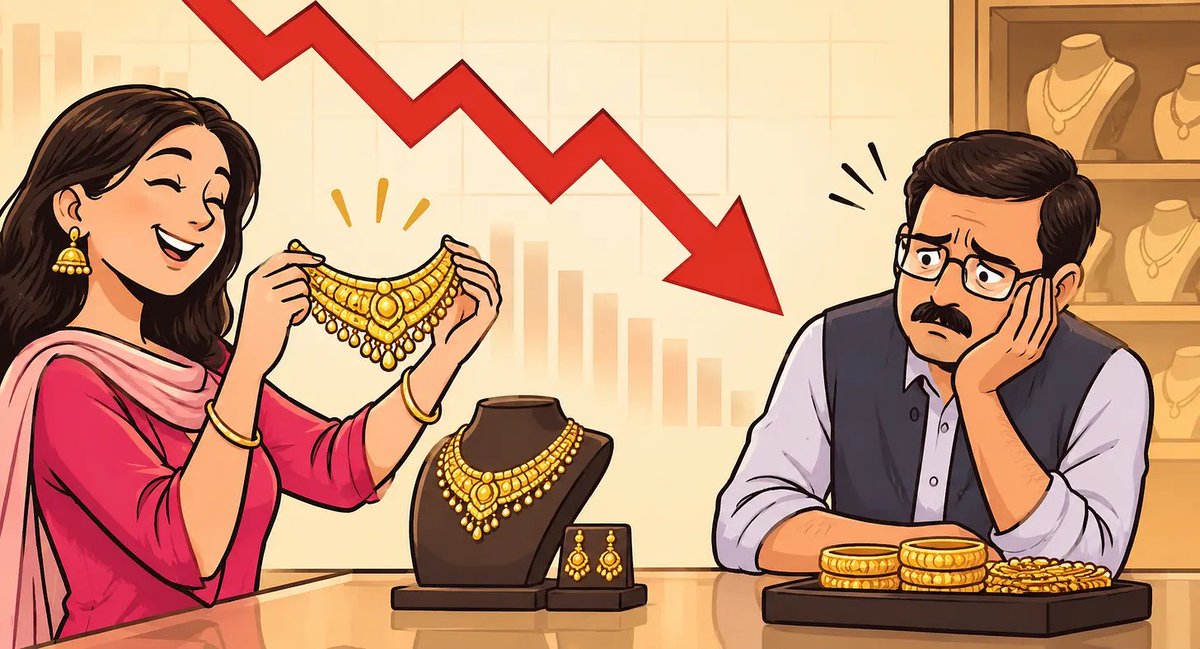
The Gold Price Correction: A Boon for Buyers, A Setback for Some Businesses
Last week gold had its sharpest weekly fall since March. For someone planning a wedding purchase, that’s a lower price tag. For a jeweller who stocked up at higher prices, or a lender who accepted gold as collateral, it can look different.
Same metal, same week, two different experiences.
What Happened
Spot gold fell for a fifth straight day on Friday to about $3,543 an ounce, heading for a weekly loss of nearly 9%, its biggest since March, and the lowest level since September 2025. Market reports linked the slide to bets on US interest rate hikes keeping pressure on gold.
Zoom Out
In India, PTI data put the price of 10 grams of 24-karat gold at ₹1,35,800 on 19 November. That is ₹47,200 below its all-time peak of ₹1,83,000 set on 29 January 2026, and about 75% above its 18 November 2024 level of ₹77,450. Prices have fallen further since.
So, this is a correction from a record, not a return to where gold was two years ago.
The Buyer’s Side
To see why buyers care, look at what high prices did to demand. The World Gold Council reports that India’s gold demand fell 29% year-on-year to 162.5 tonnes in July-September, amid a higher import duty, soaring prices and the Prime Minister’s appeal to curb purchases. Yet the value of purchases rose 3% to ₹2.42 lakh crore. People bought less gold but spent more.
There is also a sign of how buyers respond when prices ease. The WGC says jewellery demand strengthened 33% from the previous quarter to 100 tonnes, supported by a pullback in prices late in the quarter that encouraged some deferred purchases. Local jewellers echo that. A Shimla trader told Asianet News that the fall brought relief to wedding shoppers and increased customer interest and bookings.
The Business Side
Jewellers who hold stock bought at higher prices are exposed when prices fall, because the metal in the showcase is now worth less. The same Shimla report said jewellers faced heavy losses and strain on inventory valuations.
Some large buyers had seen this coming. Bloomberg reported in October that Indian jewellers were holding back purchases, betting that the price drop had further to run, with demand subdued after the government more than doubled the import duty to 15% in May.
The Lender’s Side
Gold loans work differently. A gold loan is secured against jewellery pledged by the borrower. The lender advances only a portion of its assessed value and retains a margin to absorb potential losses. That portion is the loan-to-value ratio (LTV).
When prices fall, the cushion narrows. Business Today explains that falling prices reduce the value of collateral and can lower the amount lenders offer to new borrowers. The cushion helps: LTVs at major gold lenders were capped at 75% at origination before revised rules took effect on 1 April 2026, and an Equirus analyst said most lenders have LTVs of around 60-70%. The impact is not necessarily immediate or uniform across lenders.
This sits in the same NBFC universe we looked at earlier this month, where lenders hold different kinds of collateral and risk.
Another Side Effect of a High-Price Market
The WGC also noted that unofficial gold imports surged multi-fold to 50 tonnes in the September quarter. That is a consequence of the high prices and duty, not of last week’s fall, but it shows how a big price move spreads through the whole trade.
The Takeaway
A price move doesn’t create or destroy gold. It shifts who is better off: shoppers about to buy, against traders who already hold stock and lenders who accepted it as collateral. None of this says where prices go from here.
When you read “gold has corrected”, the useful question is which peak the fall is measured from, and which side of the counter you are on.
Sources: World Gold Council (Gold Demand Trends Q3 2026, via PTI and others), PTI, Bloomberg via Business Standard, Business Today, Gulf News, Free Press Journal, Asianet News.
Markets traded lower at mid-day on 23 November.
– Sensex fell 938.08 points to 82,981.63, while Nifty 50 declined 292.35 points to 25,508.60.
– Nifty IT and Nifty MidSmall IT & Telecom led the gains, while Nifty Metal and Nifty PSU Bank saw the steepest declines.
– TCS, TECHM and SHRIRAMFIN were among the top gainers, while TATASTEEL, AXISBANK and HDFCBANK were among the top losers.
– Ashoka Buildcon shares jumped 7% after securing projects worth over ₹4,200 crore from NHAI and Rajasthan Metro.