The mechanics of a gamma squeeze are simple.
When investors buy call options en masse, someone has to sell them-market makers. To hedge their risk, market makers buy the underlying stock. More buying pushes prices up. Higher prices increase their risk. So they buy more stock. Which pushes prices up further.
It’s a self-reinforcing loop. The market doesn’t move because companies are worth more. It moves because the options market forces buyers into existence.
We’ve seen this before.
GameStop in 2021: retail piled into call options, gamma kicked in, the stock went from $20 to $480 in days. Then the options expired.
The forced buying stopped. The stock collapsed back to $40. The company hadn’t changed. Only the mechanics had.
Tesla in 2020: same dynamic. Options euphoria drove valuations to levels that had no connection to earnings. Then it was cut in half. Twice.
The difference today is scale. $2.6 trillion in a single day of S&P call options isn’t GameStop. It’s the entire market running the same playbook simultaneously.
But there’s one variable the GameStop comparison misses.
GameStop had no earnings to fall back on. The S&P right now does. Consecutive AI beats from Alphabet, Meta, Microsoft have created a genuine fundamental floor underneath the gamma mechanics. The squeeze amplifies real moves. That makes it more durable and more dangerous when it ends.
Because it will end. Options have expiry dates. When they roll off, the forced buying becomes forced selling at the same magnitude.
The question isn’t whether this unwinds. It’s what cracks the fundamental backstop first an AI earnings miss, a capex disappointment, or simply the calendar.
$META Strategic change.
This is probably one of the smartest ways to monetize AI capex.
If Meta can both improve its own products and rent out excess compute, every GPU becomes a more productive asset.
It also reinforces something important: hyperscalers are no longer just building AI for themselves. They’re becoming infrastructure providers.
Market might see this as overcapacity at some point. Reason $NVDA is going down.
I think that’s exactly the dilemma.
Much of today’s inflation no longer comes from excessive demand but from energy, housing, insurance, tariffs and supply constraints.
Higher rates can reduce demand, but they cannot produce oil, lower electricity costs or fix structural shortages.
The risk is that central banks tighten into a K-shaped economy where asset owners remain resilient while a growing part of consumers is already under pressure.
That is why Fitch is downgrading consumer-sensitive sectors while parts of the market still price perpetual growth.
Today’s buyers are competing for a very limited supply of shares.
Below is the schedule for when that supply bottleneck begins to unwind. 👇
SpaceX $SPCX traded 256 million shares yesterday.
The entire public float is 556 million.
So in one day, almost half of every tradable share changed hands. Bought and sold, over and over, in a few hours.
Here's why that number is absurd.
SpaceX sold 555.6 million shares at $135 to raise $75 billion. That float is barely 4% of the company. Musk and insiders hold the other 96%, locked up and unable to sell.
Tiny supply. Enormous demand. Index funds that have to own it, retail that wants to, traders chasing the move.
The result is a $2 trillion company that trades like a penny stock. Up to $211 pre-market, swinging double-digit percentages between coffees.
This is what happens when you list 4% of the seventh-largest company in America and let the world fight over the scraps.
The price isn't telling you what SpaceX is worth. It's telling you how few shares there are to buy.
But the real story is what happens when the supply dam breaks.
Unlike a standard 180-day IPO cliff, SpaceX implemented a staggered, tiered lock-up that drip-feeds supply into the market to prevent a total collapse.
The schedule is brutal for the current bulls:
• Late July/August 2026: The first "earnings" window opens, releasing up to 20% of the restricted 4.6 billion shares held by employees and early backers.
• Aug–Oct 2026: A series of rolling 7% tranches hit the market every few weeks, creating a constant supply bleed.
• Late Oct/Nov 2026: Q3 earnings trigger a massive 28% release, the single largest supply injection of the year.
• December 8, 2026: The "Day 180" full expiry. Every remaining non-Musk share becomes liquid.
And Elon Musk? He is completely locked up until June 12, 2027.
The current valuation is a "scarcity premium" built on a temporary vacuum.
As these tranches unlock, the float will expand, the scarcity will vanish, and the stock will eventually have to find its true fundamental equilibrium likely far away from the current IPO-frenzy highs.
Be careful what you're buying. You aren't investing in the company; you're currently just providing exit liquidity for the early tranches.
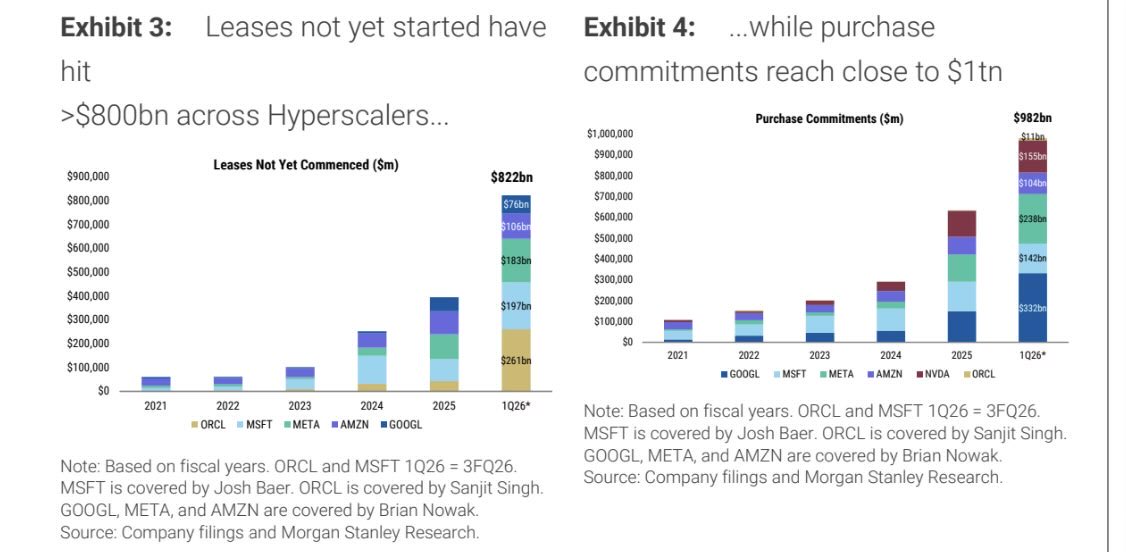
This Morgan Stanley report highlights what I’ve been arguing for months.
The AI story is gradually becoming a financing story.
The numbers are staggering:
~$1T of purchase commitments
$800B+ of leases not yet commenced
$2T+ of remaining performance obligations
$110B of unpaid capex sitting with suppliers
That’s more than $1.8T of future obligations outside traditional debt metrics.
Meanwhile, earnings are still benefiting from assets sitting in construction-in-progress.
Morgan Stanley estimates $520B+ of depreciation is coming over the next three years.
Oracle is perhaps the clearest example.
Its depreciation ratio is projected to rise from 7% to 28%.
RPO has surged more than 300%.
Capex-to-sales has reached 189%.
And supplier financing has become so aggressive that DPO reportedly jumped from 35 days to 170 days.
The technology may be real.
The demand may be real.
But the financial engineering behind the buildout is becoming just as important as the AI itself.
When funding becomes harder, the next source of capital becomes obvious:
IPOs.
Because someone eventually has to finance the buildout.
This is exactly what I’ve been questioning for months.
The challenge was never just building AI.
It was always financing it.
OpenAI still needs enormous amounts of capital.
SoftBank is committing to massive investments in the US, France and elsewhere.
Yet we’re now seeing reports that even securing a relatively small financing package tied to its OpenAI stake is becoming difficult.
That matters.
Higher inflation and higher interest rates mean capital is no longer as abundant or as cheap as it was a few years ago.
Even the hyperscalers are increasingly turning to debt markets to fund AI infrastructure.
So when I hear hundreds of billions of future commitments, my first question is no longer about technology.
It’s about who provides the capital and at what cost.
At some point, I suspect the solution becomes obvious:
✨IPO.✨
When private markets start struggling to finance the buildout, public markets are usually next in line.
I’m not convinced a move from 0.75% to 1.0% changes the story as much as people think.
The bigger issue is that Japan is trying to defend a currency while still carrying the legacy of decades of QE and ultra-low rates.
A stronger yen would help with imported inflation.
But even at 1%, the rate differential versus the US remains enormous.
That’s why interventions keep buying time rather than changing the trend.
The market isn’t just trading the yen.
It’s pricing the consequences of 30 years of monetary policy.
I wouldn’t call it insanity.
I’d call it buying time.
The problem is that intervention treats the symptom, not the cause.
As long as the rate differential remains massive and Japan continues dealing with the consequences of decades of QE, the underlying pressure on the yen doesn’t disappear.
That’s why every intervention seems to buy a few months rather than solve the problem.
@KobeissiLetter Maybe.
What stands out to me is that the economy that defeated inflation in the early 1980s is not the economy we have today.
Debt levels are vastly higher.
That makes the inflation fight look very different.
🌟4.2%.
Funny how discussions about alternative inflation measures become more popular when inflation refuses to cooperate.
Meanwhile, the K-shaped economy remains alive and well.
Asset prices continue to hold up.
A growing share of households are experiencing something very different.
I think the debt story is actually much bigger than most people realize.
When people look at China, they often focus on sovereign debt.
The real issue sits elsewhere.
Local government debt.
LGFVs used to finance projects off the balance sheet.
Property developers.
Shadow debt structures.
And years of infrastructure investment that doesn’t always generate an economic return proportional to the capital invested.
Once you start combining all of those layers, the leverage in the system becomes far larger than the headline numbers suggest.
That said, I don’t think China’s rise was an illusion.
The country built an extraordinary industrial base and became a manufacturing powerhouse with enormous strategic influence.
The real economy behind that growth is very real.
What I find remarkable is that China is simultaneously one of the most powerful industrial nations in history while also dealing with what may be one of the largest property crises ever seen.
So far that crisis has remained largely contained within China.
But the scale of the adjustment taking place in real estate over the last few years is difficult to overstate.
I’m not sure Apple ever had the lead in the kind of AI we’re talking about today.
They were ahead in voice assistants.
That’s different from leading in large-scale AI models.
Apple spent the last decade optimizing hardware, vertical integration and on-device computing while others were pouring capital into models and data centers.
Ironically, many of the companies leading AI today are now doing the opposite and investing heavily in their own hardware.
Google has TPUs.
Meta is developing custom chips.
Amazon has Trainium.
Microsoft is building Maia.
So maybe Apple wasn’t ignoring AI.
Maybe they were solving a different part of the stack.
Controlling the hardware becomes an advantage again as AI becomes more expensive to run.
🌟 I think many investors still misunderstand what AI means for $META.
They look at Meta AI and compare it to ChatGPT.
That’s probably the wrong framework.
The biggest opportunity isn’t a chatbot.
It’s the algorithm itself.
Every improvement in recommendation quality increases engagement.
Every improvement in targeting improves ad performance.
Every improvement in content discovery increases time spent on the platform.
Meta isn’t starting from zero.
It already owns some of the largest attention platforms on Earth through Facebook and Instagram.
And unlike many AI companies, Meta already has billions of users, decades of behavioral data and one of the most powerful advertising engines ever built.
That’s what makes the AI investment interesting.
Not because Meta will build the best chatbot.
But because AI can improve the economics of an ecosystem that already dominates global attention.
People also forget that Meta survived what many considered a disastrous Metaverse bet.
The company recovered because Facebook, Instagram and WhatsApp remained extraordinary assets.
Now imagine those assets with significantly better recommendation systems, ad targeting and monetization driven by AI.
At 18x forward earnings, the market still seems more excited about AI infrastructure than AI distribution.
I’m not sure that remains true forever.
🌟I think the bigger question is what happens when operating cash flow is no longer enough.
Investors keep pointing out that free cash flow is falling because companies are reinvesting aggressively into AI infrastructure.
That’s true.
But we’re increasingly reaching a point where even massive operating cash flow generation isn’t sufficient to fund the buildout.
That’s when things get interesting.
Debt issuance rises.
Equity issuance appears.
Leases, partnerships and various financing structures become more important.
And suddenly the story shifts from technology to capital allocation.
The challenge is that the returns are still largely theoretical.
The spending is visible today.
The economic payoff remains far harder to measure.
That’s why I spend less time looking at AI revenue projections and more time looking at balance sheets, financing decisions and incremental returns on capital.
Anyone can spend.
Looking at the scale of the spending, one conclusion becomes hard to avoid:
the AI opportunity doesn’t just need to be big.
It needs to be extraordinarily large for all the participants in the ecosystem to earn the returns currently being implied.
The scary part isn’t the yen.
The scary part is realizing how much of modern Japan was built on the assumption that rates would stay near zero forever.
Debt.
Government spending.
Asset prices.
The BOJ balance sheet.
Everything worked as long as inflation stayed dead.
Now inflation is back.
And suddenly every solution creates a new problem.
Raise rates?
Pressure on debt markets.
Don’t raise rates?
Pressure on the yen.
Defend the yen?
Sell reserves.
Do nothing?
Imported inflation.
That’s what makes Japan fascinating right now.
Not because it’s about to collapse.
But because it’s probably the first major economy being forced to test what happens when 30 years of monetary experiments meet the real world.
The funny thing is that you don’t need a complicated AI model to understand why I like names such as MELI, DLO or UBER.
Just read the financial statements.
Revenue growth.
Margin expansion.
Improving cash generation.
Strengthening balance sheets.
These aren’t broken businesses.
They’re simply outside the market’s favorite narrative.
In the short term, momentum follows stories.
In the long term, capital tends to flow toward businesses that keep improving their economics.
That’s why I find these periods more interesting than exciting AI headlines.
What caught my attention isn’t the size of the contracts.
It’s the cancellation clause.
Google and Anthropic are committing billions for AI compute, but both negotiated the ability to walk away with only 90 days’ notice after December 2026.
That tells us something important.
These companies clearly need capacity today.
But they’re not willing to lock themselves into multi-year commitments without flexibility.
In other words, they’re confident about near-term demand.
They’re less certain about what the infrastructure landscape looks like three years from now.
Maybe their own buildouts catch up.
Maybe hardware becomes significantly more efficient.
Maybe AI demand keeps exploding.
Maybe it doesn’t.
The interesting part is that the contracts seem designed for all of those scenarios.
SpaceX gets a powerful revenue story ahead of its IPO.
Google and Anthropic get immediate access to scarce compute.
And both retain the option to change course if the market evolves differently than expected.
To me, that doesn’t look like a lack of conviction.
It looks like an industry growing so fast that even its largest participants don’t want to make irreversible bets too far into the future.
🌟One thing I find interesting in today’s market is that many investors say US equities are too expensive and are waiting for a correction before deploying capital.
Yet some world-class businesses have already corrected significantly.
Visa is down roughly 🔻14% over the last year.
Mastercard is down roughly 🔻19%.
The selloff largely followed concerns around potential regulation of credit card interest rates after comments from Trump.
But the market may be focusing on the wrong thing.
Visa and Mastercard are not traditional lenders.
They remain two of the most dominant payment networks ever built.
The long-term drivers haven’t changed:
electronic payments continue gaining share,
global commerce continues to grow,
and the economy continues to digitize.
What I find remarkable is that two companies with such powerful network effects and competitive advantages are trading well below their highs while investors keep saying there are no opportunities left in US markets.
Maybe they go lower.
Maybe they don’t.
Nobody knows where the bottom is.
But it reminds us that an expensive index doesn’t necessarily mean every great business is expensive.
Really similar as $NOW $UBER $SAP not in the current AI momentum.
Still, $VIS and $MA are becoming increasingly difficult to ignore at these levels.
The carry trade gets all the attention.
What interests me more is the fact that the BOJ now seems more worried about inflation than growth.
For decades Japan fought deflation.
Now wages are rising, inflation is above target and rate hikes are back on the table.
A move from 0.75% to 1% isn’t huge by global standards.
But for Japan, it’s a completely different regime.
The challenge is that Japan is not entering this period with strong wage growth across society.
Many salaries have been relatively stagnant for decades, and inflation hits much harder when purchasing power has already been under pressure for years.
We’re also seeing a K-shaped economy emerge.
Asset owners, exporters and people exposed to financial markets have benefited enormously from the era of ultra-low rates and asset inflation.
Many households have not.
And this isn’t just a Japanese phenomenon.
Across most developed economies, we’re slowly discovering that the era of unlimited liquidity and effectively free money is ending.
That shift could have consequences far beyond a single BOJ rate hike.
I’ve been writing about this for months.
The central issue of AI was never going to be just technology.
It was always going to become a financing story.
$GOOG just announced an $80 billion capital raise to fund AI infrastructure.
Not debt.
Equity.
That distinction matters.
Google is one of the most profitable companies on Earth.
It generates enormous cash flow.
It sits on a massive cash position.
Its stock is near all-time highs.
And yet management still chose to issue shares.
To me, that’s the signal.
If even Alphabet prefers dilution over fully self-funding its AI expansion, it tells you how capital-intensive this race is becoming.
The Berkshire Hathaway participation is also notable.
Seeing an investor historically associated with capital discipline, cash flow and return on capital commit $10 billion gives credibility to the demand side of the AI thesis.
In some ways, it’s even surprising.
Berkshire is not known for chasing speculative trends or taking outsized risks on emerging technologies.
The fact that it is willing to participate at this scale suggests that even traditionally conservative capital allocators see the strategic importance of AI infrastructure.
And that’s despite Google still benefiting from one of the strongest moats in the world, with dominant positions in search, cloud, advertising and a balance sheet that remains exceptionally strong.
But it doesn’t answer the most important question.
Will the returns justify the spending?
Because AI infrastructure is now entering a different phase.
The conversation is gradually shifting away from model releases and benchmark scores toward:
capex,
dilution,
debt,
financing structures,
and ultimately return on invested capital.
The bullish case is obvious.
Demand for compute continues to explode.
Cloud demand remains strong.
The hyperscalers are still investing aggressively.
But if Alphabet needs to raise $80 billion despite its financial strength, the scale of the spending required is becoming impossible to ignore.
This is bullish for the infrastructure ecosystem.
Semiconductors.
Networking.
Power.
Cooling.
Data centers.
But it also reinforces what may become the defining question of the next few years:
Who can finance the AI buildout without destroying shareholder returns?
The technology story is now becoming a capital allocation story.
And markets eventually care about both.