Wilberforce Akello’s constitutional petition argues that the Traffic (Motor Vehicle Inspection) Rules, 2026 and NTSA’s notice of 26th June were rolled out without a Regulatory Impact Statement, without meaningful public participation and without timely tabling before Parliament, contrary to the Statutory Instruments Act and Articles 10 and 118 of the Constitution. He also challenges the blanket age‑based inspection rule as irrational and disproportionately punitive to lower‑income motorists who own older cars, turning economic status into a proxy for regulatory burden.
Substantively, the case attacks four pillars of the regime. The compulsory annual inspection for vehicles over four years old (Rule 3/“Rule 31”), the power to de‑register “Category A” salvage vehicles without notice, hearing or compensation (Rule 12/“Rule 122”), the vague offence of “any act intended to circumvent” the Rules (Rule 30(1)(d)), and the booking fees payable to NTSA which are projected to raise billions but are not tied to any disclosed costed service or public‑finance framework as required under Articles 201, 206 and 210.
Crucially, the Court has issued conservatory orders suspending the operation and enforcement of the impugned provisions and the NTSA notice of 26th June, to the extent they affect private non‑commercial vehicles, until June 2027, when the application will be heard inter partes. That means, for now, private car owners cannot be compelled to undergo the new annual inspections or pay the contested booking fees on the strength of the challenged Rules, even as enforcement continues for PSVs, commercial vehicles and school transport under the existing legal framework.
Beyond motorists’ immediate relief, this dispute is a major stress‑test of delegated legislation and administrative power in Kenya. It asks whether Executive agencies can effectively create mass-revenue-raising, criminally‑enforced obligations through subsidiary legislation and shifting press statements, or whether they must submit to the full rigour of constitutional public‑participation, reasonableness, and public‑finance safeguards before loading billions of shillings and penal risk onto citizens.
The Thika Superhighway Speed Limit Circus: Proof That Kenyan Engineering and Tenderpreneurship Are Brain-Dead
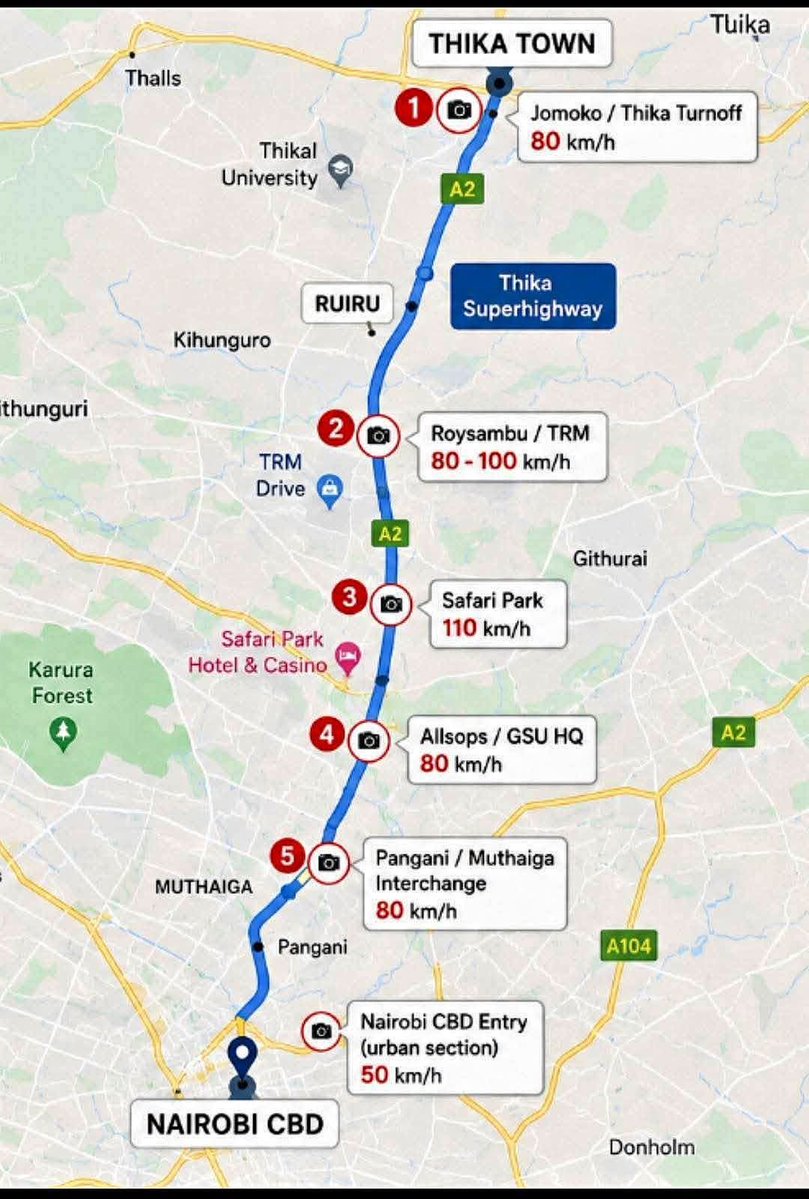
The sheer stupidity and retardation guiding policy-making in Kenya has reached new heights of absurdity, and this map from the Thika Superhighway says it all.
Instead of building proper footbridges, underpasses, or sensible infrastructure that would actually protect lives, the corrupt NTSA and their tenderpreneur friends have rolled out this ridiculous patchwork of speed variations and cameras.
One minute you’re doing 110 km/h, the next you’re being harassed down to 50 km/h in random stretches. It’s not road safety - it’s a carefully designed extortion racket.
These rural-bred retarded bastards with dog poop for brains sit in offices and craft policies that are then rubber-stamped by equally compromised politicians.
The initial planning of the Thika Superhighway should have included comprehensive pedestrian infrastructure from day one. But no - they deliberately sabotaged the project to create future “eating opportunities.”
Build poorly now, install cameras later, harass drivers, collect bribes, and repeat the cycle.
This is classic Kenyan tenderpreneur logic: never solve a problem completely when you can milk it for decades through corruption. Every inconsistent speed limit, every poorly placed camera, and every unnecessary bottleneck is a revenue stream for someone connected to the system.
British-backed war criminal and mass murderer William Ruto cannot stay in office a single day longer than August 10th, 2027. His entire style of governance - from infrastructure to institutions - is built on this same primitive accumulation mentality.
But let us be very clear: replacing him with either the corrupt United Opposition or the Linda Mwananchi bandwagon of scammers will only continue the same nonsense. These people are not reformers. They are the same breed of looters who engineered the mess we’re in today.
The Thika Superhighway was supposed to be a symbol of progress. Instead, it stands as a monument to Kenyan engineering incompetence and tenderpreneur greed - varying speed limits, missing pedestrian safety features, and endless opportunities for extortion.
Kenya deserves better than this endless circus of half-baked projects designed to enrich a few while endangering and frustrating the many.
The stupidity on display here is not accidental. It is the system working exactly as intended.