For the first time yesterday, I experienced the new @alamodrafthouse QR code ordering system and I can tell you it’s truly awful. Rather than making ordering food and drink more efficient, it actually adds steps to the process AND if you want to order additional items during the film you HAVE to open your phone. No, your cute reference to that irony in your How To Alamo video doesn’t negate how ridiculous this is. Please don’t cut corners with your staff and revert back to physical menus and order cards.
This has often happened to me:
1) Watch old movie and think "this is terrific."
2) Read Pauline Kael review arguing movie is shoddy, incompetent, etc.
3) Have to admit her critique is smart, well-observed, accurate, even profound.
4) Still think movie is terrific.
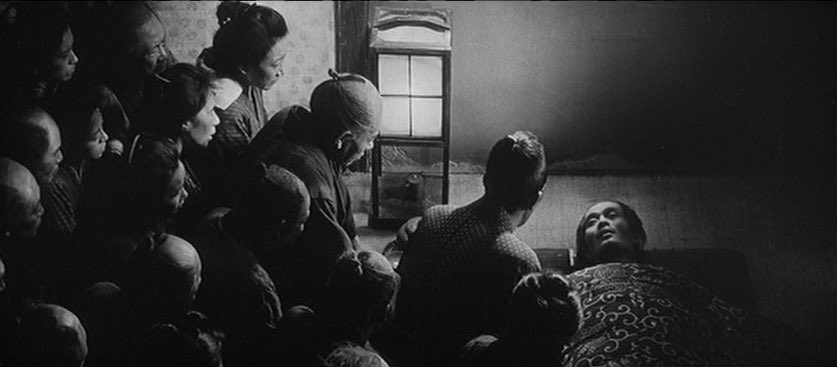
Director Mark once showed Keanu Reeves *The Naked Emperor’s Army Marches On*.
He has deep respect for the work of director Kazuo Hara. I am grateful for that.
Kazuo Hara has never chosen a life of luxury.
With a camera in hand, he has continued to film by crawling through reality itself. Now 80 years old and having undergone surgery, he remains a true independent documentary filmmaker. He wishes to give his all to shoot and complete this film, which may well be his last.
@kazu19451
Palme d’Or winner Cristian Mungiu (for FJORD): “Today the society is split, it's divided, it's radicalized, and… this film is a pledge against any kind of fundamentalism.” He says we often talk about tolerance and inclusion in Europe but we need to actually mean it. #cannes
Alfred Hitchcock explains why he was against showing explicit violence in his movies:
"Interviewer: Do you enjoy making people frightened, scaring them?
Hitchcock: Oh yes. Fear is a basic emotion. People like to be scared if they can control it. That’s why people go on the fast rides at amusement parks and to movies like mine. They want to be scared for some inner emotional reason. They don’t want to be scared in a real sense, though. They want to be scared of non-existent things like monsters and theatrical characters. Imagination plays an important part in what I do, the way I scare people.
Interviewer: You do not believe in explicitness in your technique?
Hitchcock: Not in the terrifying scenes. Only for the expositions, the setting up of the stage, so to speak, so people know all the facts, so they can be frightened the way I want them to be frightened. Explicit violence is never as good as people can make violence in their heads. In 'Psycho' (1960), I never show the knife touching the girl, for example. It’s all suggested.
In 'Frenzy' (1972), the n*de girl is dumped from the truck in a bikini of potatoes wired to her body, but the mind fills in the nakedness. I never take a chance at offending anyone. That would spoil their enjoyment of my films. I usually allow the editing to do the suggesting. Again in 'Frenzy', I let the murderer take the girl to his room and then I pull the camera away, allowing the audience to listen and imagine what is taking place in the room above. All they see is a window. My films are largely reaction films. I never do whodunits.
Interviewer: Why not?
Hitchcock: Because whodunits are not emotional experiences. Murder mysteries are intellectual puzzles and most of the audience wants to experience, not think. Thinkers don’t function well if they get emotionally involved.
In that scene in 'Frenzy', the murderer takes the girl upstairs and says to her, “You know, you’re my kind of girl.” Now we know from previous events that he will ki!! her. When the camera retreats down to the street and we see the window, the audience is automatically clued to think “he is killing her, but no one will hear it.”
(Alfred Hitchcock's interview with Allen Leider, 1978)
P.S: On this day, 54 years ago, "Frenzy" (1972) premiered at the Cannes Film Festival, France.
According to James B. Harris, the preview screenings for Stanley Kubrick's "The Ki!!ing" (1956) were poor. It was said that the poor response was due to the confusing non-linear structure and the movie was ruined because of it. Sterling Hayden's agent suggested to edit the movie again to make the structure linear.
Kubrick and others rented an editing room in New York & started to work. Midway through the process, they had the realisation that it was the structure of the book by which they were impressed and took the decision to make the movie. Everyone felt changing it would be wrong. So, they showed the movie with the original structure to United Artists, who thought it was terrific. No changes were made.
(James B. Harris's interview to Film Comment, 2015)
P.S: On this day, 70 years ago, "The Ki!!ing" (1956) premiered in New York City, USA.