Nike paid Tiger Woods $100 million, the richest endorsement deal in sports, and in 2005 his ball froze on the edge of the cup for two seconds with the swoosh staring straight into the camera, and the world only saw it because one man in the CBS truck didn't cut away.
Final round of the 2005 Masters. Tiger was one shot ahead on the 16th.
His ball sat against the rough. He chipped it up the slope and watched it roll back down toward the hole.
It stopped on the lip. Swoosh facing the camera.
Inside the CBS truck, the director decided it was over and called for a close-up of Tiger.
Technical director Norm Patterson didn't cut. He waited.
The ball dropped. The whole world saw it.
A 30-second ad that day cost about $250,000. Those two seconds were worth $16,666 every time a network replayed them. Within four days, Nike had over $1 million in free advertising.
The director's words: "Thank you, Norm."
It was Norm's last Masters. A few months later, he died of a sudden heart attack. He was 45.
Tiger stayed with Nike for 27 years. His deals added up to $660 million.
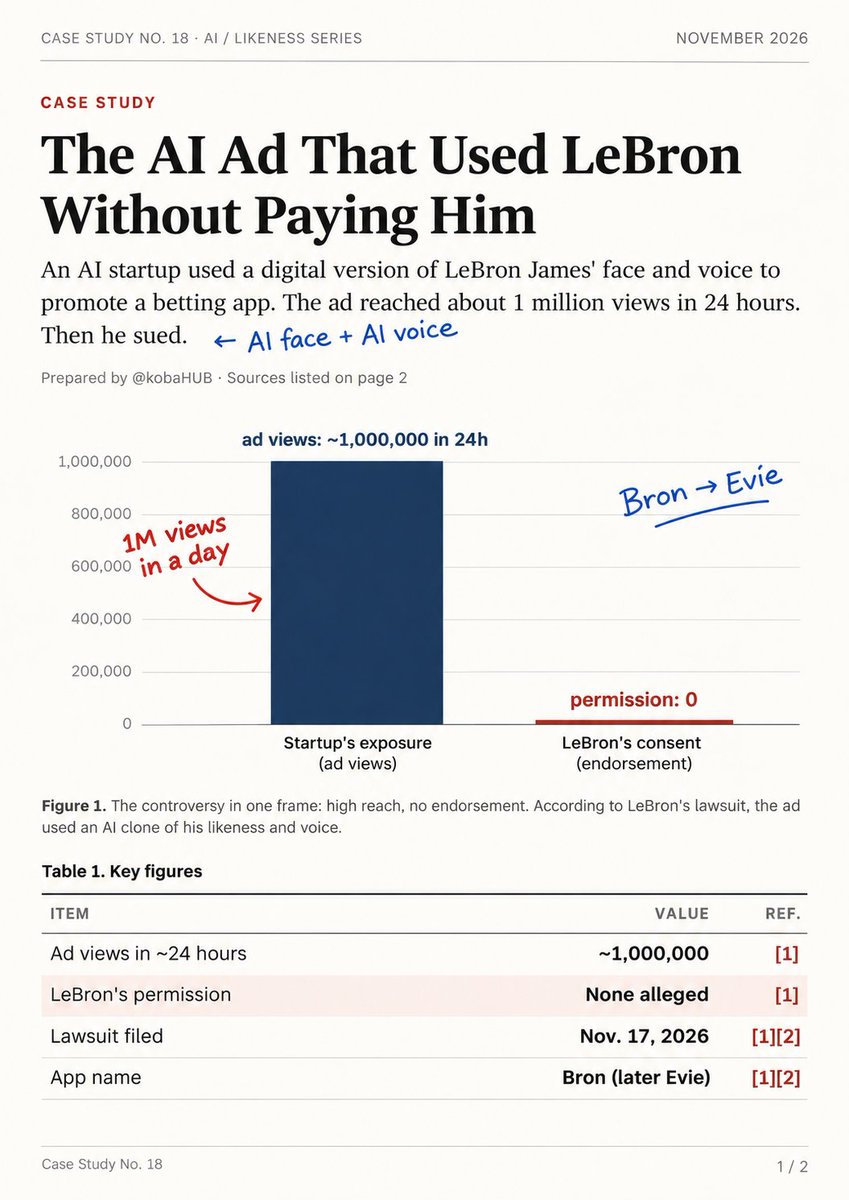
An AI startup used LeBron James to advertise its app without paying him a dollar. The ad got 1 MILLION views in 24 hours. Then LeBron sued.
The company was PlayVision, and its new sports-betting research app was called Bron. Instead of signing LeBron to an endorsement deal, it created an AI version of him.
The ad showed him sitting in an NBA locker room, scrolling through basketball bets. It copied his recognizable tattoos, his No. 23 jersey and even his voice.
There was one problem. LeBron had never agreed to appear in the advertisement.
On November 5, his lawyers demanded that PlayVision stop using his identity. The company removed the video but continued promoting the app and teasing a new name.
Twelve days later, LeBron filed a federal lawsuit, accusing the startup of using his name and likeness to make people believe he endorsed its product.
PlayVision eventually renamed the app Evie. LeBron, whose endorsement deals are worth millions, is seeking damages and an order stopping the unauthorized use of his identity.
The company could delete the advertisement. But it couldn't take back the million views it had already generated.
In 2015 Oprah paid $43 million for 10% of WeightWatchers. The stock more than doubled almost overnight.
In 2018 she sold 2 million shares for $110 million. The same statement said she was "deeply committed" to the company.
Then came Ozempic. She said she was using a weight-loss drug, left the board, and gave her last shares to a museum. They were worth about $4 million.
In 2025 WeightWatchers filed for bankruptcy.
She bought at $7 and sold at $60. Who was buying at $60?
OpenAI is raising money at a $1.25 trillion valuation and getting ready to go public.
Microsoft put in $13.8 billion. Its 27% stake (based on Oct. 2025 share structure, before any subsequent dilution) would be worth around $338 billion at that price.
Greg Brockman’s stake was estimated at about $30 billion in filings/testimony during the Musk trial.
Sam Altman’s stake: zero. Last week Brockman said he told Altman to take equity at the start. Altman: "I should have listened to Greg."
At $1.25 trillion, just 1% of OpenAI is worth $12.5 billion.
Should the board give him a stake before the IPO?
In 2023 Sam Altman sat in front of the Senate and said he owns zero equity in OpenAI. "I'm doing this because I love it."
He still has no direct stake. His OpenAI salary is $76,001 a year.
But in May a court filing in Elon's lawsuit listed what he does own: more than $2 billion in 9 companies that do business with OpenAI. $1.7B of it is Helion, the fusion company OpenAI signed a power deal with.
He says he steps out of those decisions.
Smart setup or conflict of interest?
In 2015 Oprah paid $43 million for 10% of WeightWatchers. The stock more than doubled almost overnight.
In 2018 she sold 2 million shares for $110 million. The same statement said she was "deeply committed" to the company.
Then came Ozempic. She said she was using a weight-loss drug, left the board, and gave her last shares to a museum. They were worth about $4 million.
In 2025 WeightWatchers filed for bankruptcy.
She bought at $7 and sold at $60. Who was buying at $60?
Ken Jennings lost to a computer on Jeopardy! in 2011 and wrote "I for one welcome our new computer overlords."
IBM gave the $1 million prize to charity. Great TV.
What nobody saw: IBM then spent over $4 billion trying to turn Watson into a cancer doctor.
MD Anderson, one of the top cancer centers in the US, paid $62 million for it. It was never used on a single patient.
IBM's own internal slides later flagged "unsafe and incorrect" treatment advice.
In 2022 IBM sold what was left. Reported price: around $1 billion.
Every AI company is making the same promises today. Who do you trust?
In 2023 Sam Altman sat in front of the Senate and said he owns zero equity in OpenAI. "I'm doing this because I love it."
He still has no direct stake. His OpenAI salary is $76,001 a year.
But in May a court filing in Elon's lawsuit listed what he does own: more than $2 billion in 9 companies that do business with OpenAI. $1.7B of it is Helion, the fusion company OpenAI signed a power deal with.
He says he steps out of those decisions.
Smart setup or conflict of interest?
Shohei Ohtani signed the biggest contract in sports history, $700 million, then asked the Dodgers to pay him just $2 million a year for the next decade and push $680 million to 2034–2043 with zero interest, and California says the move could cost it $98 million in taxes.
It was his own idea.
For 10 years he gets $2 million a year. That's 3% of the deal.
Then, starting in 2034, the Dodgers pay him $68 million a year for 10 more years. No interest.
Because money paid later is worth less, MLB values the contract at about $460 million, not $700 million.
That lets the Dodgers count him as $46 million a year instead of $70 million, so they can afford more stars around him.
Here's the twist: California's income tax is 13.3%.
If Ohtani isn't living in California when the $68 million checks start, he may not owe the state on them.
California's estimate of what it could lose: $98 million.
The state controller asked Congress to cap deferred pay.
He took 3% now so his team could buy stars. The bill comes due when he's 40.
Jeff Bezos' $500 million yacht was too tall to leave the shipyard: its masts were nearly twice the clearance of a 95-year-old bridge in Rotterdam, the city was ready to take the bridge apart for him, and thousands of locals signed up to throw rotten eggs at the yacht.
The yacht, Koru, is 127 meters long, the largest ever built in the Netherlands.
To reach the sea, it had to pass under De Hef, a lift bridge from 1927. With its center span raised, the clearance is about 40 meters.
The main mast is estimated at 65 to 85 meters.
In February 2022, reports said the city was willing to remove the bridge's center section. The mayor said Bezos might have to pay.
Rotterdam had renovated the bridge in 2017 and promised it would never be dismantled again.
Locals started a Facebook event: bring rotten eggs and throw them at Jeff's yacht when it sails through. Thousands signed up.
The shipbuilder withdrew its request, citing fears of vandalism.
So the $500 million hull was towed out before dawn with no masts at all. The masts were put on downstream.
The bridge was never touched.
$500 million could build the yacht. It couldn't buy the bridge.
@PovialJunk fair, but it wasn't the cameraman. the director had already called to switch the broadcast to a close-up of tiger, norm was the one at the switcher and didn't punch it. the director told cnn and the la times about it himself
Nike paid Tiger Woods $100 million, the richest endorsement deal in sports, and in 2005 his ball froze on the edge of the cup for two seconds with the swoosh staring straight into the camera, and the world only saw it because one man in the CBS truck didn't cut away.
Final round of the 2005 Masters. Tiger was one shot ahead on the 16th.
His ball sat against the rough. He chipped it up the slope and watched it roll back down toward the hole.
It stopped on the lip. Swoosh facing the camera.
Inside the CBS truck, the director decided it was over and called for a close-up of Tiger.
Technical director Norm Patterson didn't cut. He waited.
The ball dropped. The whole world saw it.
A 30-second ad that day cost about $250,000. Those two seconds were worth $16,666 every time a network replayed them. Within four days, Nike had over $1 million in free advertising.
The director's words: "Thank you, Norm."
It was Norm's last Masters. A few months later, he died of a sudden heart attack. He was 45.
Tiger stayed with Nike for 27 years. His deals added up to $660 million.
Bill Gates, worth about $92 billion, went on Ellen in 2018 and guessed that a box of Rice-A-Roni cost $5, it cost $1, and seven years later the man who said he hadn't been in a supermarket in "a long time" announced he would give away 99% of his fortune.
The game was called "Bill's Grocery Bills." If he got three of five prices within a dollar, the audience won a prize.
Rice-A-Roni: he said $5. It was $1. "I'll take five," he joked.
Tide Pods: he said $4, then $10. They were $19.97.
Pizza rolls: he started at $22. They were $8.98.
In May 2025, Gates said he would give away virtually all his wealth and shut down his foundation on December 31, 2045, after spending $200 billion.
At $1 a box, that's 200 billion boxes of Rice-A-Roni.