Thanks @GoAwayWithJae for letting me add my thoughts to your @RollingStone piece. As music becomes increasingly global, conversations like this become increasingly important. This is the kind of dialogue that helps move the industry toward something more inclusive for everyone.
A few years ago, Gene Simmons of the famous 70s metal band KISS was asked whether BTS could become the next Beatles. He dismissed the idea almost immediately. He said he didn't know any BTS songs and asserted that, unlike the Beatles, no one would start a garage band because of BTS. He went even further, saying that boy bands like BTS don't change the world; they simply make teenage girls' hearts flutter before eventually disappearing, and that they have no gravitas.
Why am I suddenly bringing this up? Today, on an online community I frequent—members mostly professionals in their 40s and 50s with progressive political views—a post about BTS really caught my attention.
He said he had finally realized that BTS is 대체불가. This word means "irreplaceable." It describes something so unique that nothing else can truly take its place. Words like singular, peerless, or one of a kind also come close to capture the meaning.
He admitted that he used to believe BTS's success had more to do with the global popularity of K-pop than with BTS themselves. He assumed that groups like BLACKPINK or Stray Kids would eventually replace them. Like most Koreans, he also believed military service would effectively end BTS's career. After all, that's what had happened to previous idol groups. They enlist, newer groups debut, and they never quite regain the same level of popularity.
But over the past few months, simply watching the news about BTS's worldwide concerts, seeing the sold-out stadium crowds, reading international media coverage, and watching presidents, celebrities, and people from all over the world react, he suddenly realized something. No, BTS really is different. He compared them to the Beatles, and now believes that no matter how many new idol groups debut from now on, no one will match what BTS has achieved. 대체불가.
His post has already been read by more than 8,000 people today alone, and among them were people who immediately lost their minds the moment they saw BTS and the Beatles mentioned in the same sentence. Some insisted that BTS could never be compared to the Beatles because there aren't BTS songs that "everyone" can sing along to like "Hey Jude," basically echoing almost exactly what Gene Simmons said a few years ago.
Reading those comments, I couldn't help shaking my head. They are judging BTS using standards from a completely different era. During the Beatles' time, British and American popular music dominated the world in a way that's difficult to imagine today. Radio, a handful of television networks, and record stores were the only ways people discovered music. Also, there were relatively few artists and genres competing for people's attention, and almost everyone was exposed to the same songs over and over again.
You didn't really choose whether to hear "Yesterday" or "Penny Lane." Radio stations played them constantly. Record stores played them constantly. Those songs became part of everyday life because nearly everyone was consuming music through the same limited channels.
Today's world couldn't be more different. There are hundreds of genres, tens of thousands of artists, YouTube, Spotify, Apple Music, TikTok, Instagram, and countless other ways to listen to music. Every listener can build a completely different musical world with just a few taps on a phone. That also means it's much harder for any artist to become a truly universal phenomenon.
Over the past ten years, has there really been a song like "Hey Jude" that almost everyone in the world could sing together? I’m sorry but I can't think of one. In fact, the closest examples I can think of aren't even songs by pop stars. They're one-time phenomena like Disney's "Let It Go" or, more recently, Netflix’s "Golden."
That's why I think comparing BTS and the Beatles simply by asking whether everyone can sing one of their songs misses the point entirely. If anything, becoming a global phenomenon in today's fragmented digital media landscape is much more difficult. That's precisely what makes BTS's extraordinary worldwide popularity all the more incredible. If the Beatles were debuting today, their path to global dominance would have been far more difficult than it was in the mid-1960s.
Another commenter claimed that considering the Beatles' musicality and the sheer breadth of their popularity during their era, suggesting that BTS belongs in the same conversation was preposterous. This commenter says that with complete confidence because, like many other Koreans, he doesn't realize how deeply BTS's music has resonated with people around the world. Nor does he realize how highly respected the members are for their songwriting and producing abilities. That's partly because Korean media rarely discusses those aspects of BTS.
Korean media mostly reports BTS's achievements by talking about sold-out concerts, Billboard rankings, awards, or the number of tourists visiting Korea because of BTS. But I don't remember seeing serious discussions about why BTS became this popular in the first place. Very few journalists or programs explore their musicality, the members' songwriting and producing abilities, or why millions of people around the world feel such a deep connection to them and their music. Journalist Kim Ou-joon and the late music critic Kim Young-dae are the only people I can think of who tried.
To me, BTS isn't just a musical phenomenon. They're a cultural phenomenon. Millions of people didn't simply become fans of seven people. They became interested in Korea itself. They started learning Korean. They began reading Korean literature, visiting Korean museums, eating Korean food, and traveling to Korea. That's an extraordinary kind of influence. People didn't begin learning English because of Taylor Swift, nor did they suddenly become fascinated with Britain because of Coldplay. Their music is loved by many, but BTS became something more than a musical phenomenon.
And finally, BTS is also 대체불가 because ARMY is 대체불가. There has never been another fandom quite like it, and I doubt there ever will be.
This is the voice of a singer who's been praised by countless legends and recognized among the greatest vocalists of all time. He's the kind of singer who can perform the same song in different styles & make it sound incredible, all while singing live.
My Letter to the Korean Music Critic Who Downplayed BTS's AMA Triumph
Two days ago, when I wrote my post about BTS's victory at the American Music Awards, I had no idea that a Korean music critic, someone prominent enough to serve on the selection committee for the Korean Music Awards (KMA), had publicly disparaged BTS's Artist of the Year win.
He argued that the AMA is no longer one of the three major music awards ceremonies in the United States. And that it has lost much of its prestige and influence. He also claimed that because the winners are determined by fan voting, the AMA should not be taken seriously.
He even suggested that BTS was the only major artist who attended the ceremony while other big names stayed away. The critic's view: because they don't give a hoot about the AMA.
He never explicitly said that BTS's victory meant nothing. But by dismissing the AMA itself so thoroughly, the implication was difficult to miss.
This was not the first time I had encountered this sort of reaction. Back in the late 2010s, when some Korean journalists and online writers downplayed BTS's achievements, I often reached out to them through email or social media messages to offer a different perspective. In one case, we ended up exchanging many thoughtful replies back and forth, and over time, I felt that some of his views on BTS began to change.
As many of you know, even when I strongly disagree with someone, I try to remain polite, reasonable, and emotionally grounded. That was the approach I took then, and it was the approach I took again this time.
After obtaining the critic's email address, I wrote to him and respectfully explained why I disagreed with his assessment.
I want to share that letter with you because some of the points I raised may be of interest, particularly the history and original purpose of the American Music Awards, which many younger fans outside the United States may not be familiar with.
I wrote to him in Korean, and below is my own translation of the letter:
Dear Mr. Jung Min-jae,
Hello. I am an educator living and working in Seoul. I am well aware that you have received your share of criticism from ARMYs. However, I am writing not out of hostility, but out of a genuine desire to have an open and constructive conversation.
I would simply like to offer a different perspective on some of the points you raised regarding the American Music Awards.
First, you argued that the AMA is no longer one of America's three major music awards shows and that it has lost much of its former prestige and influence. As someone who spent his youth and college years in the United States, I see things differently. For people like me, the AMA and the Grammys were, and still are, the two pillars of American music awards. The Billboard Music Awards did not enter the public consciousness in a major way until much later.
At least before the 2010s, the Grammys carried a reputation for being overly conservative and establishment-minded. To be frank, many people considered it somewhat dull. The AMA, by contrast, was always the fun one. It was energetic, accessible, and unapologetically fan-oriented. Personally, I have rarely watched the Grammys except in years when BTS received nominations. Yet from my youth until I moved back to Korea, I watched the AMA every single year without fail.
When Dick Clark created the AMA in the early 1970s, he did so as an alternative to the Grammys. The Grammys still operate through a system in which nominees are selected by committees and winners are chosen by voting members. Many of those committee members and voters are older industry insiders, and historically they have been disproportionately white and male. That has long been the nature of the institution. The AMA, on the other hand, was built from the beginning around the idea that music fans and the general public should have a meaningful voice.
In fact, I spoke with my friends in the United States about this issue yesterday. Every one of them still considers the AMA and the Grammys to be the two most iconic music awards shows in America.
For those reasons, I hope you will not take the opinions of some Americans who dismiss the AMA because BTS, a foreign group, won the award (you even reposted one such tweet) as evidence that the AMA has somehow become irrelevant.
You also argued that because AMA winners are ultimately determined through fan voting, the awards should not be taken too seriously. I would respectfully disagree.
The AMA nomination process is not a simple popularity contest. Nominees are selected based on a wide range of objective metrics, including album sales, radio airplay, streaming figures, and other measurable indicators of public engagement. Fans then vote among those nominees to determine the winners.
Music, perhaps more than any other art form, is powered by fans. Fans buy albums. They call radio stations to request songs. They organize streaming parties. They purchase concert tickets and fill arenas. Given that reality, it seems entirely reasonable for a music awards show to reflect the voices of the people who sustain the industry.
The same principle applies even in classical music. No matter how extraordinary a musician may be, their work ultimately depends on audiences. The reason pianist Yunchan Lim sells out concert halls around the world is because he has earned the admiration of countless music lovers. After becoming the youngest winner in the history of the Van Cliburn International Piano Competition at just eighteen years old, he captivated audiences globally and built a devoted following.
For that reason, I believe the AMA is one of the awards shows most closely aligned with how popular music actually functions today. In many ways, the Grammys represent an older model. The AMA does not. That is why I do not believe its influence will fade anytime soon.
Finally, you pointed out that BTS attended the ceremony while many other major artists did not. But the same has always been true of the Grammys. Every year, numerous high-profile artists skip the event, even when invited. That is hardly unusual.
More importantly, who is the most popular and influential music act in the world right now?
In my view, the answer is BTS.
And BTS showed up.
It is comparable to the Beatles attending an awards show in the 1960s or Michael Jackson attending one in the 1980s. The presence of the Beatles alone was enough to give an event significance and prestige. The same logic applies here. The fact that BTS chose to attend demonstrates that the AMA remains a meaningful and influential platform.
As a music critic, I am sure you understand better than most what it means for an artist from a non-English-speaking country to win an American music award of this magnitude.
You know how extraordinarily difficult it is.
You know the barriers that must be overcome.
And you understand what such an achievement symbolizes, not only for the artist but also for the broader cultural landscape.
That is why I cannot help but wish that more attention had been given to that larger cultural significance and value, instead of focusing on whether the AMA has lost prestige or influence.
Thank you for taking the time to read my thoughts. If the opportunity ever arises, I would be more than happy to hear your perspective and any rebuttal you may have. My feeling is that you and I probably have far more in common than we do in disagreement. Above all, we both care deeply about music.
I wish you good health and all the best.
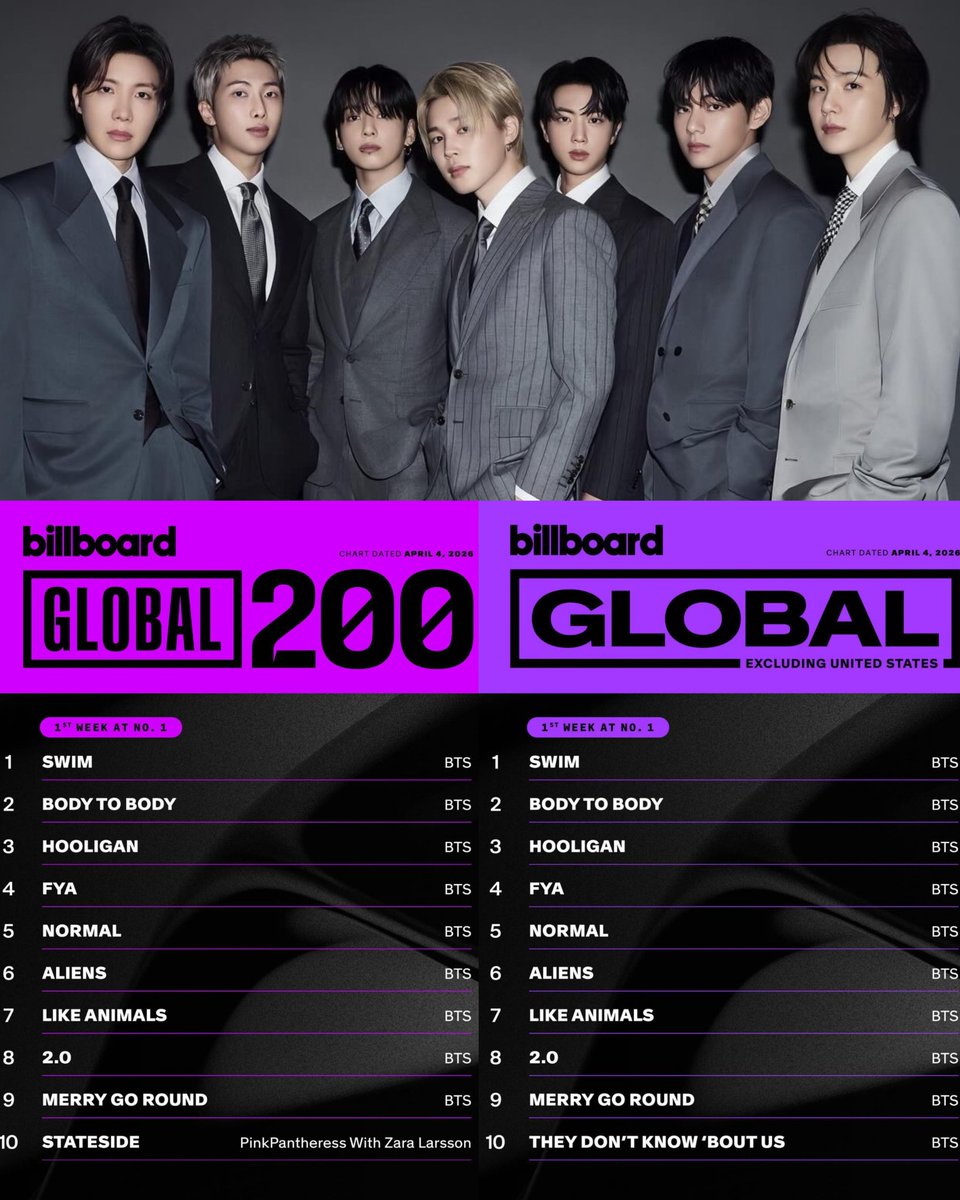
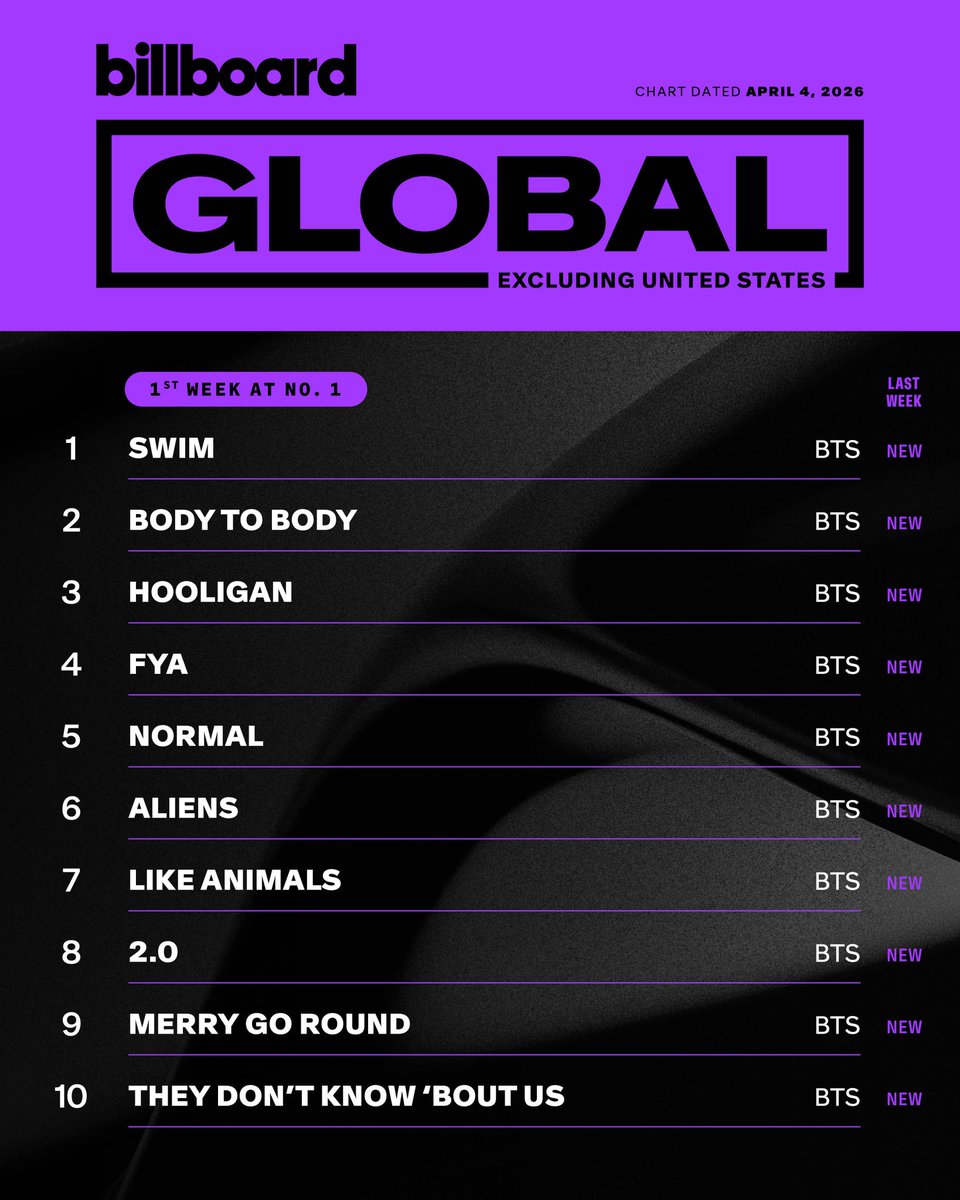
BTS completely dominate the charts as tracks from ‘ARIRANG’ occupy the entire Top 10 on the Billboard Global Excl. U.S. and the Top 9 on the Billboard Global 200.
— They make history as the FIRST Act ever to achieve this.
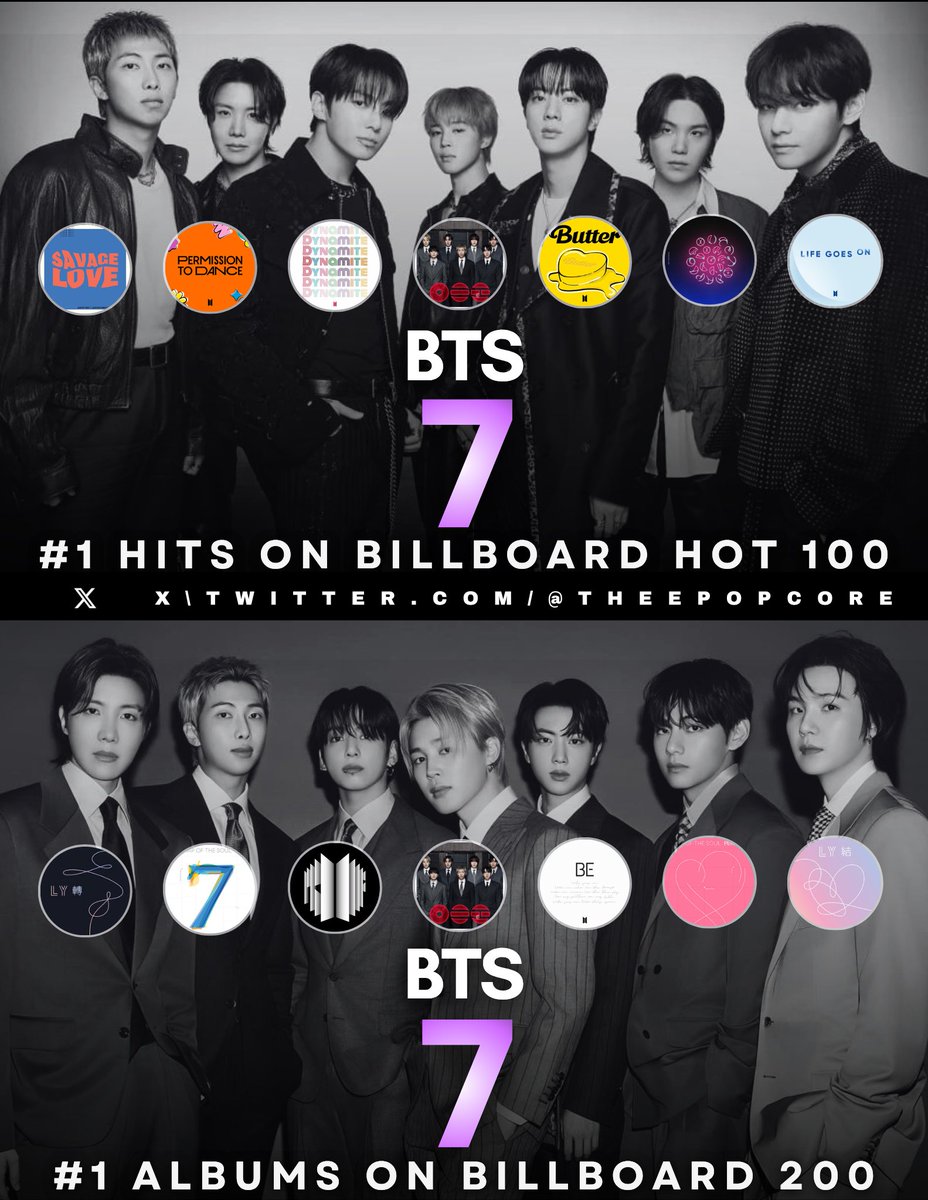
.@BTS_twt is No. 1 on all of the following charts this week:
Billboard Hot 100
Billboard 200
Billboard Artist 100
Billboard Global 200
Billboard Global Excl. U.S.
Digital Song Sales
World Digital Song Sales
Top Album Sales
Vinyl Albums







![bts_bighit's tweet photo. [#2026BTSFESTA]
20130613 Congratulations BTS🎉
#BTS #방탄소년단
#BTS13thAnniversary https://t.co/HZXALKi0tF](https://pbs.twimg.com/media/HKnwB50aYAAjQ2_.jpg)