Montra vừa tổng kết tuần đầu public mainnet trên @Enter_Elysium .
Số liệu khá ấn tượng: hơn 95 triệu đô volume, hơn 1,5 triệu đô phí sinh ra, hơn 1 triệu giao dịch và hơn 100.000 token được launch.
Số người trade cũng lên hơn 55.000, holder hơn 16.000.
Mình thấy con số này cho thấy lượng người tham gia tuần đầu khá đông. Phần lớn phí vẫn được trả về creator và holder như họ vẫn nói từ đầu.
Giờ thì phải xem sau tuần FOMO đầu tiên, hoạt động có giữ được không.
nfa - dyor, đây không phải lời khuyên đầu tư @MontraXYZ
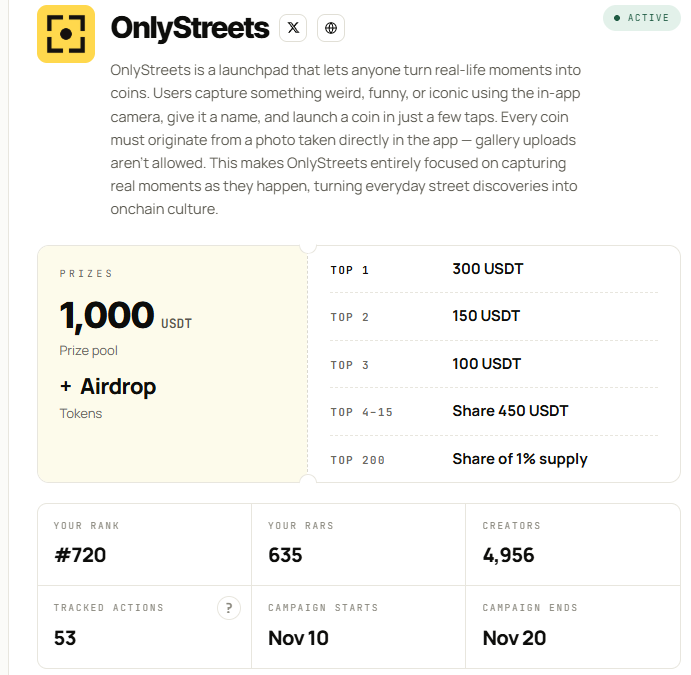
Còn 1 ngày nữa thôi là end campaign của @onlystreetsfun trên @rarelistio rồi nha anh em.
Hiện tại rank mình là 720, chưa lọt thỏm nổi vào top 200 vì quá căng ae ạ.
Chắc phải đợi @rarelistio ra thêm campaign mới thôi, mà công nhận viết bài trên X thế này kết nối được nhiều anh em chung chí hướng phết, giao lưu chia sẻ alpha dự án mới, quá đã!
The first question I ask a trading bot is not how fast it is. It's whether @Hypesium is holding my funds, or just signing for a wallet I own.
Their security page is clear: there is no deposit contract and no pooled balance. Each wallet is a normal Elysium account. The key is encrypted at rest with AES-256-GCM so the bot can sign quickly. You can export it at any time. /export shows the private key in a message that deletes itself.
The signer runs in a read-only, unprivileged container with no open port, and secrets live only in the host environment. Nothing is sent for real until two separate switches are on, so a misconfigured deployment cannot trade.
That last line is the one I'd want more products to copy. Speed is useless if a bad deploy can move funds.
The uncomfortable part is still on you. Whoever controls your Telegram controls your bot wallets. I'd export every wallet once, store the key offline, and lock the Telegram account with a passcode and two-step verification.
Would you use a bot you couldn't export a key from?
Always DYOR
The pool you can see is not always the pool you should buy. That's the routing problem @Hypesium is solving before you tap Buy.
A token on Elysium does not always trade against HYPE, and it may have more than one pool. A bot that only watches the obvious pair can send your size into the shallow one and let the fill move the price more than it had to.
From their docs: every pool of the token is scanned, V2, V3 and V4, in any quote asset, and the buy is routed through the deepest one so your size moves the price as little as possible.
I'd want that to be automatic, because in the opening minutes I am not going to sit there comparing pool depths by hand.
It doesn't make a thin market deep. It just stops you from picking the worse route when a better one exists. I'd still size down when even the deepest pool is small.
Do you check which pool your buy is routing through, or do you assume it's the one on the chart?
Always DYOR
Speed claims are easy to repeat. The part of @Hypesium I wanted to understand is what happens in the few milliseconds after the pool's log lands.
Elysium has a block every 100 ms and no public mempool, so there is nothing to front-run and nothing to wait for. The route, calldata and gas of an armed snipe are built in advance. Gas figures are refreshed every second, and nonces are kept per wallet.
When the log arrives, the hot path is a nonce check and one write, under 5 ms, out through four lanes at once: two WebSocket sockets and two keep-alive HTTP lanes. The receipt is polled every 150 ms.
Their own comparison is the useful one: a typical bot still has to read, quote, sign and send, and can land around 600 ms later, several blocks behind. Hypesium is aiming for the opening block.
The tip you set, snipeGwei in Settings, is what orders you inside that block. Being in block 0 is not the same as being first in block 0.
I'd rather understand that path than argue about marketing adjectives. If the work wasn't done before the trigger, you're already late.
Do you set a higher tip on a launch you really want in the opening block, or leave the default?
Always DYOR
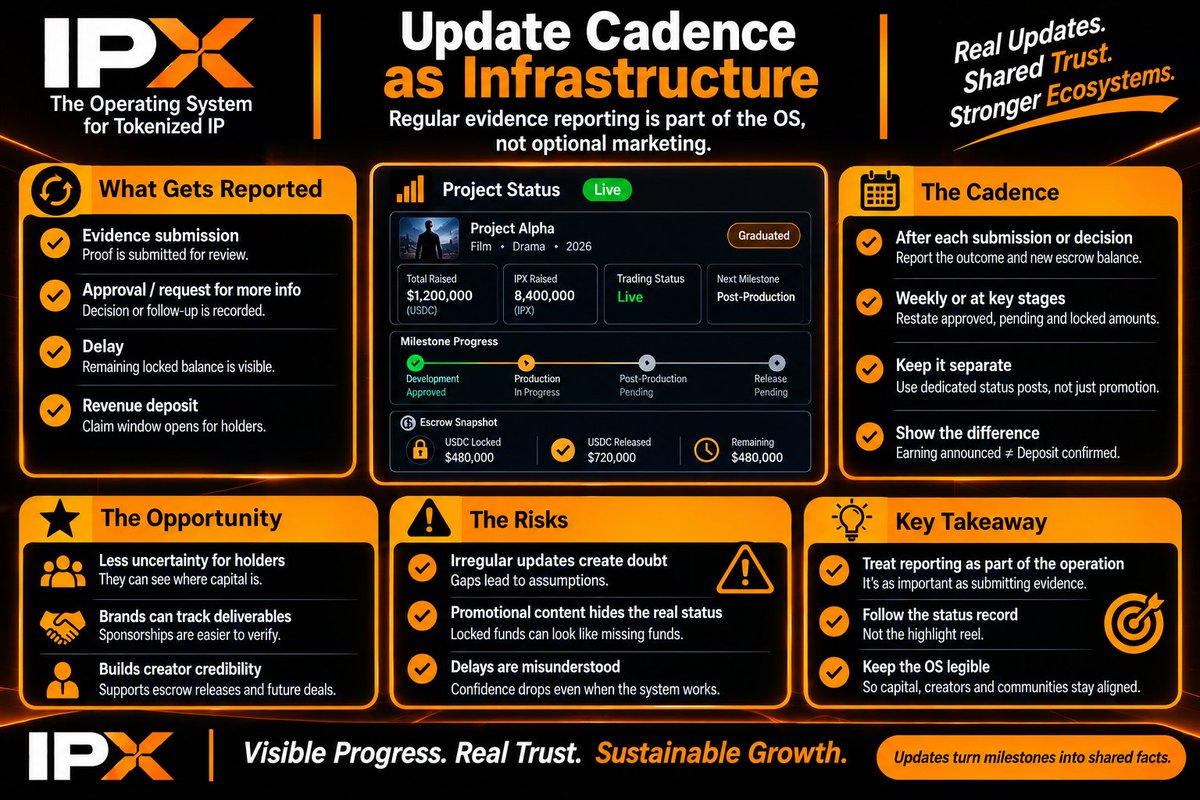
Update cadence as infrastructure why regular evidence reporting is part of the OS, not optional marketing.
The controlled-release design only stays legible if the status of escrow and milestones is kept current. When a creator submits evidence and receives approval or a request for more information, that event changes what holders and brands can verify. When a delay occurs, the remaining locked balance is still a fact. When revenue is deposited, the claim window opens. These are state changes in the system. Reporting them on a predictable cadence turns the state changes into shared information.
A practical cadence matches the milestone rhythm. After each submission or decision, note the outcome and the new remaining escrow figure. On a regular interval weekly or at each major stage restate what is approved, what is pending, and what is locked. Separate promotional posts from status posts so the escrow record is easy to find. When external revenue arrives, distinguish the announcement of earning from the later announcement of an on-chain deposit.
The opportunity is reduced uncertainty. Holders can see whether capital is moving against evidence or sitting protected. Brands can track sponsored deliverables. The creator builds a record that supports both escrow releases and later credibility on revenue. The risk of irregular or purely promotional updates is that participants fill gaps with assumptions. Locked funds can look like missing funds. Delays can look like abandonment. The mechanical rules continue to operate, but confidence erodes when the visible record lags.
Creators who treat status reporting as part of operating the project as necessary as submitting the evidence itself keep the OS legible. Holders who follow the status record rather than the highlight reel stay aligned with where capital actually sits. The system can enforce releases and recovery. It cannot generate the updates. Live projects will show which creators maintain a cadence that matches the escrow activity and which leave the state changes unreported. That difference determines how usable the transparency layer remains once many projects are active.
@IPXExchange $IPX #FANSZN
Early cohort effects what the first projects teach about the OS before later ones launch.
The initial projects that run on the platform establish the practical precedents. They show how strictly milestone evidence is reviewed, how quickly status updates appear, how sponsorship escrows behave alongside production escrows, whether failure declarations occur when work stalls, and how often revenue deposits follow commercial receipts. They also show whether fan and brand onboarding stays simple once real users arrive, and whether secondary markets develop any usable depth.
Later creators and participants will use those outcomes as the reference. A first cohort that releases funds only against clear proof, keeps remaining balances visible, declares failure when appropriate, and deposits revenue when earned makes the controlled-capital model credible. A first cohort that shows loose reviews, unclear status, undeclared stalls, or missing deposits sets the opposite expectation. Platform responses speed of review, consistency of declarations, reliability of interfaces become part of the same record.
The opportunity is that successful early execution can lower the perceived risk of the structure for everyone who follows. Proven escrow discipline and working revenue paths make the OS easier to trust. The risk is that early shortfalls become the template. If the first projects reveal gaps between the described controls and live behavior, subsequent raises face higher skepticism even if the contracts are unchanged. Entertainment timelines are long, so the lessons arrive gradually. Volume and attention concentrate on whatever the early set demonstrates.
Creators preparing later projects should watch the first cohort for review standards and recovery handling rather than only for promotional results. Participants considering any project should compare its live behavior, once underway, against the patterns the early projects set. The OS can be described completely in advance. The first projects supply the operating evidence. That evidence, more than further architecture, will determine how widely the model is used.
@IPXExchange $IPX #FANSZN
NAVY PATROLS AND PIRATE COMBAT IN HYPERHAUL
The sea is not always peaceful. Sometimes, survival depends on how well you command your guns.
In @HyperHaulio, combat is another important part of the captain's journey.
There are navy patrols during the day and cursed crews during the night.
But winning a fight requires more than simply attacking.
Let's understand the combat system.
1. EIGHT BATTLE ORDERS
HyperHaul gives captains eight different combat commands.
Each one serves a specific purpose.
• Round Shot: Damages the enemy's hull.
• Chain Shot: Tears enemy sails and affects movement.
• Grape Shot: Attacks the enemy crew at close range.
• Close In: Reduces distance and prepares for stronger attacks or boarding.
• Evade: Makes your ship harder to hit.
• Board: Allows you to capture an enemy ship when its hull falls below 40%, at close range.
• Repair: Controls fires and stops leaks.
• Flee: Allows you to leave a fight that is going badly.
2. COMBAT REQUIRES STRATEGY
Every round gives you an opportunity to choose an order and aim it.
Your decisions matter.
Do you damage the enemy's hull?
Destroy its sails?
Reduce its crew?
Or move closer and prepare to board?
A battle can last up to 14 rounds.
The healthier ship wins.
3. WHAT HAPPENS WHEN YOU LOSE?
Combat carries consequences.
Losing a fight costs you one-third of the fish in your hold.
Your ship is also towed back to port for repairs.
A victory can reward gold and XP, and sometimes tokens.
4. BLACKBEARD IS A DIFFERENT CHALLENGE
Blackbeard introduces a shared battle.
He visits each sea every three hours and stays for 45 minutes.
Every captain contributes damage to his shared hull.
No single captain can claim more than 50% of the damage.
If the fleet sinks him before he leaves, gold is distributed according to damage dealt, with tokens for the highest contributors.
If he escapes, nobody receives the battle payout.
MY TAKE
What makes this combat system interesting is the need to balance aggression and survival.
Your ship upgrades, hull condition, weapons and tactical decisions all matter.
A captain who understands when to attack, evade, repair or board has a better foundation for surviving at sea.
In HyperHaul, the strongest captain is not necessarily the one who fires first.
It is the one who knows which order to give next.
Alpha for @ChaoticorderNFT:
Chaotic Order is a browser co-op cooking game set in a floating Sky Kitchen above the clouds. Up to 4 players team up to handle nonstop orders under pressure Overcooked-style chaos with actual NFT utility.
- 1,111 Head Chef Licenses
- Free mint (gas only) · 1 per wallet
- Chain: Robinhood
- Mint date: TBA
Holders play as their NFT chef, Open their own kitchen lobby, Bigger share of each season’s $CHAOTIC reward pool
$CHAOTIC Play-to-earn token distributed from fixed seasonal pools based on team performance.
Apply for Whitelist: https://t.co/J3YIQj6PuK
Early stage, small supply, free mint, and real gameplay instead of a pure PFP. The kitchen just opened.