Since everyone is a precious metals expert today, here is something actually helpful you can trade here (or in other things, as this happens in all markets).
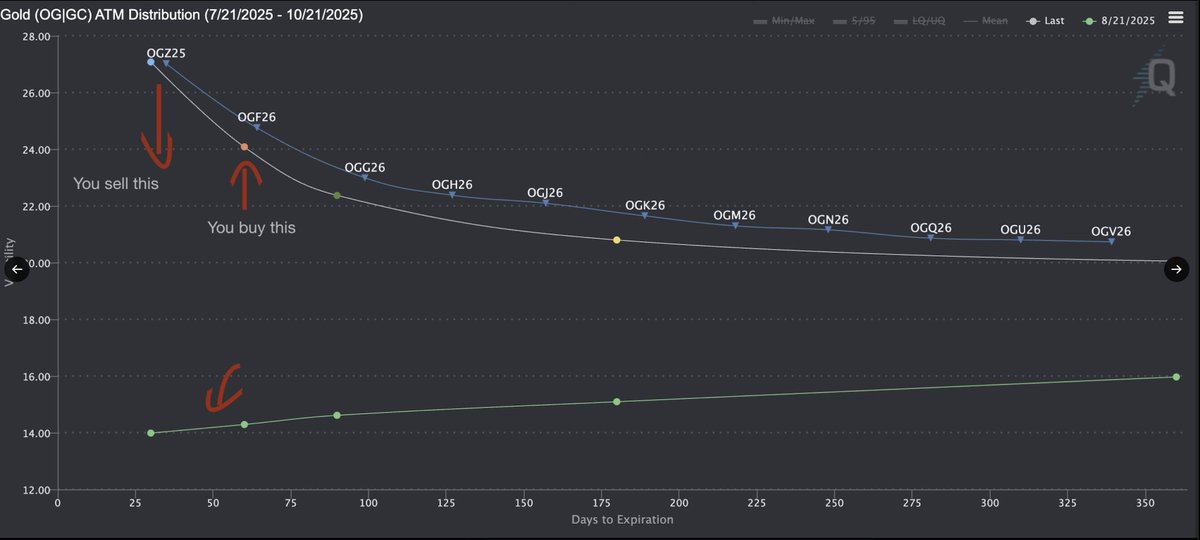
So gold is now in backwardation, which means front expiration implied volatility is more expensive compared to back months IV.
Because this is a pretty rare thing to see, you can take a bet that the curve will be again soon (in contango), by selling the front month and buying the back.
I am not going to bore you with some more complex stuff, but you can basically measure the forward volatility and how steep it is between two of the expiration months.
In simple terms, selling vol is like selling insurance, and you are now selling the overpriced near-term option (high IV) and buying a normally priced back option. The great thing about this is that since the front option is overpriced, you are creating debit positions.
This means you have fixed risk compared to other volatility strategies, which usually suffer from significant tail events.
Since this forward factor is now quite high on Gold, you can get a great risk-to-reward trade by trading a calendar spread.
You just need to keep in mind that it is still path dependent, so you either hedge it or open a new one if the edge is still there.
I didn’t start as a great trader.
I was reckless. Inconsistent. Chasing setups without a plan. I made every mistake, sometimes twice.
What changed wasn’t talent. It was consistency.
Now, before I enter a trade, I know exactly where I’m wrong. If price hits that level, I’m out.
No debate. No hesitation. No story.
This one shift, trading with structure, changed everything.
It gave me clarity. It sharpened my edge.
Because when you know where you’re wrong, you finally understand when you’re right.
Most traders don’t fail because they’re dumb. They fail because they build confidence on bad habits.
A winning trade for the wrong reason is more dangerous than a loss.
Why? Because it reinforces chaos. And unlearning chaos takes longer than building discipline.
If you want to grow, track your decisions, not just your PnL.
Consistency is your alpha. Discipline makes it repeatable.
I started in the bottom 0.1%. I clawed my way up. You can too.
But only if you surrender the chaos… and commit to the process.
Mastery isn’t talent. It’s discipline refined over time.
When ppl claim this I always wonder how they think it happens, or have unrealistic expectations on how much $1bn actually is.
I joined crypto with $200. If I held my initial bitcoin since then and never traded, I would have ~$300k.
If, instead, from that moment I sold the top and bought the bottom of every crypto cycle on Bitcoin, and never paid any taxes, I would have ~$6m USD.
If I put my entire net worth into the Ethereum ICO and never touched it, today I would have ~$150m pre-tax.
While it was definitely possible to have made >$1bn with the opportunities in the market, these versions of reality would also require me to make no mistakes, and have no need to spend $ in real life, or take excessive risk via leverage.
In reality, I grew up in a working class family. I didn’t have a trust fund and I had to pay off my student loan myself. I had a job at Tescos while at high school. After university, I needed to pay rent and fund cost of living and eventually buy a place to live.
I worked at startups for relatively little $ salary, and while a couple have done okay, they still are illiquid and worth nothing until some exit.
Perhaps if I erase a couple of dumb mistakes and drawdowns, or if I had a lil more grind, then my answer would be different today. But it is easy to say this with perfect hindsight vision. It’s easy to see where you could have optimised better, and decisions you made look dumb when the past makes things so obvious.
The truth is I have always optimised for enjoying my life and not going to 0. I never felt like I had a safety net, so it was never possible for me to do anything in any other way. I would probably have less money if I had tried to add more risk or chased $ harder, because being all-in with your entire livelihood is a mental battle and I feel I only win that battle when the stakes are lower.
In writing this, maybe I do understand why CT folks believe this, because modern CT sees crypto as a late-stage lottery ticket farm, where the optimal strategy is to 5x leverage up your portfolio in a hope of catching a good 20% move and then leaving. Or, literally going all-in on the next coin they heard Ansem is buying. So perhaps to them, looking back at the charts, of course that’s what successful folks did.
In reality, I use leverage close to never (and typically to reduce risk rather than add risk — have used it to add risk maybe 3 times in the last 5 years, and maybe 15 times ever). I never go all-in on anything, have only ever done that on BTC and ETH before in the last decade. When I buy other things, I limit risk to tiny amounts, because I treat it as a 0 until proven otherwise (so, always <1% liquid portfolio). Liquid portfolio is also a smaller % of overall portfolio to future-proof against my own fuckups.
Obviously I made a lot of money, I have been here 12 years! CT doesn’t want to hear about “getting rich in a decade” though. I am happy with where I am and have never really cared or optimised for maximising $ earnings, but instead having a nice life that lets me enjoy the game we play together.
📝An open market reflection:
I prefer to look at my Crypto account growth in percentages.
Don't look at the gains other people are making and gigantic PNLs being posted with leverage. Just focus on myself.
Focusing on trying to double an account quickly is more likely to lose money from over-exposure.
Just focus on growth with good risk management and you'll likely see better and more consistent gains over time and through any market conditions.
Biggest thing that I see happen is people who constantly over-expose get absolutely smashed on big red days when they happen and this can wipe out a large portion (or all) of bull market gains.
I've been adding no more than 10% exposure to any position in my main portfolio this week and it's up 10% in 3 days. That's really good growth in my opinion. Especially if you consider most growth focused stock accounts expect 7% returns in a YEAR. Could it be up more? Probably but could it be down more? Definitely. Also some positions I may have sold at a loss on drawdown if I were overexposed.
I just keep focused on the goal and hand and drown out any outside factors. Only way to keep from getting carried away. And over years and years I can maintain consistent upside in a portfolio even on red days or weeks or months and in very bullish conditions the growth is just expedited but drawdowns are always contained. Drawdowns are part if it and you have to expect some red days but also have to be graceful on those days.
Last Friday delivered one of the worst altcoin wipeouts in crypto history, and the post-mortem of it has been a whisper.
When LUNA blew up, it owned the news. When FTX collapsed, it ruled the cycle. When we had our COVID crash, Crypto Twitter couldn’t stop talking about how we almost went to zero and what saved us.
But this time, a week later, there’s near silence. Instead, we’re told it was just a tweet. That’s not serious analysis. Yes, late Friday, Trump dropped a trade-war headline after U.S. markets closed: 100% tariffs on China and new export controls. That was the spark.
But a single tweet doesn’t send alts down 70% in minutes or vaporize entire portfolios within an hour.
The violence came from structure, from a breakdown deep in crypto’s plumbing.
During the flush, Ethena’s synthetic dollar, USDe (ticker USDe), printed as low as $0.65 on Binance while holding near $1 on other venues. This wasn’t a global depeg. It appears to have been a Binance-local pricing failure, an oracle and order-book divergence that instantly slashed collateral values for users on Binance’s unified margin system.
When your collateral is repriced that far down on a single venue, everything built on it collapses.
On Binance’s unified / cross-margin system, traders can post multiple assets, including USDe and wrapped tokens, as collateral across all their open positions.
When Binance’s feed suddenly marks USDe at $0.65 instead of $1.00, the user’s collateral value shrinks, maintenance ratios blow up, and the liquidation engine begins selling their other assets, often high-beta alts, into an already collapsing market.
Those forced sells push prices lower, triggering more liquidations across the exchange and, through arbitrage, across the entire crypto market.
Example:
Imagine a trader with $200,000 total equity.
$50,000 in USDe collateral
$150,000 in long altcoin positions
Binance marks USDe at $0.65, so that $50,000 becomes $32,500; In this case, $17,500 in margin cushion vanishes instantly.
The system detects the shortfall and auto-liquidates part of the alt positions to rebalance. Those sells slam into thin order books, driving alt prices down another 20–30% almost instantly.
Now the trader’s remaining alts, which weren’t yet liquidated, are worth even less, cutting collateral ratios further and triggering the next round of liquidations.
Each liquidation dump pushes prices down for everyone else using the same assets as collateral, igniting a chain reaction. By the time the loop finishes, hundreds of millions in positions are forcibly sold, and the cascade becomes self-fueling, a liquidation spiral that consumes everything in its path.
What started as a local pricing glitch becomes a global liquidity collapse.
Arthur Hayes @CryptoHayes summed it up perfectly: “USDe didn’t depeg. Binance did.”
The Ethena protocol remained solvent and over-collateralized. The problem was the venue’s internal feeds and book structure under stress.
When an exchange values collateral based on its own shallow order book instead of a broad market reference, small cracks become sinkholes.
This doesn’t absolve Ethena, any asset printing 35% below peg, even locally, shows fragility. But this wasn’t another LUNA.
It was a mechanical failure, a venue-specific collateral mispricing colliding with excessive leverage and opaque cross-margin rules. The result was one of the largest liquidation waves in crypto history, nearly $19 billion in forced unwinds within 24 hours.
That doesn’t happen from headlines. It occurs when margin engines and oracles fail under stress.
Binance has since promised to compensate affected users and rework how wrapped and synthetic assets are priced. That alone is an admission something broke. And yet, this event has been largely swept under the rug thus far.
We’ve seen bigger macro shocks before: Liberation Day, COVID, and even FTX contagion, yet none triggered alts to implode 70–99% in an hour.
This wasn’t fear. It was faulty design.
One venue’s pricing feed dislocated, collateral collapsed, and liquidation engines spread that contagion everywhere. The industry’s core issue is now undeniable: Too many opaque, venue-specific risk systems govern leverage, collateral, and liquidation.
When one breaks, the entire system pays for it. Design flaws, not tweets, keep blowing up the market.
If this reconstruction is wrong, then @binance and @cz_binance should publish the data:
Which feeds broke and when?
Which collateral assets were hair-cut, and how many users were liquidated? How is the compensation being calculated?
And @ethena should release a venue-by-venue chart showing USDe pricing, redemptions, and hedging during the event, to prove solvency and pinpoint where the break occurred.
Roughly $19 billion didn’t vanish into thin air. People were liquidated, portfolios erased, and careers ended because the pipes broke. If this wasn’t the cause, prove it. If it was, fix it.
Because headlines aren’t destroying crypto, it’s being destroyed by its own infrastructure.
This can’t be another story buried under “macro fear.” The silence is the loudest signal of all.
Systems failed. Users paid the price. And the industry owes them an explanation.
If we don’t fix the plumbing now, the following “tweet” could light the same fuse, and eventually, there might not be much left to save.
Because if a tweet can burn $19 billion, it’s not the tweet that’s the problem; it’s the system.
When downside comes fast and unexpected, many can cope with it because people get caught up in it and after tend to believe the worst is done, up only now.
The real pain and doubt come when time-based capitulation kicks in: more chop, revisits of the lows, fake outs, partial wick fills.
This is often (no certainty!) how bottoms form after massive downside.
If you’re already in a bad mental state, please take it slow, take a little time off, and come back fresh to make a plan.
There’s imo no need to rush to go all in now after prices bounced hundreds of % off the lows and we just had total madness.
I did buy some spot, but that was in the midst of the chaos, a bit lower than here, and I took it slow.
Not gonna be able to finish the post mentioned in the tweet above, it’s too late, but will get back with some thought posts tomorrow. 🫡
Real men don’t chase pleasure. They chase purpose.
Pleasure is cheap and loud. Purpose is quiet and costly.
Pleasure gives you dopamine now. Purpose gives you a legacy later.
The hardest weight a man will ever lift is the truth about himself.
Lies are heavy, especially the ones we tell in the mirror.
You can’t out-train a lie, out-hustle it, or pray it away while you protect it.
If you won’t be ruthlessly honest about your habits, your motives, and your excuses, you’ll build a life on sand and call it “freedom.”
Test yourself daily:
•Did I serve my mission or my moods?
•Did I choose the hard, right thing, or did I do the easy, empty thing?
•What did I do today that my future self would thank me for?
If the answers sting, that’s good. That’s your compass, not your condemnation.
Cut the escapes that steal your edge such as endless scrolling, video games, empty comforts, & convenient lies.
Replace them with reps that compound such as work, study, service, faith, discipline.
Here’s the paradox: when you chase purpose, the right pleasures arrive as byproducts such as peace, respect, strength, sleep.
Chase pleasure, and you���ll lose all four of those.
Be the man who chooses mission over mood, truth over ego, discipline over distraction.
Own your hours. Own your story.
Choose purpose today and keep choosing it tomorrow.
Lot of crypto folks asking me "What happened?"...
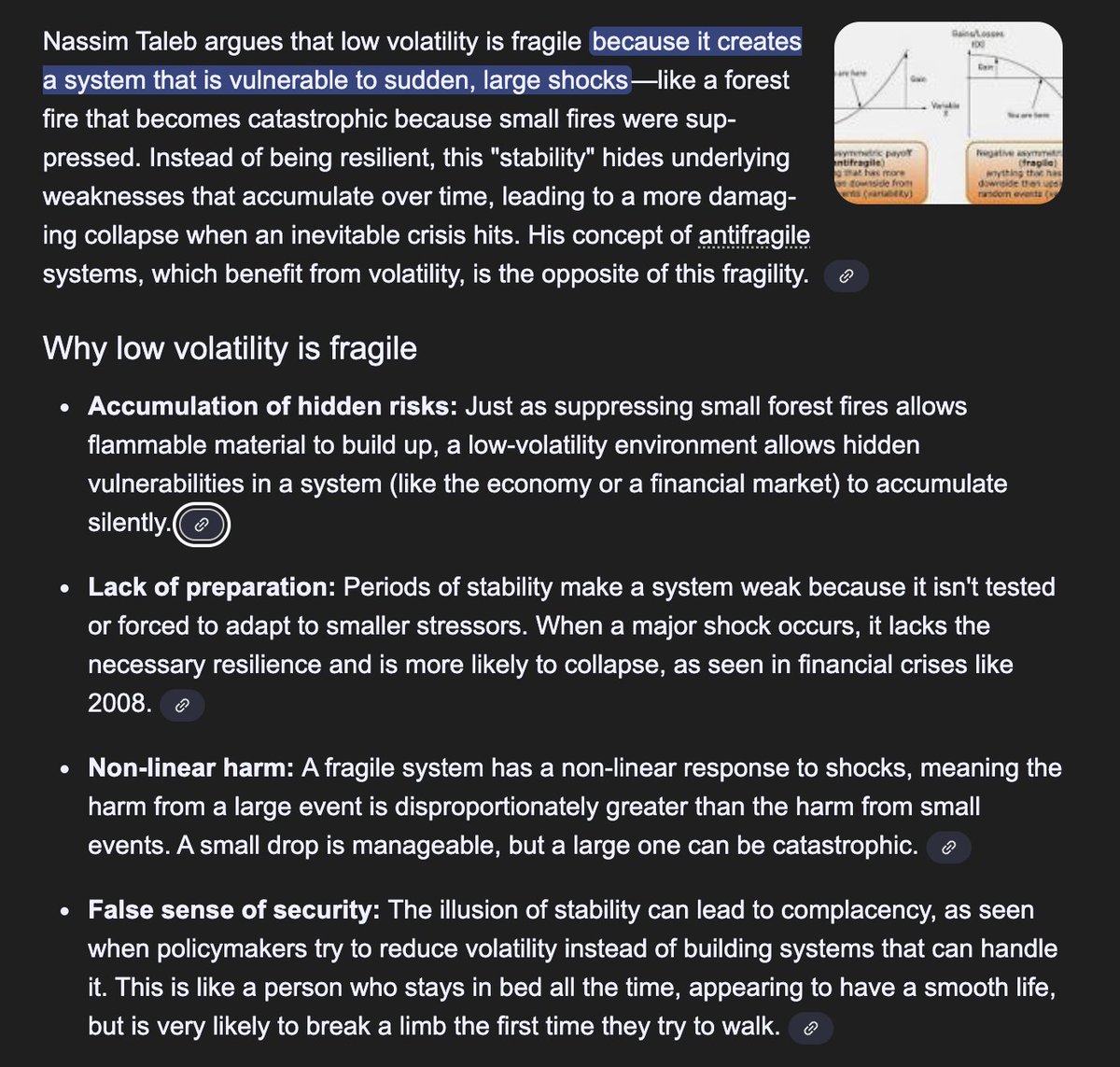
It's probably time to dust off the Taleb book 'Antifragile'.
The amount of Open Interest that has been taken off in one day is unreal. 15B -> 6B on hyperliquid alone, the real total number must be insane!
People always want a clear simple headline. FTX, Luna, Celsius, we've had plenty smoking gun collapses in the past so makes sense to look.
But most likely this is more like the liquidation cascade of May 2021 where after months of run-up and low volatility, people start taking more and more risk as they chase more money.
Especially in this macro environment where gold is at $4k, stocks break all time high every day, and even if you are up you don't know if you are up relative to others when the denominator USD is rekt.
In recent months I've been hearing more and more retarded theses for buying coins. Did you know that CZ's gardener dog is called $ASTERIX? Time to bet on that shit, its BSC season.
Solana trenchers used to flipping shitcoins on their mobile phantom trying to tell me why this or that shitty perp dex is worth billions. Zero self-awareness of knowing what their game is and what it isnt.
Add to that people chasing perps as a narrative, while the liquidity isnt there to support. Hidden risks everywhere, where people are using synthetic dollars as collateral, trading premarket perps with no funding external reference, and telling you not to cry in the casino like they are some hotshot from a Joe Pesci mob movie.
Reality is, in recent months as we were awash with liquidity and every launch was faced with a huge hot ball of money, a lot of the fragility was being hidden under it.
Too much FOMO from retail, not enough focus on robustness from founders seeing their token price as the school report card instead of thinking about their product being more resilient to shocks.
I get it, if you dont play the hype game in crypto you die anyway. If you dont fomo sometimes you miss the big trades. Its a fine balance and none of us are perfect at finding it. And maybe there are some timeless lessons from that cranky boomer that can at least explain why this happened.
A good trader prepares to win.
But a great trader accepts the loss.
Because the truth is… Every trader loses.
The difference is how you respond.
Amateurs fight losses.
They hold. They hope. They blow up.
Professionals take losses with discipline.
They know being wrong is part of the game.
They define the risk, stick to the stop, and move on.
Winning in trading isn’t about avoiding losses.
It’s about surviving them.
Clarity > hope. Process > ego.
Prepare to win. Accept to lose.
That’s how you last long enough to let your edge play out.
📑 ABOUT THE 'WEEKLY BEARISH DIVERGENCE' MANY OF YOU SEEM TO WORRY ABOUT
I keep getting comments about a weekly bearish divergence that's going to be the end of us all.
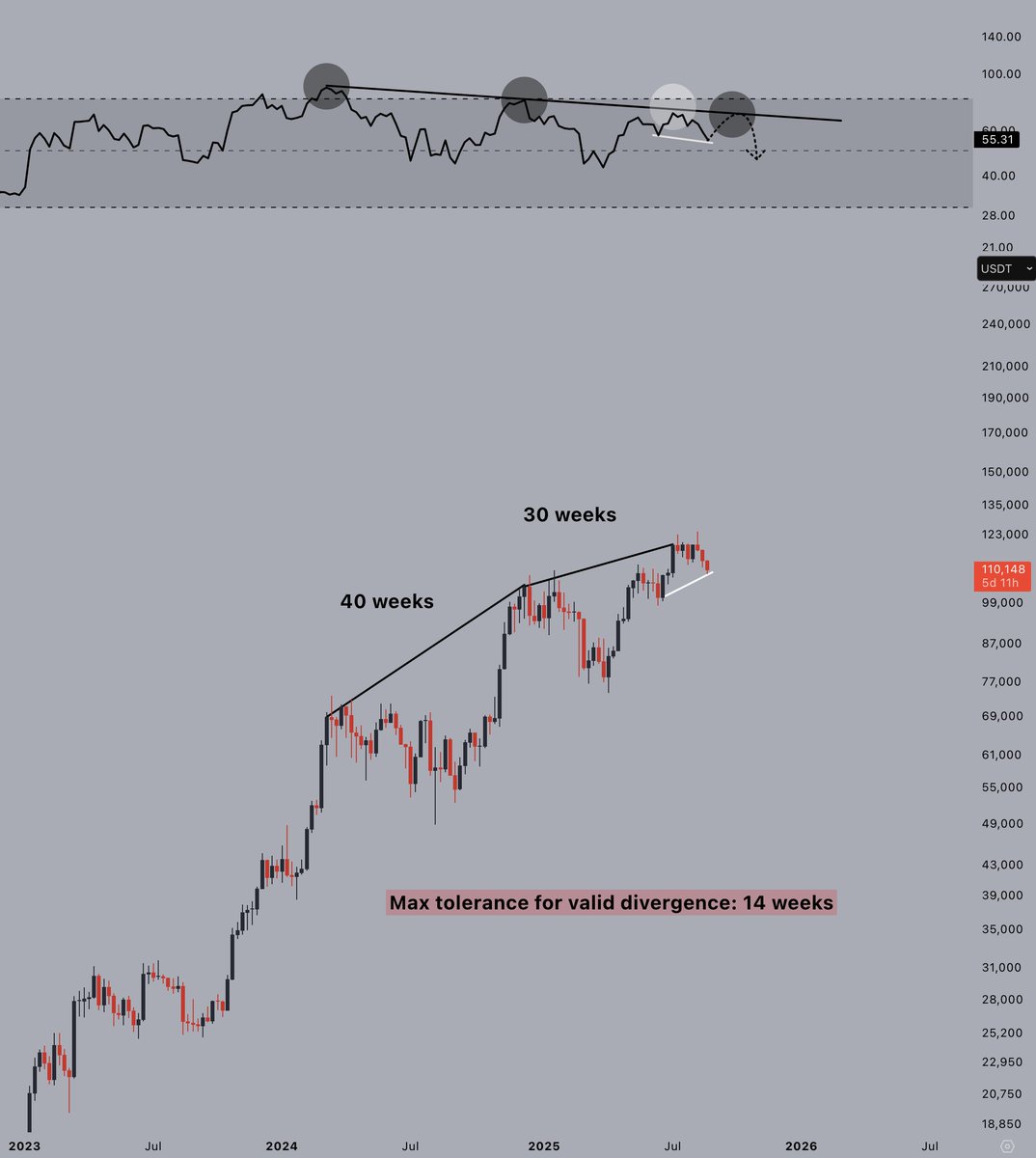
We've seen our fair share of divergences this cycle, most notably in March 2024, which led to a long and painful bleed towards $50k in August 24.
And sure, the RSI is making lower highs over the course of this cycle, but they're way too far apart to form a valid divergence.
🤓☝️ The RSI looks back 14 candles, which means any highs further apart than that are not relevant to one another in terms of a divergence.
Sure, the RSI is making lower highs, but there's no divergence. Not yet, at least.
We could be forming a divergence as we speak, but it's a bullish one. Higher low in price, lower low in RSI, within the 14-candle timeframe.
Needs a bullish weekly candle in the next 2-3 weeks without going much lower to lock in.
Once that does, I expect one more tag of the trendline I drew on the RSI. We likely form an actual bearish divergence there much like in March 24 - and then face the music.
Send it higher. 🫡
In a strong uptrend, great traders don’t chase green
They buy support with a stop.
If it holds, they surf the trend.
If it breaks, they pay small tuition and try again.
Paid > Right.
Win 1 BTC as we race to 5M X followers! 🚀
🚀 From 4.6M–5M followers, every +0.1M = 200 winners split 0.2 BTC
👥 Invite friends to get double chance
1⃣ Follow @bitgetglobal
2⃣ RT & tag 3 friends w/ #FollowToWin1BTC
1,000 winners in total
Join now 👉 https://t.co/FIs6SIVLZj
Trading feels less chaotic when AI breaks it down.
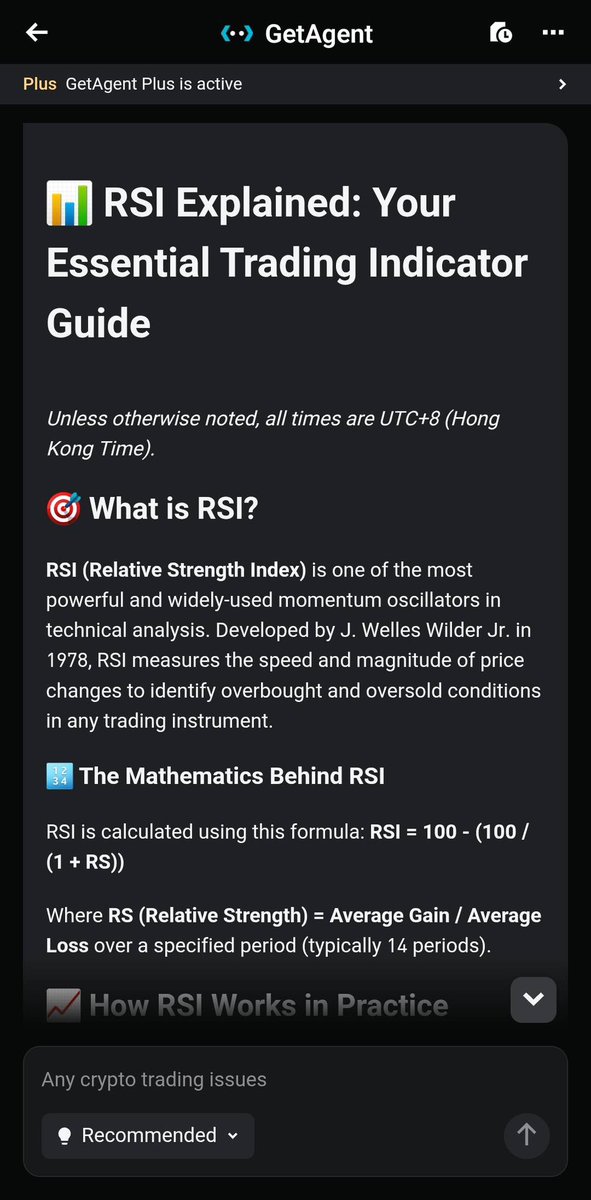
GetAgent explained RSI in plain English AND gave me position sizing tips from my own history .
GetAgent on #Bitget is kinda wild! asked it about top coins and it pulled live data sentiment faster than I could search Twitter.