“Inflation” is a blunt term & its causes are variate, something @LynAldenContact does a STELLAR job expressing in her recent piece.
👉https://t.co/Zg7acPsggc
Here’s 6 key quotes that explain why these differences matters so much and produce the unavoidable discomfort of the 2020s fiscal straight jacket.👀
1️⃣“In the 1940s and 2020s inflationary periods, most of the money supply growth was from fiscal deficits (related to the war and the pandemic stimulus respectively). In the 1970s, most of the money supply growth was from bank lending (related to demographics primarily). A lot of analysts get confused or talk past each other about how to fight inflation, when they are unknowingly referring to very different causes/sources of inflation.”
2️⃣“At the current time, Fed Chairman Jerome Powell is treating the 2020s (which is fiscal-driven inflation in a high public debt environment) as though it’s like the 1970s (which was lending-driven inflation in a low public debt environment). He is sharply raising interest rates to try to quell bank lending, even though bank lending wasn’t the cause of inflation in this cycle.”
3️⃣“If inflation is caused by runaway fiscal deficits, high interest rates do not really do much to stop that. A central bank and the commercial banking system in general is basically forced to finance its government’s runaway fiscal deficits anyway, so if they are printing money to help the government put more money into circulation than it removes, then changes in interest rates are going to be a distant second in terms of any impact they may have. It’s like giving someone Tylenol when they have a gunshot wound; what really needs to be done is to stop the bleeding.”
4️⃣“Many of the hawks are missing is that raising rates increases the fiscal deficit, and the deficit has been the primary driver of inflation in this cycle rather than excessive lending. It’s more like the 1940s than the 1970s in that regard.”
5️⃣“…at high enough debt and deficit levels, it can instead become a choice between fiscal-driven inflation and lending-driven inflation. And it becomes a matter of timelines. [] For this reason, those types of environments often result in capital controls and various restrictions on lending eventually, which is the government’s version of reprogramming the test. Specifically in that context, lawmakers generally want to reduce interest rates to quell the fiscal-driven inflation, while also avoiding the speculative attack on the currency that such negative inflation-adjusted interest rates would encourage. They want to reduce the various ways to borrow money to buy private assets, while mandating institutions to buy government debt at interest rates that are below the prevailing inflation rate, and closing the various exit doors that people turn to in order to avoid holding the devaluing currency.”
6️⃣“To address the underlying cause of inflation would be outside of the Fed’s purview, since it is more of a fiscal conundrum. The government would likely have to restructure the public debt and the existing mix of taxation and spending, encourage more industrial and energy production to come online, and then leave it to the Fed to harden the currency after that point. That combination might give a decent foundation for a period of longer-term disinflationary growth, but is extremely difficult to do and is basically a non-starter politically.”
Money Supply contracts again in March. 📉
This is a massive economic warning. Money Supply contraction hasn't happened in 90 years.
Only other times it has happened we had Depression / Major Banking Crisis.
The "Fed Put" is back with assets on their balance sheet increasing $297 billion over the last week, the largest spike higher since March 2020. Thus nearly half of the Quantitative Tightening since last April was undone in a single week.
Bitcoin Bottom Signal Series.
A thread of on-chain signals which suggest the Bitcoin bottom is in, or very close. In my opinion, these are the most important on-chain metrics today. Based on Bitcoin's 13 year history, they are telling me this is an extraordinary opportunity.
The exchange is set to enter the crowded market of institutional #bitcoin custody as it aims to become a service provider in the cryptocurrency space.
https://t.co/hkjeo4tw27
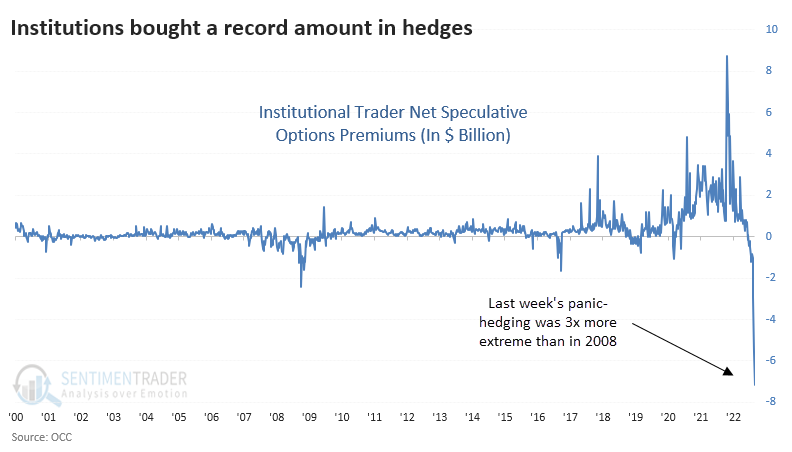
Sometimes, there's a chart that just blows your hair back.
In 22 years of doing this, none stand out like this one.
Last week, institutional traders bought $8.1 billion worth of put options. They bought less than $1 billion in calls.
This is 3x more extreme than 2008.