#AI creates the most value when it's embedded into the way your business operates.
Fill out the form to get exclusive access and discover how NTG APPS AI helps organizations accelerate business execution through intelligent #automation.
🔗 https://t.co/D1isaUOhS5
Real processes aren't simple flowcharts; they have exceptions, parallel approvals, and mapping all of that manually takes weeks to build.
NTG AI #Workflow Builder models it all from your description, and embedded #AI Agents that #automate decisions, and trigger real-time actions
Every department needs its own app, and every request lands in the same overloaded queue.
NTG APPS #AI Builder skips that queue entirely: describe what you need, and the data model, rules, and dashboards are generated.
#ArtificialIntelligence#DigitalTransformation
When #change approvals live in email threads, the risk sits with the team, not the process.
NTG #ITSM encodes every change, approval, and rollback into the system, giving IT a defensible, auditable record by default.
#IT teams spend too much time maintaining processes that should be running automatically.
When #governance is encoded into the platform, your team stops holding the process together and starts driving the IT operation forward.
HR shouldn't be about getting stuck in endless paperwork and manual approvals 🤨
That’s why I’m so excited to share the new NTG APPS - HRMS application🎉
Explore a smarter way for your organization to work 🦾
You were hired to drive workforce strategy, but you're stuck in #HR manual work that takes forever.
NTG HRMS connects people processes, systems, and data into one HR orchestration layer, automating time-consuming workflows and delivering insights when decisions need to be made.
The enterprises leading the next decade will be the ones whose systems move as one.
A new era of enterprise operations is taking shape and NTG APPS is built to:
🔗Orchestrate operations
⚡Activate faster execution
📊Elevate performance
The future runs on business orchestration
Head of Product is one of the hardest roles. One minute you're knee-deep in a bug filed by an important customer and the next you're talking 3 year strategy.
Product management is hard and it only gets harder the further you go.
@PatThePM Sure thing, a here's my routine working on healthcare products:
1. Identify the relevant regulations
2. Assess the impact of the regulations
3. Work with legal and compliance teams
4. Build compliance into the product development process
5. Stay up-to-date on regulatory changes
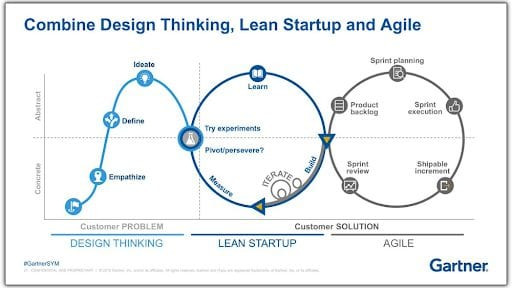
In 2016 Gartner introduced a model that combined Design Thinking, Lean Startup, and Agile.
The goal here was to create a robust framework for innovation and product development.
It ensures that products are user-centered, validated in the market, and developed in a flexible and adaptive manner.
I still believe in the merits of the individual frameworks, and most discovery + development processes already follow these steps.
One could consider this framework overkill and already something that is in action in most product development companies, but Gartner presented the case for combining them.
How They Work Together in the Gartner Model:
Start with Design Thinking: Understand the user's needs and problems, and create innovative solutions through brainstorming and prototyping.
Move to a Lean Process: Test the prototypes in the real world, gather feedback, and iterate quickly. This phase helps in validating the assumptions and learning what works and what doesn't.
Implement with Agile: Once a validated solution is found, the development process begins using Agile methodologies. This allows for continuous iteration and improvement, adapting to changes as needed.
What do you think - did we really need to combine these? 🤔
Full stack product management or not, at the end of the day – an amazing product manager understands the importance of being well-versed in multiple domains to excel in their role and bring to life value delivering, successful products.
https://t.co/K7zS5VRRzO
It's crazy. The most crucial product funnel, Awareness + AARRR, is often divided between two silos: Product and Marketing.
And Revenue isn't addressed at all.
This often results in a lack of a holistic view of growth and bureaucracy. Making simple decisions takes weeks or even months.
How to fix that?
People discuss merging PMM and PM roles, but there's an alternative. The most successful product companies, like Meta, LinkedIn, Dropbox, and Uber, have implemented Growth Teams that focus on the entire funnel.
Where do you begin?
1. Start with just a one team
Make it an experiment. Over time, you might end up with more teams dedicated to specific product areas or products or even teams exploring growth opportunities outside what the company is currently doing.
A good example is Facebook's Growth Team, that many years ago recommended acquiring a small, promising company. Instagram.
2. Identify a Growth Leader
You need one person with the ultimate decision-making authority, typically a Product Growth Manager with a deep understanding of data. The Growth Leader is responsible for leading the team.
3. Make the team cross-functional
The Growth Team will typically include:
- Product Manager
- Product Marketing Manager
- Data Scientists
- Product Designers \ CX
- Engineers
4. Report directly to executives
The Growth Team will take risks, experiment, and possibly disrupt the status quo.
Hence, they need to report directly to one or more executives, for example:
- PM reports to the Head of Product
- PMM reports to the Head of Marketing
- Product Designers report to the Head of Design
This will allow the team to experiment and take calculated risks while aligning with the overall strategic direction.
5. Determine Your North Star Metric
Once the team is in place, it's time to identify your North Star Metric (NSM). It's a single metric that aligns everyone in the company with the core value that your product delivers to customers.
Free PDF guide (no paywall): https://t.co/aiYRyWbHRk
-
The team identifies smaller, manageable objectives and works in iterations to:
- Synthesize knowledge and identify growth opportunities
- Brainstorm ideas and design growth experiments (e.g., A/B tests)
- Run promising experiments and monitor them to catch any unexpected issues early
- Analyze data with reference to the original hypothesis and success metrics, and interpret the results
- Implement the idea if the experiment was successful
- Share learnings with the wider organization
- Iterate again, armed with knowledge from the previous experiment
-
Hope that helps.
Have you already implemented this approach?
What are your thoughts?
-
This post was inspired by Hacking Growth by @SeanEllis and Morgan Brown. I highly recommend that you read it if you haven't already.
-
P.S. If you liked this post, you might enjoy my newsletter. Join 26K+ subscribers and get 1 actionable tip for PMs every Saturday. The link is under my profile: @PawelHuryn
Great points on why hiring PMs is different
• High valence role
• Being capable of making a step change 🪜
• No convenient set of boxes and processes for the PM
🚨 LEAKED:
Meta CEO Mark Zuckerberg’s thoughts on the Apple Vision Pro.
He e-mailed this to the company.
1. The reveal was news to him as much as anybody:
AI Generated QR Codes!!! - This is probably one of the best Controlnet usecases I've seen so far (Yes they work) (thx @BenTheEgg for the find!) https://t.co/Gn2EC5huyI