This woman is holding a newspaper that she has kept since 2011.
The paper contains an article by Bill Gates called "Depopulation through Compulsory Vaccination". Gates thinks it would be the most "environmentally friendly solution".
No one gave it much thought at the time.
Shortly after her Oscar win, she mysteriously began to disappear from big studio films. The truth, which only came out decades later, was much darker than anyone expected. Her career had not slowed down on its own; it had been deliberately ruined by one of the most powerful men in movies.
In 2017, Mira Sorvino broke her silence about Harvey Weinstein.
She revealed that in 1995, the Miramax boss cornered her in a hotel room, massaged her shoulders, and chased her around. She escaped by lying that her boyfriend was coming.
Weeks later, he even showed up at her apartment past midnight, leaving only when she threatened to call the police.
Mira protected her dignity, but saying no to a mogul carried a devastating professional price tag.
For over twenty years, Mira suspected her rejection cost her roles, but lacked proof. That proof arrived when director Peter Jackson made a stunning public confession.
He revealed that while casting his monumental Lord of the Rings trilogy, he wanted to hire both Mira Sorvino and Ashley Judd. However, Miramax explicitly warned him away.
"I recall Miramax telling us they were a nightmare to work with and we should avoid them at all costs," Jackson admitted. "At the time, we had no reason to question what these guys were telling us, but in hindsight, I realize this was very likely the Miramax smear campaign in full swing."
Hearing this confirmation brought the actress to tears.
Upon reading Jackson's interview, Mira took to social media to express her profound grief.
"Just seeing this in black and white has brought me to tears," Sorvino shared. "There it is, confirmation that Harvey Weinstein derailed my career, something I suspected but was unsure of. Thank you Peter Jackson for being honest. I’m just heartsick."
The blacklist worked perfectly. Other directors later admitted they faced similar executive pressure to reject her.
A generation of moviegoers was robbed of seeing a phenomenal actress reach her full artistic peak, all because a fragile, powerful man couldn't handle the word "no."
This forces us to look at the unsettling reality of how Hollywood operated.
It makes you wonder how many brilliant careers were quietly extinguished in dark hotel rooms before they even had a chance to burn bright.
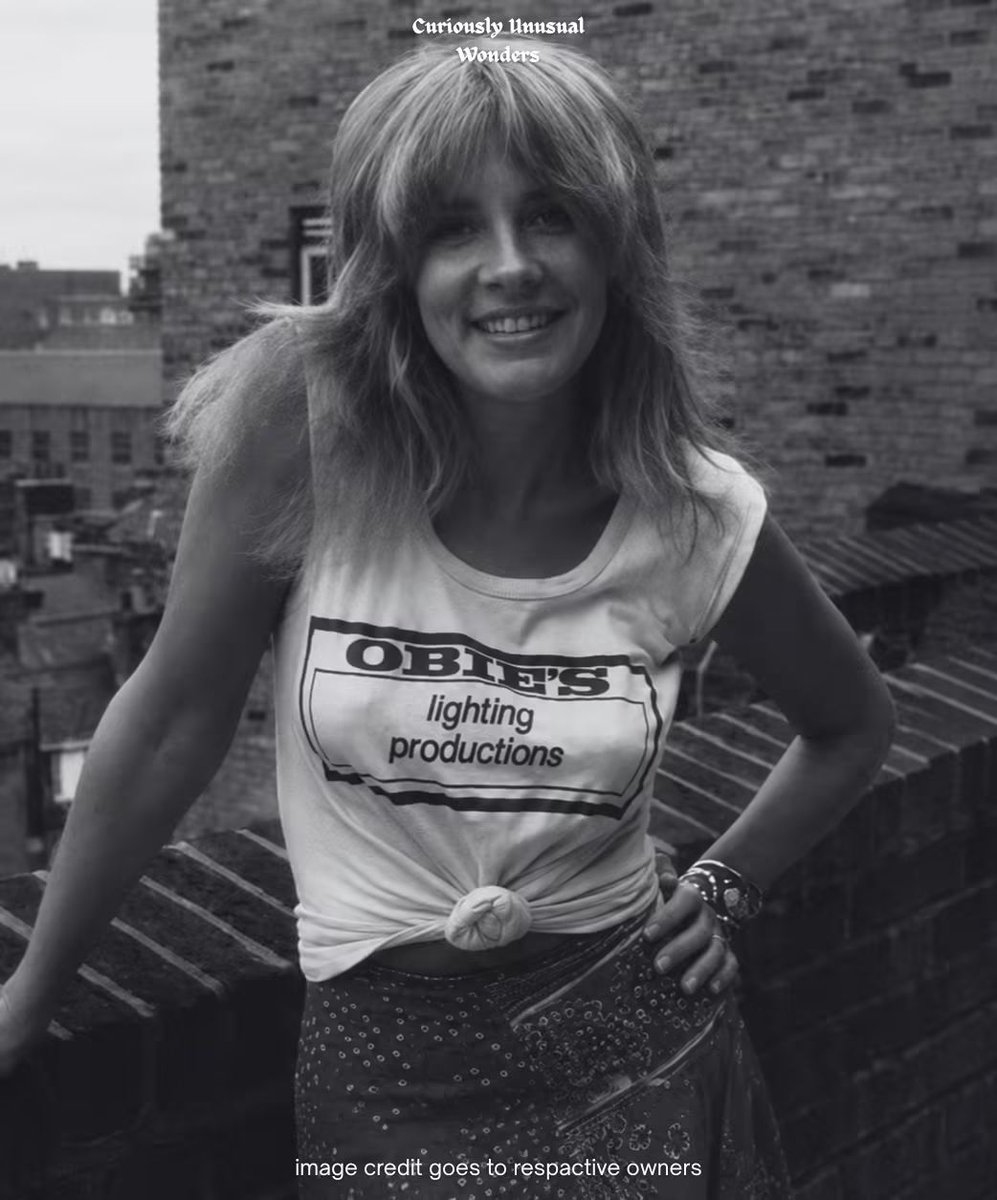
In 1974, a twenty-six-year-old waitress in Los Angeles quietly gives her exhausted father one final deadline: three more months of music, then she comes home for good.
She has no idea the call that changes everything is already on its way, arriving three days before her own deadline runs out.
Her name is Stephanie Lynn Nicks. As a toddler, she could not pronounce "Stephanie." It came out "Stevie" instead, and the nickname stuck for life.
Stevie was born May 26, 1948. Her father's corporate career moved the family constantly — Arizona, New Mexico, Texas, Utah before they finally settled in California when she was a teenager.
In 1966, she transfers into Menlo-Atherton High School as a senior. At an after-school "Young Life" meeting, a junior named Lindsey Buckingham starts strumming "California Dreamin'." Stevie sits down and starts singing harmony without being asked.
Two years pass before they speak again. Then Buckingham calls, inviting her to sing for his band, Fritz. She says yes.
Fritz opens for Janis Joplin and Jimi Hendrix but never lands a record deal. By 1971, the band collapses, and Stevie and Lindsey — now a couple as well as collaborators — move to Los Angeles to try again as a duo.
In September 1973, Polydor Records releases their album, Buckingham Nicks. Critics like it. Nobody buys it. The label drops them almost immediately.
Stevie takes a waitressing job at Clementine's, a Beverly Hills bar, earning $1.50 an hour. She also cleans houses on the side. Lindsey tours briefly as a backing musician for Don Everly. At night, the two of them keep writing songs nobody has heard yet — including one called "Rhiannon."
Here's what most people miss: by the fall of 1974, Stevie Nicks had essentially given up.
Her father had just undergone open heart surgery. Watching his daughter waitress and clean houses in another state weighed on him. So Stevie made him a promise: three more months. If nothing happened by January, she would come home and go back to college.
She kept the promise a secret from almost no one. She was tired, thin, and scared the music would never work.
Then, in late 1974, producer Keith Olsen plays a track from the failed Buckingham Nicks album for a drummer scouting a Los Angeles studio for new material. The song is "Frozen Love," a seven-minute epic closing the record. The drummer is transfixed.
His name is Mick Fleetwood, and his band, Fleetwood Mac, has just lost its guitarist.
On New Year's Eve, 1974, Fleetwood calls Olsen for the guitarist's name. Olsen tells him: Lindsey Buckingham. But Buckingham and Nicks are a package deal, Olsen warns — take one, you take both.
Fleetwood agrees, mostly because he needs a guitar player and has no particular opinion about the singer. He does not yet know what he has just done.
Stevie doesn't quit her waitressing job right away. She keeps working it for three more days after saying yes, unwilling to leave her boss without notice, unsure the opportunity is even real.
On January 1, 1975, Fleetwood Mac begins rehearsing with its new lineup. The band's next album, self-titled and released later that year, sells 500,000 copies by December and reaches Number 1 on the Billboard 200. Two of Stevie's songs, "Rhiannon" and "Landslide," become instant signatures.
Two years later, the band records Rumours while Stevie and Lindsey's relationship collapses in real time, alongside the marriage of bandmates John and Christine McVie. The album turns their breakups into songs. "Dreams," written by Nicks, becomes Fleetwood Mac's only Number 1 single in the United States. Worldwide, Rumours goes on to sell more than 40 million copies.
Stevie Nicks never went back to college. She stayed with Fleetwood Mac for decades, launched a solo career in 1981 with the album Bella Donna, and built a catalog now credited with more than 120 million records sold worldwide.
In December 2018, she is announced as an inductee into the Rock and Roll Hall of Fame for a second time — first as a member of Fleetwood Mac, now as a solo artist — making her the first woman ever inducted twice.
Decades later, a new generation of artists, including Taylor Swift, would cite her as a direct influence. Swift has called Nicks one of her childhood heroes, brought her onstage as a guest, and referenced her by name in a song of her own — a small tribute passed from one generation of songwriters to the next.
None of it happens if that three-month deadline runs out one phone call too early.
The waitress at Clementine's had no way of knowing how close she came to walking away — or how close the answer was to finding her first.
> Be Jonny Kim
> Born to South Korean immigrants in Los Angeles
> Grows up in an intensely abusive household, constantly full of fear
> The night before he graduates high school, his father threatens the family with a gun
> Police arrive, a shootout happens, and his father is killed
> Decides he wants to protect people so he enlists in the Navy at 18
> Survives Hell Week and becomes a Navy SEAL
> Deploys to Iraq twice as a combat medic, sniper, and point man
> Completes over 100 combat operations under fire
> Earns a Silver Star and a Bronze Star for saving wounded comrades
> Watches his close friends die in battle and realizes he wants to heal people, not just fight
> Leaves active duty to get a degree in Mathematics from USD
> Auditions for medical school and gets accepted into Harvard
> Graduates from Harvard Medical School as an M.D. in 2016
> Starts his residency in emergency medicine at Massachusetts General Hospital
> Gets bored of being a regular doctor and applies to NASA
> Selected as 1 of only 12 candidates out of 18,300 applicants
> Becomes a NASA Astronaut in 2020
> Decides space isn't enough, so he joins Navy flight school to face his fear of flying
> Earns his wings as a fully certified military pilot and naval flight surgeon
> Launches into space on a rocket to the International Space Station
> Logs 245 days in orbit, traveling 104 million miles around the Earth before returning home
> Returns to Earth as a SEAL, a Harvard Doctor, an Aviator, and an Astronaut at just 41 years old
And Jonny Kim is still the most humble guy on the planet who makes everyone else's resume look blank.
Jonny Kim is badass.
In 1988, Warner Bros. dropped a bombshell: Michael Keaton was Batman.
People lost their minds.
There was no social media. No online outrage. Instead, fans picked up pens and mailed more than 50,000 angry letters directly to the studio. Comic book stores organized protests. Convention audiences booed executives whenever Keaton's name appeared.
To many fans, the star of Mr. Mom and Beetlejuice had absolutely no business playing the Dark Knight.
The backlash became so intense that it even made headlines in major newspapers.
Inside Warner Bros., executives were getting nervous.
Very nervous.
Some reportedly contacted director Tim Burton and asked whether it was too late to recast the role before production moved further ahead.
Burton refused.
He wasn't looking for another traditional action hero with a square jaw and perfect confidence.
He wanted someone different.
Someone damaged.
Someone lonely.
Someone who felt like Bruce Wayne would actually feel.
Michael Keaton had exactly that quality.
The studio hated the criticism, but by that point they had invested too much money to reverse course. So while fans demanded he be fired and headlines questioned the casting, Keaton quietly focused on the work.
Then came the suit.
The Batsuit was a nightmare.
Made from thick rubber, it severely restricted movement. Keaton couldn't turn his head properly. He could barely hear. The cowl was so tight that it triggered feelings of claustrophobia and even panic attacks during early fittings.
For a moment, he genuinely wondered whether the entire project might fall apart.
Instead, he adapted.
Rather than fight the limitations, he used them.
Since natural movement was impossible, he embraced stillness. Slow movements. Deliberate turns. A heavy, intimidating posture.
The result was unexpected.
Batman suddenly felt less like a traditional superhero and more like a creature lurking in the darkness.
The suit's biggest flaws became part of the character.
At the same time, Jack Nicholson was negotiating what would become one of Hollywood's most legendary contracts.
Warner Bros. initially offered him a huge salary.
Nicholson declined.
Instead, he accepted less money upfront in exchange for a percentage of box-office revenue and merchandise sales.
The studio believed it was saving money.
It wasn't.
Nicholson ultimately earned many times more than the original offer, creating a deal that future movie stars would spend decades trying to replicate.
Then came June 23, 1989.
Batman arrived in theaters.
And it exploded.
The film opened to record-breaking numbers. Bat-symbols appeared everywhere. Merchandise vanished from store shelves. Prince's Batdance climbed the charts. Audiences packed theaters across the world.
The movie earned more than $400 million globally and became a cultural phenomenon.
And the same fans who insisted Michael Keaton would destroy Batman?
They suddenly loved him.
The actor they mocked became one of the most respected Dark Knights ever portrayed on screen.
More importantly, the film changed Hollywood.
Before Batman, superhero movies were often viewed as colorful entertainment for children.
Tim Burton's version introduced darkness.
Psychological depth.
Trauma.
Moral complexity.
Gothic atmosphere.
Without Michael Keaton's Batman, the modern superhero era might look completely different.
Decades later, when he returned to the cape in The Flash, Keaton proved something many fans had already accepted.
The gamble everyone feared became one of the greatest casting decisions in movie history.
And the 50,000 people demanding he be fired before seeing a single frame couldn't have been more wrong.
Bob Geldof did not want them on the bill.
He had agreed to include Queen in the Live Aid lineup only reluctantly, pushed by promoter Harvey Goldsmith. By the summer of 1985, Geldof was not alone in thinking their moment had passed. Their biggest hits were nearly a decade old. Critics had started writing them off. Privately, the band itself was wondering if it was finished.
Then came July 13, 1985.
What nobody watching that day knew was what had happened the week before. Queen had booked the 400-seat Shaw Theatre near King's Cross in London and rehearsed their 21-minute set down to the exact second. Not the general shape of it. The exact second. Six songs, every beat drilled until nothing could go wrong.
And then, reportedly, their roadies disabled the sound limiters on the PA before the set. Every other band on that stage was capped. Queen was not.
At 6:41 PM, Freddie Mercury walked out. White jeans. White tank top. Studded armband. Seventy-two thousand people erupted.
He sat at the piano and played the opening of Bohemian Rhapsody, not the whole song, just enough to set the crowd on fire. Then he stood. Strode to the microphone.
Radio Ga Ga filled the stadium. Seventy-two thousand people raised their hands in perfect unison, one of the most iconic images of the entire decade.
Then Freddie stopped the band. He turned to the crowd. He opened his mouth and sang a single sustained note.
""Aaaaaaay-o.""
And waited.
Seventy-two thousand people sang it back. He went higher. They followed. Higher still. They stayed with him. Back and forth, the note climbing, the crowd holding on, the moment stretching into something that felt almost sacred.
It would later be called The Note Heard Round the World.
They tore through Hammer to Fall, Crazy Little Thing Called Love, a shortened We Will Rock You, and finally We Are the Champions. The stadium shook.
Twenty-one minutes after they walked on, Queen walked off.
Bob Geldof, the man who had not wanted them there, said afterward: ""Queen were absolutely the best band of the day. They played the best, had the best sound, used their time to the full. It was the perfect stage for Freddie: the whole world.""
An estimated 1.9 billion people across 150 nations had been watching. In 2005, music industry insiders voted it the single greatest rock performance in history. Not one of the greatest. The greatest.
Authors and musicians who were there have said those 21 minutes may have saved the band itself, that Queen was on the verge of a permanent split, and that afternoon reminded all four of them what they were still capable of together.
Freddie Mercury died on November 24, 1991. He was 45 years old.
But on July 13, 1985, for 21 minutes, standing before 72,000 people under a London summer sky, he was the most alive person on earth.
DO NOT touch that keyboard. This is one of the most dangerous attacks circulating right now.
This is called a ClickFix attack. It is not a CAPTCHA. It is not a verification step. It is a social engineering attack designed to make you execute malicious code on your own machine while believing you are proving you are human.
Here is exactly what happens if you follow those steps.
The fake page has already silently copied a malicious PowerShell command to your clipboard without you knowing. It happened the moment the page loaded. You did not click anything. You did not consent to anything. The clipboard was written to in the background by JavaScript running on the page.
When you press Win + R you open the Windows Run dialog. When you press Ctrl + V you paste that malicious command directly into it. When you press Run you execute it with your own permissions on your own machine. No exploit needed. No vulnerability needed. You did it yourself. Willingly. While thinking you were completing a CAPTCHA.
The payload varies. Researchers have documented ClickFix delivering infostealers, remote access trojans, and credential harvesters. The malware executes instantly and silently. By the time the Run dialog closes the damage is done.
The reason this attack works so well is threefold. The fake CAPTCHA looks visually identical to a real one. The instructions sound technical and therefore trustworthy. And critically, you are the one executing the command so endpoint security tools see a legitimate user action rather than an automated attack.
Real CAPTCHAs never ask you to open Run dialogs. Real CAPTCHAs never ask you to paste anything. Real CAPTCHAs never give you keyboard shortcuts.
If a webpage ever asks you to press Win + R for any reason, close the tab immediately.
🚨THIS SHOULD SCARE EVERYONE🚨
While Prime Minister Carney deepens Canada’s partnership with the UK — including co-developing “nation-building digital public infrastructure” and aligning on child safety — the UK just ordered Apple and Google to install scanning software on every phone and computer sold in the country.
Not an app. Not social media. On the device itself. Your camera. Your photos. Your messages. Scanned before they can even be encrypted.
Signal — one of the most trusted privacy companies on Earth — called it exactly what it is: “invisible surveillance infrastructure switched on by default.”
The government’s excuse? Protecting children.
But here’s the part that should terrify every Canadian:
The same law requires the Prime Minister’s personal sign-off to spy on a politician… while ordinary citizens get zero protection and no opt-out.
Once this infrastructure exists, history shows the scope never shrinks. Today it’s “nudity.” Tomorrow it’s whatever the government decides is a threat — including political speech.
Carney’s Liberals already rammed through their own censorship and backdoor bills before vanishing for summer. Now they’re actively aligning Canada with the exact UK model that’s turning every citizen’s pocket into a government listening post.
This isn’t about child safety. It’s about control.
They always sell it as “common sense” and “for your own protection.”
Until it’s not.
Canada First means rejecting the surveillance state before it’s installed by default in every Canadian device.
We don���t need invisible backdoors. We don’t need government scanning our private lives. And we sure as hell don’t need to import the UK’s authoritarian tech agenda.
#cdnpoli #Carney #SurveillanceState #DigitalPrivacy #BillC22 #ChildSafetyExcuse #CanadaFirst
Isaac Wright Jr. was a young father and businessman in New Jersey when he was arrested and charged with drug distribution.
In 1991, he was sentenced to life in prison.
He never stopped fighting. From his prison cell, he taught himself law, spending hours in the library, filing motions, and building his own defense.
After seven years, his conviction was overturned—and he was exonerated. His case was so compelling that it was featured in the series For Life, based on his life.
In 2017, Wright passed the bar exam and became a licensed attorney. Today, he practices law and is working to free others who were wrongfully convicted. ⚖️💪
The Schoolboy Who Discovered a Physics Paradox
In 1963, a 13-year-old Tanzanian student named Erasto Mpemba was making ice cream in his school's cooking class in Magamba, Tanzania. When space in the freezer ran out, he skipped the cooling step and put his hot milk-and-sugar mixture straight in. His froze first.
He told his physics teacher. The teacher said he was confused, his observation was clearly impossible. His classmates laughed. The incident stuck. For years, other students at his school called his blunder out by name: "That is Mpemba's physics."
A few years later, Denis Osborne, a physicist from University College in Dar es Salaam, came to give a guest lecture at Mpemba's new school. At the end, Mpemba asked him directly: "If you take two beakers with equal volumes of water, one at 35°C and one at 100°C, and put them in a freezer, the one that started at 100°C freezes first. Why?" The room erupted. Osborne was caught off guard, but instead of dismissing the question, he promised to test it.
Back in his lab, Osborne asked a young technician to run the experiment. The technician confirmed hot water froze first, then added: "But we'll keep repeating the experiment until we get the right result." Repeated tests gave the same result every time. In 1969, Mpemba and Osborne co-published their findings in the journal Physics Education under the title "Cool?" The phenomenon became known as the Mpemba Effect.
The mechanism is still not settled. Evaporation, dissolved gases, convection currents, hydrogen bond dynamics, each has its proponents, none has closed the debate. A 2024 paper in the Journal of Chemical Physics proposed yet another molecular explanation. Erasto Mpemba, who spent his career as a game warden in Tanzania, died in May 2023. The question he asked in a school kitchen sixty years ago is still officially open.
He was laughed at twice for the same question, once as a child, once as a teenager. Physics has been trying to explain it ever since.
🚨BREAKING: The Green party-led Bristol City Council, which banned St George's flags flying during the World Cup as it was "divisive and makes migrants feel uncomfortable", has now been COVERED in St George's flags by locals
F*ck the Greens, this is England! 🏴
This Canadian girl just said what millions are thinking but are too afraid to say out loud.
“Can somebody please tell me how we’re still calling Canada a free country?”
Then she laid out the receipts:
- We can’t access certain news channels without the government or platforms getting in the way.
- We can’t even pray in peace without someone trying to shut it down.
- Don’t fill out the census? Get fined.
- Someone breaks into your house? You can’t defend yourself properly — you can’t even hurt them without risking jail.
- We can’t own guns to protect our families.
- The government now decides what your kids can see on social media — not you.
- And we don’t even get to decide what goes into our own bodies… or our babies’.
This isn’t freedom.
This is a managed population.
Year after year, the Liberals chipped away at it — one “reasonable” restriction at a time — until regular Canadians started asking the question this woman is asking.
Mark Carney and the people running this country didn’t inherit a free nation.
They inherited one they could control.
And they’ve been very busy.
If this still feels like “Canada” to you, you’re either not paying attention… or you’re part of the problem.
Watch this.
Share it.
Then ask yourself the same question she did.
#cdnpoli #CarneyResign #LiberalFail #Freedom #ParentalRights #SelfDefense #NannyState
A father buys Halo: Campaign Evolved on the family PS5 with the intention of playing the advertised split screen co-op with his son.
He immediately discovers upon booting the game that he needs to purchase a PS Plus subscription for not only himself, but also a second PS Plus subscription on a second account for his son so that they can play the campaign together side by side in the living room on the couch after purchasing a $50 game with no multiplayer.
Read that again, let it sink in and then understand that this is all true and was posted on the official Halo website earlier today.
An absolutely horrific story
A woman sexually assaulted by an immigrant
She begged him to leave
She's trembling on national television as she tells the world what happened
And what did she get for it?
Convicted for inciting racial hatred
Insanity has taken over Europe
WERE THEY WRONG?
A pistol jammed in your face. A female coworker slammed to the floor. In a split-second, life-or-death gamble, Michael Harris realized the gun was fake, fought back, and saved his coworker.
The corporate reward? A cold phone call terminating him on the spot.
Starbucks chose to protect their liability over the humans bleeding behind the counter.
Now, attorney Ryan Krupp is drawing a line in the sand and arguing that the right to self-preservation cannot be written out by a corporate handbook
Starbucks' response? Total, deafening silence.
Born this day in 1925 in a Texas sharecropper's shack, one of twelve kids. His dad walked out, his mom died young, and Audie Murphy quit school in fifth grade to pick cotton and hunt rabbits to feed his brothers and sisters. He got deadly accurate with a rifle for one reason: the family couldn't afford a wasted bullet.
After Pearl Harbor he tried to enlist and got laughed off. The Marines rejected him. The Navy rejected him. The paratroopers rejected him. He was 5'5" and barely 110 pounds, and they all said he was too small to fight. His sister had to fudge his paperwork just to get the Army to take a 17 year old.
Then he went to war and became something out of a legend.
January 26, 1945, near Holtzwihr, France. His company was down to a handful of men facing six tanks and 250 German infantry. Murphy sent his men back, then climbed onto a burning American tank destroyer that could have exploded under him at any second, grabbed the .50 caliber machine gun, and held off the entire assault alone for nearly an hour. He was wounded in the leg and kept firing. When a buddy asked over the field phone how close the Germans were, he reportedly said hold on and let me ask them.
He came home the most decorated American soldier of the entire war. Every valor award the Army could give, some of them more than once, plus French and Belgian honors on top.
Life magazine put his baby face on the cover, James Cagney saw it and invited him to Hollywood, and the cotton picker who couldn't pass a physical became a movie star. He made over 40 films. In 1955 he played himself in To Hell and Back, the movie of his own memoir, and it was Universal's biggest hit until Jaws came along twenty years later.
But the war never let go. He had what we now call PTSD, slept with a loaded pistol under his pillow, and got hooked on sleeping pills trying to outrun the nightmares. He kicked the addiction by locking himself alone in a motel room for a week. Then he did something almost no famous man did back then: he went public, told the country that combat had wrecked his nerves, and pushed the government to study and treat what war does to a soldier's mind.
He died in a plane crash in 1971 at just 45 years old. They buried him at Arlington, where his simple headstone is the most visited grave in the cemetery after John F. Kennedy's.
Every branch told him he was too small to fight. He outfought all of them, then spent the rest of his life trying to help the men who came home broken like he did.
🇬🇧 UK lawyer Paul Powlesland cleaned 200 bags of waste from a polluted river.
Fish and dragonflies have returned.
Now he faces up to 2 years in prison for doing it without a permit.
This is modern Britain: punishing people who actually clean up the environment while the bureaucracy strangles common sense.
Absolutely insane.
Source: @Coinvo / Writer: Oliver