Everyone wants adoption. Few are willing to redesign the foundation required to support it. Kaspa did.💪🏻
From BlockDAG... to 10 blocks per second... to Toccata and programmability...
This isn't a boat riding the wave.
It's the reason the tide is changing. 🌊⚡
FLOAT ACCORDINGLY.
$Kas #Kaspa #Toccata
$KAS FAM
QUICK TOCCATA OVERVIEW:
In short: Covenants++ + native tokens + ZK on Kaspa's speedy base = big step toward competing as a full L1 while staying true to its "money first, fast" roots.
The $KAS community and devs are SUPER hyped for the post-fork ecosystem growth!!!
Why It Matters: $KAS has always been a blazing-fast PoW payments/monetary base (BlockDAG with high block rates). Toccata turns it into a programmable L1 without turning it into a congested smart contract spaghetti chain like some others. It aims for sustainable miner fees as block rewards halve by driving real on-chain activity (tokens, apps, ZK stuff)
The future of $KAS is HERE
Toccata, Kaspa's next consensus upgrade, is currently targeted for mid to late June.
Here's what it means for the ecosystem and for Igra.
What is Toccata?
Toccata is the first major Kaspa hard fork since Crescendo. It is a foundational shift towards new L1-native primitives and a stronger base for the execution layers built on Kaspa.
What features does Toccata add to Kaspa L1?
- Covenants: Kaspa-native primitives for enforcing how KAS can be spent. Enables future native L1 assets and vault-like designs.
- ZK opcodes: Groth16 and RISC Zero STARKs verification on Kaspa. Cryptographic groundwork that future capabilities like vProgs and trust-minimized bridges will build on.
- Partitioned sequencing: application-specific lanes that let L1 applications and execution layers maintain isolated transaction history. This scales L1 by isolating each application's data.
How does Toccata relate to rollups?
These primitives are additive to existing execution architectures on Kaspa. EVM rollups like Igra already operate on Kaspa. L1-native capabilities advance in parallel: native Kaspa assets, including potential native stablecoins, become possible as the primitives mature.
What does it mean for Igra?
Several changes for teams integrating with Igra at the L1 level:wy Igra release. We are migrating from txid_mask grinding to a dedicated IGRA lane with updated ATAN storage format and deployment tooling. We are integrating with TN12 and TN10 (where the DAA score transition will be tested) and runnwing our own devnet on the Toccata branch for repeated fork simulation.
What does it mean for the Igra ecosystem?
Several changes for teams integrating with Igra at the L1 level:
- Code that filters or searches for Igra transactions on L1 will need to add a subnet check.
- Code that generates Igra entry transactions (wallets, bridges) will need to include the correct subnet.
More details here: https://t.co/Y3P0wLcwIE
We're considering a transition period to support the current prefix alongside the new subnet requirement; we'll communicate the decision as it firms up.
What's the timeline for integration on Igra?
Igra's Frigate testnet for Toccata integration will be available end of May. Expect several weeks of testing to validate the integration. If you're building on Igra, or plan to, reach out and we'll get you set up.
What does it mean for Igra users and holders?
Your iKAS and all other assets are safe. All bridges and protocols remain operational throughout the testing and upgrade window. Igra has navigated complex mainnet operations before with no asset loss, and we are preparing redundant testing infrastructure to simulate the fork transition extensively before mainnet deployment. No action required from you during this period.
We will keep you informed at every step.
Questions or comments? Please join our socials. Telegram: https://t.co/JBObsp4KNs
Discord: https://t.co/Hrmhj0vKzp
Email: [email protected]
I see $BTC vs $KAS appearing a lot, but this isn't the case and here is why:
Bitcoin was designed to create digital scarcity.
Its main achievement was proving that decentralized money could exist without governments, banks, or centralized control. That breakthrough changed finance forever.
But Bitcoin intentionally prioritizes security and stability over speed. Blocks are produced roughly every 10 minutes. The network processes transactions relatively slowly and its architecture is deliberately conservative because changing Bitcoin’s base layer is extremely difficult.
That conservatism is part of Bitcoin’s identity.
It is designed more like digital gold than a high-speed global transaction engine, Kaspa approaches the problem differently.
Instead of using a traditional linear blockchain structure, Kaspa uses something called a blockDAG. In Bitcoin, miners compete to add one valid block at a time.
If two blocks are found simultaneously, one usually becomes discarded “orphaned” work.
Kaspa changes this model, its architecture allows multiple blocks to exist and be processed in parallel rather than forcing the network into a single-file chain.
That difference is extremely important because parallel block processing dramatically increases throughput while still maintaining proof-of-work security.
In practical terms: Bitcoin measures confirmation times in minutes, Kaspa measures them in seconds.
Bitcoin prioritizes maximum historical reliability.
Kaspa prioritizes scalability and real-time performance while keeping PoW.
Another major distinction is network philosophy, Bitcoin’s base layer changes very slowly.
Kaspa is more experimental from an engineering perspective. The project is attempting to modernize proof-of-work infrastructure itself by improving:
→ transaction speed
→ scalability
→ confirmation latency
→ and eventually programmability
While still keeping:
→ decentralized mining
→ fair launch principles
→ UTXO architecture
→ and proof-of-work consensus
That combination is why many people call Kaspa an “evolution” of PoW rather than a replacement for Bitcoin. But the two assets are not necessarily competing directly.
Bitcoin dominates the “store of value” narrative.
Its strength comes from:
→ security
→ brand recognition
→ liquidity
→ institutional adoption
→ and monetary credibility built over more than a decade
Kaspa’s argument is different.
Its supporters believe proof-of-work networks should also be capable of:
→ instant settlement
→ high throughput
→ scalable infrastructure
→ and eventually more advanced on-chain functionality
without sacrificing decentralization.
This is where blockDAG architecture becomes central.
Traditional blockchains force transactions into one sequential history. Kaspa’s system allows many blocks to coexist and then organizes them through consensus ordering. The result is a network designed for much higher throughput than Bitcoin’s original architecture can realistically achieve at Layer 1. Another key difference is development direction. Bitcoin intentionally limits complexity at the base layer.
Most innovation happens through external layers like Lightning.
Kaspa is beginning to push more functionality directly into the protocol itself through upgrades like the upcoming Toccata hard fork, which introduces covenant-based programmability and foundations for zero-knowledge systems. So while both projects use proof-of-work, they are evolving in different directions.
Bitcoin focuses on being the most trusted decentralized monetary asset in the world. Kaspa is attempting to become a scalable, programmable, high-speed proof-of-work infrastructure layer. So Kaspa is not simply a “faster Bitcoin” and it isn't $BTC vs $KAS.
June 2026. The Toccata upgrade goes live. ⚡️
Native programmability.���ZK capabilities. A new era for Kaspa begins.
Most people still have no idea what’s coming.
$KAS
Toccata isn’t hype. It’s what happens when years of research become throughput.
While most chains debate tradeoffs, Kaspa keeps removing them.
Real Proof-of-Work. Real decentralization. Real scalability. Still early.
$kas #kaspa
If you bought $KAS below $1 billion market cap
You’re a absolute legend. Kaspa is going to start plowing through these ranks
Top 3 soon
One mans trash is another mans Silver.
45.6% of Kaspa supply hasn’t moved in over 1 year. 👀
Strong hands don’t panic.
They wait. ⚡
While most chase hype, long-term holders are quietly building conviction.
Less supply moving.
Less selling pressure.
More belief in the future. 🔥
kaspa:native kaspa:native
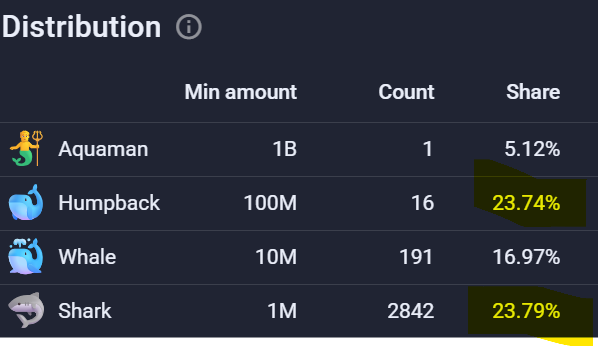
Sharks just overtook Humpbacks for being #1 holder $kas cohort. Do you know how big of a deal this is?
Let me explain:
Have you ever seen a company with a directory board of 2842 seats? No you have not, that's because it doesn't exist.
It means 2842 individuals hold the majority of shares in this venture called Kaspa.
What does this tell us? It tells us Kaspa has a higher chance of succeeding than any company or venture especially at this size. Why? Swarm-Intelligence, that's why.
It is my utmost strongest belief that a collective of thousands of people form better decisions than a single operator.
Look at a swarm of fish, they find the best solution to dodge attacks and a part always survives to replicate back to full strength.
This is why Kaspa will win.
KASPA'S 2026 PIVOT: PAYMENTS RAIL TO PROGRAMMABLE L1
Kaspa is shifting categories this year. The proof-of-work BlockDAG that runs at 10 blocks per second now has a roadmap pushing it from a fast payments chain into a programmable base layer.
Igra Network went live in March as a decentralized EVM execution layer on top of Kaspa, hitting 3,000 transactions per second with 15 protocols deployed at launch and a clean Sigma Prime audit. KAS wraps 1:1 to iKAS as the network's gas token.
The Toccata hard fork follows in June. It bundles native KRC-20 tokens, covenants, and zero-knowledge verification opcodes into Layer 1 through a new scripting language called SilverScript.
$KAS trades around $0.036 with a $985 million market cap, up 12% on the week. Roughly 95% of the 28.7 billion supply is already mined.
DAGKnight consensus is queued for Q3.
What most people are missing about Toccata is that it is not “smart contracts coming to Kaspa” in the Ethereum sense. That framing is lazy. Toccata is more specific and more important: it is Kaspa adding constraint logic, zk verification, and sequencing commitments to a high-throughput UTXO blockDAG without converting the base layer into a global execution machine. It is programmability without surrendering the architecture that made Kaspa distinct in the first place.
The first piece is Covenants++. In a normal UTXO system, coins are locked by conditions and then spent if those conditions are satisfied. Covenants extend this by letting outputs impose rules on future spends. That means the transaction graph itself can carry enforceable structure: vaults, staged releases, spending paths, asset lineage, canonical bridges, escrow flows, multi-step contract interactions, and constrained application logic. This is not a VM where every node executes arbitrary program state. It is local UTXO computation with recursive constraints. The difference matters. Ethereum-style programmability globalizes execution. Kaspa-style covenants localize it.
The second piece is zk verification. Toccata includes zk opcode/verifier infrastructure, with support discussed around flexible proof verification paths such as Groth16-style proving and RISC Zero-style STARK verification. This lets external computation be proven to L1 instead of replayed by L1. That is the real scaling primitive: do the heavy work elsewhere, submit a proof, and let Kaspa verify the commitment. This is how you get toward zk apps without turning every Kaspa node into an application server.
The third piece, and maybe the least understood, is partitioned sequencing commitments. ZK applications need proof costs to scale with their own activity, not with the entire global DAG. Sequencing commitments are designed to let apps reference L1 ordering in a more scalable way, so based zk systems can follow Kaspa’s sequencing without needing to prove the whole network history every time. That is not a minor detail. That is the bridge between high-BPS settlement and practical zk application design.
Toccata is not the final form of Kaspa programmability. It is explicitly not full vProgs yet. The current stage enables standalone zk applications, canonical proof-based bridging, covenant logic, and the primitives needed for later synchronously composable verifiable programs. In other words, Toccata is the hinge: Kaspa moves from fast money into programmable settlement, while still refusing the bloat of a monolithic world computer.
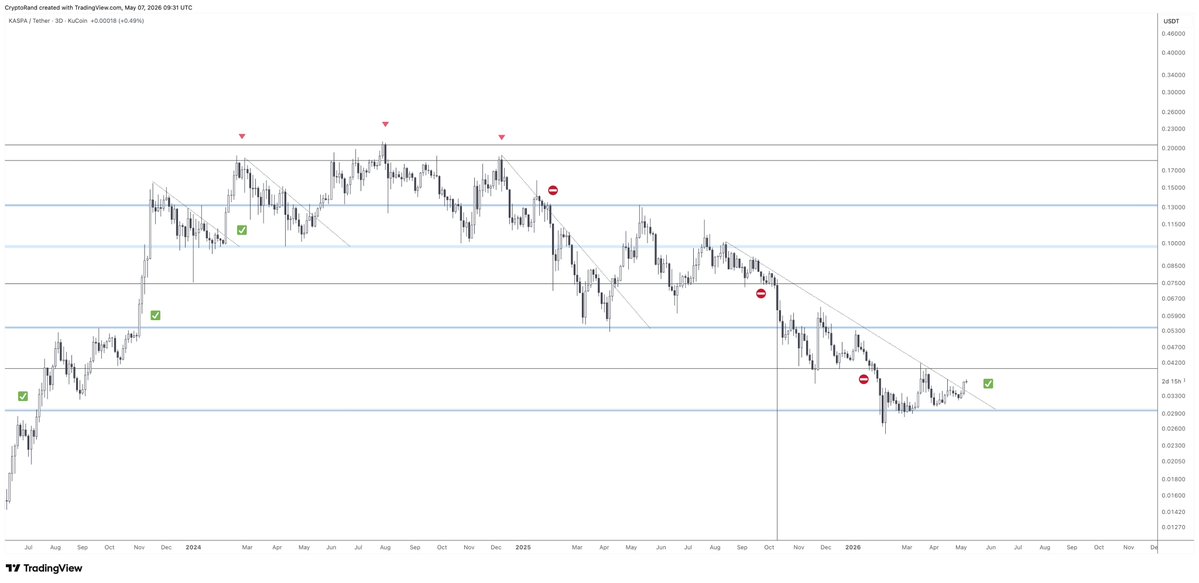
Tracking $KAS closely. Breaching the main downtrend resistance after ONE year. Pushing for the BULLISH reversal 👀
More trading setups at: https://t.co/N3WuQcWWkm
Zealous Flow Whitepaper Deep Dive ( @ZealousSwap )
Zealous Flow = Zealous Swap V2. Not another AMM or CLOB.
It’s the first on-chain Continuous Clearing Market (CCM) — a brand-new primitive where every open buy + sell order on a pair clears every block at one single uniform price.
No LPs. No market makers. Orders are each other’s liquidity.
Core Idea (the “third way”)
• AMMs = curve + passive LP pool → slippage + LVR + sandwiches.
• CLOBs = discrete matches → latency wars + ordering games.
• CCM = resting capital sets one clearing price (cp) per block. Every eligible order fills proportionally via lazy math. Price walks up/down as buy/sell imbalance changes. Zero intra-block price walking.
Result: same-block orders always get the exact same price + same fill rate, no matter submission order.
How the OrderFlow Engine Works (the magic 🪄 )
• Users post limit orders at discrete ticks (buy = max price they’ll pay; sell = min they’ll accept).
• Engine maintains global monotonic accumulators (scalar + accum). Fills are O(1) lazy — computed on cancel from snapshot deltas. No looping orders.
• Every block: fixed quantum of value matches at current cp. Minority side fills fully; majority side scales proportionally.
• Saturated orders freeze once (immutable payout). Fully filled orders stay filled forever — no drift.
• Gas-bounded everywhere (tick walks, freezes, advances). Permissionless settle() crank handles backlogs.
Killer Incentives: Counter-Liquidity Rebates
Fees charged only on exit (not submission):
• L1 Protocol fee on fill (up to 1%, discounted by how much you actually matched).
• L2 Linear-decay cancel penalty on refund (max 10%, decays to 0 after cooldown).
• L3 Rebate split: most of L1+L2 flows to the opposite side’s resting orders (structural pull toward book balance). Your exit literally pays the capital that enabled your fill.
No self-rebates. No JIT edge. Persistence wins.
MEV Resistance (by construction)
• Same-block submissions = identical state & snapshots → no frontrunning/sandwich profit.
• Single cp per block + SameBlockCancel revert kills atomic pumps.
• No trade-order sensitivity. Price is recomputed after all inclusions.
What It’s NOT
• Not replacing Zealous Swap V1 (AMM stays for memecoins + casual swaps).
• Not high-frequency CLOB (per-block cadence, not ms ticks).
• Immutable (except owner fee config — hard-capped, no retroactive changes).
Why It Matters
First on-chain mechanism that rewards resting counter-liquidity instead of LPs or latency.
Patient capital gets paid. Large/strategic orders get predictable fills without moving the market. MEV surface is structurally near-zero. Gas is predictable.
Built from first principles (spun out of their ZAP uniform-price auction).
Fully specified, audited-ready, immutable deployment.
TL;DR: Zealous Flow turns the order book into a continuous uniform-clearing engine.
One price/block, O(1) fills, rebates for staying on the book, MEV-proof by design. The liquidity primitive blockchains have been missing.
Full whitepaper: https://t.co/5L1ujiXvrf + ZealousFlow-Whitepaper.md )
Kaspa is superior to TON not because it currently beats TON’s headline finality number, but because it is attacking a much harder problem: compressing permissionless Proof-of-Work finality toward real time instead of optimizing a validator committee. TON’s current advantage is real. Its architecture targets extremely fast block production and near-instant finalization through a stake-weighted validator process where validators coordinate, vote, and finalize once quorum agreement is reached. That is technically impressive, but it is still finality by committee coordination. TON answers the question: how fast can a validator set agree? Kaspa asks the deeper question: how fast can open, permissionless energy become ordered enough that reversal becomes economically and physically incoherent?
Kaspa’s present model is already fundamentally different from linear Proof-of-Work. Since Crescendo, Kaspa moved to 10 blocks per second, meaning the network targets 100 ms block intervals while GHOSTDAG orders parallel blocks instead of discarding honest work as orphan waste. This gives Kaspa fast inclusion and low-second practical confirmation, but its finality remains probabilistic because it is still Nakamoto consensus expressed through a BlockDAG. That distinction matters. TON’s finality and Kaspa’s finality are not the same object. TON finalizes through stake signatures. Kaspa accumulates irreversible work across a high-frequency DAG. One is administrative certainty from a validator quorum; the other is thermodynamic certainty from energy, ordering, and adversarial cost.
DAGKnight is where Kaspa’s superiority becomes much harder to ignore. GHOSTDAG still relies on a hardcoded latency parameter; DAGKnight is designed to remove that fixed assumption and make confirmation responsive to actual network conditions. In plain terms, Kaspa would stop confirming according to an assumed worst-case delay and start confirming according to the real observed structure of the network. This matters because finality is not just wall-clock speed. It is the density of honest ordering inside time. At higher block rates, especially the long-term 100 BPS direction, Kaspa samples Proof-of-Work far more densely, causing adversarial reorg probability to collapse across shorter windows.
So yes, TON leads the clean finality chart today. But TON is fast inside the validator paradigm. Kaspa is building something more politically and technically durable: near-real-time settlement without a staking cartel, privileged sequencer, or committee ceremony. If DAGKnight lands as intended, Kaspa does not merely catch up to TON; it beats TON on the deeper axis: finality that is fast, permissionless, energy-backed, and neutral at the base layer. TON is optimized coordination. Kaspa is consensus physics approaching internet speed.
I don’t know how I feel about the ‘for kids’ title🤣 but this is superb to teach anyone who’s not overly experienced in crypto technology about kaspa:native
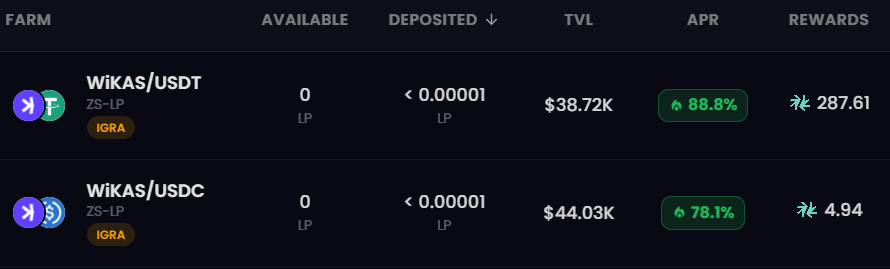
Did you know you can put your $KAS and stables (USDC/USDT) to work on Kaspa’s EVM layer @Igra_Labs ? ⚡️
Provide liquidity in the iKAS/USDC and iKAS/USDT pools on @ZealousSwap, then stake your LP tokens in the Farms to earn rewards, currently up to 90% APR.
How to start:
1️⃣ Bridge USDC & USDT to Igra Network via @hyperlane Bridge.
2️⃣ Bridge L1 KAS to iKAS via @Kaspa_KAT Bridge.
3️⃣ Add liquidity on ZealousSwap DEX.
4️⃣ Deposit the LP tokens into Farms.
Recommended wallet (extension + mobile): @KastleWallet 🔐
Passive yield opportunities are starting to grow on Kaspa.