@MichalSemotan@SkupinaPPF Uz se těším na produkty v rámci PPF... ale zároveň věřím ze fondy, které jste zanechal JT budou spravovány obdobně jako doposud
$PYPL roční návratnost za posledních 10 let:
🟢 2016: +9,03 %
🟢 2017: +86,52 %
🟢 2018: +14,22 %
🟢 2019: +28,64 %
🟢 2020: +116,51 %
🔴 2021: -19,48 %
🔴 2022: -62,23 %
🔴 2023: -13,77 %
🟢 2024: +38,98 %
🔴 2025: -31,60 %
🔴 2026 YTD: -1,60 %
I přes jeden silný rok (2024) akcie stále nedohnala propad z roku 2022 - recovery je pomalejší, než by naznačoval jen poslední rok.
@aleshrad@ZdenekFolprecht@oneplaysportcz 2/2 zmaření zjevné brankové možnosti v Pú s možností hrát míčem by byla možnost 3, PK + ŽK.
A otázka je v té rychlosti jestli tam ta možnost hrát míč byla.
3. Variantu modle mě viděl původně R na hřišti a po VAR to změnil na surovou hru.
@aleshrad@ZdenekFolprecht@oneplaysportcz 1/2 Za mě máš 3 možnosti a 2 konci PK a ČK, oboje si rozhodčí obhájí..
Buď surová hra (CK vsude na hřišti, v souboji o míč, ale s použitím nepřiměřené síly, ohrožení zdraví soupeře a nebo zmaření zjevné brankové příležitosti bez možnosti hrát míč.
Novo Nordisk $NVO is currently down nearly 50% over the past year, and yet, just a month ago, Goldman Sachs named it their top European stock pick, forecasting an astonishing 91% total return over the next 12 months.
Since that report was released, the stock has dropped even further.
At current levels, if Goldman’s price target still holds, they now see an upside of over 100%.
Is this a rare opportunity to scoop up shares of a world-class compounder at a major discount, or is the market telling us something we’re missing?
Let’s dive in.
💉 A Global Leader in Diabetes and Obesity Care
Novo Nordisk is a global healthcare powerhouse based in Denmark, best known for its leadership in diabetes and obesity treatments. Their two blockbuster drugs, Ozempic and Wegovy, are GLP-1 therapies that have rapidly gained global popularity for managing Type 2 diabetes and promoting weight loss.
Over the past three years, Novo has nearly tripled its global GLP-1 patient reach, and now commands an estimated 62% market share in GLP-1 treatments.
These drugs have transformed Novo Nordisk’s financials. Over the past decade:
Their return on invested capital (ROIC) has consistently exceeded 40%, with 2024 coming in at a still-impressive 39%
Gross profit margins remain extremely high, averaging 84.1% over the last 10 years
2 Key indicators of a high quality business.
📉 So Why Is the Stock Down 50%?
Despite all the positives, the stock has been hammered over the past year. There are two main reasons:
1. A Modest Guidance Cut
Novo recently lowered its full-year 2025 guidance:
- Revenue growth lowered to 13–21%, from a prior forecast of 16–24%.
- Operating profit growth reduced to 16–24%, down from 19–27%.
These are still strong growth rates, but the market doesn't like downward revisions.
2. Competitive Threat from Eli Lilly
Eli Lilly $LLY, Novo’s biggest competitor, announced successful Phase 3 results for an oral GLP-1 therapy, potentially offering a more convenient alternative to injectable treatments like Ozempic.
Investors quickly re-priced the competitive landscape, sending LLY stock higher and NVO lower.
📊 Here’s What Most Investors Are Missing
This is not a winner-take-all market.
According to Bloomberg, the obesity drug market is projected to exceed $170 billion by 2030, representing a 32% compound annual growth rate, one of the fastest-growing markets in the world, even faster than many AI forecasts.
That means even if Eli Lilly captures some market share from $NVO, the overall pie is expanding so rapidly that Novo Nordisk can still deliver strong double-digit earnings growth.
Basically, a rising tide will lift all boats.
📈 Is Novo Nordisk Undervalued?
Let’s look at it two ways:
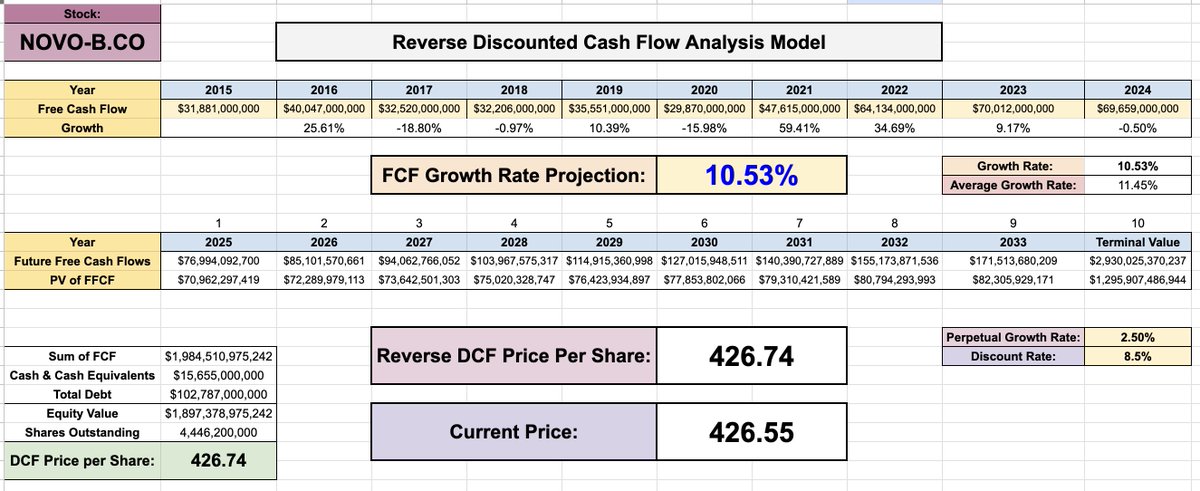
1. Reverse DCF Analysis
At the current price of ~$441.40 (non-USD listing), the market is pricing in just ~10.5% annual free cash flow growth through 2033.
But analysts are projecting 14–15%+ earnings growth, which would suggest the stock may be undervalued relative to its future cash flow potential.
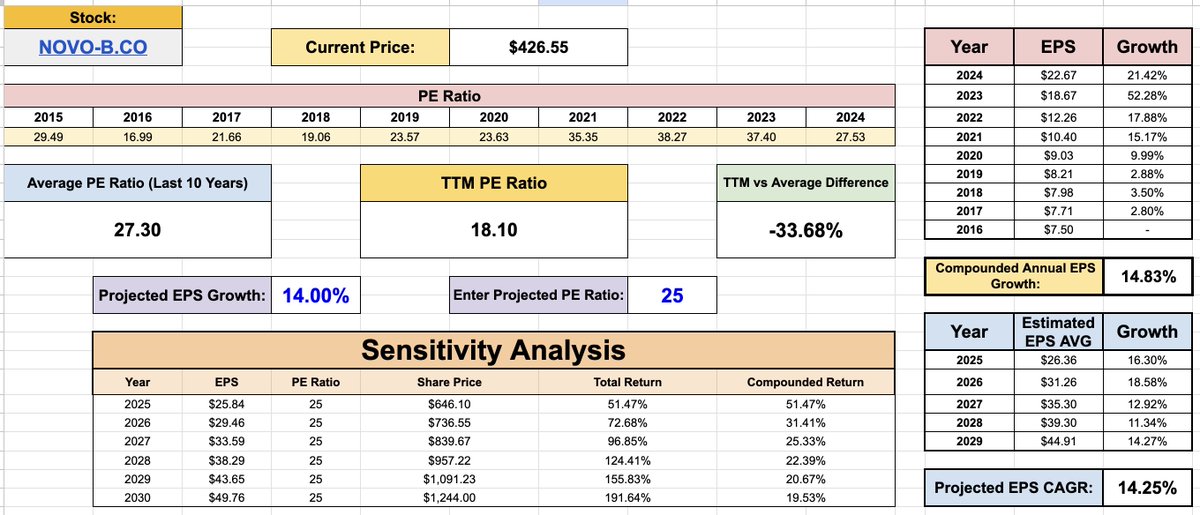
2. Sensitivity Analysis Based on Earnings Growth
Let’s take a conservative and a slightly bullish scenario:
Conservative Case
EPS growth: 12.5%
Forward P/E: 20
Total return by 2030: 115%
CAGR: ~13.6%
Bullish Case
EPS growth: 14%
Forward P/E: 25
Total return by 2030: 191%
CAGR: ~19.5%
In both cases, you're looking at returns that significantly outperform the S&P 500 average of ~8–10% CAGR.
Despite the recent sell-off, Novo Nordisk remains a dominant player in one of the fastest-growing healthcare sectors in the world. The company is highly profitable, efficient with capital, and still has a long runway for growth, even if competition takes some market share over the next 5 years.
If the projections of the obesity drug market are even close to accurate (projected to exceed $170 billion by 2030, representing a 32% compound annual growth rate), then $NVO is positioned to do quite well.