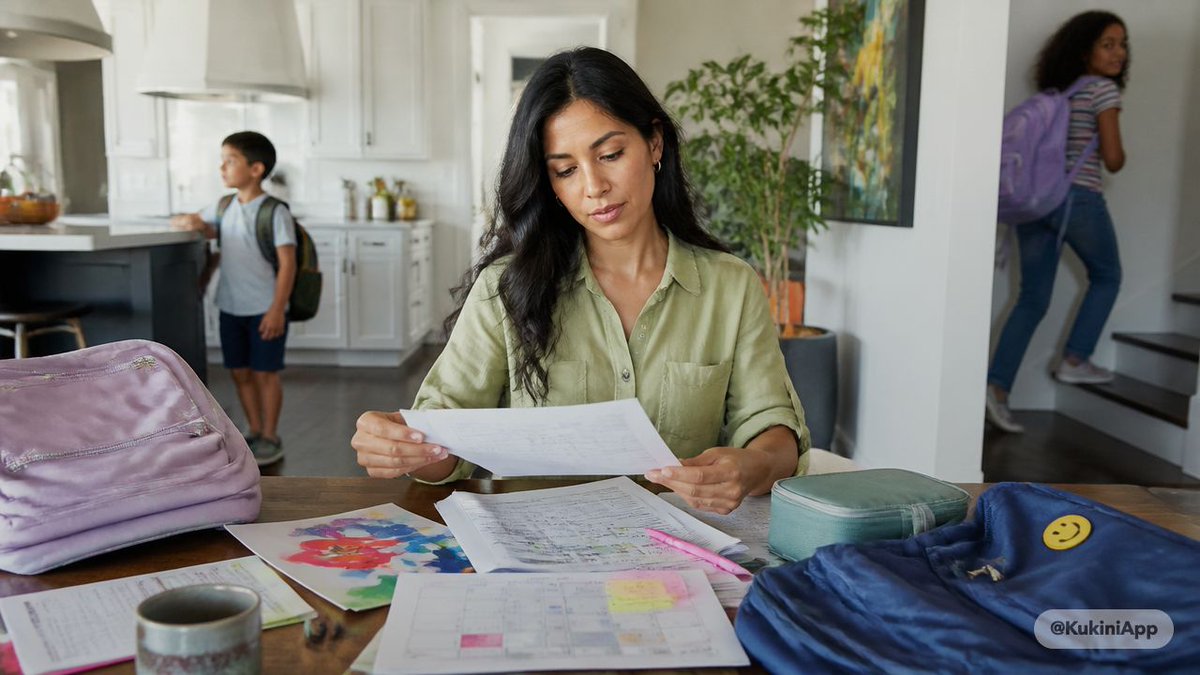
Turn your favorite AI assistant into your family's new personal assistant!
Connect @KukiniApp to agents like @claudeai and @ChatGPTapp to:
- manage your shared family calendar
- log and summarize health & activity events
- plan meals from your saved recipes
Washington University, via Euronews: socioeconomic factors explained about 16% of the variability in kids' brain-function measures. Invisible load is not imaginary. https://t.co/hbT1kYDgFn
Household coordination is not “just admin.” Shared calendars, lists, and permissions can cut friction that adds to stress when families are already stretched thin. https://t.co/hbT1kYDgFn
2026 Kids Count Data Book shows a national decline in child well-being, with education, health, and housing indicators all worsening. Families benefit from more visible, shared routines when the environment gets harder to manage. https://t.co/JVK51IPh5w
When parenting questions feel private, Facebook groups start to feel too exposed. A February 2026 study of 109 mothers found judgment and privacy concerns pushing some toward AI. https://t.co/QfD3YlqqWj
School-home communication fails less from lack of care than from fragmented reminders and missed follow-through. One lost note can ripple across the week. https://t.co/okY5nbW9eq
Parents are going broke on berries. They’re naming a real weekly grocery leak.
A fruit haul gone by lunchtime is exactly the kind of tiny expense that starts feeling huge. https://t.co/qz8faH3LEV
97% of parents felt stress in the past month. When the pressure is behavior, worry, and daily coordination, the fix has to include the family system, not only the individual. https://t.co/Be2A88os1g
88% of US public schools now issue devices to every student, even as school officials tell parents to limit screens at home. You're not the only one feeling the cognitive dissonance. https://t.co/HDDBaGTWhc
Sweden's public health agency now wants "screen-free zones" in the home (bedrooms, dining table) after research showed parents' screen habits directly shape kids' habits. https://t.co/8q5LY9lpfQ
Mothers are more likely than fathers to say being a parent is tiring (47% vs. 34%) and stressful (33% vs. 24%) all or most of the time.
When both adults are busy, the invisible work does not disappear. It usually gets louder.
https://t.co/oL0tHffXqa
The care crisis is a household coordination crisis. Burnout, lost sleep, and fragmented care are all part of the same load. Families need less guessing and more shared visibility. https://t.co/d1t1kcZzkg
If you are paying for kids and helping aging parents, your budget is not broken. It is doing two jobs at once.
That is the sandwich-generation squeeze: child costs, medical bills, and care support landing in the same household.
https://t.co/TMIEnMryMM
College-educated dads are spending more time on childcare and housework, and less time in paid work. Helpful shift if they also help hold together the family system. https://t.co/6XVgZ4fp1o
If you can't control the neighborhood, control the routines. Harvard notes that predictable routines help children even when external stability is limited: https://t.co/UEMPzKhs4b
Summer here yet? School year makes one adult the dispatcher for pickups, forms, practices, meals, and feelings. Kids Mental Health Foundation says 40% of parents report more mental load in school season: https://t.co/gKU2KuM6yf
You're not failing bedtime. You're carrying the hidden coordination load of a family. The BBC piece on ancestral baby sleep is a good reminder: this is often about systems, not willpower. https://t.co/dBiSs4kWsD
Bus tracking is becoming family infrastructure, not a perk. OSSE is testing BusWhere for 3,800 students with 60-second updates, and CalAmp redesigned Here Comes The Bus with alerts and safety controls. https://t.co/IIPtUslqNq
Consistency matters more than perfect routines. In a study of 2,353 families, kids with stable-high preschool routines had fewer attention, behavior, and mood problems than kids whose routines declined. Protect the anchors. https://t.co/0eXPoQQ4Fr
Parenting stress is not always a mindset problem. A recent survey found 97% of parents felt it in the past month. When one person is holding the handoffs, notes, and worry, everything feels heavier. https://t.co/Be2A88os1g