@Bonta_kun9029@NIKKE_en So you know, you can disable the Launcher's browser completely using Windows Firewall, negating any possible attacks that might occur via the browser.
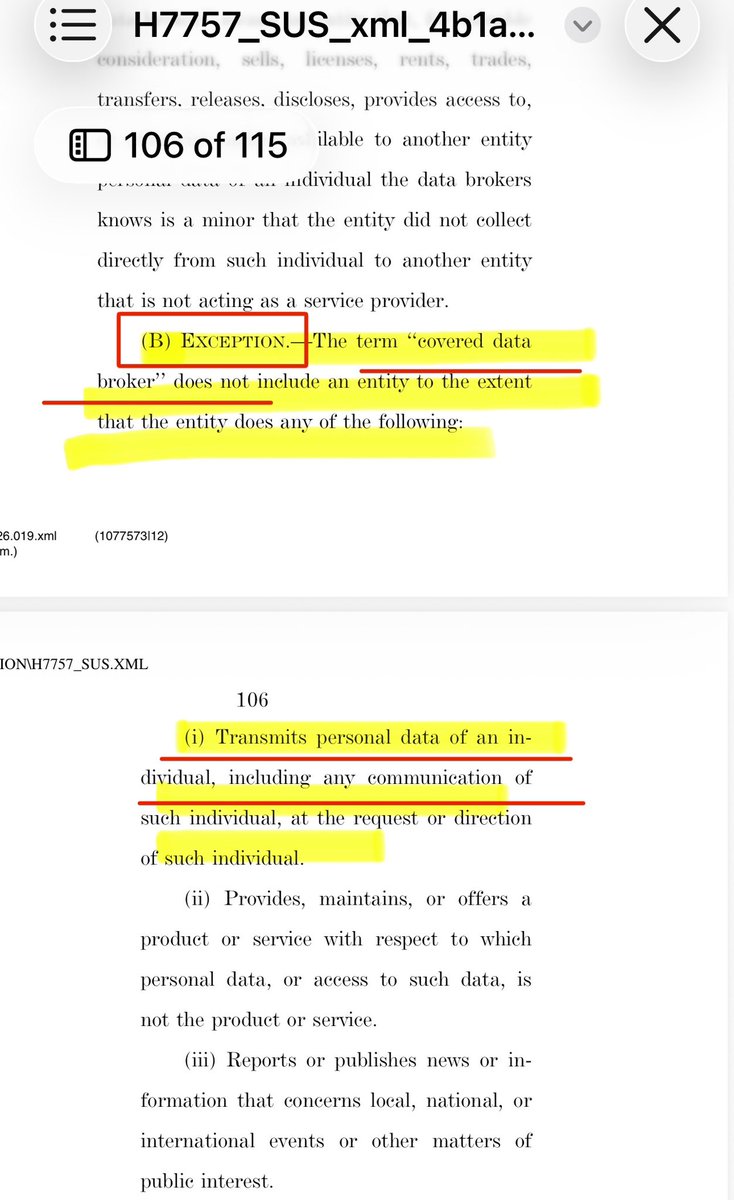
This section you see is from the (KIDS ACT) ⬅️
It shows you the REAL INTENTION on page 110. 🚨
First this ENTIRE bill is a wolf in sheep's clothing🚨 - it uses children's safety as a vehicle to expand government control over the internet, normalize surveillance and verification systems, and create a regulatory framework that can be expanded to adults later.⚠️
One section that LIFTS the MASK is page 110 🎭 where they RESTRICTED DC as ONLY place where you can CONSTITUTIONALLY CHALLENGE this SURVEILLANCE court IN COURT ‼️
In the jurisdiction provision (Section 702)
IF this bill were truly about protecting children, why would you need to concentrate all constitutional challenges in one court?
It TELLS you this is about controlling the legal narrative and preventing scattered rulings that might strike down provisions.⚠️⚠️
——-
Deeper look there are TONS of CONTRADICTIONS 🚨🚨
The bill says it does not require age verification in three separate places:
• Page 38, Section 220: "Nothing in this subtitle may be construed to require the provider of a covered platform to implement an age gating or age verification functionality"
• Page 99, Section 602(f): Same language for COPPA 2.0
• Page 13, Section 103(f): "Nothing in this section may be construed to require the submission of government-issued identification"
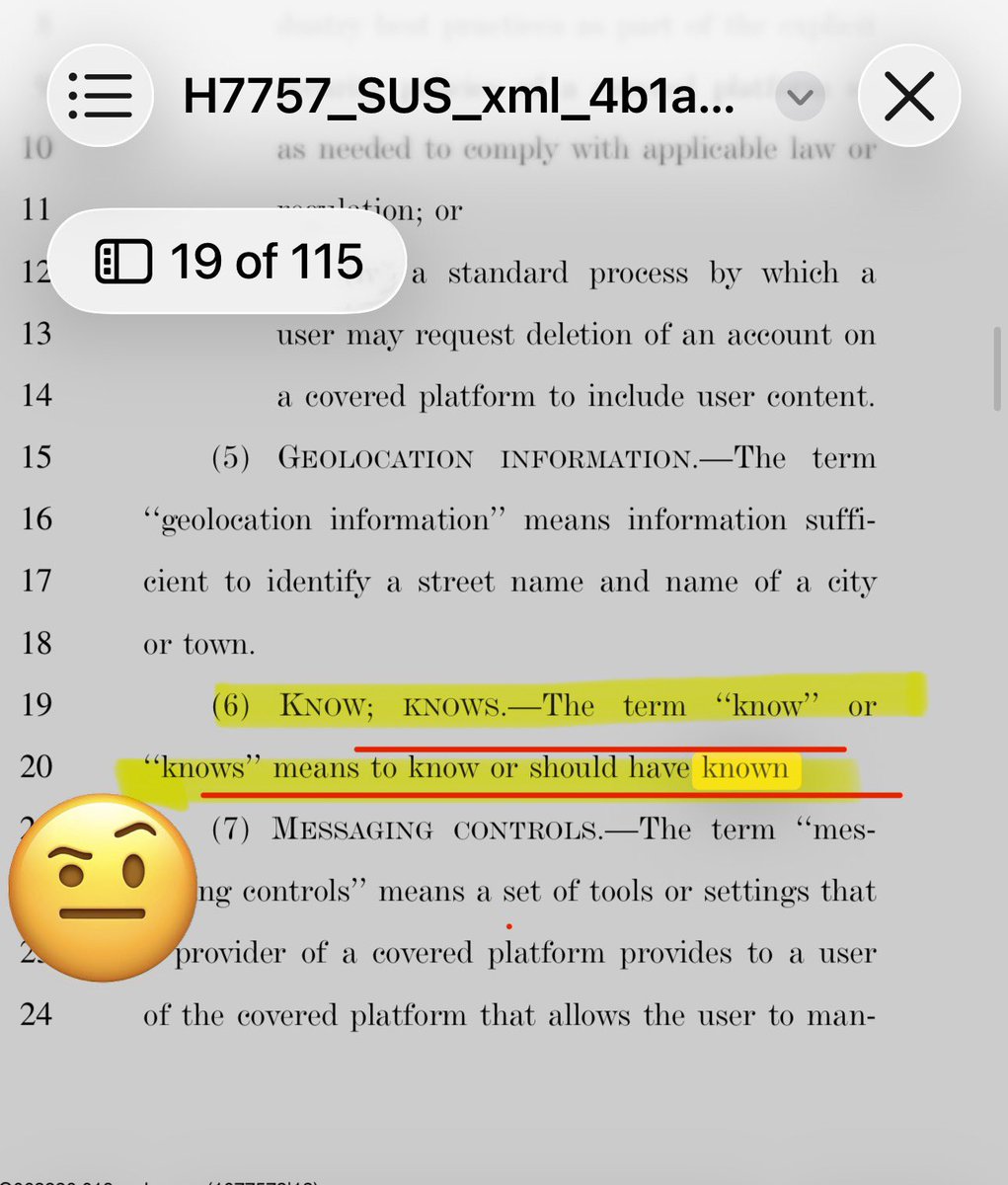
But every single protection in the bill is triggered by one phrase: when a platform "knows" a user is a minor. The "knows" standard is defined as "know or should have known" on pages 17, 40, 45, and 79.⚠️
This creates an impossible trap:🚨
1. If a platform does NOT verify age, it "should have known" minors were present and faces liability for failing to provide protections
2. If a platform DOES verify age, it collects age data on every user, which creates privacy risks and potential liability
The bill says "you don't have to verify age" while simultaneously making it impossible to comply without verifying age. This is not a contradiction. This is the design.
The bill uses children's safety as the vehicle to normalize age verification across the entire internet. Once age verification infrastructure exists for minors, it exists for everyone. The system built to check if you are 16 will be the same system used to check if you are 21, 35, or a registered voter.⚠️🚨🚨🚨
—
JURISDICTION SHELL GAME 🚨
Page 107, Section 702: "The United States District Court for the District of Columbia shall have exclusive jurisdiction over any challenge to the constitutionality of this Act or the constitutionality of any action, finding, or determination under this Act."
One court. All challenges. No exceptions.
This means:
• A company in California cannot challenge in the Ninth Circuit
• A civil liberties group in New York cannot challenge in the Second Circuit
• Every constitutional challenge must go to the same DC court that routinely handles federal government cases
This is designed to concentrate legal challenges in a venue favorable to the government and prevent multiple circuit courts from issuing injunctions against the law. If the DC court upholds the law once, it becomes extremely difficult to challenge elsewhere.🚨🚨
—-
THE ADVERTISING MEASUREMENT LOOPHOLE🚨🚨
Page 39, Section 233(b): "Nothing in this subtitle may be construed to limit the processing of personal information solely for measuring or reporting advertising or content performance, reach, or frequency, including through an independent measurement."
➡️⚠️🚨The "Stop Profiling Youth and Kids Act" does not stop profiling for advertising measurement. It only stops "market research." Platforms can still process minor's personal information for advertising performance metrics. This is the commercial exploitation pathway left open while the privacy provisions are presented as protections. 😆
—-
**This bill is a fucking Trojan Horse. Period.**🚨🚨🚨
Its a federal surveillance and control system over the entire internet that will be used on adults.🚨🚨🚨
Using child safety. As cover 🚨🚨
1. It builds a national digital ID system through the back door.🚨⚠️
The bill says three times it does not require age verification. That is a lie. Every single protection in the bill only triggers when a platform "knows or should have known" a user is a minor. No platform can prove it did not know without checking. The bill creates a legal trap where the only safe path is to card everyone. Once that infrastructure is built, it does not get turned off when you turn 18. The same system that checks if you are 16 today checks if you are 21 tomorrow. The same database that verifies a teenager verifies a gun buyer, a voter, a patient. This is a national digital identity system built under the cover of child protection.
⚠️⚠️2. It hands the FTC the keys to the internet.**
The FTC gets authority over age verification standards, content safety audits, data broker registries, social media research, chatbot rules, gaming platform safety, educational resources, advertising regulations, and enforcement of the entire act. The FTC becomes the operational regulator of the American internet. This is the largest federal power grab over online platforms in a decade, buried inside a children's safety bill where nobody will vote against it.
⚠️⚠️3. It forces companies to spy on children to prove they are protecting them.**
The audit requirements mandate platforms track and report how many minors use their service, how long they spend, what safety features they use, what reports they file, and what personal information is collected. The government orders companies to gather detailed statistics about children under the banner of protecting them. A bill that claims to protect children's privacy mandates the collection of more data about children than has ever been collected before.
🚨🚨4. It shields Big Tech and crushes small competitors.
The data broker rules exempt Google, Meta, Amazon, and Microsoft because their product is advertising services, not data sales. The companies that collect the most minor data in the world are exempt from the data broker regulations. The compliance costs annual third-party audits, safety tools, parental controls, reporting systems, age verification infrastructure cost millions. Big tech absorbs this. Small platforms die. The bill consolidates market power among the largest tech monopolies while pretending to regulate them.
5. It cuts parents out through school contracts.**🚨🚨🚨
Educational technology companies can collect children's personal information without parental consent if they have a written agreement with a school. The school consents. The parent is never told. Google Classroom, Microsoft Teams, Canvas—they all get direct access to student data through school district contracts. This is a corporate pipeline of minor data with zero parental involvement, written into a bill that claims to empower parents.
6. It kills encryption through regulatory pressure. 🚨🚨🚨
The bill says it does not require breaking encryption. Another lie. It requires platforms to provide messaging controls, content filtering, and safety features for minors. On an end-to-end encrypted platform, you cannot filter content you cannot see. The only way to comply is to either break encryption for minor accounts or disable it entirely. The bill creates regulatory pressure to destroy encryption while claiming to protect it. Once encryption is weakened for minors, the vulnerability exists for everyone.
@CEOofKuberaLeez@Solowarrior17@JGasor How come you don't add the name to the original post? It would prevent so many comments from asking you what the source is.