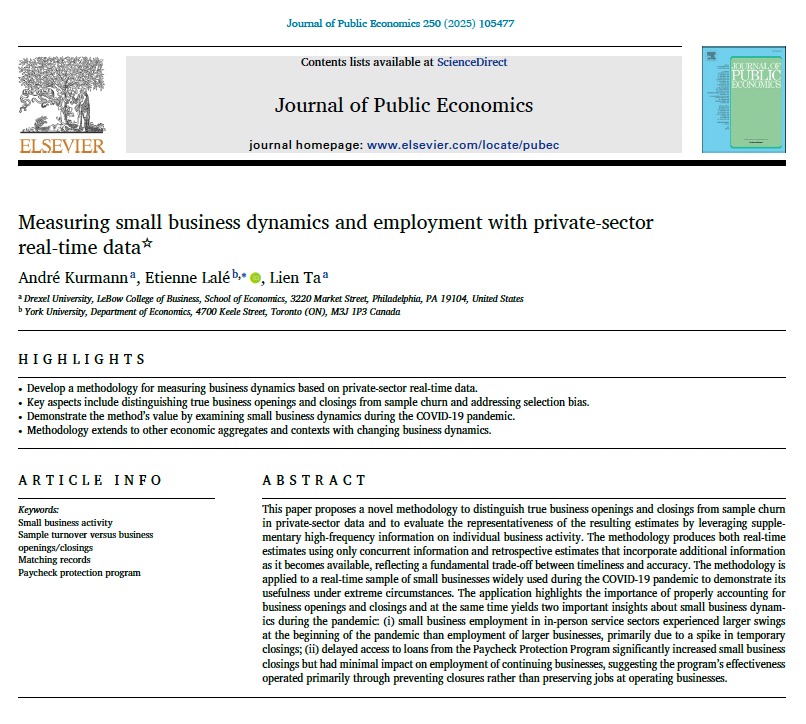
There's a lot of interest about the revisions in the BLS payroll numbers. A lot of this has to do with how the BLS adjusts for birth / death of businesses. How fitting then that our paper on exactly this issue was just published in @JPubEcon! 1/n
https://t.co/vPl3wSXw7B
@voxeu@LeBow@DrexelUniv@LaleEtienne@YorkUniversity@iza_bonn@esg_uqam@homebase 14k-42k jobs may not seem like that much (then again: we care greatly about +/- 50,000 in the monthly payroll numbers), but these effects are highly concentrated in a few places and don't take into account negative effects on larger businesses or spillover effects.
@JesusFerna7026 Skunk Works is indeed a terrific book (I didn't know we share a love for planes). And yes, I've been asking myself exactly the same question: what value-added do universities provide in the age of AI? Would love to hear more of your thoughts on this!
If AI and workers were strong complements, what would we see?, https://t.co/dujBIpnM7a Does the latest data tell us AI is a substitute for human work? Nope. Is that comforting? Also nope. My comments on @erikbryn and co. (and @Noahpinion)
There's a lot of interest about the revisions in the BLS payroll numbers. A lot of this has to do with how the BLS adjusts for birth / death of businesses. How fitting then that our paper on exactly this issue was just published in @JPubEcon! 1/n
https://t.co/vPl3wSXw7B
@LaleEtienne@LienTa4795@joinhomebase@rsandza@SafeGraph Long-story short:
- The method works well, even under extreme circumstances.
- But there are also important challenges with regards to data consistency / availability.
- That's why it's not so easy for the BLS to "just use a better method" 10/n