John Hunt may be the best example of a living legend that the South African media industry has.
He’s built a name for himself as one of the most influential voices in the country, working alongside the likes of Nelson Mandela to create a vision of what South Africa would eventually become.
John challenges the idea that creative breakthroughs are this clean, perfectly formed moment we so often see in movies. He proves that the best ideas nearly always come from discomfort and chaos. Nothing like bomb threats to get the creative juices flowing…
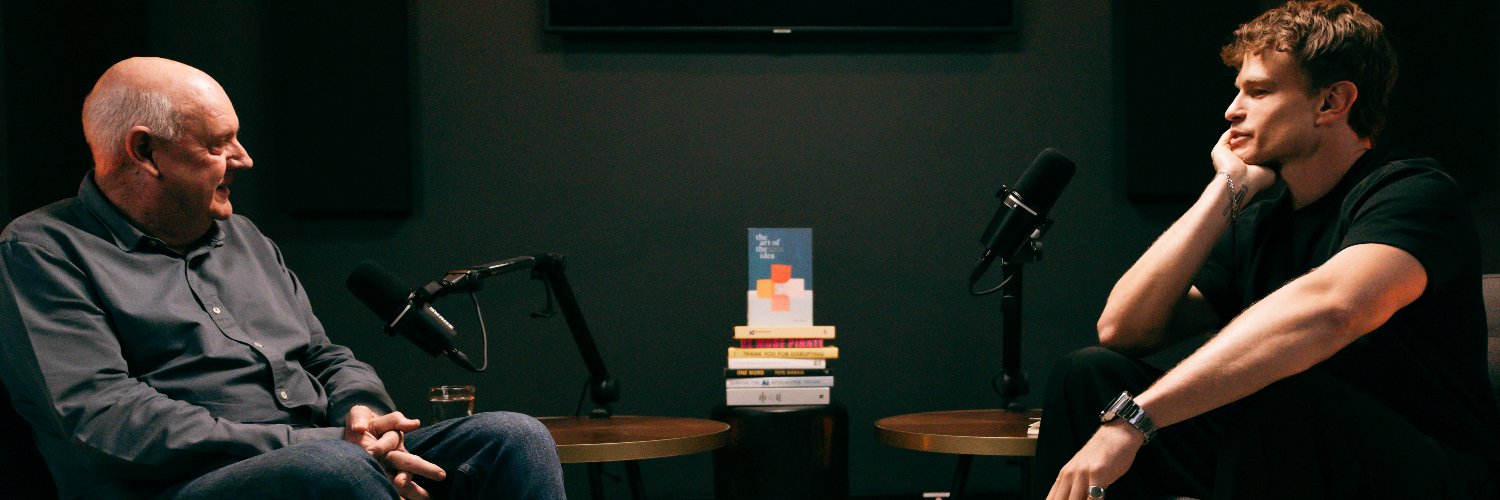
It was a great privilege to sit down with him on Never Think Alone and pick his brain on his process and creativity in general. He’s spent his life understanding people, pressure, and the incredible things that happen when you mix both of them together.
In 1960, Theodore Geisel took on a bet.
His buddy Bennet Cerf bet Geisel that he couldn’t write a successful book using 50 or less unique words. The bet was for $50 dollars and Geisel wasn’t one to shy away from a challenge.
Cerf, thinking it was just a silly bit of fun, laughed about it and moved on. A few weeks later, Geisel presented his book: He’d used exactly 50 words. True to his word, Cerf, who worked for a major publisher, published the book, likely believing it would never be a success.
Geisel wanted to publish the book under pseudonym, so to honour his late father, who’d always hoped his son would earn a doctorate, he took on the honorific and paired it with his second name:
Seuss.
The book in question was Green Eggs and Ham. It went on to become one of Random House’s best-selling titles. Globally, it’s sold over 200 million copies and remains the fourth best-selling hardcover children’s book in the US.
What a lot of people don’t realise is that this was the second time Geisel took on a challenge like this. Several years earlier, an educational director challenged him to write a story 7-year-olds would love but it had to be limited to 225 words from a standard vocab list.
Geisel failed that challenge. He used 236 words. But the result was a little book called The Cat in the Hat. It sold a million copies and allowed him to become a full-time writer.
The lesson should be clear to anyone who follows me: 𝐒𝐞𝐭𝐭𝐢𝐧𝐠 𝐦𝐞𝐧𝐭𝐚𝐥 𝐛𝐨𝐮𝐧𝐝𝐚𝐫𝐢𝐞𝐬 𝐡𝐞𝐥𝐩𝐬 𝐜𝐫𝐞𝐚𝐭𝐢𝐯𝐢𝐭𝐲.
When you limit your options, you force your brain to take bigger logical leaps. It breaks your patterns and prompts different angles.
So next time your team is stuck coming up with a concept, maybe give them a smaller box to think outside of.
Is SEO Dead?
If you work in digital marketing, you might have heard the rumblings dominating media headlines about AEO.
That’s Answer Engine Optimisation. Similar to SEO, AEO focuses on optimising for search platforms like ChatGPT and Gemini. Even just plain Google ever since it rolled out the AI Overview feature.
No matter your feelings on AI (of which there are definitely plenty flowing around online), you can’t deny its influence on culture. People all over the world (read South Africans too) are increasingly asking AI questions in place of more traditional browser searches.
Our browsing behavior has changed.
We used to Google “phones 2026” when shopping for a new device. Now, the inclination is to instead ask a direct question.
“What was the best-reviewed phone of 2025?”
If traditional SEO was about convincing Google to list your website link, AEO is about convincing Google’s AI overview to actually pull your data, cite your source, and recommend your brand as the definitive answer.
That means that copywriting has to adapt to that change as well. Content has to be written in such a way as to be easy to access for an AI bot. It needs to be simple, natural, and more direct than ever. Clear answers have to take the lead before any flowery text.
PlusNarrative is currently building a system that helps optimise AEO. We’re currently in the research stage and I’d love to get people into a room to talk about it.
Comment on this post if you’re interested in participating. Tag anyone else who might benefit from the whitepaper that we’re building.
How many times have you had an excellent idea, something you’re convinced could be a game-changer, right before you’ve fallen asleep?
It’s certainly happened to me. That old cliche of keeping a notebook beside your bed to journal your dreams? I prefer using it for those ideas that hit me right as I’m about to drift off.
Our brains are at their most creative right before they go into standby mode.
Yet some of the world’s most important creators figured out a way to use it to their advantage. Salvador Dali and Thomas Edison both settled in for a nap in a comfy chair while holding a heavy object; Edison used a metal ball, but Dali preferred a massive key.
As they drifted off to sleep, they’d enter that “creative sweet spot.” Their muscles would relax, and they’d drop whatever they were holding, waking themselves up. That way, they were able to access that elusive part of their brain and actually use it.
Again, it sounds like a silly idea from two notoriously eccentric thinkers, but it clearly worked. Decades later, MIT actually proved it.
A 2023 study successfully established a link between onset sleep (called N1 sleep, or hypnagogia if you want to be extra scientific) and creativity. Subjects who participated in the study scored higher on a series of creative tasks after N1 sleep than when completely awake.
Worth considering next time you’re struggling with writer’s block or can’t quite crack a design pitch. Instead of another cup of coffee, grab a small weight and settle in for a nap.
John Hunt may be the best example of a living legend that the South African media industry has.
He’s built a name for himself as one of the most influential voices in the country, working alongside the likes of Nelson Mandela to create a vision of what South Africa would eventually become.
John challenges the idea that creative breakthroughs are this clean, perfectly formed moment we so often see in movies. He proves that the best ideas nearly always come from discomfort and chaos. Nothing like bomb threats to get the creative juices flowing…
It was a great privilege to sit down with him on Never Think Alone and pick his brain on his process and creativity in general. He’s spent his life understanding people, pressure, and the incredible things that happen when you mix both of them together.
In my experience, one of the most common problems teams face when launching a campaign is glossing over the actual definition of their product. They have a “Diamond” problem.
It’s a common trap. The marketing world moves so quickly and often demands instant results that we forget that speed doesn’t equate to progress. That’s why I often fall back on The Double Diamond framework.
It’s a classic for a reason. The Double Diamond was conceived by the British Design Council in 2005 after studying the design processes of 11 leading companies, including Lego and Sony. At its core, it forces us to do one thing: Slow down and face the finish line before the sprint starts.
The first diamond is about finding the right problem. You start with Discovery, where you diverge by gathering raw data and getting inside the user’s head. Then, you move into Definition. This is where you converge, taking everything you’ve learned and framing it into a single, specific problem,
As 2026 research from the Corporate Finance Institute highlights, this is the most critical step for reducing strategic risk. If you haven't defined the "why," your "how" is just a guess.
The second diamond is about finding the right solution. Once the problem is Defined, you open up again for further development. You co-create multiple options, sketch prototypes, do whatever you need to do to generate an idea. Finally, you move into Delivery, where you converge on the most feasible solution through testing and refinement.
I’ve always been a fan of the Double Diamond. It’s an excellent way to reframe the creative process in a way that’s more productive. It allows teams to get creative but also places boundaries. Ultimately, it results in a plan that’s actually been considered through and through.
Next time you’re tempted to "just start building," ask yourself if you’ve actually finished the first diamond. Solving the wrong problem efficiently is the most expensive mistake your team can make.
If you’re not embracing 𝐓𝐫𝐞𝐚𝐭𝐨𝐧𝐨𝐦𝐢𝐜𝐬, you’re missing out on a major consumer trend.
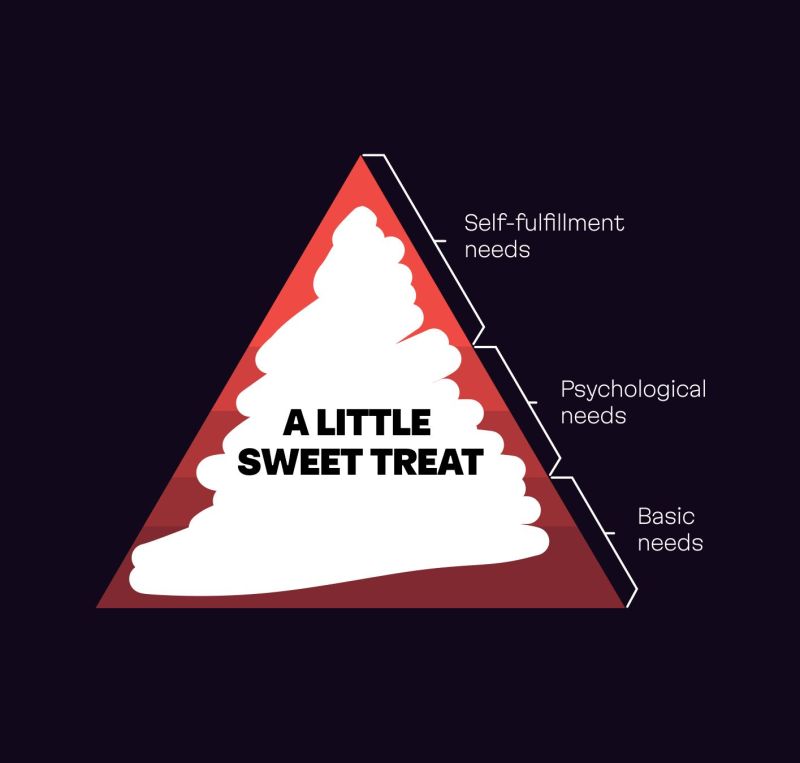
Even if you don’t know what Treatonomics is, you’ve likely indulged in it already. You’ve probably seen it in your weekly shop at Checkers or Pick ‘n Pay. While money is tight, you still allow yourself a little luxury. Maybe a decent bag of coffee beans. Or something even smaller, like a Tex bar.
Households are aggressively rationalising their baskets and cutting non-essentials, yet they are simultaneously “spoiling” themselves with small, inconsequential treats. Research house WARC calls this “Affordability Tension,” but it’s become colloquially known as Treatonomics.
There are some who might write it off as financial recklessness; that saving the R12 you spent on a chocolate will be of greater benefit down the line. Yet when things are difficult, I think it’s more of a survival mechanism for most people.
It’s not a new concept. Ever heard of the Lipstick Effect? It’s an economic theory that consumers will be more willing to buy cheaper luxury goods when facing some kind of economic crisis. The title derives from the sale of red lipstick during World War 2: Despite the recession, cosmetic sales surged because they offered women an accessible morale boost and a sense of normality.
When major milestones like a car or home are out of reach, people pivot to “inchstones.” The dopamine hit becomes valuable and takes on a much greater importance than just "a doughnut after work.”
For those of us building brand strategies right now, Treatonomics means we need to adjust our marketing. We have to start designing for reward and reassurance.
We need to help people celebrate their small wins.
The human desire for joy, no matter what form it takes, is non-negotiable. If your brand can provide customers with a moment of peace, a reprieve from their day-to-day stress, you’ll become a valuable part of their world.
How many times do you finish up your work day, tick everything off your to-do list, but still feel like you barely interacted with anyone?
To some people, that might be the ideal reality. But to most of us, myself included, that disconnect makes work feel more unproductive than it actually is.
It’s the paradox of the modern workplace: our tools have made the days “easier,” but not as satisfying. There’s a significant gap opening up in how we actually relate to each other when we work together. We might be technically reachable, but that doesn’t mean we’re available.
I’ve certainly felt it. It’s why I prefer having in-person meetings. That’s a connection you don’t get through Slack or Teams.
It’s not just a personal feeling, though; It’s a measurable change in what people actually want out of their work. All the way back in 2022, a study by BetterUp Labs found that 53% of employees would trade compensation for more meaningful relationships with their colleagues.
I have to imagine that number has climbed since then…
We too often assume that because we’re visible on a screen or active on WhatsApp that we’re present. I’d argue that just makes you available, not present.
It’s something more of us need to take into account: Presence.
Designing for presence requires us to move beyond the "status update" and create intentional spaces where your team can actually think together. That doesn’t mean introducing a new project management tool.
It means providing your team with a space where connecting with each other isn’t a distraction from work. If anything, it’s what makes their work important.
Some people do their best thinking because they genuinely enjoy the search. Give them a wide brief and they come alive.
Other people lock in and think deeply when something doesn’t make sense. They feel the need to close a gap or figure out a missing piece of the puzzle.
In both cases, those two kinds of people can generate genuinely creative ideas. Which may strike you as odd given the vastly different context in which they’ve been left to think.
A 2025 article published by Technovation suggests a reason for that: They’re fueled by different forms of curiosity.
The former is led by “interest-type curiosity.” You could call them Wanderers. They’re driven by a need to explore their space and dig into a problem with total freedom. They usually feel more creative in high-variety environments with plenty of ways to stimulate their mind.
The latter makes use of a “Deprivation-type curiosity” where they’re motivated by the need to resolve some kind of uncertainty. Funnily enough, this form of curiosity is closely linked to stronger radical creativity, especially in more focused contexts. Diggers would be an apt title.
It’s useful to keep that in mind. Curiosity isn’t just one idea. It takes different forms and can have a major impact on how we solve problems.
Some people like to Wander. Others need to Dig. It’s good to bear that in mind because forcing everyone into the same mode is an excellent way to cause frustration.
It all feeds into the idea that your environment impacts your productivity. The more we understand how different people think, the greater our chance of creating conditions where stronger ideas surface.
“There are no original ideas. It is impossible.”
That’s a quote from Mark Twain,that’s often cited but usually never in its entirety. People forget the second half which is far more poignant:
“We simply take a lot of old ideas and put them into a sort of mental kaleidoscope. We give them a turn and they make new and curious combinations. We keep on turning and making new combinations indefinitely; but they are the same old pieces of colored glass that have been in use through all the ages.”
Which, I’m sure you’ll agree, is far more encouraging than simply stating that originality is impossible.
The best way of looking at it is this: There are no original ideas, but there are an infinite number or original perspectives.
Which should come as a relief to creatives. You don’t need to chase total novelty every time you make something. That’s frustrating and worse, exhausting.
You need to pay closer attention to how you see the world, what you notice that others miss, and what only you can bring to the work.
Toss some existing ideas around in your own head and think about them in a way that makes sense only to you. That’s where you find something truly original.
When does experience help and when does it get in the way?
There’s no cut-and-dry answer to that question, but there is something I am certain about: Sometimes we need to unlearn our habits instead of relying too much on experience.
The thing about experience is that it can be an invaluable asset, but only when it’s used in tandem with other traits like flexibility or mindfulness.
The more experience you have though, the harder it becomes not to use it as a crutch when approaching problems. Because problems change, they evolve alongside the rest of the workplace. Your experience dealing with a problem just three years ago may not be all that helpful now.
That’s why I think unlearning is becoming just as valuable as learning.
Leading a team increasingly requires letting go of inherited ideas. Plenty of leaders have an issue with making assumptions about the work they do and the results they’ll achieve by simply sticking to their playbook.
Hence, the need to unlearn and adapt to a new situation. Stop using the framework that no longer fits your context and listen to the team. Create something that works now rather than rely on what worked then.
Which isn’t to say that experience is useless, far from it.
But the most successful leaders I’ve worked with aren’t the ones clinging hardest to what made them successful before.
Being reliable is a good thing… right?
There’s no debating that reliability is something we all want in our teammates, but it’s important that we don’t lean too heavily on any one person. Most leaders are guilty of that, to some extent, but they only realise their mistake once the damage is done.
Harvard Business Review recently published an article on what it describes as “boomerang work.” Work that keeps coming back to the same leader no matter how far they “throw it.” It could be for any number of reasons, but the most frequent is that the system built around them has learned to depend on their presence.
To some extent, they’ve become an anchor. Either because they’re really good at the job or their superiors don’t trust anyone else to do it.
In either case, there’s a very fine line between reliability and 𝐬𝐲𝐬𝐭𝐞𝐦𝐢𝐜 𝐝𝐞𝐩𝐞𝐧𝐝𝐞𝐧𝐜𝐲.
The most glaring issue is that the entrusted leader usually becomes overworked and overloaded very quickly. Not to speak on the personal ramifications of that (of which there are many), but since they’re the anchor point of the team, everyone else then suffers.
Even if everything is going smoothly, “boomerang work” trains your team to never stretch further since they know most of the important tasks will be covered by someone else. Their burnout worsens, and the cycle keeps looping.
It’s easy to misread that kind of dependency as having high standards or strong leadership, when in reality the room has quietly organised itself around one person’s judgment. That might keep things moving in the short term, but it only harms everyone the longer it goes on.
So pay attention to what work keeps bouncing back to one person and ask why that’s the case. Maybe it’s time to give that person a break and someone else a chance.
How do ideas travel?
It’s a question with an answer that’s changed a number of times. Ideas used to travel through heralds riding through towns on horseback, shouting about the latest news. Then we invented the printing press, alongside someone to stand on a street corner and hand out pamphlets.
Then we started making films, then television, and then the internet, which is simultaneously the most efficient yet somehow inefficient means of spreading ideas around the world.
So then let’s talk about WhatsApp, because in South Africa, there’s no other platform that’s more critical when it comes to sharing ideas. It’s not an exaggeration to say that WhatsApp is one of South Africa’s most important creative spaces.
A voice note in a family group. A link dropped into a team chat with “this is so you.” A joke, a recommendation, a screenshot, a product, a political take. Before many ideas ever show up in public, they’ve already done the rounds in private.
What makes WhatsApp so interesting is that it’s not a public feed. People share things there because they actually want someone specific to see them. That poses a unique creative question compared to Facebook or Instagram where the guiding query is whether or not something will get attention.
On WhatsApp, people instead ask, “Is this worth passing on to someone I know?” That means the ideas that are spread through the platform are usually made with more intentionality behind them.
When we think about how ideas travel, we usually default to main social media platforms, but we neglect the smaller services like WhatsApp. Some of the most powerful creative influence in this country happens off-stage, in smaller circles, through people who trust each other enough to say: “check this out.”
If you want to understand where the country’s head’s at, pay attention to what’s being forwarded.
Did you ever have a mentor?
It doesn’t need to be in any official capacity. Just someone who took you under their wing and showed you ropes and guided your thinking. They didn’t give you all the answers or did the work for you, but instead provided the tools to figure it out yourself.
In effect, rather than moulding you, they helped you grow into your own person. That’s an invaluable relationship to have.
It’s also something many young people are actively looking for.
Deloitte’s 2025 Gen Z and Millennial Survey found that younger workers are increasingly prioritising mentorship and meaning in their careers. Moreover, these generations are more focused on learning and development rather than compensation (although that’s still important).
That speaks to a gap that currently exists in many workplaces. Mentorship used to be a perk, a bonus for signing on to a job that was a little out of your depth. But nowadays, it should be part of a business’s infrastructure, especially if we want more original, creative thinking in South Africa.
Original thinking grows faster when someone more experienced creates room for it. Confidence builds quicker when someone credible says, “There’s something here, just keep going.” If younger creatives are only ever given tasks to run down the clock of their workday, we shouldn’t be surprised when their work becomes uninspired.
Mentorship is a system that needs to be built into the core of your workplace. It needs to become second nature for your leaders if you want to continue fostering new talent. That philosophy is something the PlusNarrative team takes very seriously.
Younger generations want to learn. They want to rise to the challenge. So stop denying them the chance and help them so that later on, they can return the favour.
Guess my guest: NTA S2E1.
A seasoned creative leader. A sharp mind. Someone who has helped shape the standards of an industry for decades.
Think you know who it is?
Drop your guess below.
If you’re right, I’ll DM you an exclusive link to the episode before it launches.
The Never Think Alone podcast goes behind the curtain into the minds of creative leaders the world over. We strive to give you direct access to exemplars of creativity leadership and strategy, shining a light on their frameworks, methods, and beliefs
Eat the frog.
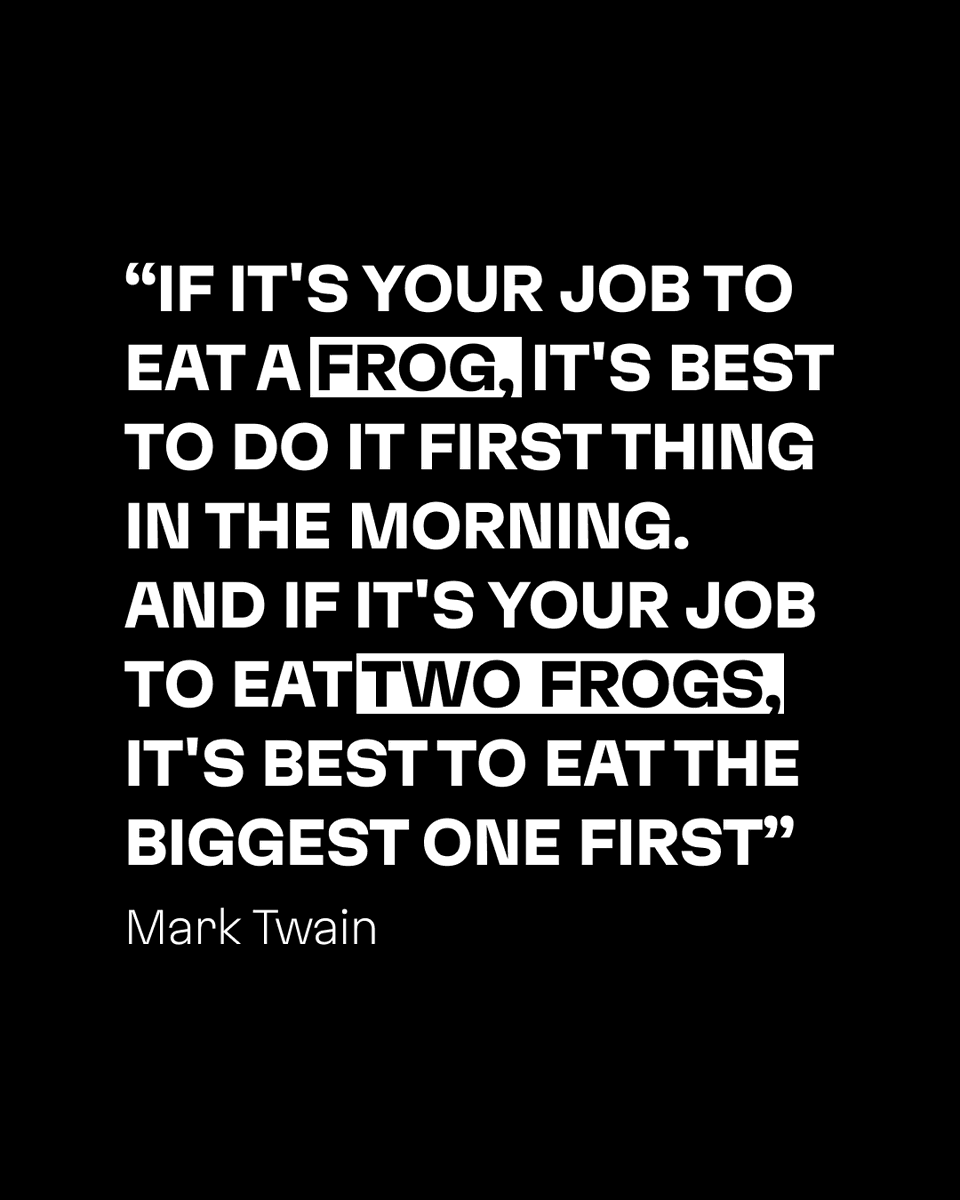
That’s a line that’s become a guiding principle for those looking to improve their productivity. It comes from an excellent quote by Mark Twain:
“If it’s your job to eat a frog, it’s best to do it first thing in the morning. And if it's your job to eat two frogs, it’s best to eat the biggest one first.”
Put simply: When you’re staring down tasks that you really don’t want to do, always start with the toughest one. To some, that may just sound logical, but it’s less common than you might think.
If you deal with the most important and most resisted task early, you reduce the chance that avoidance will quietly shape the rest of your day. It’s like a trail of dominoes: Knock the first one over, and the rest tumble much faster and with far less effort.
“Eating the frog” is less about some macho sense of, “Just buck up and do it.” It’s more about taking care of problems that are most likely to cause a delay, especially if that delay is disproportionate to the required effort.
Once the day fills up with smaller decisions, interruptions, and easier wins, the odds of tackling that meaningful task usually fall. There’s that fragmentation we spoke about earlier this week, coming back to haunt us.
Don’t begin the day by clearing low-stakes admin just to feel busy. Start with the task that would make the rest of the day feel lighter, clearer, or more honest.
Easier said than done, but you’ll not regret it.