Our paper modeling visual cortical circuit novelty effects using simple synaptic modulations was recently published (https://t.co/zWIUeVawNM)! Work with @matchings, @lukecampagnola, Shawn Olsen, and @Stefan_Mihalas at the @AllenInstitute. (1/5)
Altogether, our findings demonstrate how simple plasticity mechanisms within a cortical circuit structure can produce qualitatively distinct and complex novelty responses. Hope you check out our work! (5/5)
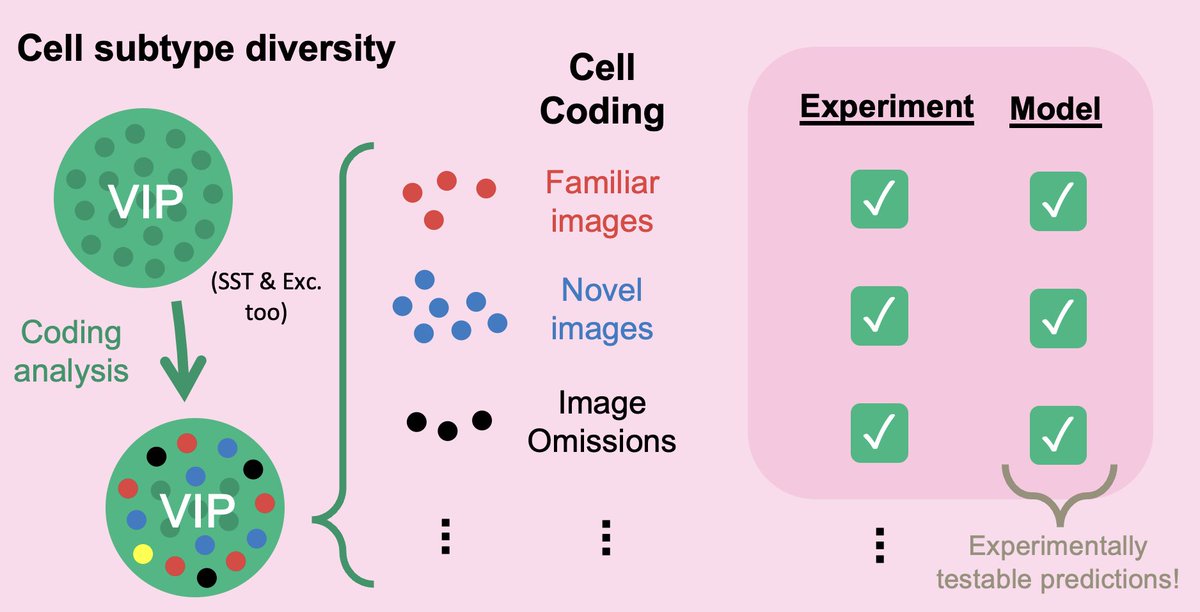
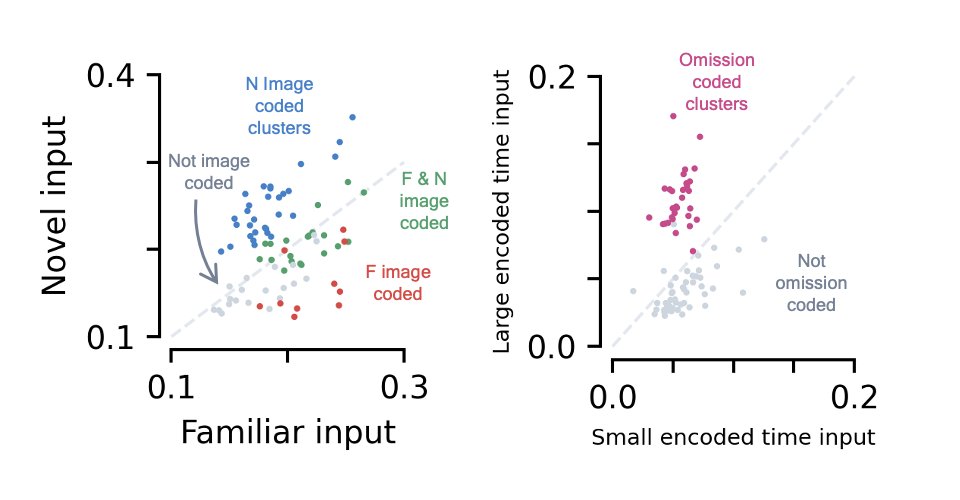
Our model also reproduces functional diversity within cell subpopulations, leading to experimentally testable predictions about connectivity and synaptic dynamics that can produce both population-level novelty responses and heterogeneous individual neuron signals. (4/5)
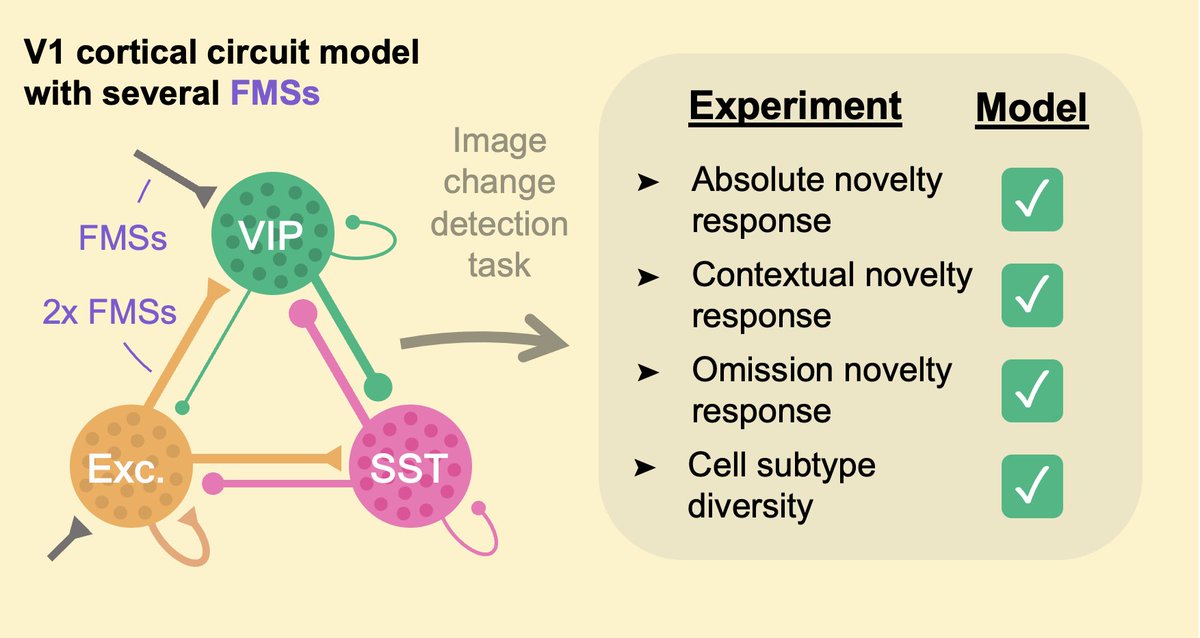
Using an experimentally-constrained model of a cortical circuit with plasticity at specific synapses (data from https://t.co/dF6uhHMg8m), absolute, oddball, and omission novelty effects observed in the aforementioned experiment are simultaneously reproduced. (3/5)
Detecting novelty is ethologically useful for an organism’s survival. Recent experiments (https://t.co/cx9WK9KeHz) characterize how different types of novelty over timescales from seconds to weeks are reflected in activity of excitatory and inhibitory neuron types. (2/5)
Our paper modeling visual cortical circuit novelty effects using simple synaptic modulations was recently published (https://t.co/zWIUeVawNM)! Work with @matchings, @lukecampagnola, Shawn Olsen, and @Stefan_Mihalas at the @AllenInstitute. (1/5)
We think we’ve just scratched the surface of looking into what these FMSs can do and how they can be used to model novelty responses and learning in the brain. Many more details can be found in our paper: https://t.co/ehCn1T9FFQ! (13/13)
Our paper on modeling synapse plasticity to encode familiarity within the cortical disinhibitory circuit is online (https://t.co/ehCn1T9FFQ)! Work done with Marina Garrett (@matchings), @lukecampagnola, Shawn Olsen, and @Stefan_Mihalas at the @AllenInstitute. 🧵(1/13)
A cool thing about our model is that we can look at what causes these subpopulation differences. E.g., how do their connectivity properties differ? We find several experimentally testable reasons why a cell’s coding may change with stimulus and/or experience-level. (12/13)
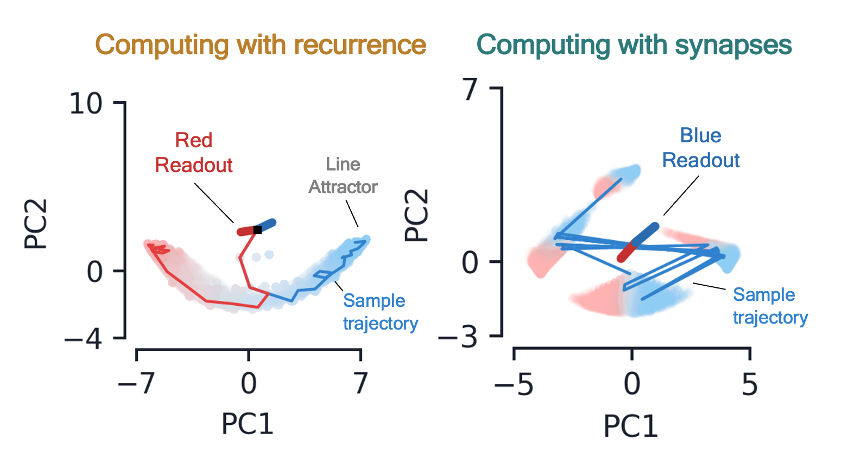
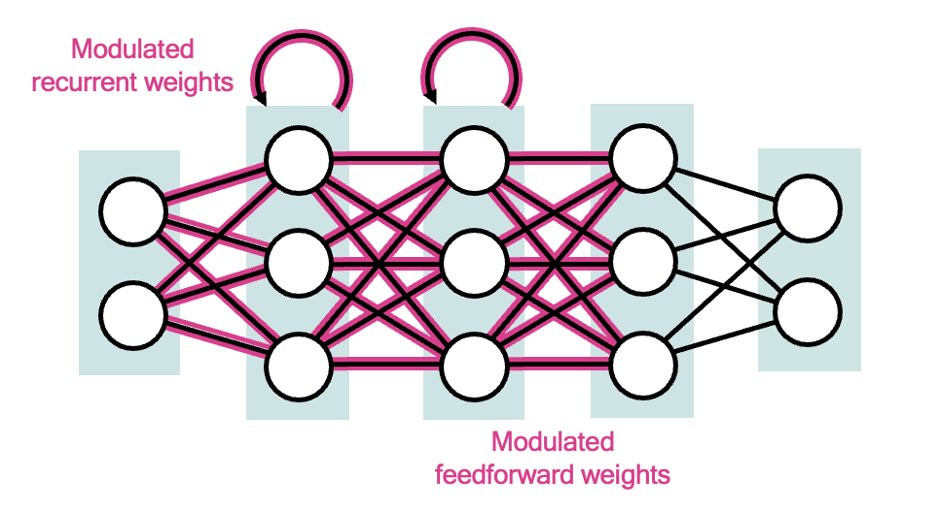
How do networks that compute using synaptic modulations behave from a neural population dynamics perspective? We set out to answer this question in new work now on bioRxiv (https://t.co/H0RUbDKTeQ)! Work done with @Stefan_Mihalas at the @AllenInstitute. 🧵 (1/9)
Our work on computing with synaptic modulations is officially out in eLife (https://t.co/iDIehGgJed)! We’ve added several new results that we think make the findings even more interesting. Work with @Stefan_Mihalas at the @AllenInstitute. 🧵(1/7)
We’re very excited to see how these modulations behave in more complicated architectures. What if you put them in deeper networks or put them on recurrent connections? Lots of possibilities for future work! (6/7)