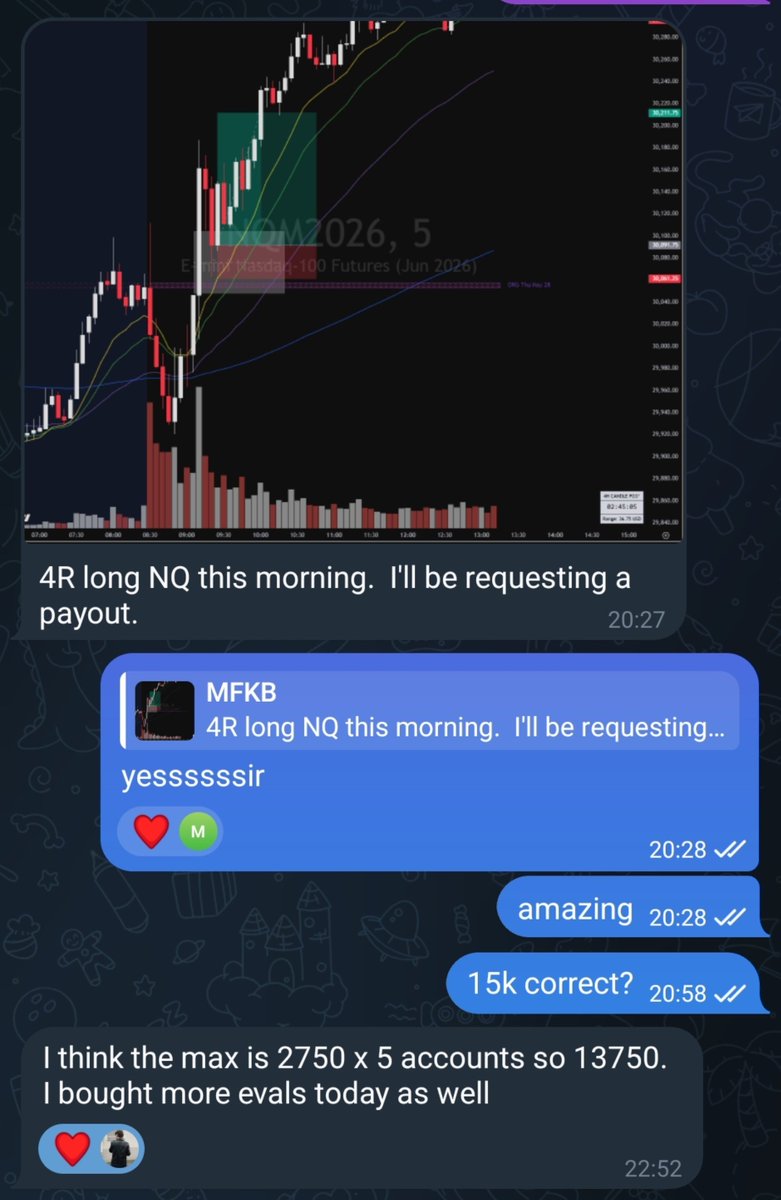
$15.000 payout in LESS than 3 weeks of work
and they told you it takes years lmfao
if you want to lead, you need to lead by example
half of these traders on social media don't even trade
prop firms are giving away millions in capital
and you're trying to "pass" one challenge like it's a fucking exam
meanwhile smart traders are treating it like a business acquisition:
let me show you the psychology that turned $3k into $500k in capital:
most traders:
buy one $100k challenge for $300
pressure is MASSIVE
"i have to pass this or i wasted money"
overthink every trade
emotional breakdown when losing
usually fail
cry about losing $300
stacker traders:
buy ten $100k challenges for $3,000
pressure is DISTRIBUTED across 10 accounts
"i just need to pass half of these"
execute mechanically
don't give a fuck about any single account
the psychology is completely different:
when you buy ONE challenge:
every loss feels catastrophic
"shit, i'm fucking this up"
you tighten up
you second guess
you break rules from fear
you fail
when you buy TEN challenges:
every loss is just data
"okay, that didn't work, next account"
you stay mechanical
you execute without emotional attachment
you pass half
the secret isn't being a better trader
it's REMOVING the emotional pressure
$3,000 isn't "buying 10 challenges"
$3,000 is acquiring $500k in trading capital
that's your Capital Acquisition Cost
now here's the business math:
once you pass 5 challenges = $500k funded
month 1: 5% return on $500k = $25,000 payout
your ROI on $3,000 investment = 733%
compare to traditional model:
save up $100k personal capital (takes years)
trade it yourself
make 5% = $5,000/month
or
spend $3k on challenges (takes one month)
get $500k capital
make 5% = $25,000/month
which is smarter?
here's the psychological cheat code:
use a trade copier
execute ONE trade
it copies to all 10 accounts simultaneously
you're not "managing 10 accounts"
you're executing ONE system with 10x capital
setup:
- buy 10 challenges
- trade copier software
- ONE strategy
- execute once on main account
- copies to all other accounts
pass 5 = $500k capital acquired
fail 5 = expected, you planned for 50% pass rate
the guys making $50k+/month from prop firms aren't better traders
they just understand CAPITAL ACQUISITION PSYCHOLOGY
prop firms are HOPING you think small
"let me carefully pass this one challenge"
while stackers are thinking:
"let me acquire as much capital as possible"
you're playing by their rules
stackers are playing the actual game
prop firms expect:
retail trader buys 1 challenge
feels massive pressure
fails emotionally
buys another
fails again
repeat
they make money on challenge fees
stackers flip it:
buy 10 at once
distribute emotional pressure
pass half
never buy challenges again
collect payouts forever
prop firms lose money on stackers
but stackers are only 2% of traders
the other 98% are you
buying one challenge at a time
feeling massive emotional pressure
failing
repeat
"but $3,000 is expensive"
vs saving $100,000 in personal capital?
$3k to acquire $500k is CHEAP
you're just scared to think like a business
this is capital acquisition
not "challenge passing"
prop firms are capital sources
you're acquiring their capital
at $3k acquisition cost
or you can keep trying to "pass" one challenge emotionally
while your competition stacks 10 and prints
your choice
if you want to build a system designed for the STACKING psychology (distributing pressure across multiple attempts), DM me "SYSTEM"
we'll build your execution system for capital acquisition, not emotional challenge passing (high ticket - fully private work, opening my last spot and closing it after)
your strategy works sometimes and fails sometimes
and you think it's "just part of trading"
no mf
it works in ONE market phase
and fails in the other TWO
and you're too stupid to tell the difference:
here's what's actually happening:
the market only has 3 states:
STATE 1: TRENDING
- clean moves
- clear direction
- your strategy PRINTS
- easy trades
- you feel like a genius
STATE 2: RANGING
- no clear direction
- your strategy gets DESTROYED
- false breaks outs
- you feel retarded
STATE 3: CHAOS
- news driven
- violent whipsaws
- your strategy is a coin flip
- impossible to read
- you feel lost
your strategy was designed for STATE 1 only
but you're trading it in ALL THREE STATES
and wondering why you're inconsistent
"some days i'm up, some days i'm down"
yeah
because some days market is trending (your strategy works)
some days market is ranging (your strategy dies)
and you can't tell the difference
so you blame yourself:
"i need better discipline"
"i need to study more"
"i need to follow the plan better"
wrong
you need to stop trading your strategy in the wrong state
profitable traders don't trade "a strategy"
they trade "state-appropriate strategies"
monday: market trending → trade trend strategy
tuesday: market ranging → don't trade trend strategy
wednesday: market chaos → don't trade at all
they have 3 playbooks
one for each state
you have 1 playbook
used in all states
that's why they're consistent
and you're not
here's the data that'll hurt:
traders who identify states first: 68% profitable
traders who "just trade their strategy": 14% profitable
because the 68% are only trading when their edge exists
the 14% are trading even when their edge doesn't exist
you don't have a strategy problem
you have a STATE IDENTIFICATION problem
here's how to fix it:
STEP 1: LEARN TO IDENTIFY STATES
before you even look for a trade
identify the current state:
trending?
- higher highs + higher lows (bullish)
- lower highs + lower lows (bearish)
- clean moves with minimal chop
ranging?
- price bouncing between clear levels
- no clear direction
- lots of false breaks
chaos?
- major news events (FOMC, NFP, CPI)
- violent moves with no structure
- can't identify clear levels
STEP 2: MATCH STRATEGY TO STATE
trending: use your trend strategy
ranging: DON'T use your trend strategy (or use range strategy)
chaos: DON'T trade
that's it
STEP 3: TRACK IT
journal every trade with state identification:
"took trend trade in trending state: win"
"took trend trade in ranging state: loss"
after 100 trades you'll see:
trend strategy in trending: 65% win rate
trend strategy in ranging: 35% win rate
now you know:
only trade trend strategy in trending state
sit out ranging state
your win rate jumps to 65%
not because you got better at your strategy
because you stopped trading your strategy when it doesn't work
this is what separates amateurs from pros:
amateur: "why did my trade fail?"
pro: "why did I take a trade in the wrong state?"
amateur: "i need better entries"
pro: "i need better state identification"
amateur: "my strategy doesn't work"
pro: "my strategy works, but only in specific states"
every strategy has an ideal market state
find your strategy's ideal state
only trade in that state
that's the edge
if you want to learn how to identify market states for YOUR specific strategy and schedule, DM me "SYSTEM"
we'll build a state-based trading system designed for YOUR psychology (high ticket offer, taking my last client and closing this for good)
revenge trading is killing your account
and you're trying to fix it with "discipline"
which is like trying to stop an avalanche with your hands
here's the actual solution that works:
trader i was working with had massive revenge trading problem
every time he'd take 2 losses in a row
he'd immediately take a 3x size revenge trade
blow 10% of account
swear he'd stop
repeat next week
tried everything:
- journaling
- meditation
- breathing exercises
- "mindset work"
- taking breaks
- therapy
nothing worked
because revenge trading is an EMOTIONAL ADDICTION
and addictions can't be "journaled" away
so we used a different method:
PRE-COMMIT TO CONSEQUENCES
here's what he did:
before each trading session
he would write down his rules:
"i'm allowed 2 trades today
if i take a 3rd trade, i will:
- close trading platform immediately
- transfer 50% of account to savings
- ban myself from trading for 3 days"
notice what this does:
he's making the decision BEFORE emotions spike
not during the emotional spiral
not when he's desperate
BEFORE he's emotional
the commitment is made when CALM
then enforced when EMOTIONAL
month 1: he broke the rule 3 times
month 2: he broke it 1 time
month 3: he stopped breaking it
not because his "discipline" improved
because he feared the CONSEQUENCE more than he wanted the revenge trade
the psychology is simple:
in the moment of revenge trading:
your brain is flooded with emotion
you NEED to trade
you NEED to get it back
logic is gone
if you're relying on "discipline" in that moment:
you'll fail
every time
but if you PRE-COMMITTED to consequences when calm:
you remember the pain of following through on that consequence
fear of consequence > desire to revenge trade
this is how you actually stop revenge trading:
STEP 1: identify your pattern
how many losses before you tilt?
for most people it's 2-3
STEP 2: pre-commit to consequences BEFORE session
write it down:
"if i take more than 2 trades, i will _____"
the consequence must HURT:
- transfer money out of account
- ban yourself from trading for X days
- delete your trading app
- tell your accountability partner you failed
STEP 3: when you break the rule, IMMEDIATELY enforce consequence
no negotiations
no "just this once"
no mercy
you break rule = you enforce consequence
immediately
after 2-3 times of actually following through:
your brain learns
"revenge trading = pain"
the urge decreases
not from willpower
from CONDITIONING
you're training your brain like you'd train a dog
bad behavior = immediate consequence
every time
no exceptions
eventually the bad behavior stops
but here's what you're doing instead:
"i'll just be disciplined"
"i'll control myself"
"i'll resist the urge"
that's not a plan
that's a prayer
and prayers don't work when emotions are screaming
you need a system of PRE-COMMITTED CONSEQUENCES
not a system that relies on in-the-moment willpower
because willpower fails when emotions spike
fear of consequences works when emotions spike
it's not about being disciplined
it's about being smart enough to make yourself scared of breaking your own rules
institutional traders use this all the time
they don't "try to be disciplined"
they create painful consequences for breaking rules
then they don't break rules
not because they're superhuman
because they're scared of their own consequences
if it's possible to revenge trade with no consequence
you'll revenge trade
if revenge trading = painful consequence you PRE-COMMITTED to
you'll stop
that's the difference
revenge trading isn't a discipline problem
it's a consequence design problem
design consequences that scare you more than the revenge urge
and you'll stop revenge trading
not because you got better discipline
because you got smarter about conditioning yourself
if you want to build a consequence system for YOUR specific psychological breaks, DM me "SYSTEM"
we'll identify every emotional trigger you have and design consequences that actually change your behavior (fully private work, opening my last spot and closing it after)
your "risk management" is the reason you're broke
you risk 0.5% per trade and call it "discipline"
i call it poverty cosplaying as prudence
let me show you the math that'll piss you off:
trader A (you):
- $100k account
- risks 0.5% per trade
- 2R average winner
- 55% win rate
monthly reality:
takes 60 trades
33 winners
27 losers
net: +6R = 3% gain = $3,000
annual income: $36,000
"i'm being disciplined"
trader B (profitable):
- $100k account
- risks 1.5% per trade
- 2R average winner
- 55% win rate (SAME EDGE)
monthly reality:
takes 60 trades
33 winners
27 losers
net: +6R = 9% gain = $9,000
annual income: $108,000
SAME WIN RATE
SAME STRATEGY
SAME SKILL
3x different income
because one is using size as a weapon
one is using size as a shield
here's the uncomfortable truth:
you're risking 0.5% because you're SCARED
not because the math says to
not because your backtest says to
not because it's optimal
because you're TERRIFIED
and fear isn't a risk management strategy
it's just fear with a spreadsheet
profitable traders ask: "what does the MATH support?"
you ask: "what feels safe to my emotions?"
feelings ≠ strategy
here's how to actually calculate optimal risk:
step 1: backtest your edge (minimum 100 trades)
step 2: calculate your expectancy
step 3: use Kelly Criterion:
Risk% = (Win% × Avg Win) - (Loss% × Avg Loss) / Avg Win
step 4: that's your MATHEMATICAL optimal risk
not 0.5%
not 1%
not "what feels safe"
what the MATH says
if your math says 1.5% is optimal
and you're risking 0.5%
you're not being conservative
you're being POOR
by choice
scared money doesn't make money isn't a cliche
it's a mathematical reality
0.5% risk with your edge is leaving 2/3 of your potential profit on the table
not because you're disciplined
because you're terrified of your own edge
you backtested it
you verified it works
you have the data
but you still don't trust it
that's not discipline
that's not risk management
that's just being a pussy with math
the guy making $100k/month isn't smarter than you
he just risks what the MATH supports
instead of what his FEAR demands
and the math is always higher than your fear wants
here's what kills me:
you'll risk 0.5% per trade
take 100 trades to make 10%
spend 6 months grinding
when you could risk 1.5% per trade
take 30 trades to make 10%
spend 6 weeks printing
same edge
same skill
different balls
size is a weapon
not a shield
use it like one
or keep being "disciplined" and broke
your choice
if you want to build a system with MATHEMATICALLY optimal risk (not fear-based risk), DM me "SYSTEM"
we'll backtest your edge and calculate what you should ACTUALLY be risking based on data, not feelings (high ticket offer)
there are traders making $100k/month who've never had a profitable demo account
sounds impossible but the psychology is simple:
demo accounts are where real discipline goes to die
let me explain why demo trading is actually hurting you:
met this trader last month
6 months on demo
perfect execution
following every rule
consistent profits
"ready for live"
went live with $300
lasted 4 days
"what the fuck happened?"
here's what happened:
DEMO PSYCHOLOGY:
takes loss: "it's fake money, doesn't matter"
holds loser: "let's see what happens"
breaks rule: "just testing something"
wants to revenge trade: "why not, it's not real"
feels NOTHING
LIVE PSYCHOLOGY:
takes loss: "that's REAL money gone"
holds loser: "it HAS to come back, i need this"
breaks rule: "just this once, i swear"
wants to revenge trade: "i need it back NOW"
feels EVERYTHING
you built habits for trading WITHOUT emotional pressure
then added emotional pressure
and everything broke
it's like training for a fight by shadow boxing
then stepping in the ring with Mike Tyson
"why didn't my training work?"
because shadow boxing and fighting are different sports
demo and live are different sports
here's the uncomfortable truth:
those 6 months on demo?
you didn't build discipline
you built fake discipline that only works under zero emotional pressure
the second real money touches your account
your brain completely rewires
losses HURT
winners feel INCREDIBLE
fear takes over
greed takes over
FOMO takes over
and your "demo discipline" evaporates
the traders making $100k/month skipped demo entirely
they went straight to small live accounts
$50 challenges
$100 micro accounts
real money from day 1
their brain never learned "fake money habits"
their brain only knows "real money psychology"
result?
their discipline was built under REAL emotional pressure
their habits were formed under REAL fear
their psychology is BATTLE-TESTED
while you're practicing shadow boxing
they're in the ring learning how their emotions actually work
here's the data:
traders with 1+ years demo: 9% go profitable live
traders with zero demo: 43% go profitable within 6 months
seems backwards but makes sense:
demo traders built habits under zero emotional pressure
those habits don't transfer when emotions spike
live-only traders built habits under real emotional pressure
those habits work everywhere because they were forged in reality
i'm not saying demo is useless
use it for 2 weeks to:
learn platform mechanics
test your broker's execution
understand how orders work
then delete it forever
buy a $50-100 challenge
trade with REAL emotional risk
feel the REAL fear and greed
see how your brain REALLY behaves
you'll learn more in 3 days of emotional live trading
than 6 months of emotionless demo
because your brain under demo:
"this doesn't matter, it's not real, i feel nothing"
your brain under live:
"this matters, i'm terrified, execute perfectly"
one builds real discipline
one builds fake discipline
stop shadow boxing
start fighting
stop demo trading
start live trading with small size
your demo profits mean nothing
your ability to execute under REAL EMOTIONS means everything
the market doesn't care about your demo track record
it cares about your ability to control yourself when you're terrified
and fear can't be simulated
it has to be EXPERIENCED
if you want to build a system designed for live execution under REAL emotional pressure (not demo fantasy), DM me "SYSTEM" for fully private coaching
we'll skip the demo bullshit and build your system for how you ACTUALLY behave when scared 1 on 1
"just backtest 500 trades and you'll be profitable"
no mf
i watched a guy backtest 2,000 trades with an 80% win rate
went live
blew his account in 6 days
you know why?
because backtesting and live trading are completely different fucking games
and everyone's lying to you about this:
here's what actually happened:
dude spent 4 months backtesting
documented every trade
built massive spreadsheet
1,000+ trades
80% win rate on historical data
2.5 R:R average
"i'm ready"
bought $500 challenge
day 1: took his setup, got stopped out, felt the EMOTION for first time
day 2: took revenge trade (never had that urge in backtest)
day 3: moved his stop loss (never felt that fear in backtest)
day 4: closed winner at 1R because terrified (never felt that in backtest)
day 5: held loser hoping it comes back (never felt that desperation in backtest)
day 6: account blown
his backtest didn't prepare him for SHIT
because backtesting teaches you SETUPS
live trading teaches you PSYCHOLOGY
here's what nobody tells you:
backtesting is done in a zero-pressure environment
you can't feel the urge to revenge trade on historical data
you can't feel FOMO on a replay
you can't feel panic on a trade that already happened
you can't feel fear when you already know the outcome
live trading has:
real money
real fear
real greed
real FOMO
real revenge impulses
your brain functions completely differently
here's the data that'll hurt:
traders with 1,000+ backtest trades: 12% pass rate on first challenge
traders with 100+ LIVE small account trades: 71% pass rate
because live trading teaches you:
- how you react to being wrong
- how you handle 3 losses in a row
- how strong your urge to move stops actually is
- how scared you get when in profit
- how revenge trading feels in your chest
backtesting teaches NONE of that
i'm not saying don't backtest
i'm saying backtesting is 10% of the education
the other 90% comes from experiencing PRESSURE
here's the real path:
backtest 100 trades (not 2,000) just to verify edge exists
then buy the cheapest challenge you can find ($50-100)
trade it LIVE with real emotions
you'll probably fail in 3-5 days
GOOD
you just bought more education than 6 months of backtesting
because you learned:
- you revenge trade after 2 losses (didn't know this in backtest)
- you close winners at 1R from fear (didn't feel this in backtest)
- you can't handle drawdown (didn't experience this in backtest)
- your stop is too tight for your emotions (didn't know this in backtest)
now fix THOSE emotional problems
buy another cheap challenge
fail again
learn more about YOUR psychology
after 3-4 "planned failures":
you've spent $300
you've learned your exact psychological weaknesses
you've refined your system for YOUR emotional reality
you're ready to pass
vs the backtester:
spent 4 months
has zero experience with real emotions
thinks he's ready because spreadsheet looks good
fails first challenge from emotional breakdown
"my strategy doesn't work"
wrong
your strategy is fine
your psychology under pressure is broken
and you can't fix psychology without experiencing pressure
stop backtesting for 6 months thinking you're prepared
start buying cheap challenges to learn how YOU actually behave under stress
$100 failures teach you more about YOUR psychology than 1,000 backtested trades
that's the uncomfortable truth
if you want to build a system designed for how YOU actually behave under pressure (not how you THINK you'll behave), DM me "SYSTEM". we'll identify your specific psychological breaks and build around them 1-on-1. this is a high ticket offer, I'm taking my last client and closing it for good
I stacked 5 different prop firms simultaneously and withdrew thousands in 4 months while most traders can't even pass one challenge
Not luck. Pure system.
Here's the exact prop firm stacking method that turns $3,500 into $400k+ in trading capital:
Most traders treat prop firms like a test they need to "pass"
Wrong mentality
Prop firms are inventory
You're building a portfolio of income-generating assets
Here's how the stack works:
PHASE 1: THE FOUNDATION
Buy 5 challenges from DIFFERENT prop firms:
- $100k account × 5 = $500k total capital
- Total cost: $500-$1000 depending on firms
- Use: Topstep, MyFundedFutures, Tradeify…
Why different firms?
Because if one firm has issues, you don't lose all capital
Diversification in prop firms = survival
PHASE 2: THE QUALIFICATION PERIOD
Trade all 5 accounts with IDENTICAL strategy:
- Same setups on all accounts
- Same entry criteria
- Same risk management (0.5% per account)
- Same trading hours
This is critical:
You're not trying to "beat" each firm's rules
You're executing ONE system across multiple accounts
The math:
If your system has 58% win rate with 2R average:
- You'll pass 3-4 out of 5 challenges
- 1-2 might fail (that's expected variance)
Expected result after 8 weeks:
- 3 accounts passed to funded phase
- 2 accounts failed (lost $1,000)
- Net capital: $300k funded
PHASE 3: THE WITHDRAWAL STRATEGY
This is where most traders fuck up
They pass the challenge and immediately withdraw
Wrong
Here's the proper sequence:
Month 1 of funded phase:
- Trade normally, grow account to $8k-12k profit
- Don't withdraw anything
- Build psychological buffer
Month 2 of funded phase:
- Hit $15k-20k total profit across 3 accounts
- First withdrawal: Take 50% ($9k-12k)
- Leave 40% as permanent buffer
Month 3-4:
- Continue trading above buffer
- Withdraw monthly above buffer amount
- Never touch the buffer
The key principles:
1. TREAT IT LIKE A BUSINESS
Not a "challenge to pass"
It's inventory acquisition
2. STACK MULTIPLE ACCOUNTS
One account = one income stream
Seven accounts = seven income streams
3. NEVER WITHDRAW EARLY
Build buffer first
Withdraw strategically
4. USE SAME SYSTEM EVERYWHERE
Don't try different strategies per account
One proven system across all
Use multiple firms (max out every prop firm)
5. REPLACE FAILED ACCOUNTS IMMEDIATELY
Lost an account? Buy a new challenge same day
Keep the stack growing
The prop firms HATE this method
Because you're treating their "challenges" like the business opportunity they actually are
Most traders:
- Buy one challenge
- Fail
- Give up or buy another
- Repeat
Smart traders:
- Buy 5 challenges
- Pass 3-4
- Stack income streams
- Replace failures
- Scale infinitely
The difference?
Mindset
You're not a "trader trying to pass"
You're a portfolio manager building income-generating assets
Questions people ask:
"Isn't this expensive?"
$1000 to control $500k in capital?
That's 0.2% capital requirement
Try getting that leverage anywhere else
"What if I fail all 5?"
Then your system sucks
Fix your system before buying challenges
Get profitable on demo with 200+ trades
Then buy challenges
"Can I do this with more accounts?"
Yes
I know traders running 15+ accounts
Withdrawing $40k-80k per month
The ceiling is your system's capacity
If you can manage the psychology of 15 accounts, do it
Most traders treat prop firms like lottery tickets
Smart traders treat them like real estate
You're buying income-generating properties
Stack them
Maintain them
Collect rent monthly
That's the game
DM me "SYSTEM" if you want help on how to identify the setup, when to enter, how to manage risk, and how to stay calm when everyone else is panicking - this is a high ticket offer, I'm taking my last client and closing it for good
The market is not random. I need you to really understand this
Every time you look at a chart and think "this could go either way," you're looking at a system that has RULES. Predictable, repeatable rules that institutions follow every single day because they have to
Let me show you what's actually happening behind every candle on your chart:
At 9:30am when the market opens, the chart doesn't just "start moving." What happens is billions of dollars in institutional orders hit the market simultaneously. Banks, hedge funds, pension funds. They all have orders to execute at the open
But here's the problem: these orders are MASSIVE. A single fund might need to buy $500 million worth of futures contracts. They can't just click "buy" because there aren't enough sellers at the current price. They need LIQUIDITY. They need a massive pool of sellers willing to sell to them
Where do they find this liquidity? Your stop losses
When you put a stop loss below a support level, you're creating a sell order that activates when price reaches that level. Millions of retail traders put stops in the same places. Below the previous low. Below the obvious support level. Below the round number
Institutions know this. Everyone can see where retail stops cluster. So they push price DOWN into those stop losses. The stops activate. Millions of sell orders fire simultaneously. The institutions buy against those sell orders. They now have their $500 million position filled at a discount
Then price reverses. Aggressively. Because the selling is done (it was artificial, created by stop hunts) and now institutional buying pressure takes over
This is called a liquidity sweep. It happens almost every single morning. Usually within the first 15-30 minutes of the open
It's not random. It's structural. Institutions need liquidity. Retail stops provide liquidity. The sweep happens. Price reverses. The pattern repeats forever because the underlying mechanics never change
Here's what this means for you:
If you can identify WHERE stops are sitting (below previous lows, above previous highs) and WAIT for them to get swept, you can enter in the direction of the reversal with extreme precision
The entry: after the sweep, when you see a strong displacement candle in the opposite direction
The stop loss: behind the sweep (if they sweep further, you're out with a small loss)
The target: the next major level, minimum 1:3 risk to reward
This is not a "theory." This is observable on every single chart, every single morning. Go open the NQ or ES chart on TradingView right now. Look at the first 30 minutes of any random day. You'll see price spike past a previous high or low, then reverse sharply. That's the sweep. It's right there in the data
The market isn't random. The market is a machine that processes institutional orders using retail stops as fuel. Once you see the machine, you can never unsee it. And once you understand the machine, you can position yourself on the right side of every sweep
The 90% who lose money are the ones providing the liquidity. They put their stops where everyone else puts stops. They get swept. They lose
The 10% who make money are the ones WAITING for the sweep to complete and then entering in the direction of the real move. They use the 90% as fuel
You're either the liquidity or you're the trader who profits from the liquidity grab. The education to switch sides costs $0 and takes 3-6 months of demo practice
The market has rules. Learn them and you see opportunity everywhere. Ignore them and the chart looks random forever
I teach this exact strategy fully PRIVATE with you. How to identify the setup, when to enter, how to manage risk, and how to stay calm when everyone else is panicking. DM "SYSTEM" - this is a high ticket offer, I'm taking my last client and closing it for good
I pray the stock market crashes tomorrow
Seriously
Every crash is worth $50,000+ to me
Most people see red and panic. I see red and get paid.
They don't know I know the cheat code:
- Market drops 2%? Prop firm funded accounts print on shorts
- VIX spikes above 30? The setups I trade appear 3x more often
- "Experts" scream recession? Retail sells everything and I buy the exact bottom
- Stocks flash crash? I'm not holding stocks. I'm trading futures. I profit in both directions
The guys who make the most money in markets are PRAYING for the days that make you cry
One crash day in October made me $34,000 in 20 minutes
While CNBC was telling people to sell everything, I was closing my laptop and going to the gym by 11am
Here's what your financial advisor doesn't want you to understand:
The market doesn't go "up" or "down." It MOVES. And movement is money. The direction is irrelevant when you know how to trade both sides
Your 401k lost 30%? Cool. Somebody made that 30%. It didn't disappear. It transferred. From your retirement account to the account of someone who understood what was happening
This is the fundamental lie of traditional finance: they tell you "invest for the long term and pray it goes up." That only works in one direction. When it goes down, you're told to "hold" while your net worth evaporates. That's not investing. That's hoping
Futures trading eliminates this entirely. You can go long (trade if it goes up) or short (trade if it goes down) with equal ease. The setup is identical in both directions. One click to buy. One click to sell short. Same chart. Same strategy. Same profit potential
Here's exactly how crash days print money:
The market opens at 9:30am. On a normal day, price moves maybe 0.5-1% total. On a crash day, it moves 1-2% in the first 30 minutes alone. That means the same setup that normally gives you a $2,000 winner now gives you $8,000-$12,000 because the range expanded
The strategy doesn't change. The size of the moves changes. Crash days are just normal days with the volume turned up to 10
Most traders blow up on crash days because they're overleveraged and emotional. They see their positions go red and they freeze. Or they revenge trade. Or they double down hoping it bounces
The 5% who print on crash days do three things differently:
1. They trade SMALLER on high volatility days, not bigger. Sounds backwards but the increased range means you make more money per trade even with reduced position size. Lower risk, higher reward. The math is obvious once you see it
2. They wait for the first 15-minute candle to close before entering. The opening 15 minutes of a crash day is pure chaos. Algorithms firing, stop losses cascading, institutions repositioning. You don't trade the chaos. You let it settle for 15 minutes, identify the direction, and ride the continuation
3. They have a hard stop. If price moves against them by X amount, they're out immediately. No hoping. No praying. No moving the stop loss. Out. This is why they survive crash days that destroy everyone else. Their maximum loss is predetermined and small
The entire financial system is designed to make you terrified of volatility so you park your money in funds that charge you 2% annually to underperform the market
Meanwhile a 22 year old with a $200 prop firm account is making more per crash day than your retirement fund makes in a year
He doesn't care which direction the market goes. He just needs it to move. And crash days move more than anything
The next time the market crashes and your coworkers are panicking about their 401k, understand that somewhere a kid in his bedroom just made your annual salary before lunch
Crashes aren't disasters. They're payday for anyone who spent 3 months learning how markets actually work
Stop being the person who panics
Start being the person who gets paid when others panic
The setup is free to learn. The demo is free to practice on. And the next crash is coming whether you're ready for it or not
I teach this exact strategy fully PRIVATE with you. How to identify the setup, when to enter, how to manage risk, and how to stay calm when everyone else is panicking. DM "SYSTEM" - this is a high ticket offer, I'm taking my last client and closing it for good
99% of traders fail and everyone's pointing at the wrong thing
it's not psychology
it's not discipline
it's not laziness
it's that you're treating trading like a game
and the entire industry is built to keep it that way
prop firms gamified it. leaderboards, challenge timers, "funded in 30 days" dopamine loops
they turned a job into a video game and wondered why everyone plays it like one
Tiktok traders are screaming into cameras, posting P&L screenshots, turning sessions into content entertaining you broke mfs
keeping you engaged. making you feel like being a trader is a lifestyle, not a profession
trading was never supposed to be entertaining
it's a job
the same way a surgeon's job isn't exciting when it's going right
the same way an air traffic controller isn't "passionate about the craft"
they show up. they execute a system. they go home
the richest trader I've built is bored every single session
no dopamine. no excitement. no "this is my passion"
just a process, repeated until the money shows up
the moment you start enjoying it too much is the moment you start making decisions the system didn't authorize
that's where the 99% live
addicted to the feeling of trading instead of the outcome of it
my system removes the game entirely
one instrument. one setup. one window. 90 minutes. laptop closed
nothing to feel. nothing to chase. just a systematic approach
just execution, repeated until the withdrawals stack
that's why it works when everything else doesn't
(if you want me to build you an actual system - DM "SYSTEM" for fully private 1-on-1 coaching - this is a high ticket offer, I'm taking my last client and closing it for good)
I've made over $100k/m from trading. Here's literally everything you need to know to do the same — in one post…
No course. No upsell. Just the truth that took me years to figure out.
THE ONLY THING PRICE DOES:
Price moves from fair value gaps (internal liquidity) to swing highs/lows (external liquidity). Then back. Forever.
That's it. That's the entire market.
- External liquidity = where stops cluster (highs and lows everyone sees)
- Internal liquidity = where orders didn't fill (gaps in price)
Price sweeps external → fills internal → targets opposite external
Every day. Every asset. Every timeframe.
THE ONLY SETUP YOU NEED:
1) Identify a significant high or low on the 4H/Daily
2) Wait for price to SWEEP it (not just touch it — actually take the liquidity)
3) Wait for a fair value gap to form after the sweep
4) Enter when price returns to fill that gap
5) Stop loss below/above the gap
6) Target the opposite liquidity pool (minimum 3R away)
That's the whole strategy. Works on forex. Futures. Crypto. Stocks. Because it's how markets actually function.
THE ONLY RULES THAT MATTER:
- Never risk more than 1-2% per trade
- Never trade without all criteria met
- Never trade when bored/emotional/forcing it
- Never enter without knowing exactly where you're wrong
- Never target less than 2:1 reward to risk
THE ONLY SCHEDULE THAT WORKS:
- Sunday: Mark weekly levels
- Monday-Thursday: Trade 9:30-12:00 AM (or London session if you're up)
- Daily: If no setup by 12 AM, done for the day
THE ONLY METRICS THAT MATTER:
- Expectancy positive? Keep trading.
- Following rules? Keep trading.
- Breaking rules? Stop trading until you fix it.
Win rate doesn't matter if your R:R is right.
Confidence doesn't matter if your execution is wrong.
Motivation doesn't matter if your system is broken.
THE SIMPLE TRUTH:
Trading is simple. Not easy, but simple.
The market shows you exactly what it's going to do. It sweeps liquidity, fills imbalances, targets opposite liquidity. Over and over.
Your job is to wait for that pattern, enter at the right spot, manage risk, and not fuck it up with emotions.
95% of traders lose because they overcomplicate it, overtrade, or can't control themselves.
Be the 5%. It's not about being smarter. It's about being simpler.
(if you want to stop switching setups and start running the sequence that actually prints - DM "SYSTEM" - high ticket clients only, fully private 1-on-1 , taking my last client and closing this for good after)
The guys making $30k/month trading work less than 20 hours per week…
Everyone thinks profitable trading means 10 hour screen days. Charts on 6 monitors. Alerts going off constantly. Stressed 24/7.
The opposite is true.
Here's what a $30K/month trader's week actually looks like:
SUNDAY (1 hour):
- Mark up weekly levels on 2-3 assets
- Identify where liquidity sits (swing highs/lows)
- Note any fair value gaps from Friday
- Plan the week's scenarios
MONDAY-FRIDAY (2-3 hours/day max):
- 9:15 AM: Open charts, check overnight range
- 9:30 AM: Watch opening 30-minute candle
- 10:00 AM: If expansion + sweep = look for entry
- 10:30 AM: Either in a trade or done for the day
- 11:00 AM: Close laptop regardless
That's it. That's a $30K/month work week.
Some days he trades. Most days he doesn't.
Monday: No setup, done by 10:30. Total work: 1 hour.
Tuesday: Good setup, enters trade, hits target by 11:15. Total work: 2 hours.
Wednesday: Choppy open, no expansion, closes laptop at 10:00. Total work: 45 minutes.
Thursday: Setup appears, takes trade, stopped out. Reviews, done by 11:30. Total work: 2 hours.
Friday: Solid setup, 2.5R winner. Total work: 1.5 hours.
Weekly total: ~10-12 hours
Weekly result: +$7,500 (on a conservative week)
Why most traders work 10x more and make 10x less:
They think more screen time = more money.
It's the opposite. More screen time = more bad trades = more losses.
Every hour past the first 90 minutes of market open, you're more likely to:
- Force a trade that isn't there
- Talk yourself into a "B grade" setup
- Revenge trade after a small loss
- Overtrade because you're bored
The profitable guys understand:
The money is made in the WAITING, not the trading.
You get paid for discipline, not activity.
The setup either appears or it doesn't. If it doesn't, you don't get paid today. That's fine. The market's open tomorrow.
What most traders do:
"I didn't get a setup by 11am so I'll keep watching until I find something."
They find a garbage trade at 2pm. Lose money. Feel productive because they were "working."
What profitable traders do:
"I didn't get a setup by 11am. Laptop closed. Going to the gym. See you tomorrow."
One guy made $367K last year trading 15-20 hours per week.
Another guy made $12K last year trading 50+ hours per week.
Same market. Same year. Different understanding of what the job actually is.
The job is waiting for perfect setups. Not finding mediocre ones.
(if you want to stop switching setups and start running the sequence that actually prints - DM "SYSTEM" - high ticket, fully 1-on-1 only, taking my last client and closing this for good after)
The stock market will literally tell you exactly where it's going next if you look at one free chart…
Not some $2,000 indicator. Not some guru's private Discord. A free chart that every broker shows you.
95% of traders have never seen this. The 5% who know it are praying you never figure it out.
Here's what gurus don't teach retail traders:
Every single day, price leaves a map of where it's going next. It's called a fair value gap. And it's sitting right there on your chart.
A fair value gap is when price moves so fast it leaves an "imbalance" — orders that didn't get filled. Price ALWAYS comes back to fill these gaps before continuing.
This is how institutions actually trade. Not with RSI. Not with MACD. Not with moving averages.
They create the gap. Wait for price to return to it. Then push it the other direction.
And they leave the evidence on every chart, every day, for free.
The pattern that runs the entire market:
1) Price sweeps a high or low (takes out stop losses)
2) Price returns to an unfilled gap (the imbalance)
3) Price reverses and targets the opposite high or low
4) Repeat forever
That's it. That's the whole game. On every asset. Every timeframe. Every single day.
I'm not selling you anything here. Go look at any chart right now:
- Find yesterday's high and low
- Find any gaps in price (candles that don't overlap)
- Watch what happens when price touches those levels
You'll see it immediately. And you'll wonder why nobody told you this for the last 3 years while you were buying courses.
The indicators most traders use are just math formulas overlaid on this same price data. They're LAGGING. By the time RSI says "oversold," institutions have already bought.
The gaps don't lag. They're real-time evidence of where orders didn't fill.
Hedge funds pay millions for order flow data that shows the same thing these gaps show for free.
The market isn't random. It's not manipulation. It's not chaos.
It's a map that redraws itself every day. And 95% of traders never learned how to read it.
Now you know. What you do with it is on you.
(if you want to stop burning money and start running the sequence that actually prints - DM "SYSTEM" - high ticket, fully 1-on-1 only, taking my last client and closing this for good after)